
Field bumblebee (Bombus pascuorum)
The page is under construction - we are adding more photos and videos describing this species
What you will learn here
- Information about individual bumblebee species
- You will receive a summary of information for the general public, schools and breeders
Last updated: 8/12/2021
Description
Česky: Čmelák rolní (někdy i polní)
Latin: Bombus pascuorum
English: Common carder bee
Německy: Ackerhumme
Polish: Trzmiel rudy
Image
Color scheme
Basic scheme (queen and worker):
- Základní barva: od červenohnědé až po šedočernou
- Hlava: černá se světlou čupřinou
- Hruď: proměnlivé – od červenohnědé až po šedočernou
- Zadeček: 1. až 4. tergid šedočerný, 5. až 6. tergid žlutavě až červeno-hnědý
It is quite difficult to reliably distinguish between workers and queens based on their coloration.
Basic diagram (male):
- Similar to mother and worker
- Can be distinguished by more distinctive colors, richer chest coloration and, above all, a different shape of the antennae
- males have brushes on their mandibles for spreading scent marks
Size
Druh: malý
Matka : 15 – 18 mm
Dělnice : 9 – 15 mm
Samec : 12 – 17 mm
Source Hymenoptera of the Czech Republic I., Academia 2017
Sizes are very variable and the queen does not always have to be larger than the worker in the nest. The size of the first generation workers will really surprise you.
Head
Velikost: středně dlouhá
Tvar: při pohledu z předu klínový tvar
FIG
Antennae
As with other bumblebee species, the male has long curved antennae
Language
- long
Body
Ovoid
Wings
Lights
Feet
The legs of the males are noticeably long, optically longer than the legs of the mothers and workers.
Lorem ipsum dolor sit amet, consectetur adipiscing elit. Ut elit tellus, luctus nec ullamcorper mattis, pulvinar dapibus leo. FIG
Specific distinguishing features
<bude doplněno>
Photo
Mother
Worker
.
Male
Samci jsou podobně zbarveni jako matky a děnice. mají ale výrazně delší a „ježatější“ obrvení. Jejich barvy bývají zprvu výraznější.
Prozradí je ale jejich tykadla.
Detail of the facial part of the head of a male barn bumblebee (Bombus pascuorm)
Video catalog
Mother
Mother bumblebee
Worker
Worker classic form
Male
Typically colored male
Similar species
- Moss bumblebee (Bombus muscorum)
- Decorated bumblebee (Bombus distinguendus)
How to distinguish it from similar species
Moss bumblebee (Bombus muscorum)
- Trochu větší než čmelák roní
* matka 17 – 23 mm
* dělnice 10 – 16 mm
* samec 12 – 16 mm - Head medium length
- Unlike the field bumblebee, it has a densely and evenly feathered chest without mixed black feathers
- Yellow-browed rump
- Bright and contrasting colors
Decorated bumblebee ( Bombus distinguendus )
- Větší než čmelák rolní
* matka : 18 – 22 mm
* dělnice : 12 – 17 mm
* samec : 16 – 19 mm - Distantly similar in color to the field bumblebee
- Distinctive black target on the chest
Occurrence
- ubiquitous eurycene species (tolerates a wide range of environmental conditions; tolerates fluctuations in life)
- Although it is not one of the most conspicuous bumblebees in nature, it is widely distributed in the lowlands and mountains, where it can reach heights of up to 1700 m.
- occurs throughout Europe
Habitat
- mesophilic meadows (neither too wet nor too dry) to peat bogs, spruce mountain forests
- it is common in anthropocenoses (in a man-made environment)
Life cycle
- Later species
- Počet generaci v sezóně: jedna v sezóně; matky hybernují od srpna
- Matky-královny hledají hnízdiště: od konce března
- Zahnízdění matek: březen – duben
- Nové matky královny se objevují: od července
- Samci se objevují: od konce července do srpna
- Hnízdo končí: za příznivých a v závislosti na počasí až do listopadu (do mrazu a sněhu)
Young bumblebee mothers soon after mating find a suitable place for overwintering – hibernation. They very often choose a place on the edge of the forest. There they have a chance to hibernate in the dry. Here they dig a shallow chamber for overwintering (hibernaculum) in the forest floor.
Please don't disturb the sleeping mother here - thank you.
Feeding the larvae
- Stavitelé kapes (pocket maker) dělnice strhávají pyl z pylových košíčku do kapes, vytvořených na spodní části voskového pouzdra. Zde ho mísí s nektarem a larvy směs konzumují
- Polyektický (nepreferuje jen jednu rostlinu, ale široké spektrum různých kvetoucích rostlin); hojně létá na bobovité (vikev, vlčí bob, jetel luční) a další drobné květy
Nest location
- Often nests in a pile of moss, a dry pile of grass (grass rake) on the surface, in clumps of vegetation
- They also nest in the ground in abandoned rodent nests or in the attics of buildings
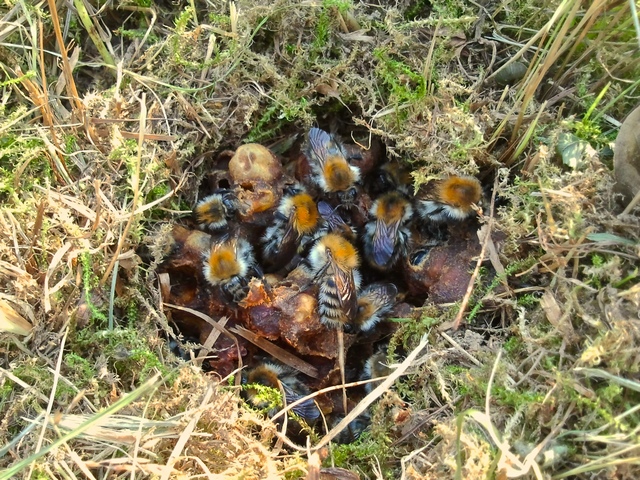
Hnízdo čmeláků rolních (Bombus pascuorum) v hromádce trávy
Foto Internet
Nest size
- Mostly small nests
- Number of individuals 50 – 100 individuals (in the wild)
A view into a small bumblebee nest. Note the beautiful yellow cocoons with pupal larvae, as well as the dark waxy cases with feeding pockets for the larvae.
Visiting Pac-Man
- Common bumblebee (Bombus campestris)
Pachmallow attack strategy:
- The mother patchouli is looking for a developed host nest, she needs a lot of workers.
- She kills the original mother, sprays pheromones on the strong workers, and they kill each other.
- If by chance some survive, they enslave the remaining workers.
- However, there are known cases of the coexistence of a mother wasp and a bumblebee
How to distinguish a bumblebee from a wasp
Common bumblebee (Bombus campestris)
- Velikost
Matka: 15 – 20 mm
Samec: 15 – 15 mm - Shorter head with wide temples, head significantly larger and differently shaped
- Na předohrudi a po stranách tergidu 3. -5. žlutavé až žlutavě oranžové pásky
- The yellow strip on the back is broken, it is better to talk about the strips on the side of the back
- Anterior tergides shiny, smooth and almost without eyebrows
- Often creates dark forms
- Dark Wings
- It makes a distinctive gurgling sound in flight
- This bumblebee also parasitizes the common bumblebee (Bombus humilis) and the common bumblebee (Bombus ruderarius)
Note the differences in coloration and the typical head of the patchouli.
U samců pačmeláka ladního lze pozorovat světlé, krásně zbarvené formy, ale i tmavé variety.
Opět se lze orientovat podle robustní hlavy pačmeláka a samčích tykadel.
As with the females, the male bumblebee makes a different call in flight. If you take your time in a meadow with bumblebees and bumblebees, you will be able to easily identify them in a few minutes.
Breeding information
Úlek: postačuje malý úlek, ale i velké úlky ale přijímá ochotně
Chodba: chodba žádná, krátká (i delší), není zásadně rozhodující;
úspěšně byli chováni v úlku za dlouhou chodbou (úlek v garáži, klapka vně na zdi)
Usazení: po usazení se matka vrací často a hned začíná pracovat
Návraty matek na jaře po hibernaci: běžné
Samousazení v úlku: poměrně běžné, matky často osidlují úlky již obsazené jinými matkami a nějakou dobu s nimi koexistují (dokud nedojde ke kontaktu matek, nebo k rozvoji hnízda a kontaktu dělnice. Přítomnost jiné matky je dle všeho atraktantem
Interesting facts
- Nests of this species survive for a long time, under suitable conditions sometimes until the first half of December.
- In very adverse weather, the entire colony falls into a state of hibernation and thus survives the worst period.
- They belong to a species that does not mind the proximity of humans
- They are very easy to raise with free range
- They are difficult to breed in the laboratory (pocket makers) = they are unable to take pollen prepared by the breeder and pass it on to the larvae in wax pouches
Photos and videos
The field bumblebee is wrongly overlooked as a "common bumblebee". Its English name is even "common garden bee". Yet it is so beautiful and deserves our attention and admiration. It was our friend who chose it as our mascot when we founded Čmeláci PLUS.
Beautiful footage of a bumblebee nest taken by my colleague Jaromír Čížek
The mother bumblebee is also beautifully colored in the spring with rich colors. These gradually fade as she ages and her fur rubs against the material in the nest.
Jako vždy (u čmeláků) jsou samci „vyfešákovaní“ a na svůj krátký život výrazněji zbarveni.
U tohoto druhu je dobré sledovat i tykadla, ta spolehlivě prozradí samce.
.
Podívejte se i na videa na YouTube Čmeláci PLUS a na jejich doprovodný text. Vybraná videa s čmelákem rolním v hlavní roli uvádíme zde,