



Imported bumblebees for pollination services: risks, options, solutions
What you will learn here
- Information on individual types of bumblebees
- Summary of information for the general public, schools and breeders
Last updated: 25/7/2021
Contents
Introduction
Bumblebees PLUS Reaction
Greenhouse pollination service
The problem mainly arises where bumblebees are to be used as a pollination service in the wild.
The main problem is the escape of sexually mature individuals, the reproduction of hybrids in the wild, and their gradual spread.
Do we really want to experience this? Do we really have to risk it in the way it's happening to bees today?
Is the Ministry of the Environment's methodology truly awful? What is the main evil?
So, do you still see the methodology as a „bee massacre“?
So, what to do about it?
Conclusion and summary
Introduction
You can find the article or its audio version HERE
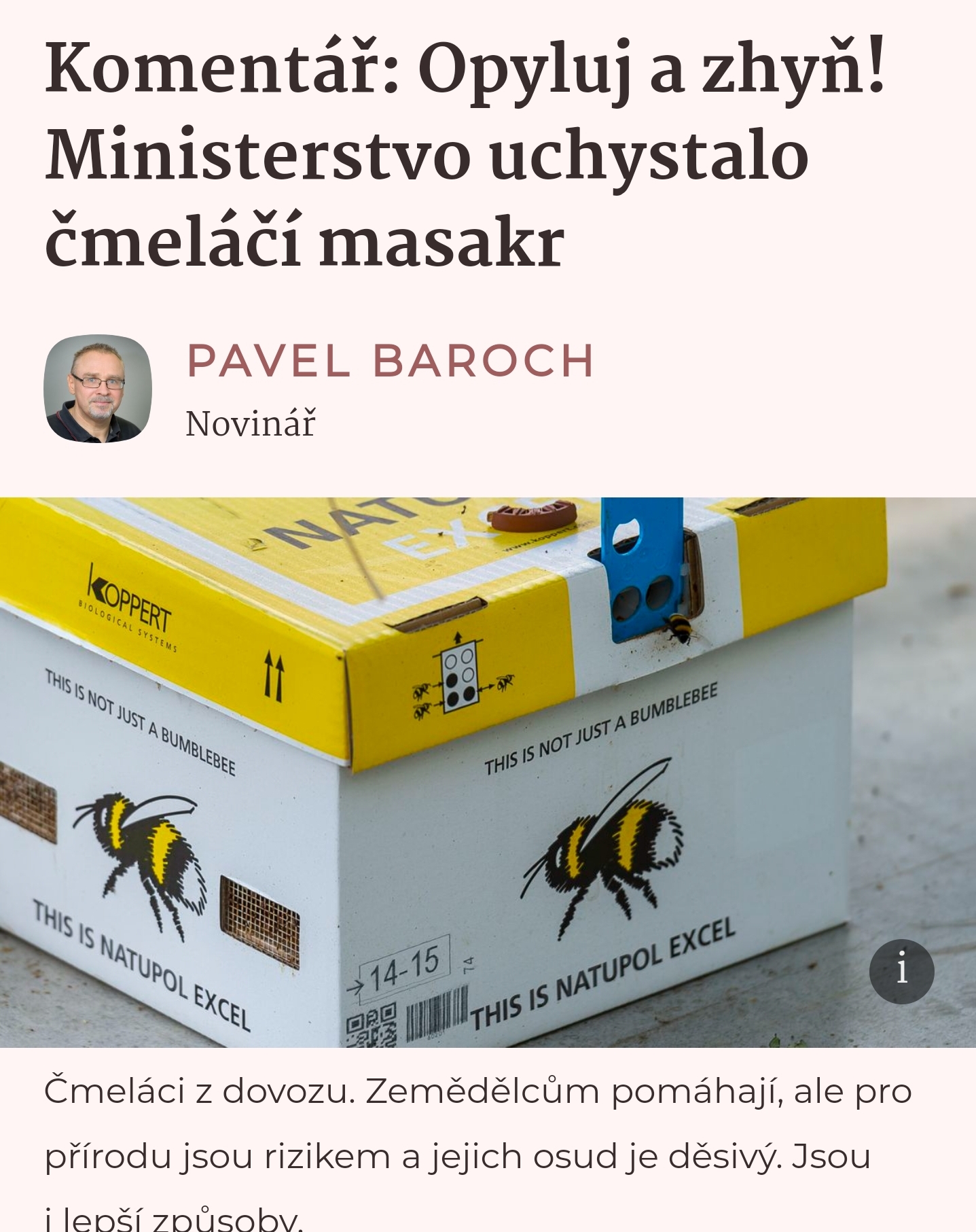
Commentary: Pollinate and Perish _ The Ministry has organised a bumblebee massacre
Photo: Seznam Zprávy
Bumblebees PLUS Reaction
The name is a bit classic. boulevard. That's unfortunately the price to pay for journalists using strong stimuli to engage readers. Well... sometimes readers themselves are to blame, but the journalist shouldn't pander.
However, we thank you for the article. The Čmeláci PLUS group has been dealing with this issue for a long time and is drawing attention to it.
The article describes a very important topic that you shouldn't miss.
Let's look at the facts and content of the article.
In the article, author Pavel Baroch correctly and critically describes how we, as human society, have become too accustomed to not being able to do without fruit and vegetables grown at any time. As a result, we resort to „quick and „cheap solutions“„ – boxes of lab-produced bumblebees and agricultural hybrids. There's not much talk about bumblebees either; it's simply called a “pollination service". Poor bumblebees have qualities that allow them to be used for this purpose (only a few species). Therefore, bumblebees are used for such services in greenhouses – regardless of the time of year.
Greenhouse pollination service
Into the greenhouse will be placed cardboard box bumblebees in the state of a developed nest and full of workers. They fly and pollinate what's around. After a few weeks, the nest reaches its peak, meaning it produces queens and males. It then weakens relatively quickly and soon dies out (see https://www.cmelaciplus.cz/zivotni-cyklus-cmelaka/).
Within greenhouses, such a „box“, hence a weakening nest, liquidate mercilessly. The machine has stopped working and will be replaced by a new one. A new box will be put in its place, and hey presto – it's back in business.
But do you think the nest will always be destroyed, or will the bumblebees simply be taken outside and left behind the greenhouse? Unfortunately, the methodology is not always followed here.
This has been happening for a long time, it's just that no one talks about it. It's all wrong. We are interested in fresh fruit and vegetables. Unfortunately, we only care about the price it's produced at when we see the price tag. No one mentions it either, and if they do, they only show nice shots with bumblebees in a greenhouse. There is no talk of bumblebees as machines, and you won't learn about their end of life by any chance. The terms „super bumblebees“ and „pollinating machines“ have appeared relatively recently, partly thanks to our efforts.
If bumblebees are working in greenhousesYou, it's wrong. We took advantage of them, we are not interested in how it ends, but so be it. It is something like another farm animal and that often ends up at the slaughterhouse, for our benefit.
The important thing is that bumblebees They work in a greenhouse and shouldn't get out of it.. The greenhouse is enclosed and has ventilation and entrances protected by a netting system. If this works and the vegetable/fruit producer follows the rules, it will not harm nature.
But is using a pollination service as romantic as you see in the following video? Did you notice that it doesn't show how the bumblebees are subsequently ruthlessly disposed of?
The problem mainly arises where bumblebees are to be used for pollination purposes in the wild.
This works pretty much the same, just It's not an enclosed space.
The producer transports boxes there and it's already being pollinated. As soon as the nest starts to weaken, he'll supply another. Just look around your locality for blueberry, raspberry, or strawberry plantations. Such boxes there you will commonly see. Only in exceptional cases is it a closed space and here we encounter „big bad“, thus a problem for nature.
No one will prevent hybrid agricultural bumblebees from flying outside areas designated for cropsMainly, this happens at the moment when such crops have finished flowering and the bumblebees begin to starve. They will start flying around and there they will steal food from other pollinators. – all insects, including bumblebees.
It needs to be realised that for a pollination service to function well from a human perspective, Agricultural hybrids bred to have strong nests, meaning as many workers as possible. These nests then create strong food competition for other bumblebees, thereby suppressing them.

Bumblebees for pollination services do not belong in our nature
The main problem is the escape of sexually mature individuals, the reproduction of hybrids in nature and their gradual spread.
If the bumblebee box with hybrid bumblebees is placed in an open space, new mothers and males spread from it into the wild. They multiply there and gradually spread further.
If it were not prevented, it could theoretically happen that pushes out the other bumblebees A V nature will then have only one species – bred by humans.
Everyone knows that the bumblebee is irreplaceable, so Why do we do itWe need to have more types of bumblebees and not be dependent on one type, similar to how we are dependent on the honey bee.
The author of the article correctly points out well-known cases of introduced alien species and their negative consequences.
The pressure from the agricultural lobby is huge. The number of applicants for operating a pollination service is increasing. Applicants speak of „public interest“This means that fruit and vegetables are on our tables.
None of them, however, are talking about the real public interest is a healthy environment and a sustainable state. If we become reliant on one species of bumblebee, nature will lose its irreplaceable helpers. Should something happen to that one species, the original „public interest“ will literally turn into a fight for survival. The costs of a solution could be immeasurable.
Do we really want to experience this? Do we really have to risk it in the way it's happening to bees today?
Pollination services have hitherto lacked firm rules, and the use of hybrid agricultural bumblebees has been neither defined nor controlled. When rules did exist, no one enforced them. Consequently, it is now common for bumblebee boxes to be left to die out, with queens and males establishing themselves in the wild. After all, who would harm good bumblebees? People genuinely take them from greenhouses home, getting them for free. And so they only have them in their gardens. However, they are largely unaware that they are thereby harming nature.
Some unscrupulous sellers even sell people such bumblebees for their gardens. They don't tell them at all what they are selling them and that they should dispose of the bumblebees after a few weeks. Who would buy bumblebees like that, condemned to death?
Is the Ministry of the Environment's methodology truly awful? What is the main evil?
Nobody wants to harm farmers or consumers. Proto experts have compiled a methodology and rules, which at least partially eliminate the consequences of using a pollination service in open space.
In the box are bumblebees, agricultural hybrids, Mother separator (queen separator) – reduced entrance. This will allow workers to work, the queen will not be let out. But it won't prevent the males from flying off, These are approximately the size of workers. These can mate in the wild with other bumblebees of related species. The consequences of such a cross are not yet known and must therefore be considered a risk..
To prevent mothers from truly entering nature, it is ordered, nest pthe use of humanely dispose and not let the mothers suffer in it. Freezing or CO2 The most humane method is when insects do not suffer. The entire nest is destroyed because, at that time, the number of workers in it is rapidly decreasing. This corresponds to empirically defined 8 weeks. In reality, the nest should be destroyed earlier; this is a compromise.
It's still a tough pill to swallow, but a nest in this condition is truly nearing its end. If its removal isn't ensured, hybrid bumblebees will spread into the wild. Therefore, removal is the lesser of two evils, whether we like it or not.
We don't want to defend the Ministry of the Environment, but we must realise that The main evil is the misuse of bumblebees for pollination services..
So, do you still see the methodology as a „bee massacre“?
Isn't it more of a massacre to decimate natural species of bumblebees, bees, and other insects with a mass of agricultural hybrids?
We should rather be glad that this methodology has finally been established and that its strict adherence is beginning to be required.
So, what to do about it?
First of all, we should avoid using the pollination service as such. It worked without it before, so let's go back to that.
It's worth the effort intensive farming, The effort to grow as much as possible on as small an area as possible. This is why pesticides are used, so that such a concentration of crops can defend itself against natural pests.
Now is also coming Pollination service, so that concentrated crops they will not manage to pollinate. If everything is on one surface, natural pollinators simply won't manage it, or it will take them longer. The surface is too large for them. They could not reproduce there because conditions were not suitable there the previous year.
Unfortunately, the use of pollination services cannot be easily prohibited. People will not give up agricultural products, even if they have to be imported from abroad. This would put our producers at a significant disadvantage.
The solution is therefore, to divide cultivation into multiple plots, leave between them strips of other vegetation and natural meadows. Pollinators will thrive here and pollinate the necessary crops. However, they will not be left wanting once these crops have finished flowering. This will have a positive impact overall.
Producers might see a slight increase in transport costs, but they will save on chemicals and pollination services, and also help the environment. It is well known that our nature has one of the worst compositions in the EU, thanks to farmers. Ultimately, it will be cost-neutral, with all effects taken into account, and much better..
If a fruit and vegetable producer cannot avoid using pollination services, they should use native bumblebee species for pollination. But it shouldn't be a common species of bumblebee, such as the buff-tailed bumblebee (Bombus terrestris). There are so many of them in the wild that further breeding of them would have a similar effect to using agricultural bumblebee hybrids.
Therefore, it is necessary to use other types of bumblebees, especially those uncommon and not focus on just one type and use as many as possible.
Can to use bumblebees from our nature, to help them multiply and to support them and their keepers.
Similarly, one can to make use of various kinds of overlooked solitary beesYou are forgotten, yet they are very important helpers.
First and foremost, one should stop abusing nature and return to it more, Don't just try to rape her.
Conclusion and summary
- In an effort to improve their situation, humans harm themselves and ultimately fare worse. The use of agricultural hybrid bumblebees for pollination services is a prime example of this.
- No farmer is forced to use a pollination service. Very often, they have trapped themselves by wanting the greatest profit. Paradoxically, this generates additional costs for them. They can grow crops in harmony with nature, utilise it and help it. The costs will not be higher, and they can even save money on it.
- To limit the negative consequences of using a pollination service, a methodology was developed, which suddenly alarms us and which the author, in the spirit of the tabloids, calls „Bumblebee Massacre“.
- Thank you very much for the methodology, it has been awaited for a long time. It is immensely good that it exists. We all pay tribute to everyone involved for it. However, the methodology must be rigorously enforced, adhered to, and strictly checked for compliance. Then it is a certain way to mitigate the negative consequences of pollination services in the wild.
- That „horrific methodology and the bumblebee massacre“ have one very important effect. Thanks to them, the public will find out what this is all about. They will start to wonder why all this is happening. Ultimately, under public pressure, a perhaps significant number of farmers will stop using pollination services. After all, they won’t want to kill bumblebees. They will look for other ways to live in harmony with nature.
Thank you to everyone who read the original report by Seznam Zprávy and our response. Yes, the topic is not simple, but thanks to public interest, things are moving forward, and hopefully in the right direction.
You can find further posts on this topic on our website HERE