Unique project of Čmeláků PLUS - rescue team
What you will learn here
- About the Bumblebee Fast Company
- How it all works
- How can you become a member of the rescue party?
- How is the evacuation of bumblebees carried out?
Last updated: 29/5/2022
CONTENTS
.
What is Bumblebee Fast Company?
My friends and I came up with the Bumblebee Company after we ourselves evacuated a few unhappily inhabited or endangered nests.
Bumblebees PLUS are already known and that is why finders are turning to us for help. There are many breeders in our community who have failed to purchase a nest, establish a queen, or have lost their nest during the season.
That's why we match findings of endangered bumblebee nests with rescuers and help everyone .
Since then, we have saved many nests every year. Many people no longer have to worry about "what to do with them" and many others are happy to have bumblebees in their hives.
All rescue missions are carried out only if the nest is in danger.
Any other relocation of the nest would violate the laws on nature conservation in the Czech Republic and bumblebees, as a creature specially protected by law.
Specifically, it concerns Section 56 of Act No. 114/1992 Coll., on Nature Protection, from the prohibitions for specially protected animals
specified in Section 50 of Act No. 114/1992 Coll., on Nature Protection, specifically the import, possession,
transport, relocation, offering for sale of individuals and various developmental stages of the bumblebee species.

How Bumblebee Fast Rota works
The Bumblebee Rapid Rota is a safety net that consists of three parts.
1. Finders of endangered bumblebee nest
- anyone who finds a bumblebee nest in danger and who needs help
2. Bumblebees PLUS Group
- matches information about nests in danger with rescuers
- provides methodological support and evacuation arrangements
3. Nest Savers
- these are our readers on FB and the website www.cmelaciplus.cz
- with our support, they evacuate bumblebee nests to their hives, where they will keep them until the end of their life cycle
Qualifications for a candidate for the role of Nest Savior
who is flexible , determined , prepared , and in the right place at the right time can become a rescuer, and thus a member of the Bumblebee Rapid Company
He must know that evacuating the nest is the beginning of it, and he must be prepared to take care of the nest.
It is not necessary for the rescuer to be an experienced breeder; even a determined and prepared beginner can do it.
Because we are a non-commercial group and we support bumblebee rescue selflessly, we set one fundamental condition - everything must be done for free and without any claim for financial reward .
A sufficiently large reward is a rescued bumblebee nest destined to live with the Savior.
But to make sure it's not completely without reward, the rescuer will become a member of the Bumblebee Fast Company. His name will be listed on our website and he will receive a commemorative patch with the Bumblebee Fast Company logo .
Specific conditions for Bumblebee Nest Rescue
We do not want to limit the number of people interested in rescuing bumblebees. However, we feel a responsibility and therefore want the rescue and survival to go smoothly.
It would make no sense to save bumblebees and relocate them to a place where they will not be able to live comfortably and safely.
Conditions for rescue
- Have a properly prepared hive (bumblebee)
- Have a chosen location for the hive.
For information on preparing the hive and its location, see HERE. - Having the option to place the hive at least 3 km from the original location (so that the bumblebees do not return to the original location) – this is an advantage, not an essential requirement
- Be equipped with aids for working with bumblebeey :
– red light (preferably a headlamp or rear bike light, mobile app) – necessarily
– large glass (3-5 l cucumber jar, glass jug, etc.) with a funnel from a PET bottle – necessarily
– beekeeping gadget – we highly recommend
– beekeeping gloves – we highly recommend (thin garden hose may not be enough) because it greatly simplifies the work
– mesh and loader – we highly recommend
– long tweezers – we highly recommend
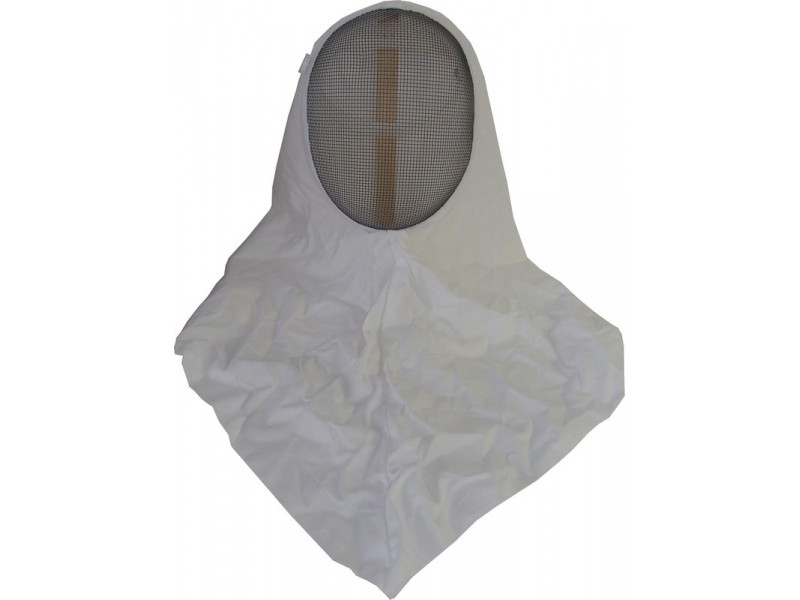
– beekeeping cocoon – not always necessary, but it is convenient above all, peace for yousee details HERE
- Suitable clothing – long, thick, sturdy pants and a thick (flannel) shirt
- In addition to breeding tools, you need to have at least a shovel for digging out the nest (preferably a garden shovel) and possibly other tools (depending on the situation).
- Having the opportunity to return to the original nest site early the next morning and having 1-2 hours to capture the remaining workers – this is an advantage, not an essential condition
As we wrote above, it is always better for the evacuation to be carried out by someone who has experience , but practice has shown us that if time is of the essence and a determined beginner , they can also do it with our help - DON'T BE AFRAID!

Bumblebees PLUS – Protective hood for bumblebee breeders
Photo Internet

Bumblebees PLUS – Red light – headlamp
Photo O. Hercog
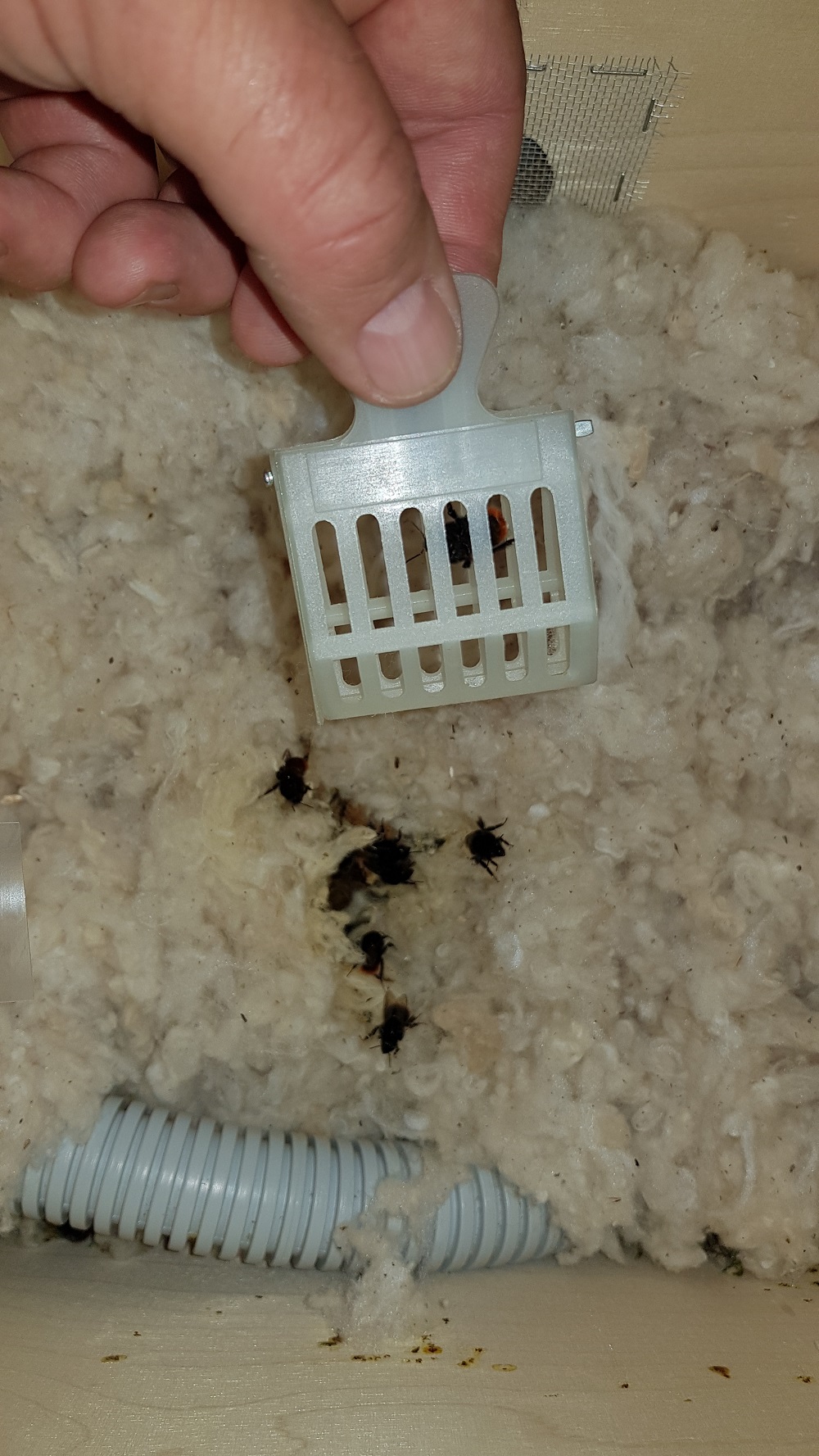
Beekeeping gadget
Photo O. Hercog
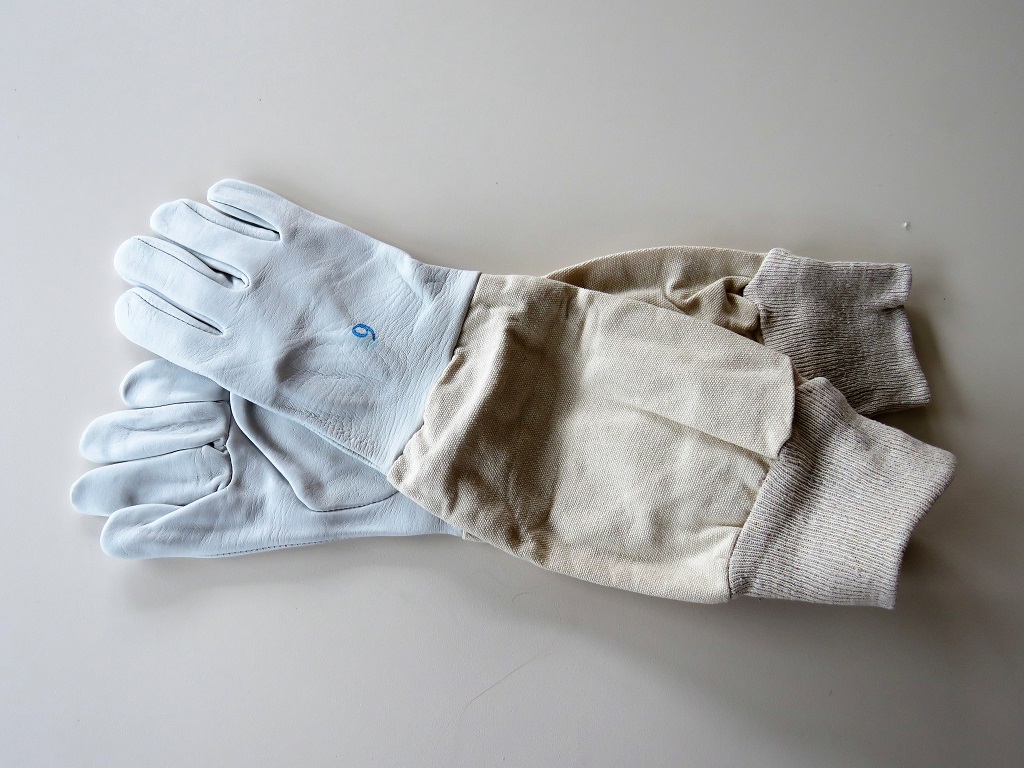
Protective gloves of a bumblebee breeder
Photo Internet
Bumblebee Rapid Company in action
For simplicity, we will hereinafter call the Bumblebee Rapid Company the ČRR.
Basic description:
- The finder of the nest contacts the Czech Red Cross, see contacts HERE
- The finder will briefly describe: what nest they found, where they found it, address, contact information and, if possible, a photo of the location of the find.
- The Czech Rescue Service will contact the Finder and assess the situation with him/her – is the nest suitable for evacuation?
- The Czech Red Cross always tries to convince the Finder to let the nest live on site, because evacuation is a major intervention for the nest.
- If it is necessary to evacuate the nest, the CRRR a call for rescuers on Facebook and the website.
- The call includes the approximate address of the location of the find and a brief description of the situation with a photo
- the Rescuer is found , the CRRR will verify his readiness and provide him with the necessary information and connect him with the Finder.
- Rescuer evacuates bumblebee nest
- During and after the evacuation, the Czech Rescue Service telephone support
We do not create waiting lists, priority is given to quickly saving the nest = the first one ready goes into action.
About nest evacuation
Here is a basic description of the evacuation process. Of course, it is different every time and depends on where and in what condition the nest was found.
Sometimes it is necessary to dig the nest out of the ground, sometimes to remove the roof insulation, sometimes to collect the disturbed nest. The evacuation procedure needs to be adapted accordingly.
It is best to evacuate the nest at night, when most of its bumblebee family is home and when the bumblebees are not foraging.
The Czech Republic will provide specific advice depending on the situation.
The process of evacuating a bumblebee nest
A) Evacuation of the nest
The nest is evacuated at night , when most bumblebees are in the nest. The work is done under red light , in which most species cannot see and fly.
- Close the hole with a plug (inlet hole) and the ventilation will close,
- Remove half of the lining from the hive and make a hole in it for the nest ,
- Expose the mouth of the inlet pipe,
- The device will remove all the bumblebees that are moving around
- grab them with the device and throw them into the jars with a funnel
- you can leave them hanging on a stick - but this can take a long time - Try to find the mother
– if she is sitting on the nest, leave her there with other workers who are holding onto the nest
– if the nest is large, the mother may no longer be there - Expose the wax part of the nest (work)
– prevent clay from entering it as much as possible - Transfer the work to the hive .
– it is important to transfer the nest structure to the hive with as little damage as possible – cocoons and part of the original lining –
the wax work is placed in the hive in a position as similar as possible to the one in which it was built
– the material found in the nest also belongs to – it contains the smell that bumblebees are fixated on, just add a little - Place the queen bee (if she remained on the cocoons) and the workers sitting on
the brood in the nest with the brood - if the queen is caught in a jar, leave her there. - the rest of the hive with the prepared clean lining, carefully cover the waxwork, but at the same time leave the entrance corridor mouth free.
- Place a lit headlamp/flashlight ( white light ) on the ground near the location of the find
– this will attract the remaining bumblebees
– kill them with a trap - Take the hive and workers home
- At home, you can separate the bumblebees in a jar from the dirt you brought them with.
– in the dark with a red light, offer them a stick/rice stick that they will climb up
– one by one, drop them into a clean jar with a funnel - At the red light, open the hive and adjust the lining so that it is up to the ventilation hole and the entrance to the corridor is revealed.
- Place a dose of food (sugar syrup in the feeder/sugar dough) into the hive on the lining HERE
- Pour the captured workers (and the queen) from the
jar into the nest on the – it is recommended to mix the bumblebees gently, as if with water on the bottom, and then pour them out
– immediately close the hive with the roof - Move the closed hive (inlet opening closed with a cork, ventilation and roof) to a new location and leave it closed in the dark until morning.

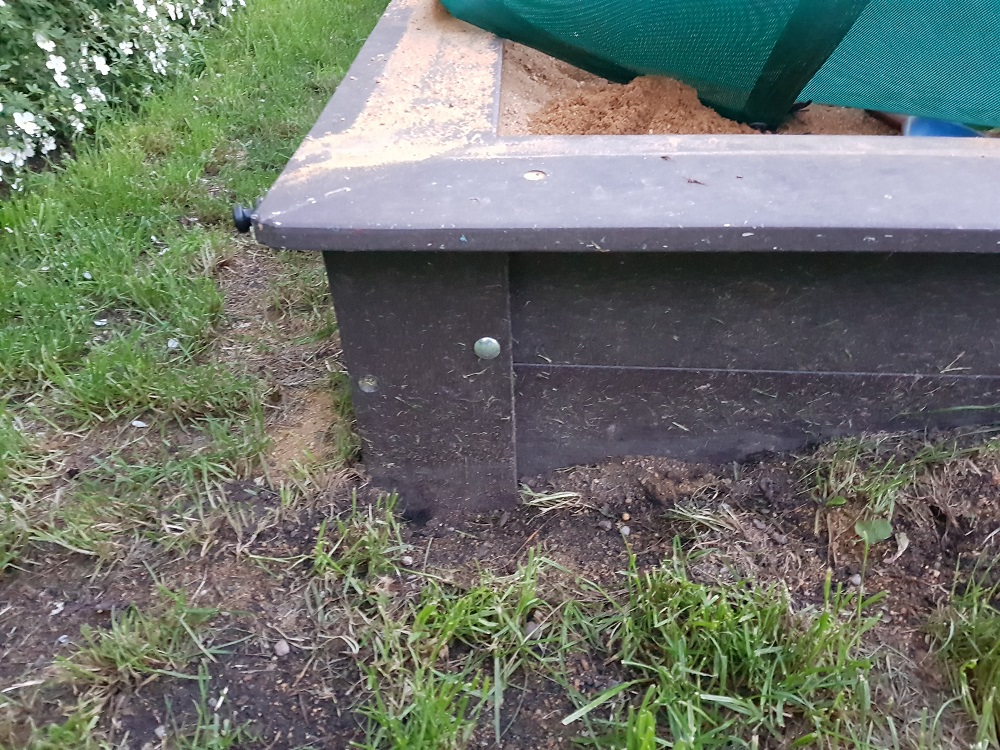
Nest evacuation – nest discovery
Photo O. Hercog (6/2019 Kněževes)
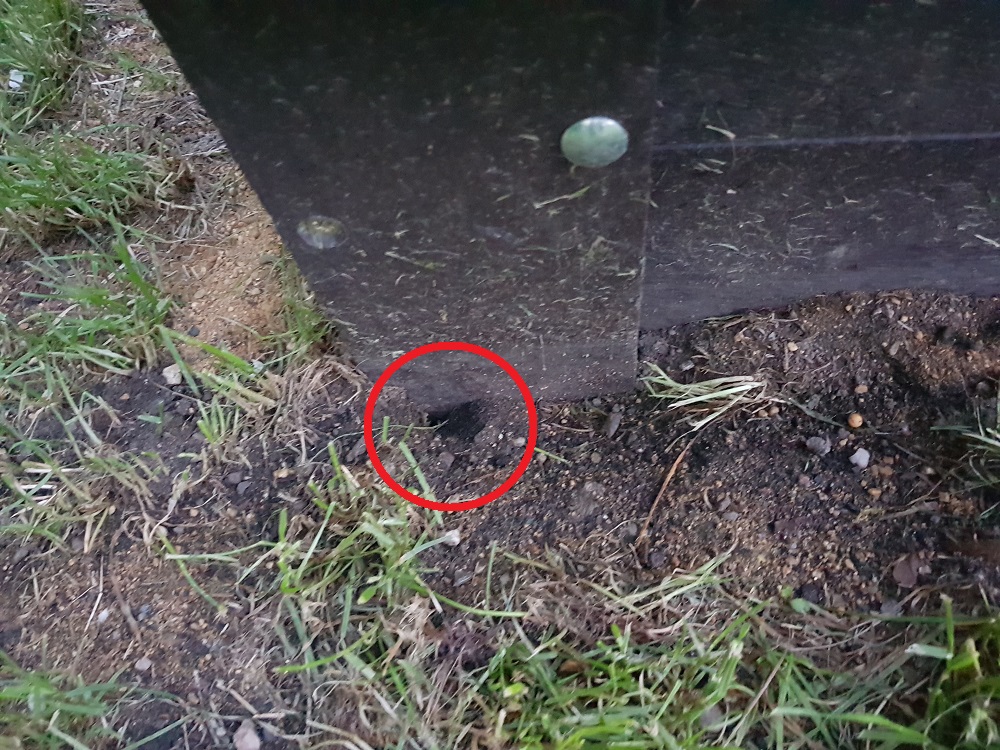
Nest evacuation – entrance to the nest
Photo O. Hercog (6/2019 Kněževes)
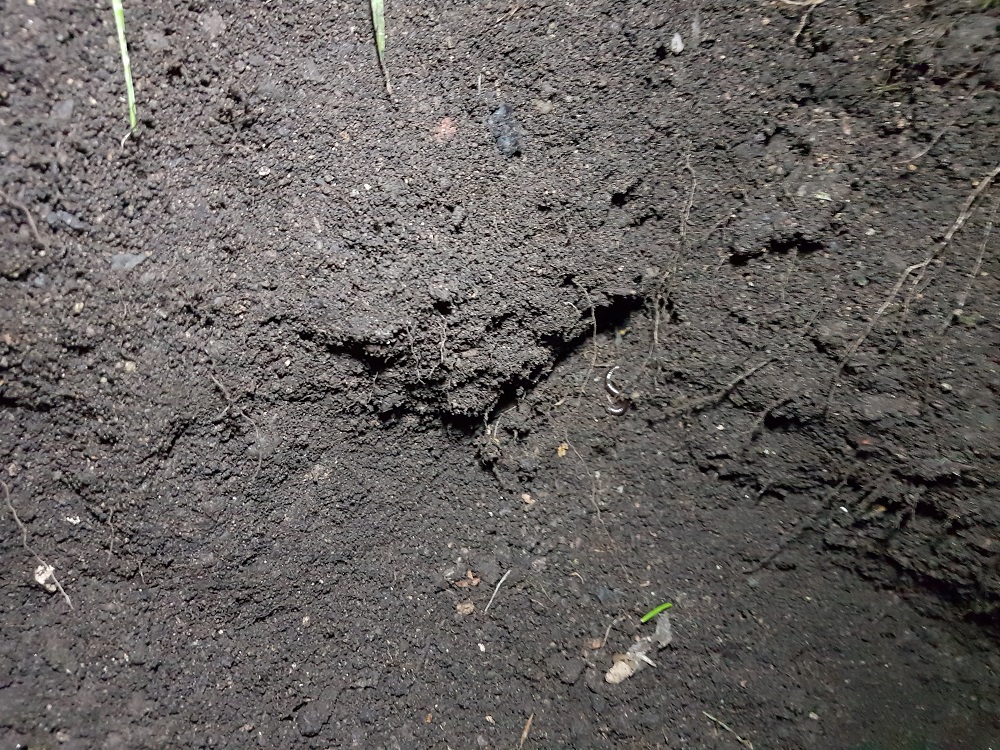
Evacuation of the nest - finding the nest - passage to the nest
Photo O. Hercog (6/2019 Kněževes)
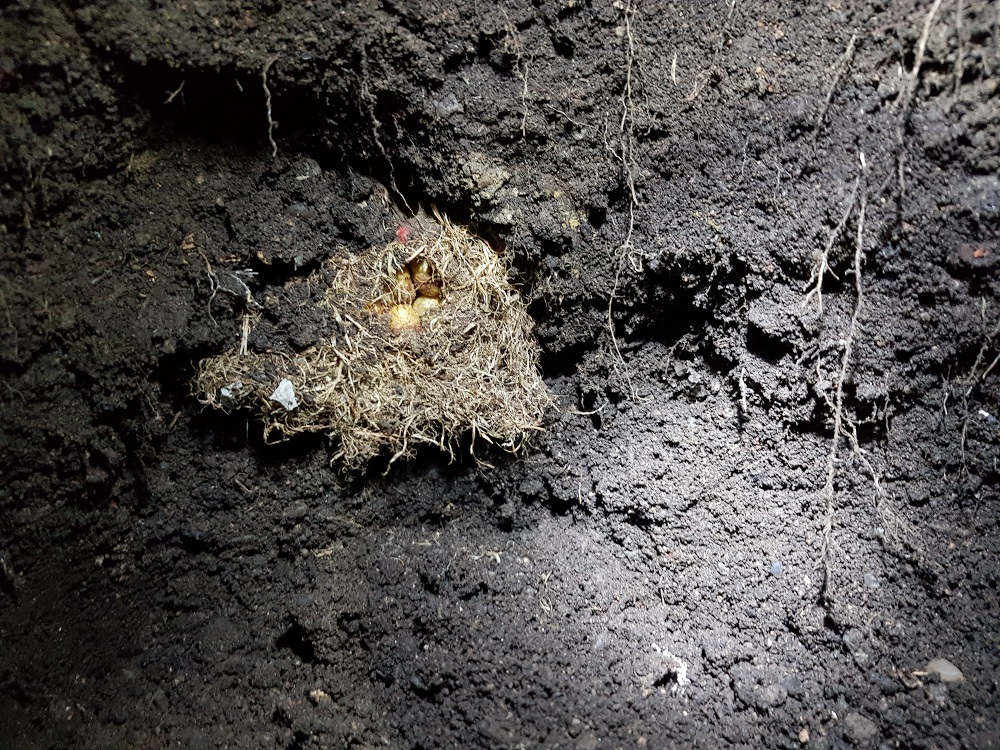
Nest evacuation - finding a nest in a rodent burrow
Photo O. Hercog (6/2019 Kněževes)
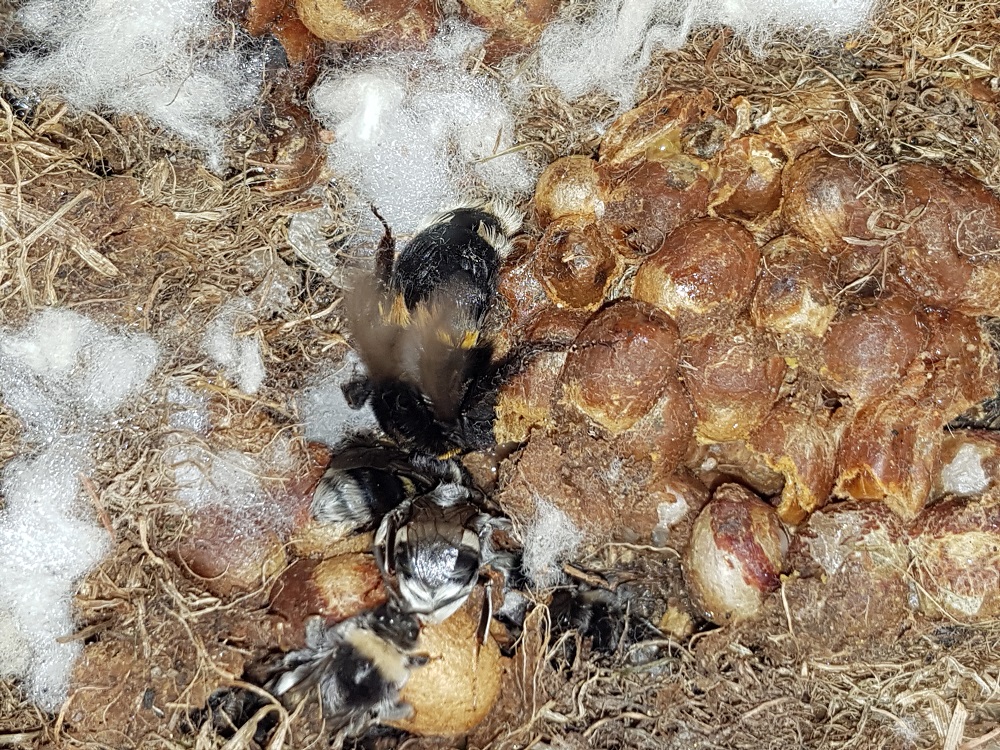
Nest evacuation – mother bumblebee and a couple of workers on cocoons
Photo O. Hercog (6/2019 Kněževes)
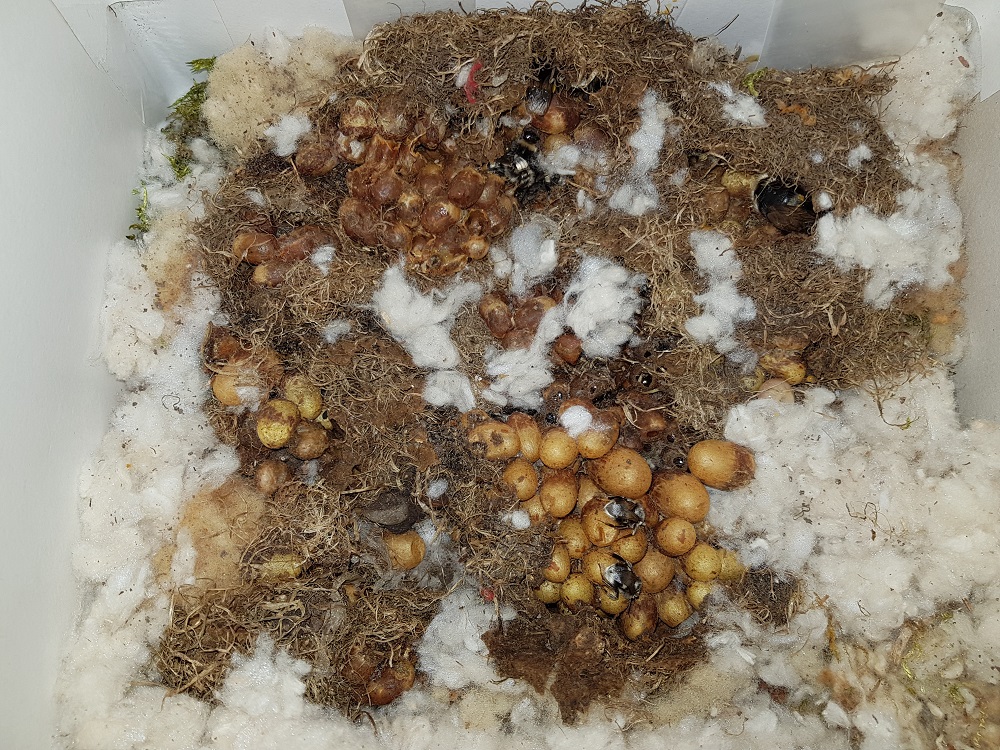
Nest evacuation - mother bumblebee on cocoons placed in the hive
Photo O. Hercog (6/2019 Kněževes)
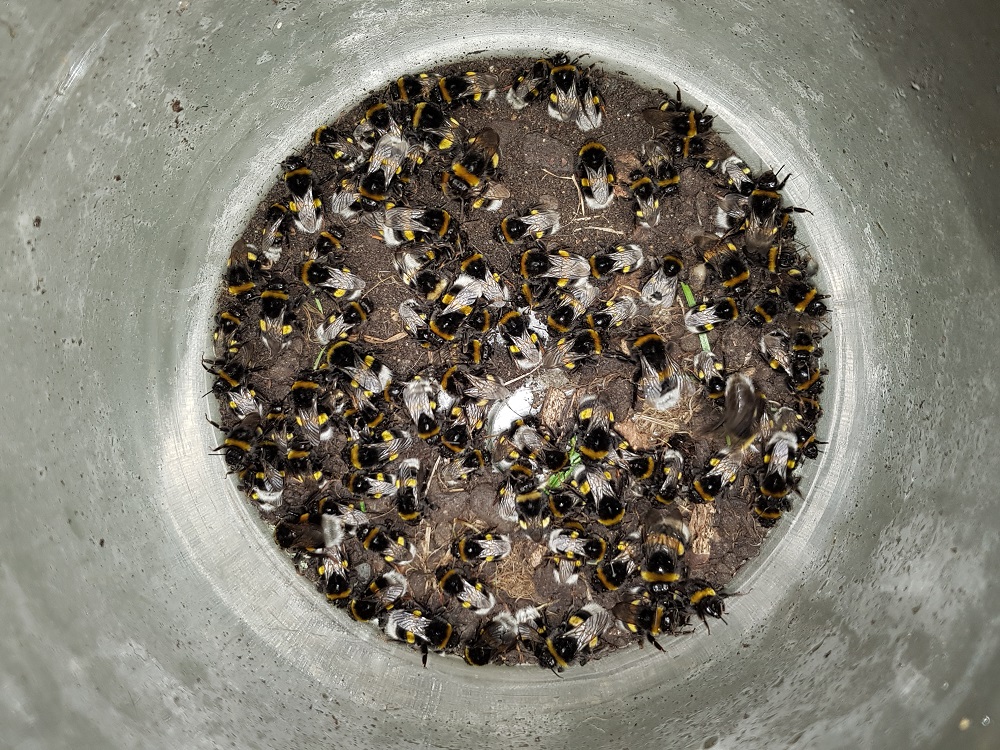
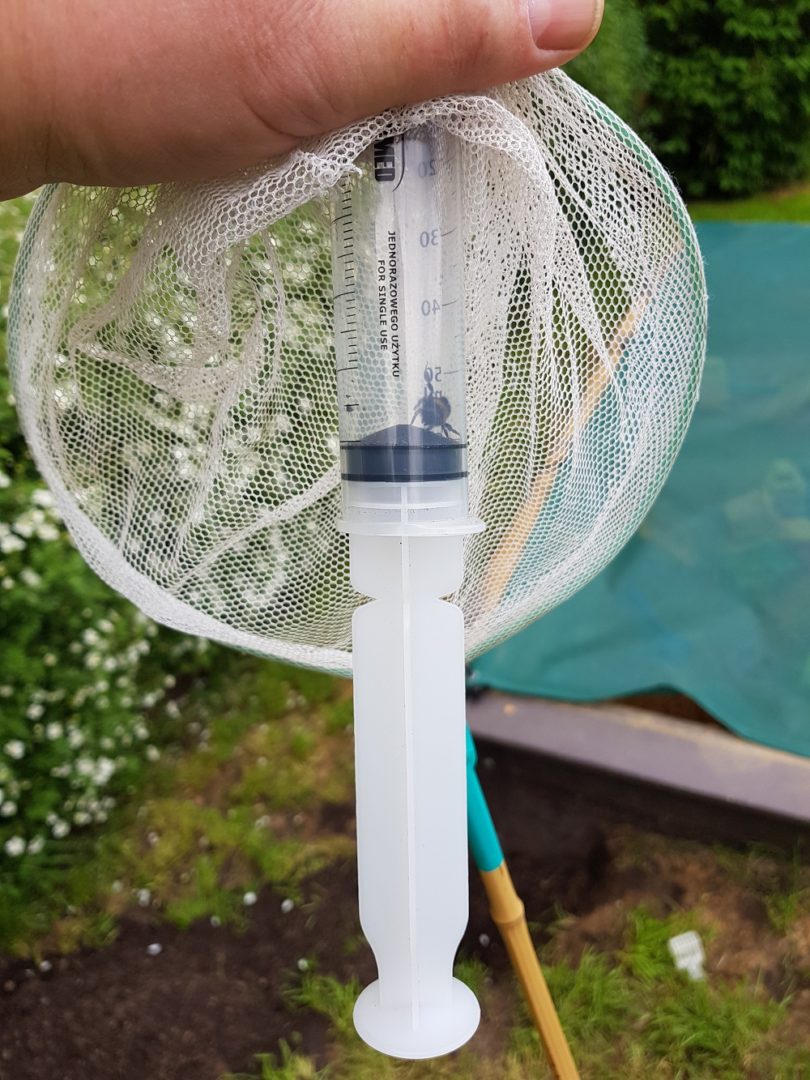
Nest evacuation – worker bumblebee collected in a glass
Photo O. Hercog (6/2019 Kněževes)
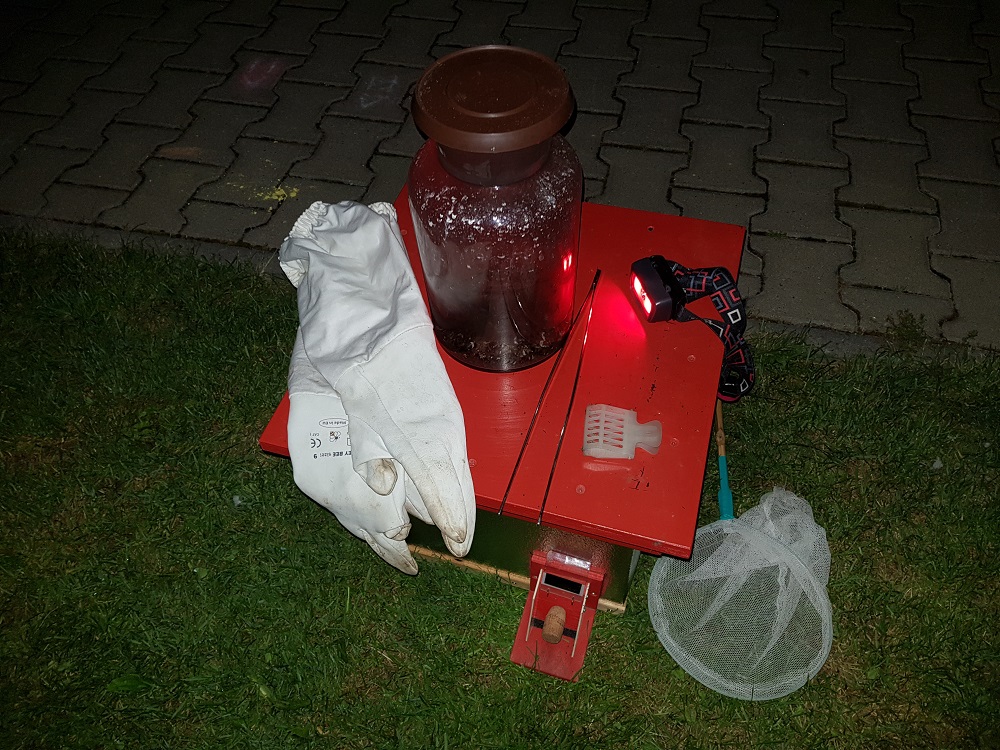
Nest evacuation – first part of evacuation completed = mother worker placed in the hive
Photo O. Hercog (6/2019 Kněževes)
B) Collection of remaining workers
During evacuation , workers who could not be caught during the night, and possibly the mother, always remain in place.
There will also be workers who spent the night outside the hive and returned to the nest after daybreak (there may be 10, 20 or more, depending on the development and size of the nest).
The rescuer should return early the next morning and collect the remaining workers – important for small nests and when the mother has not been found. The collection may take 1 to 2 hours, as the workers return and search for the nest.
- Catch bumblebees on the spot
- Wait for them to sit on the ground where the nest was – they are searching for the scent
- If you are going to transport them further, throw them into a glass with a funnel – we recommend
- If the hive with the evacuated nest is nearby and already open , you can introduce individual bumblebees into the hive through the entry hole and the introducer.

Evacuation of the nest – second day of catching workers
Photo O. Hercog (6/2019 Kněževes)
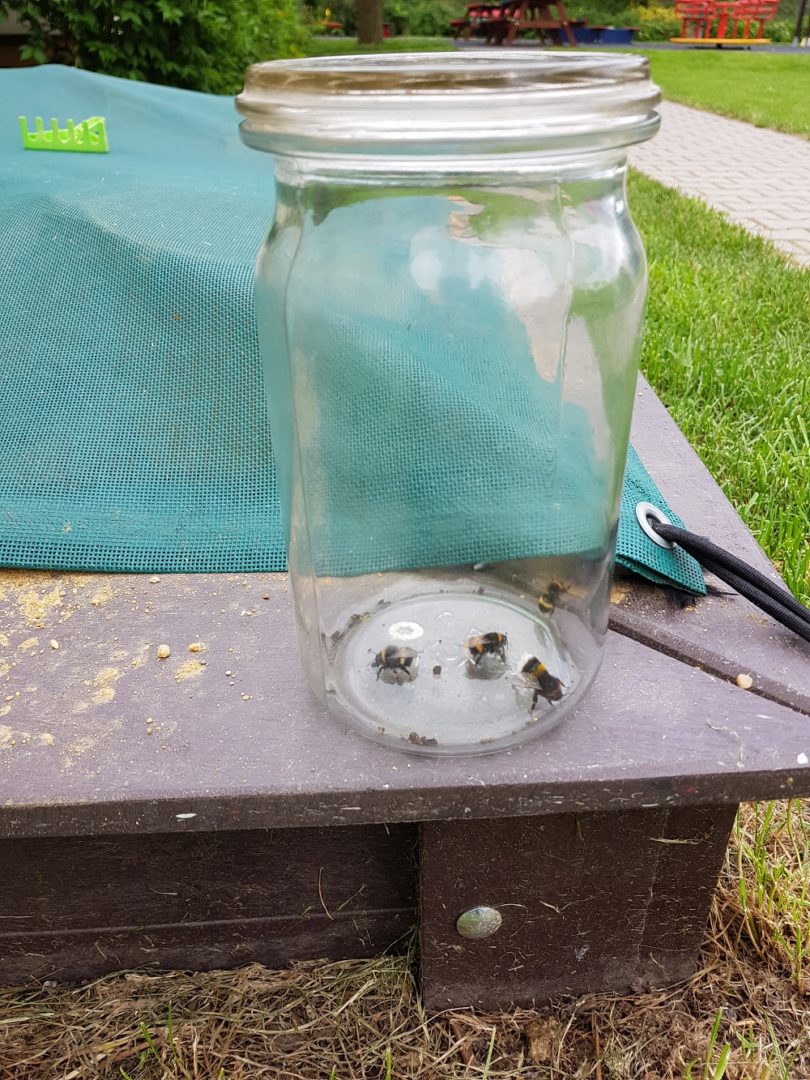
Evacuation of the nest - the second day, catching the workers and placing them in a glass
Photo O. Hercog (6/2019 Kněževes)
C) Opening a hive in a new location
The hive should be quiet for several hours (preferably at night after evacuation).
- After dawn (until morning) , open the flap and secure it in the open position,
- Check that the ventilation hole is closed ,
- Open the inlet and step away from the handle,
- After some time, the bumblebees will find the exit, make an orientation flight , and accept a new home.
D) Adding the remaining semolina
Bumblebees collected at the site of discovery can be added to the nest :
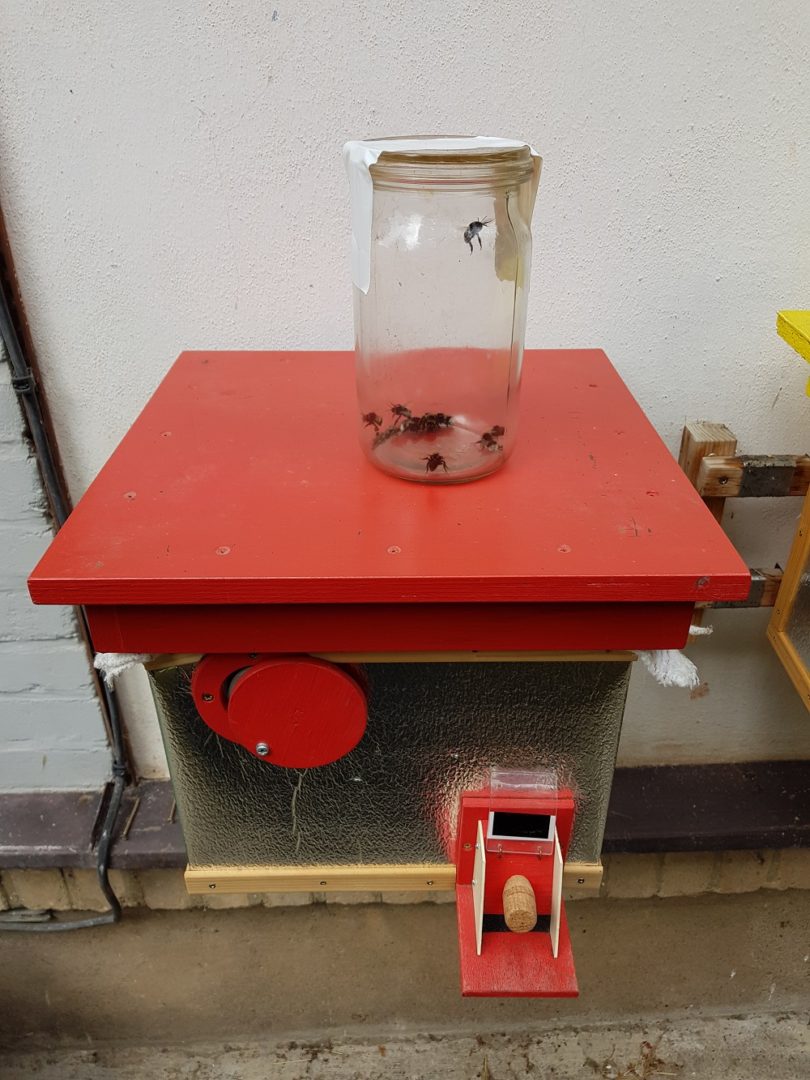
a) before opening the hive (under red light) , but then it is good to leave the hive alone for some time
b) after opening the hive and when the bumblebees find their way out of the hive and start flying, then during the day

Evacuation of the nest - second day - closed hive waiting for the remaining captured workers
Photo O. Hercog (6/2019 Kněževes)
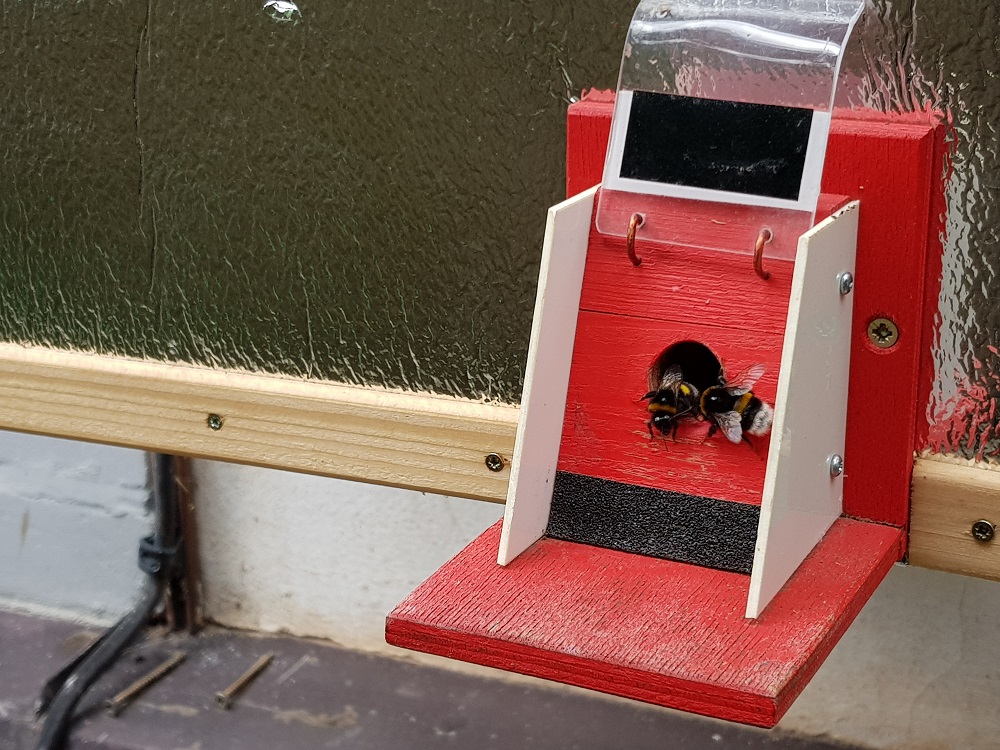
Evacuation of the nest - second day - the first workers appear
Photo O. Hercog (6/2019 Kněževes)
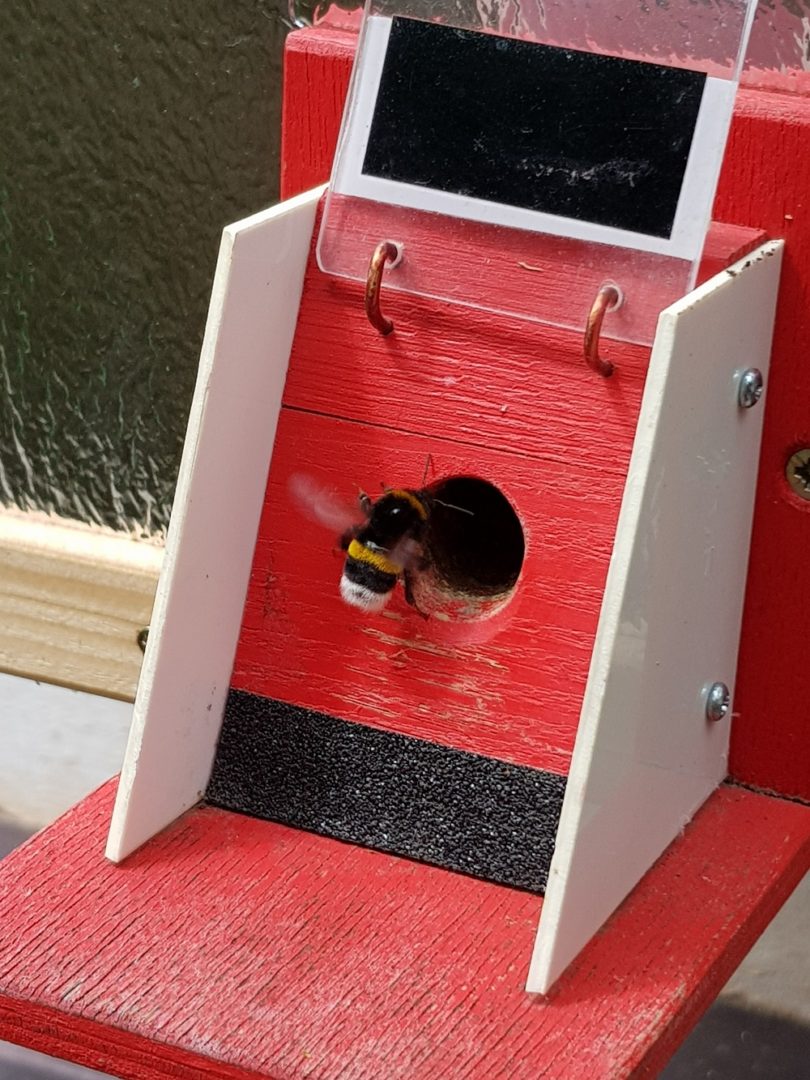
Nest evacuation – second day – the first workers appear and make an orientation flight
Photo O. Hercog (6/2019 Kněževes)
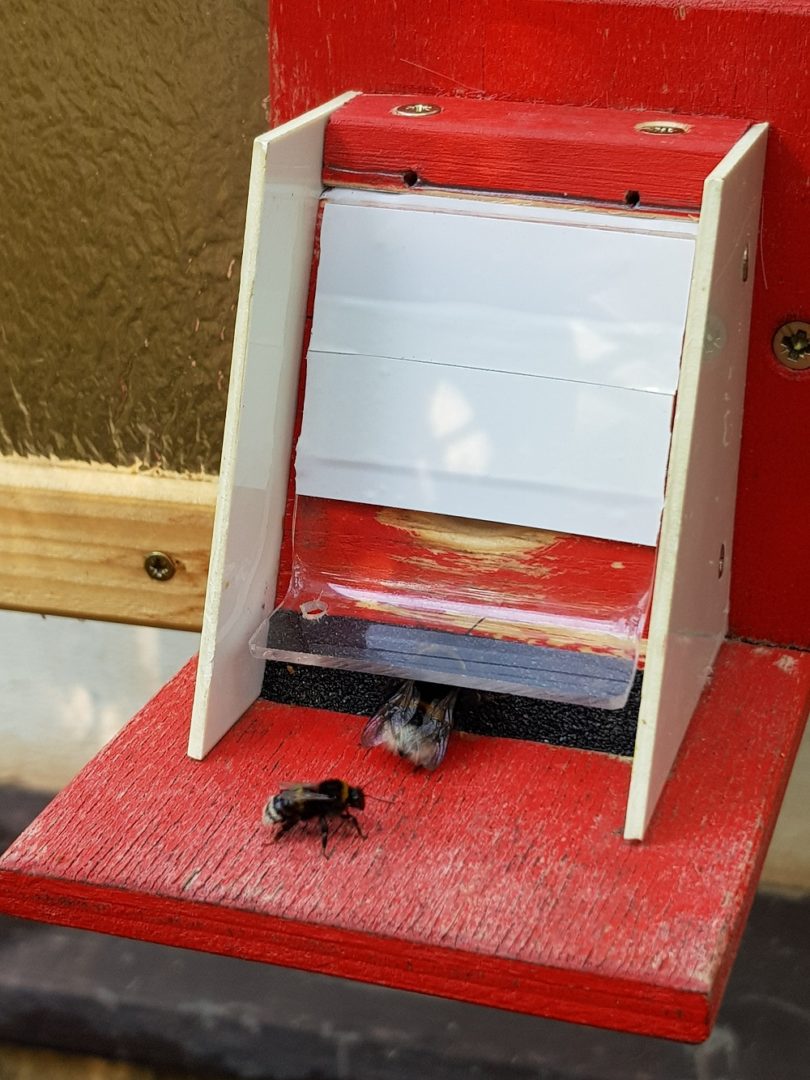
Nest evacuation - second day - the first worker learns to pass through the protective flap
Photo O. Hercog (6/2019 Kněževes)