

insect meadow in your own garden

Meadow in your own garden

The importance of meadows, or why at least a tiny corner of your garden should have a meadow.

  • Meadows are an ecosystem typical of our landscape. However, original meadows have practically disappeared. They are being replaced by either grasslands or meadows sown predominantly with grasses and fodder crops. The eutrophication of the landscape does not bypass meadow areas either. Regarding her influence on the bumblebee population And we have already written about other insects.

  • Garden owners have enormous hidden potential when it comes to restoring meadow vegetation, as even a small strip of flower-rich meadow, mown in stages, is becoming, without exaggeration, an ark for all creatures tied to the meadow ecosystem. The garden owner thus creates a reservoir and gene pool for disappearing meadow flower species with such a meadow. Just imagine if everyone had at least a meadow patch in their garden, what a huge area that would be in total.

  • It's not just about bumblebees; if we want to keep bumblebees in the landscape, we must also maintain their natural ecosystems. And establishing and maintaining a meadow is very easy, requiring minimal effort and investment from the gardener. It really is a lot of bang for your buck, and yet it's so often missing...
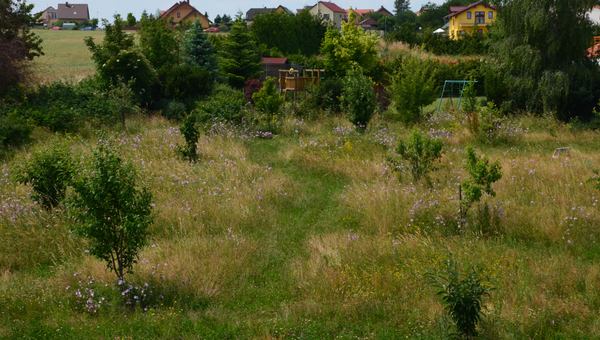
Meadow in early June

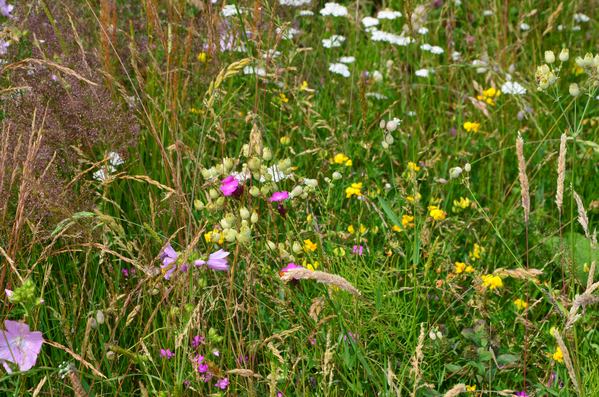
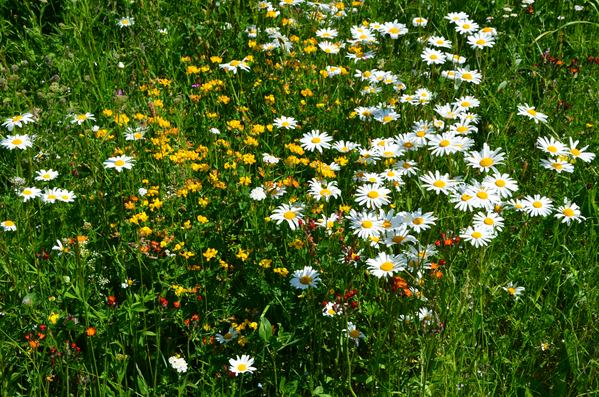
Meadow in bloom at the start of June
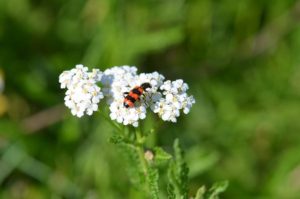
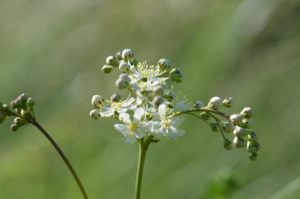
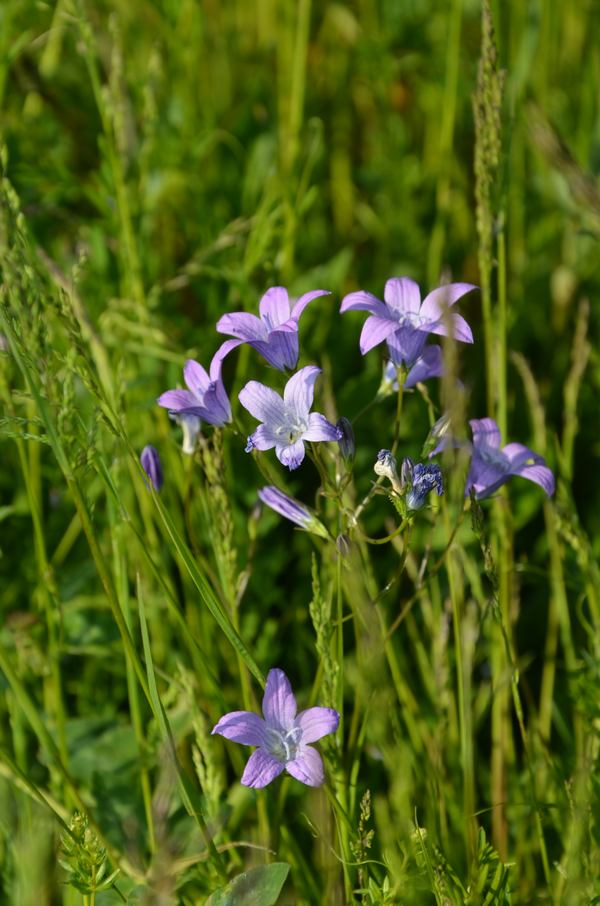
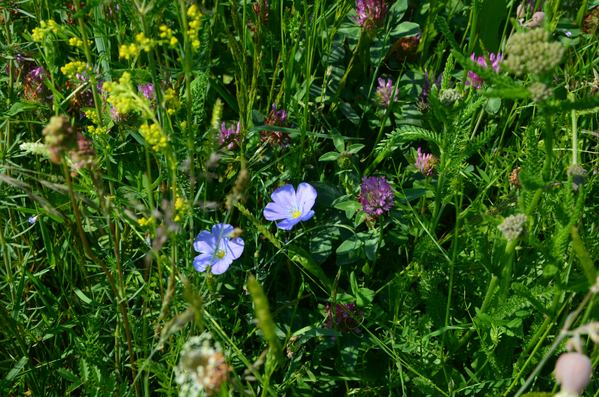
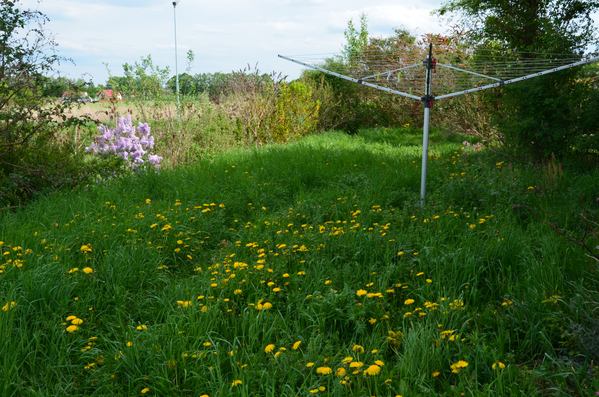
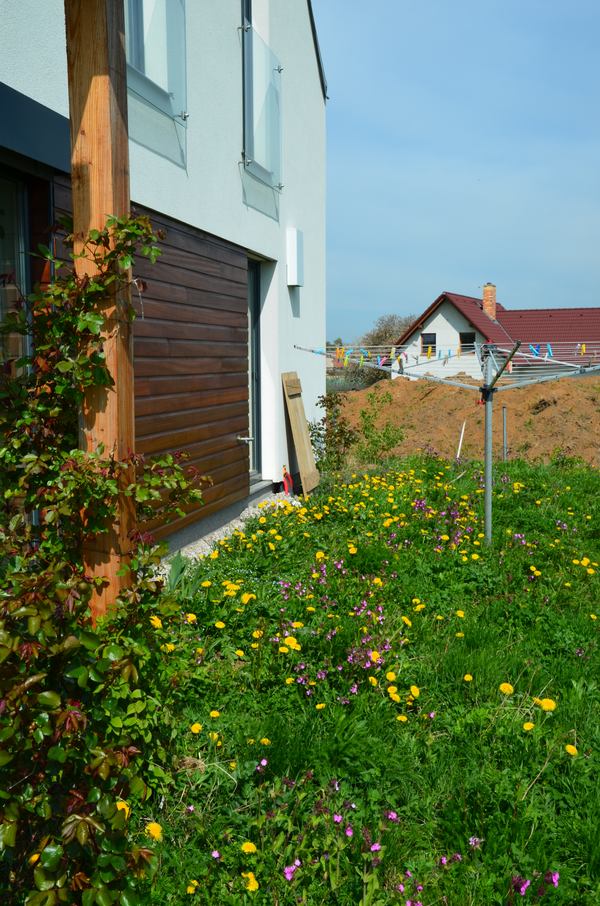
All the photographs shown here are from a single meadow – to give you an idea of the diversity that a garden owner can achieve with a meadow. Photos by K. Kučera

Introduction to a Meadow - What is a meadow and what can I expect from my meadow?

  • A meadow is a mix of grassland grasses and herbs. Their species and percentage representation will change over time according to the character of the place and the intensity and manner of human use. Each little meadow is thus a complete unique. You won't find two the same, not even this year's is ever exactly the same as last year's.

  • Meadow insects provide food, overwintering and breeding opportunities, and thus actually serve throughout the year.

  • A pond is not a sterile surface; it becomes home to a variety of invertebrates and small vertebrates. It is also a food source for birds. Yes, there will be cobwebs and anthills in it. No, there won't be more ticks in it., than their occurrence in the immediate vicinity.

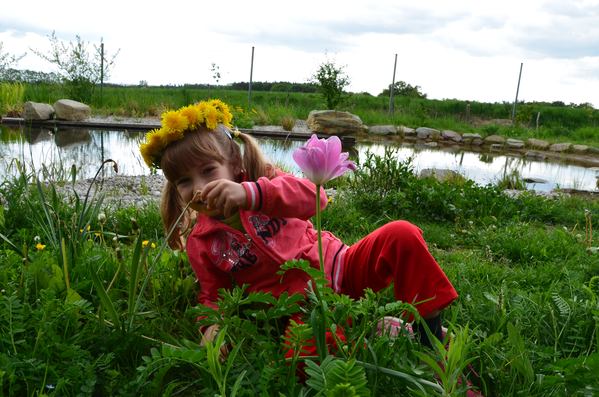
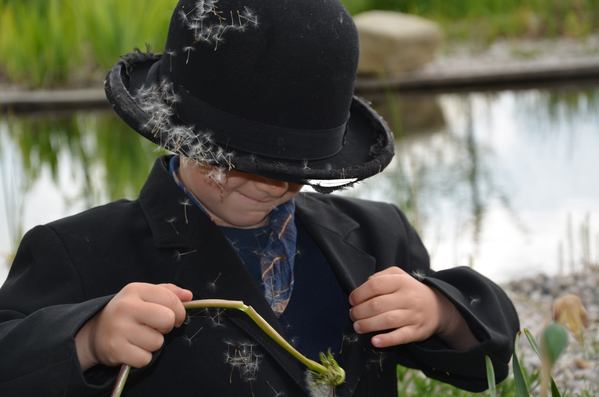
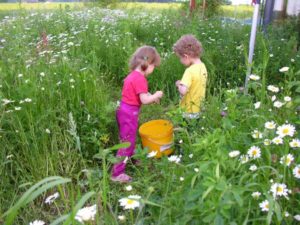
    For children, a wildflower meadow is an adventure

    The meadow offers children a new space for games and discovery.

  • Size isn't decisive, it can even be just a small island, strip, or corner. However, the owner must account for a greater growth height, less dense sowing initially, and the formation of meadow turfs after mowing, as the mowing height must not go below 5cm. A place for a meadow should therefore be planned and preferably a less used area for garden activities, also because once a blooming, flowery meadow has arrived, it almost feels like a sin to step into it 🙂. .

  • The offer of meadow seeds depends on the intended use – meadows meant for grazing livestock contain more fodder plants and fewer flowering herbs. These seeds are not optimal.  Wildflower meadows On the contrary, they are poorer in other ways, the quality of hay for farm animals is worse, but they are much more species-rich and the overall representation of flowers is richer throughout the year.

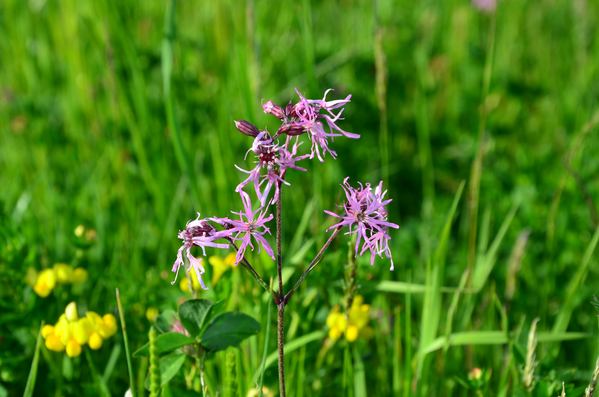
    Meadow foxtail Grass of Parnassus

  • The selection of flowering meadows is huge nowadays. For example, in Markvartice near Sobotka, there is a specialised company where customers can choose from a vast range of meadow seeds. This includes universal mixes that will gradually adapt to the specific conditions of the garden, as well as mixes designed for pollinators, or meadows suitable for specific locations such as shade, dry or damp areas, reclaimed land, and more. They also offer meadows that can withstand more frequent trampling or mowing, thus bridging the gap between a lawn and a meadow. The range even includes meadows based on colours or specific meadow species, meaning that even owners of thematically focused gardens can now afford a meadow without having to change their garden plans. Even such a horticulturally refined meadow is better than none at all...

  • However, it should be taken into account that even with thematically focused meadows, changes in the representation of plant species occur over time.
Recommendation

Consider how much you will be using the meadow area, what the local conditions are (shade, soil that is rather dry or moist for most of the year), and consider your idea of how the meadow should look – choose the appropriate seed mix accordingly. It is worth buying high-quality seed. It is essentially the first and last investment, not counting the tools for mowing and removing hay.
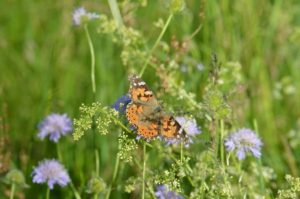
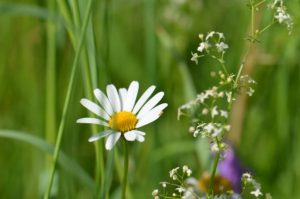
Meadow with disappearing, formerly common, herbs

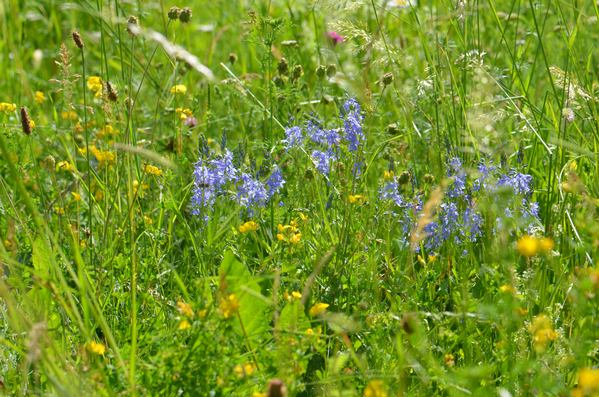
A small sample of my own meadow flowers
Growing requirements:

  • You might be surprised to learn that the poorer the soil, the better for the resulting species diversity. If the soil was previously heavily fertilised, removing the top layer won't do any harm.
  • We never fertilise or treat the soil with herbicides before or after sowing.

Ten basic tips for successfully establishing and growing flowery meadows

We have reproduced nine items with the permission of the professionals – published with the consent of Planta naturalis

  1. We are planting the leeks in clean soil.
    Seeds of natural meadow plants cannot be sown into an established lawn!

  2. We do not mix seeds of true wildflower meadows with common grass and clover seeds.

  3.  Prepare the soil for sowing a meadow as you would for lawn, but do not fertilise or use herbicides.

  4. Sowing a wildflower meadow is 1–2 g/m².
    The sowing depth is very shallow – up to 0.5 cm.

  5. Sowing period: all year round, most suitable spring and late autumn.

  6. We cut the grass with a regular lawnmower or a scythe. 4 – 5 cm above the surface soils.

  7. In the first year after sowing, meadow plants primarily develop their root systems and weeds grow above ground – we cut when the vegetation is about 20 cm high to prevent the germinating seedlings from being choked out.

  8. The meadow blooms in the second year after sowing – we mow 2-3 times a year to thicken the growth
    (1. Cut at the end of the daisy bloom)

  9. In the following years, we will mow 1 – 3 times per year.

Notes:
  • The seeding rate is very low compared to a lawn. You can help yourself by mixing the seed with e.g. sand if sparse sowing causes you problems.
  • It's perfectly fine if a meadow doesn't flower much in its first year. You might come across seed mixes that offer abundant flowering in the first year. However, this is achieved using annuals, and such seed mixes are really only for one year. Anyone who wants to create a true meadow ecosystem must wait a year for full flowering. Patience, however, brings forth a meadow…
  • The article at the end shows how the meadow gradually grows.
Cultivated meadow for 5 years

Cultivated meadow for the 5th year.


Meadow stream

  • Meadow stream in the following years, it is necessary; without it, dominant species would gradually prevail in the meadow, and the meadow would lose its diversity. In a meadow that has not been mown for a long time, pioneer shrubs such as wild roses, hawthorns, and other seedlings brought by birds will gradually begin to appear.
  • We recommend Stage mowing with a break of approximately 3 weeks between stages. This will allow animals to move to the uncut area, and in the meantime, the cut area will grow a bit. The proportion of the uncut portion should be 1/3, or even better, 1/2 of the total area.
    When mowing a meadow, it does no harm to leave larger or smaller islands of uncut areas.

    Meadow after mowing. Mowing with retention of uncut areas

  • If we recommend a scythe, it is the most gentle on the meadow. If you purchase a quality scythe (and some quality dealers will even hammer and sharpen it for you), you don't need to fear that you won't be able to manage the task. There are many instructions available online on how to scythe, sharpen, and hammer, and there are even courses and competitions held for scything. Hammering a scythe using a whetstone is easy if you know what you're doing. Anyone can manage sharpening.
  • The choice of scythe depends on the size of the area you will be maintaining. Mowing with a scythe is a wonderful morning relaxation. The sound of the whetstone on the blade, the scent of flowers, the singing of birds, and complete silence... What's more, you'll be doing something good for your body too. Teenagers can manage mowing under supervision, but it’s better to leave the sharpening to adults.
  • For small areas, even a sickle or a smaller scythe will suffice.
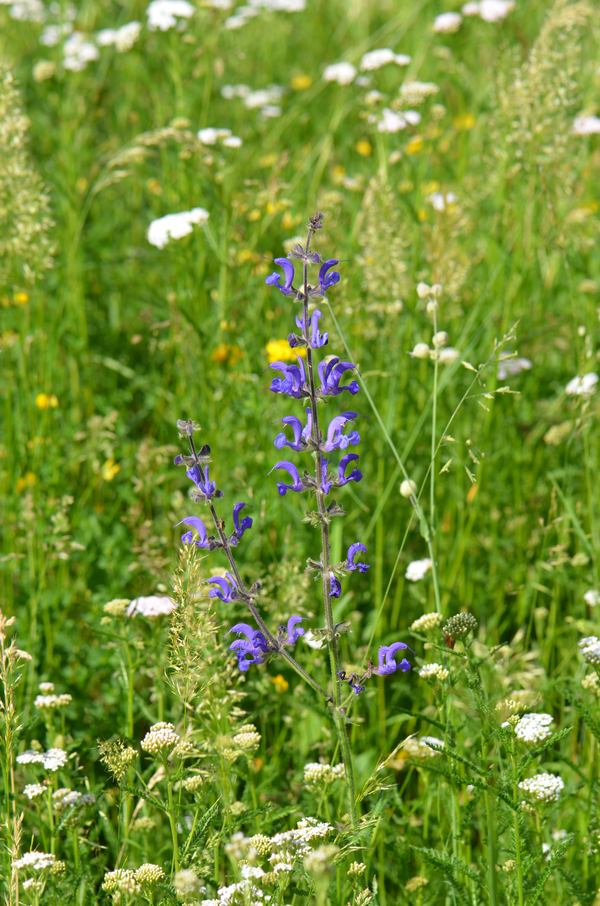
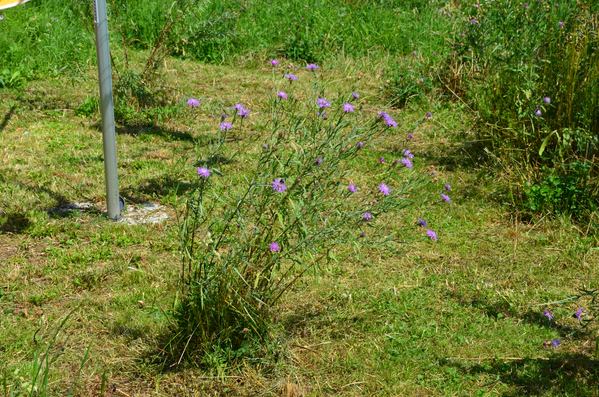
    Meadow clary in a flower meadow

    Meadow sage in a cultivated meadow

  • If you're afraid of scythes, you can use rotary mowers, flail mowers, or brush cutters. However, these come with issues of noise, weight, fuel, and vibrations. There are many types of mowers, but they must meet the requirement of cutting at a stubble height of at least 5 cm, which increases the chances of insect survival in general and speeds up sward regrowth. Rotary mowers with collection bags or even mulching mowers are not suitable. Furthermore, mulching inappropriately increases nutrient levels in the soil and favours grasses at the expense of flowering species.
  • We recommend drying the cut area to make hay and then raking it. Your garden will be enriched with a new sensation, which is the forgotten scent of hay. During the hay drying process, animals have the opportunity to move to the uncut areas, many seeds can also ripen, and the mowing protects the cut area from unnecessary drying out.
  • You must always remove hay from the meadow, it is best to offer it to a breeder, larger quantities possibly to hunting associations, it can be used for mulching shrubs and trees, or in the worst case, composted. Burning hay should be forbidden, just like grass, as hay is also home to a number of insects.
Insect-friendly stage grass

Stage cuts can be used to create paths, patterns, and the garden can be changed according to your mood.
Mulching

  • It involves cutting and mulching and returning the material back into the turf.
  • This method is not suitable for maintaining a flower meadow.
  • When establishing a meadow, the cut and mulched material prevents the further germination and establishment of small plants. It is also always necessary to realise that the cut material contains nutrients which will leach into the soil, gradually leading to a loss of diversity in the vegetation.

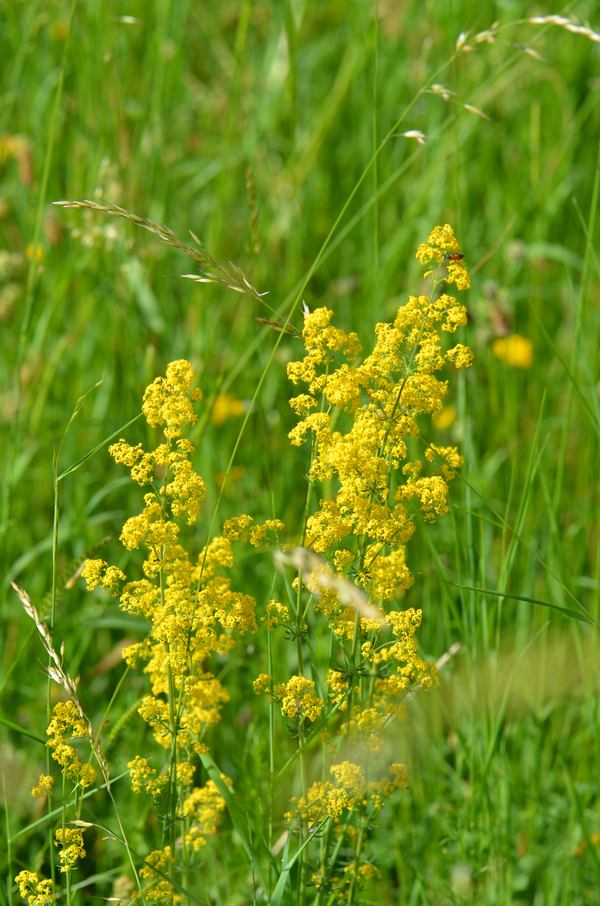
Lady's bedstraw

Further care

  • Nic – man, stop for a moment, look and marvel at the work you have established and which nature itself will complete….
  • But you can, however... bend down and look at the meadow from an insect's perspective. Perhaps the meadow itself will be the reason you buy a macro lens 🙂
  • When you tell your neighbours about your amazing „lawn“ and boast about your meadow flower patch, you, along with your garden, are giving nature more chances to survive us humans than X dedicated insect breeders in their little houses – whether they're bumblebees or others :)…

A flower meadow as insect pasture

.

Expert recommendations

The text is reproduced by kind permission of Planta naturalis from their website

How to solve the weedy stage in the development of a flower meadow

  • It should be noted that Covering the soil with fast-growing annual weeds from the soil seed bank is not detrimental to meadow development.. On the contrary, this natural ground cover maintains a humid microclimate that promotes the germination of meadow plant seeds. Even areas heavily infested with annual and winter weeds (e.g. goosefoot, chamomile, prickly oat-grass) allow for meadow development. Of course, these weeds need to be cut during flowering, about 5 cm above the ground, and removed from the area so that the emerging plants have enough light to grow. The phases of weeds and mowing alternate during establishment, and thus individual meadow plant species gradually emerge.
  • For the further good development of the meadow, only certain perennial weeds are truly unfavourable. Among the most persistent are broad-leaved sorrels, which remain in the meadow and negatively affect the appearance of the growth. Fighting them is time-consuming and usually involves eliminating each plant individually. Creeping couch grass and spear thistle are less difficult perennial weeds that gradually disappear from the meadow. These weeds can be suppressed by more frequent mowing. We must not forget to mention white clover here, which is not usually classified as a weed. This plant is highly expansive and can quickly take over space in newly established meadows. Its removal from the growth is almost impossible.
  • The first year after sowing is the most difficult stage of establishing a wildflower meadow. Many gardeners are surprised by this weed growth, even disgusted. This is due to fears of ridicule from their neighbours about what they are growing in their garden. The solution can be more frequent mowing of the weeds, which looks tidier when cut close to the ground.
Common cockscomb meadow meadow meadow

Meadow foxtail in an established meadow, third year since sowing
 Sowing term, watering sown areas

  • It is a frequently discussed topic. It is not possible to recommend a single universally suitable term for sowing a flower meadow. It will always depend on rainfall after sowing. Spring, from April to June, appears to be the most suitable under normal soil conditions. At that time, the seeds will benefit from winter moisture, rising temperatures, and will likely also be watered by the Medard showers. In dry areas and on very light soil, it is better to establish a meadow by sowing in autumn so that the seeds can utilise the winter moisture, which disappears quickly in spring.
  • To speed up germination in garden conditions by watering would likely require high-quality, continuous misting that mimics natural rain. One-off waterings are not very effective and tend to wash away seeds and create a crust.
  • For plants grown as „Natural“ is not a suitable dressing. For from the very beginning, the site must shape the vegetation with its conditions.
  • On small areas, germination can be encouraged by laying a fleece cloche. This will help retain moisture and warmth, and will improve and accelerate seed germination.
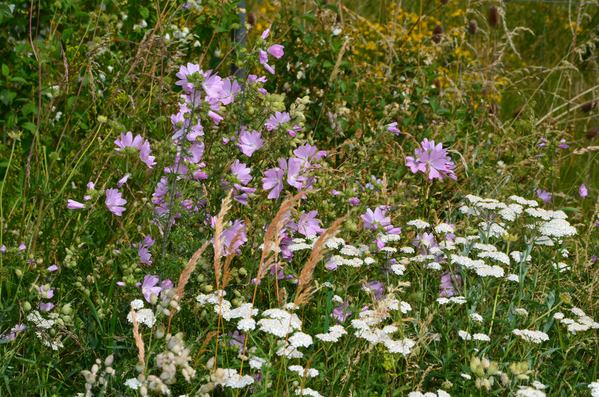
Wildflower meadow mallow and yarrow

The mallow and yarrow flowers will dress the meadow in pastel colours.
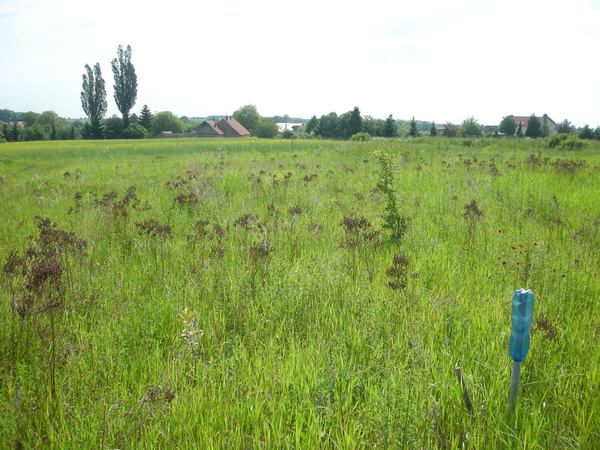
Photographic documentation of the establishment of a wildflower meadow

For a better idea, the following photo series shows the transformation of a once unkempt grassy area into a flower meadow.

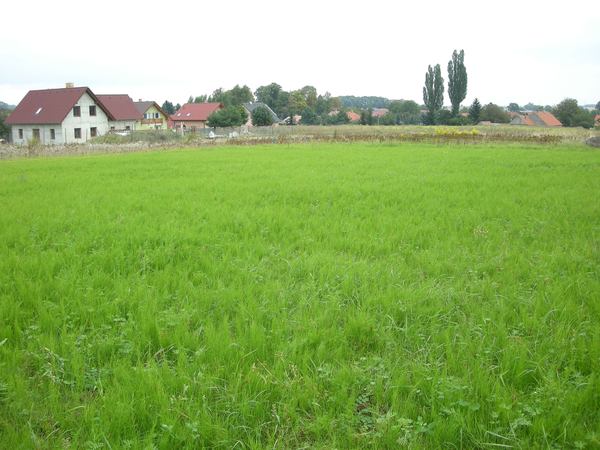
Original condition before establishing the meadow

Original state – only grasses and St John's wort prevail, with the local species orange hawkweed in places. This was transplanted to a disposal site and then returned to the meadow.
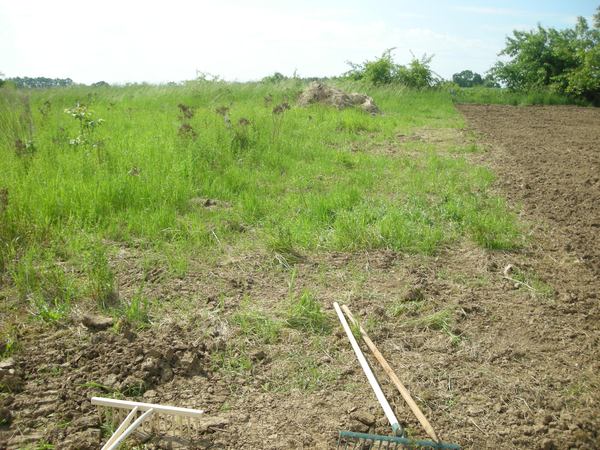
Old and newly established meadow
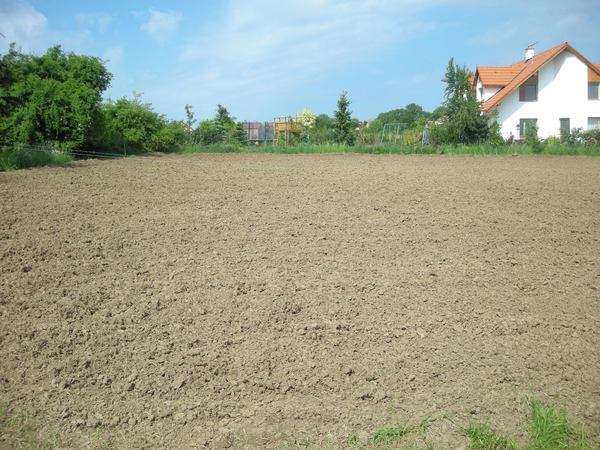
Old and newly established meadow

Seedbed preparation

Preparing the ground for sowing

Newly cultivated meadow

The apple tree in September after spring planting. It looks like a field of horsetail.
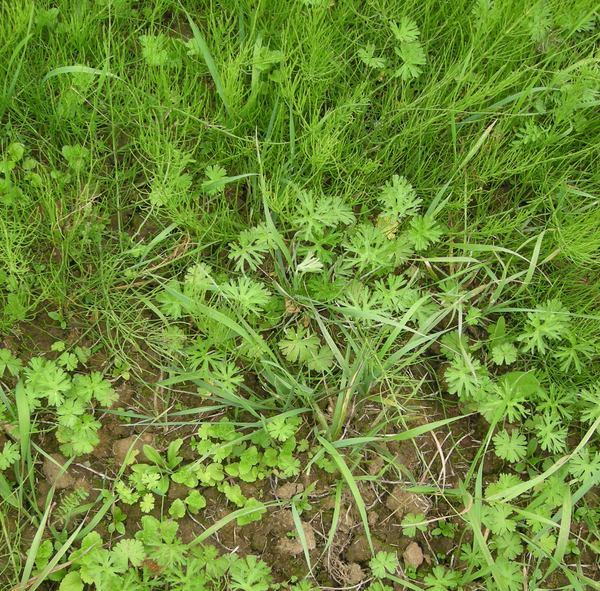
August in September after spring sowing

A detailed look at an established meadow six months after sowing (September)
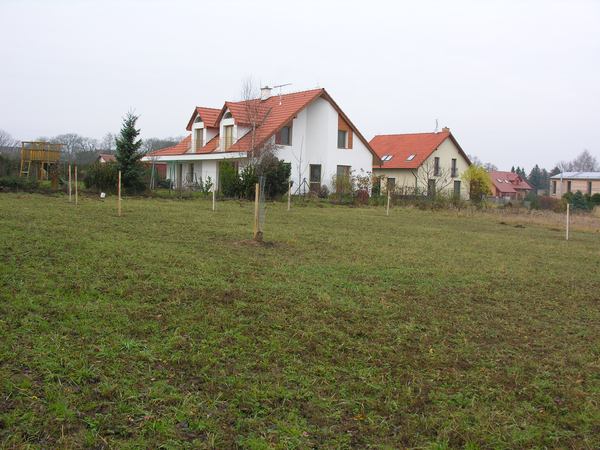
Autumn after the first cut
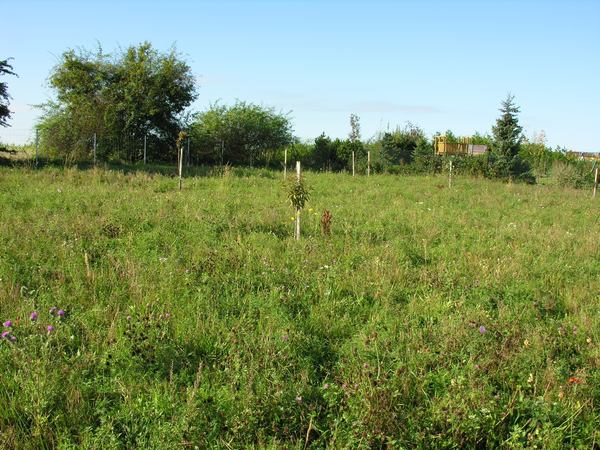
Autumn after the first cut

Tender shoot from June, one year after planting

In June, in the year following planting, the weed stage still predominates.
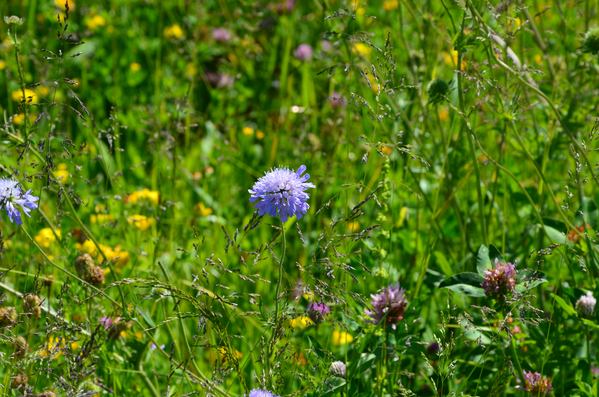
The winery in its second year since establishment

The forest is gradually formed and changes according to the conditions of the place.
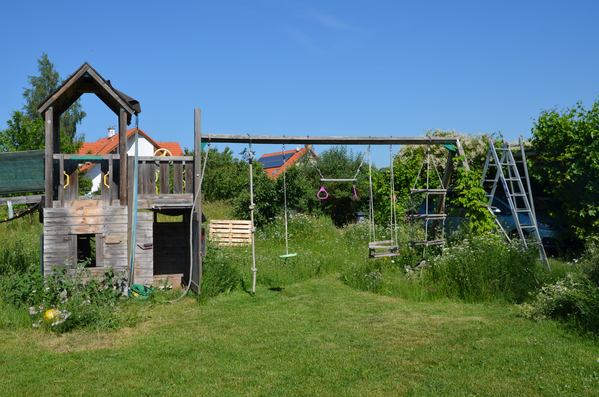
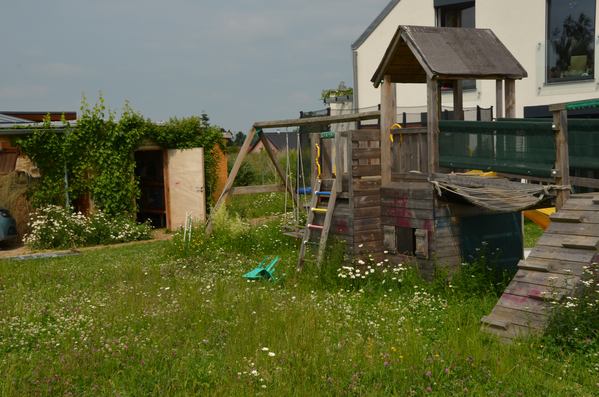
Transition between a cultivated meadow and a play area
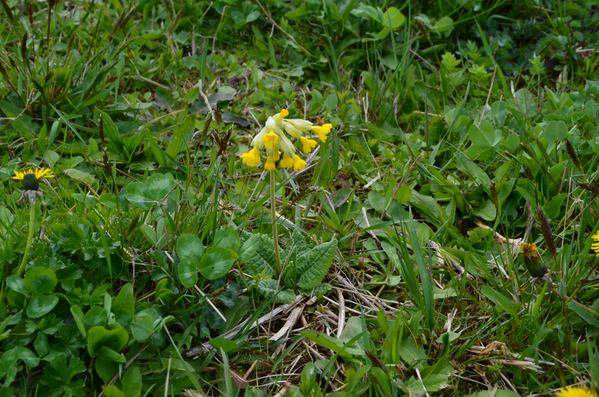
Transition between a cultivated meadow and a play area

Room during the year

The already established meadow over the course of the year.

Early spring

April in the meadow

May's loan

early May

species distribution according to conditions

May a few weeks later
The conditions determine where things will grow.
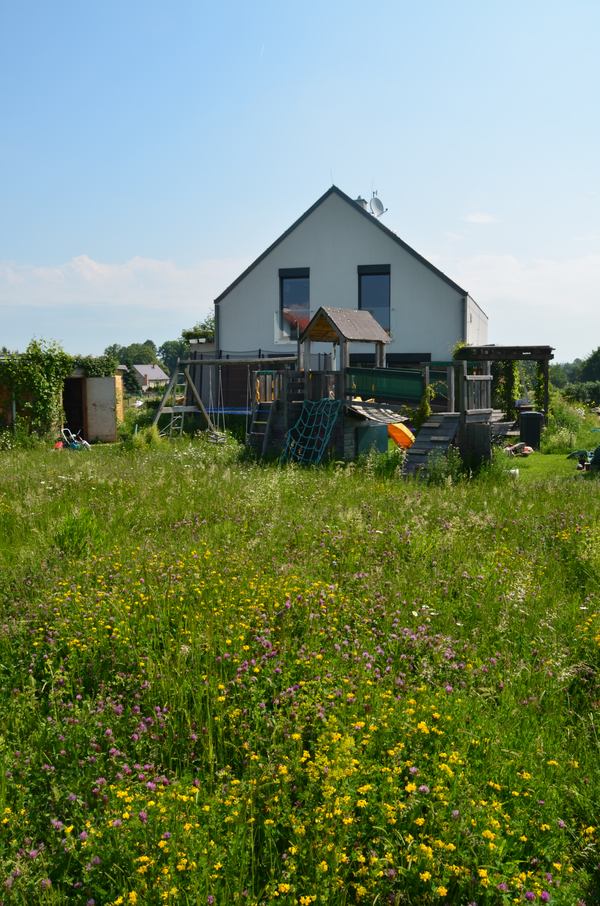
June before the daisies bloom
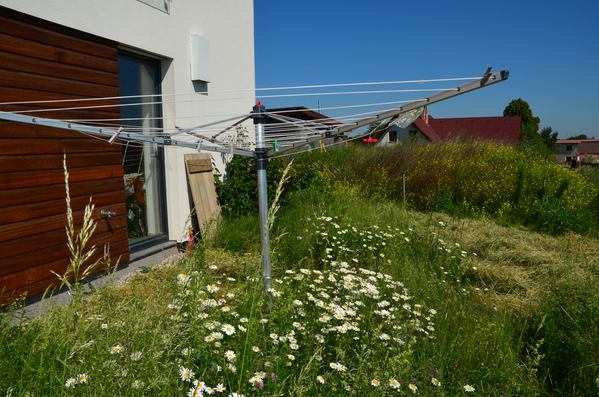
June before the daisies bloom

first cut June
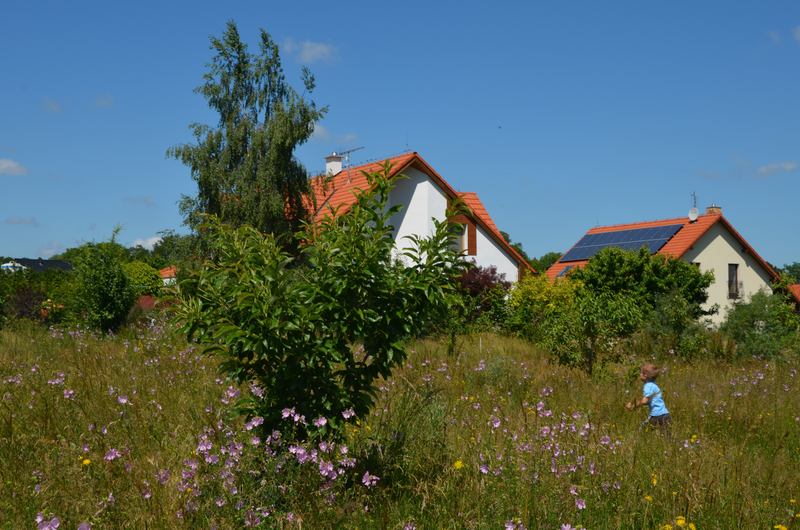
first cut June

Unmown areas during July

unharvested areas during July

Meadow in autumn after the scythe

mid-September after the autumn aftermath (second cut)
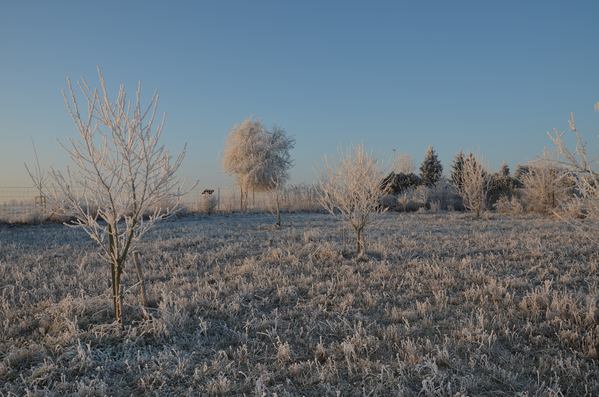
when winter casts its spell

when winter casts its spell