
Project blog
WE ARE PREPARING
What you will learn here
- How the project started
- What are his goals?
- What was achieved?
- What's new
- What are we planning?
Last updated: 28/11/2023
About the project – Introduction
How did it start?
The project to restore the cherry tree has two sources: emotional and work. They are difficult to separate from each other, but rather merge into one stream that has directed effort and time into the cherry tree.
I have long perceived the area as a beautiful, changing landscape and a reminder of family and local stories. Then the cherry tree became one of the main sources of spring pasture for my bee colonies. At the same time, over time, I gained practical and professional work experience in the field of nature conservation, which I wanted to use in some way in the place where I live and work. I managed to get the owner’s approval for the idea of restoring the orchard – the Research Institute of Animal Production vvi – and successfully submitted an application for a two-year grant to the Prague City Hall from the “Programme to Support Projects to Improve the Environmental Condition of the City of Prague for 2022”
In Třešňovka, various opportunities and experiences were connected, such as education in landscape ecology, work focus on nature conservation, beekeeping and gardening. The implementation of activities was supported by experienced and tenacious workers, helpful experts, persistent volunteers and patient members of the extended family.
Project objectives
The occurrence of the Cherry Beetle (Anthaxia candens) in the locality is documented by the survey "Faunal study of dominant beetle families in selected traditional orchards in Prague" (Horák J., Boža P., Koloničný L. & Pavlíček J., 2020). According to the Red List of Threatened Species of the Czech Republic, it is classified as endangered. The Cherry Beetle was therefore chosen as a flagship species for the purposes of this project, because other species of saproxylic insects (perhaps not as beautiful and interesting) are also associated with similar habitats
Note
Saproxylic insects, whose lives are tied to dead wood, constitute a highly endangered group of our fauna. These include, for example, our largest beetle, the common stag beetle, a number of beautiful beetles and beetles, but also small scorpions and many dipterans and hymenopterans.
The project focuses on the effective support of suitable habitats for the cherry beetle, along with other management measures that also aim to support other insect species associated with grassland communities and increase biodiversity in the agricultural landscape in general.
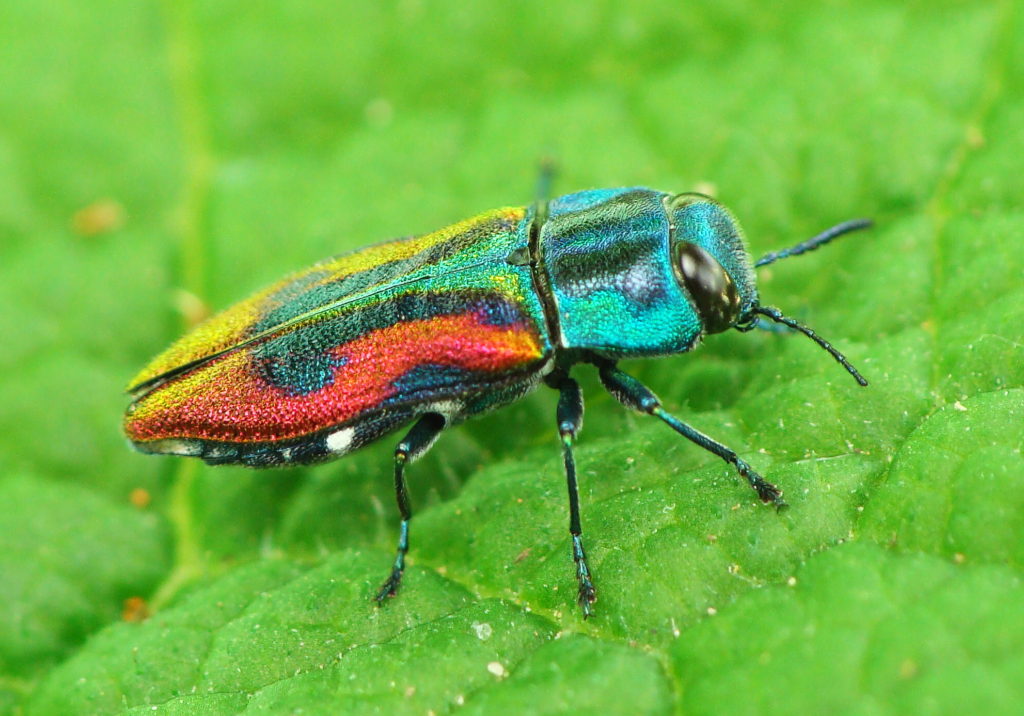
Bumblebees PLUS – Cherry Blossom (Anthaxia candens)
Photo: I. Antušek
.
Project plans (for 2024…?)
The continuation of the plan should focus on maintaining the measures taken. It will certainly be necessary to reduce the number of shoots of the cut bushes and overgrowths (rosehip, ash). The planted cherries also deserve care, they will need to be watered and shaped. It would be appropriate to arrange for the grafting of old varieties. For this professional task, we are already negotiating cooperation with a specialized workplace. We also want to focus on the grass and herbaceous vegetation in the orchard. Plan appropriate methods and dates with regard to the species composition and forage value. We will consider and discuss the possibility of grazing, with all the benefits and complications that the establishment and operation of grazing entails. Fortunately, we have someone to turn to and where to draw good ideas. An entomological survey focused directly on bumblebees or species tied to rotting wood would also be a suitable outcome.
The project and its surroundings…
The project is set in an interesting environment. See for yourself, it's quite important for understanding the context.
.
About Uhříněves
Uhříněves (German: Aurschinewes) is an urban district and cadastral area with an area of 1027.1 ha, forming most of the territory of the Prague district of Prague 22. Since 1866, Uhříněves was a township, and in the years 1913–1974 a city.
The history of Uhříněves dates back to the 13th century. The oldest records date from around 1227, when it appears in a list of localities under the name Vgrinewez. Another mention is in a document from 1228, when Uhříněves is registered as the property of the St. George Monastery at Prague Castle. At that time, it is written about as Ugrina ves. It probably got its name from its founder, a certain Ugrim, who settled here and founded a settlement.
In 1622, Prince Charles I (1569–1627) of Liechtenstein bought the Uhřiněves estate (German: Auřinowes) in the post-White Mountain confiscation. In 1850, a village in the Říčany district, In 1869–1890, a village in the Český Brod district. In 1898, still a large estate in the possession of the Liechtenstein family. In 1900–1910, a village in the Žižkov district. In 1921–1950, a village in the Říčany district. In 1961–1970, a village in the Prague-East district. In 1992, a city district of Prague 10.
The greatest development of Uhříněves occurred in the 19th century. The village became a town in 1866. Agriculture and industry developed. A steam mill was built in 1850, a local brickyard in 1866, and a local sugar factory in 1868. Thanks to the construction of the Prague - České Budějovice railway line, which was built in 1870, Uhříněves was connected to the surrounding area. Thanks to the influx of population into the village, new houses, stately villas, and, for example, a new school were built. At that time, Uhříněves had approximately 2,600 inhabitants. Cultural and social life and sports were also developing. New associations and societies were established. In 1913, the town of Uhříněves was promoted to a city, and a year later the city emblem, designed by academic painter Jindřich Bubeníček, was approved, which is still used today as the emblem of the Prague 22 district.
In 1920, as part of the land reform, the nationalized farm of Uhříněves and Netluky with the Podlesk mill was leased as a school yard for the agricultural department of the Czech Technical University in Prague, and was purchased by the Ministry of Education and Education in 1923. The UHŘÍNĚVES II Agricultural School Plant continued to be managed by the Ministry of Education and Education as a state enterprise.
At about 9 a.m. on April 25, 1945, American fighter planes, known as "deep fighters," attacked a column of German refugees on Friendship Street, between the sugar factory and the Anti-Fascist Fighters Square. The number of casualties is unknown. Two local residents were also killed and two were wounded.
After February 1948, the Agricultural School, where the Ministry of Agriculture organized training courses for cooperative members of the JZD, also underwent changes. In 1953, the Animal Production Research Institute (now the Uhříněves farm) was relocated here.
You can read more HERE on Wiki, or on the official website of Prague 22 HERE .
Uhříněvés is not just a city district. There are many interesting places with pristine and protected nature in its surroundings. You can read about it, for example HERE

Prague 22 – Uhříněves
About the village of Netluky
Netluky is a small, mainly agricultural settlement in the Prague district of Uhříněves. It is located on a flat ridge between Rokytka and Říčanka, by the road leading from the eastern part of Uhříněves to Hájek, Koloděje and Běchovice.
In 1386, a village was mentioned here under the name Pnětluky. The name is probably derived from the woodcutting activity, i.e. cutting down tree stumps.
At the beginning of the 16th century, they belonged to the Dubeč estate. In 1639, the village was plundered by Swedish troops and was never restored. In 1667, it was annexed to Uhříněves.
During the 17th century or early 18th century, the Lichtensteins founded a Baroque farmstead on the site of the original village. The oldest known depiction of the farmstead and its surroundings is on a map by AB Klausner from 1715–1718. The farmstead was rebuilt into its present form around the middle of the 18th century, with no further changes to the layout. The farmstead is dominated by a former distillery with a factory chimney. At the beginning of the 20th century, a small settlement was established again near the farmstead.
According to 19th-century maps, Netluky was located on the road to Dubče, which ran along the western side of the yard; today's road around the eastern side of the yard to Hájek did not yet exist, although a network of field roads crisscrossed the landscape. North of the yard were a pair of ponds - the larger, eastern one was demolished.
Until 1918, the Liechtenstein family owned the area within the former Uhříněves estate, from which it passed into state ownership. In 1920, the Uhříněves and Netluky estates and the mill in Podlesk were leased to the University of Agriculture at the Prague Technical University for twenty years, but on February 21, 1923, the school bought the estate from the state. The area was used for student internships.
The distillery was built in 1935 as part of the school farm of the University of Agricultural and Forestry Engineering, thanks to a generous donation from the Agricultural Distillery Cooperative. The construction of the distillery had been advocated by Professor Antonín Nýdrle since 1920, but it was hindered by the provisions of the Alcohol Act of 1919, which prohibited the establishment of new agricultural distilleries in beet-growing regions; the new Alcohol Act of 1932 relaxed this condition. The distillery was designed by the Agricultural Unity Construction Institute under the leadership of Prof. Dr. Theodor Petřík.
A field airfield was activated here in September 1938. From September 14 to October 5, Field Squadron 42 was based there.
In 1953, the farmyard area was transferred to the Animal Production Research Institute, which also built a complex of new buildings south of the original farmyard.
Read more about the village HERE
The locality is greatly benefited by the presence of the equestrian club JK VÚŽV UHŘÍNĚVES and pastures for horses. The equestrian club of the Research Institute of Animal Production in Uhříněves was founded in a new form around 1976. However, it was connected to the previous Linstenstějný farm and the University of Agriculture, see above.
Where there are horses, there is clover, where there is clover, there are bumblebees. That equation works pretty reliably.
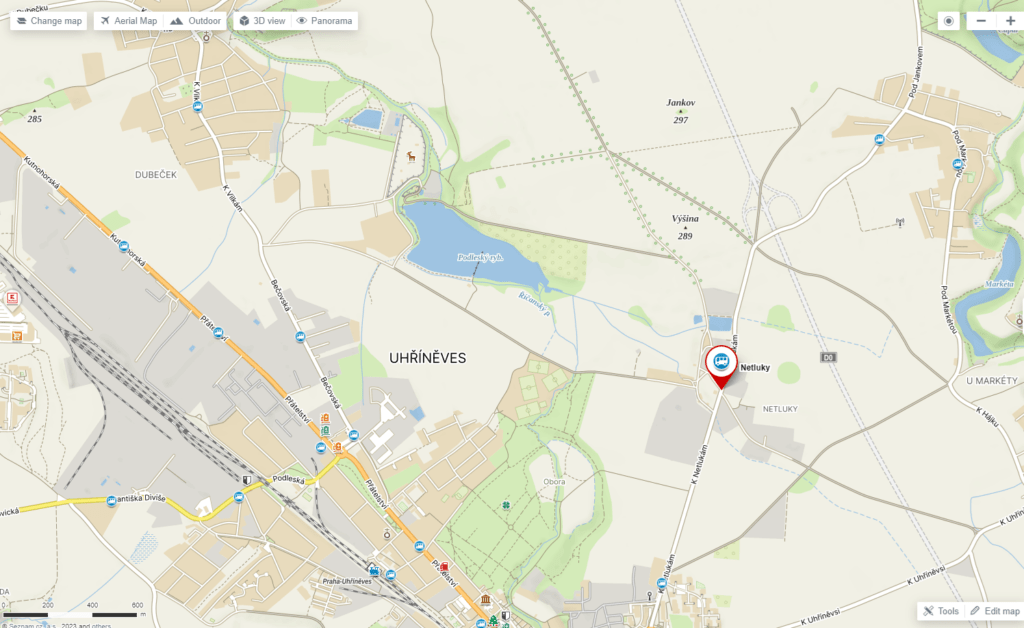
Netluky
Source: Maps CZ
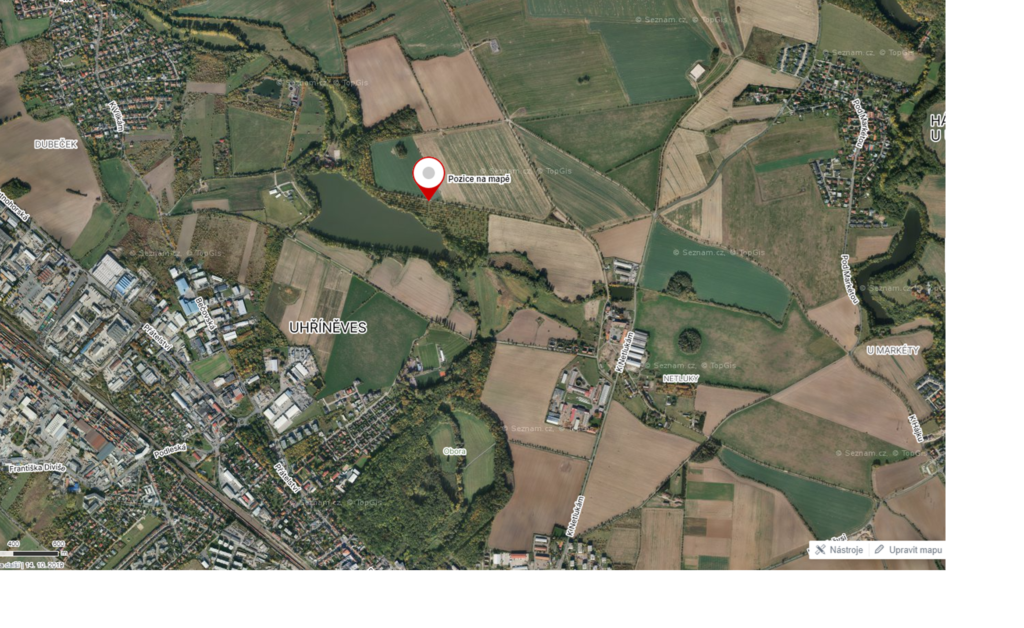
Cherry tree Netluky
History of the cherry tree in Netluky
It's always interesting to look back at history and see how it changed over time. The website Dvě Prahy is a good place to do this, for example. There you can look at maps and aerial photographs.
In our case, you can see that the cherry tree hasn't changed much. It just started to grow when it stopped being planted. It also didn't help that it was freely accessible. Not all visitors treat it well. There was originally a fence here, but that disappeared over time..
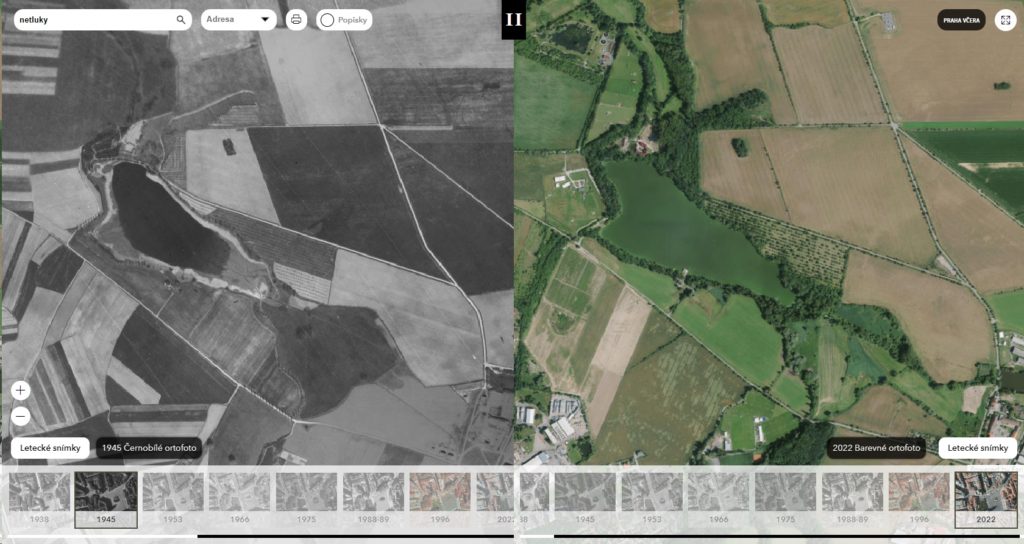
Třesňovka Netluky – Source of Two Prague
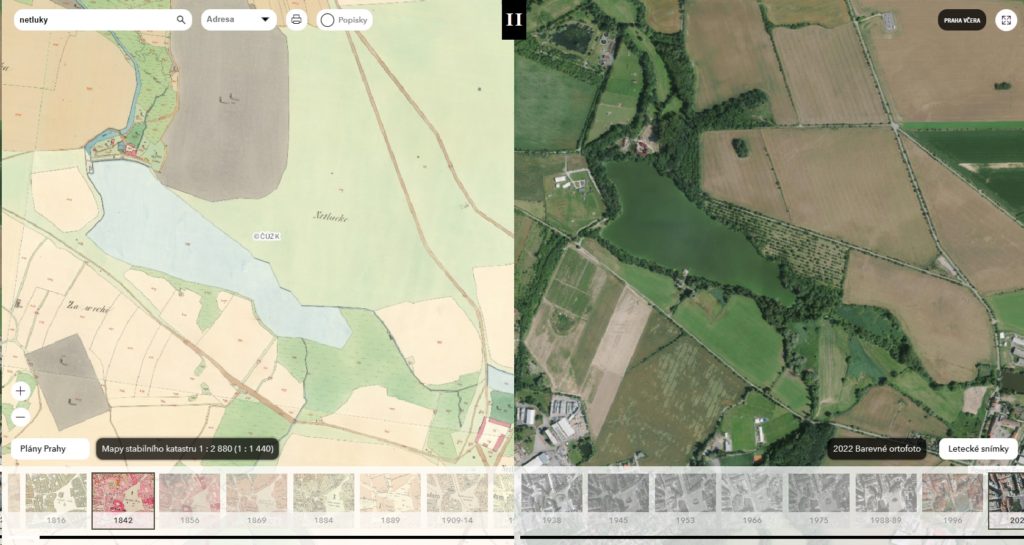
Třesňovka Netluky – Source of Two Prague
.
Check out the cherry tree from a bird's/drone's perspective - by Vikitan
About cherry blossom (Anthaxia candens)
The cherry beetle (Anthaxia candens Panzer, 1787) is a striking, brightly colored beetle of the genus Anthaxia with pronounced sexual dimorphism.
Description
This is a beetle whose coloring is one of the most beautiful among beetles in Czech nature. The body size of the beetle is approximately 7-12 mm.
In his key, Bílý describes the appearance of Anthaxia candens as follows[2]: The corymbs are red with a black saddle-shaped spot on the seam; in the front part of this spot there is a blue-green triangular field occupying only the area around the scutellum; the structure of the scutellum is formed by oval eyes with large central grains at its lateral edges; in the middle of the scutellum this structure passes into a network of transverse fine wrinkles curved backwards; between these wrinkles there are fine dots; the head and lateral edges of the scutellum are blue, the middle of the scutellum and the triangular field near the scutellum are greenish-blue, the saddle-shaped spot on the red corymbs and two spots on the scutellum are black.
Occurrence
It can be found in locations ranging from eastern Spain through France, Italy, Switzerland and Central Europe towards Ukraine and the Balkans, outside of Greece.
In the Czech Republic, its number has been decreasing noticeably in recent years, especially in Bohemia, but it is common in warmer areas of Central and South Moravia.
In Bohemia, it is more abundant in the vicinity of Prague, in the Pardubice and Hradec Králové regions, in South Bohemia, for example, in the Křemžská basin, around the Husinec dam and in the Netolice region.
Biology
- Larva
Larvae most often develop in the bark of sour cherries (Prunus cerasus) and sweet cherries (Prunus avium)[3], entomologists often also report larval development in blackthorn (Prunus spinosa) or mahaleb (Prunus mahaleb)[4][5] and less often in the bark of other fruit trees. The habitat of Antaxia candens is old, unmanaged cherry orchards, alleys and solitary trunks. It prefers sunny parts of trees. Larvae pupate in August and adults overwinter in pupal cradles, which they leave at the end of April and beginning of May. They are active on cherry and hawthorn flowers. The larval development period is most often two years. - Adults
Adults of Anthaxia candens are usually found from May to June. Most often in steppe-like habitats with sufficiently old trees. They are often seen on food plants, which they also use for laying eggs. A common food plant is old solitary cherries (Prunus avium), which are well-sunny for most of the day; they can also be found in cherry orchards. Other food plants, as well as those of the larvae, include the sweet cherry (Prunus cerasus), the Turkish cherry (Prunus mahaleb) and the common apricot (Prunus armeniaca). Adults lay eggs under the bark of trunks or stronger branches, and larval development takes about 2 years. Since the larvae pupate at the end of summer and subsequently hatch into adults, which hibernate under the bark of the tree, adults can also be found during the winter.
Presence detection
Oval exit holes in trunks and branches of old cherry trees. The exit hole is oval 3.8 – 5.2 mm wide, 2.4 – 3.3 mm high, 4.4 x 2.7 mm in diameter. It differs from other species of the genus Anthaxia in that it is slightly larger, it occurs together with the glossy thorn – A. nitidula, in which the exit hole is 3.2 – 3.8 mm wide and 1.9 – 2.6 mm high, 3.5 x 2.25 mm in diameter. The exit holes are on the sunny south side.[3]
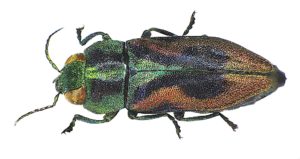
Cherry blossom (Anthaxia candens)
Photo: Wiki
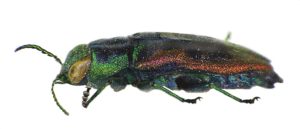
Cherry blossom (Anthaxia candens)
Photo: Wiki
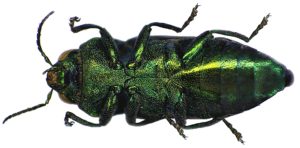
Cherry blossom (Anthaxia candens)
Photo: Wiki
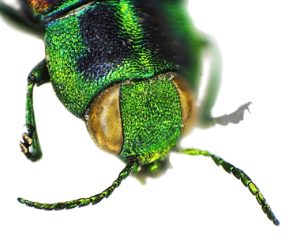
Cherry blossom (Anthaxia candens)
Photo: Wiki
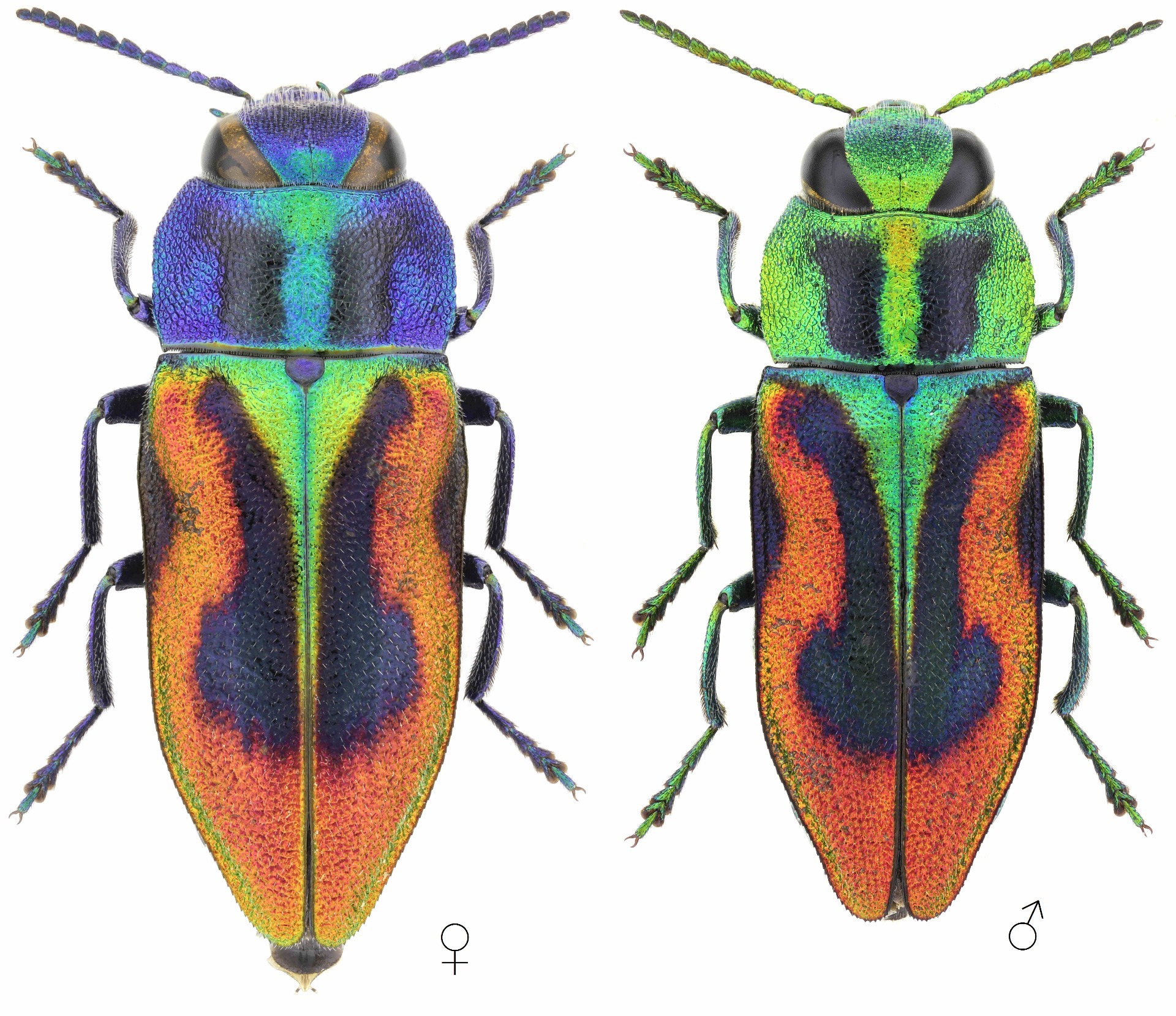
Cherry anthracnose (Anthaxia candens)
Photo: Anthracnose of Prague
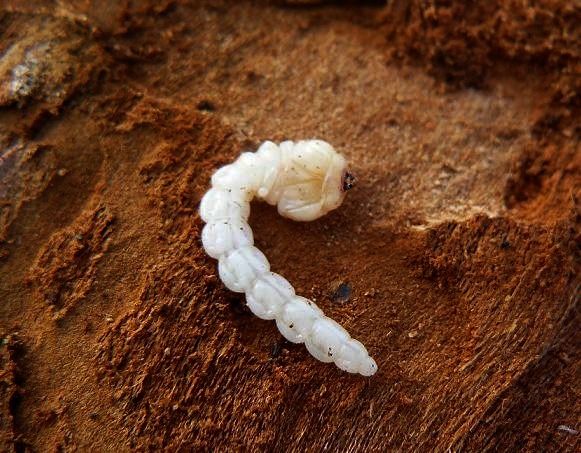
Cherry moth (Anthaxia candens) – larva
Photo: O.
Machač
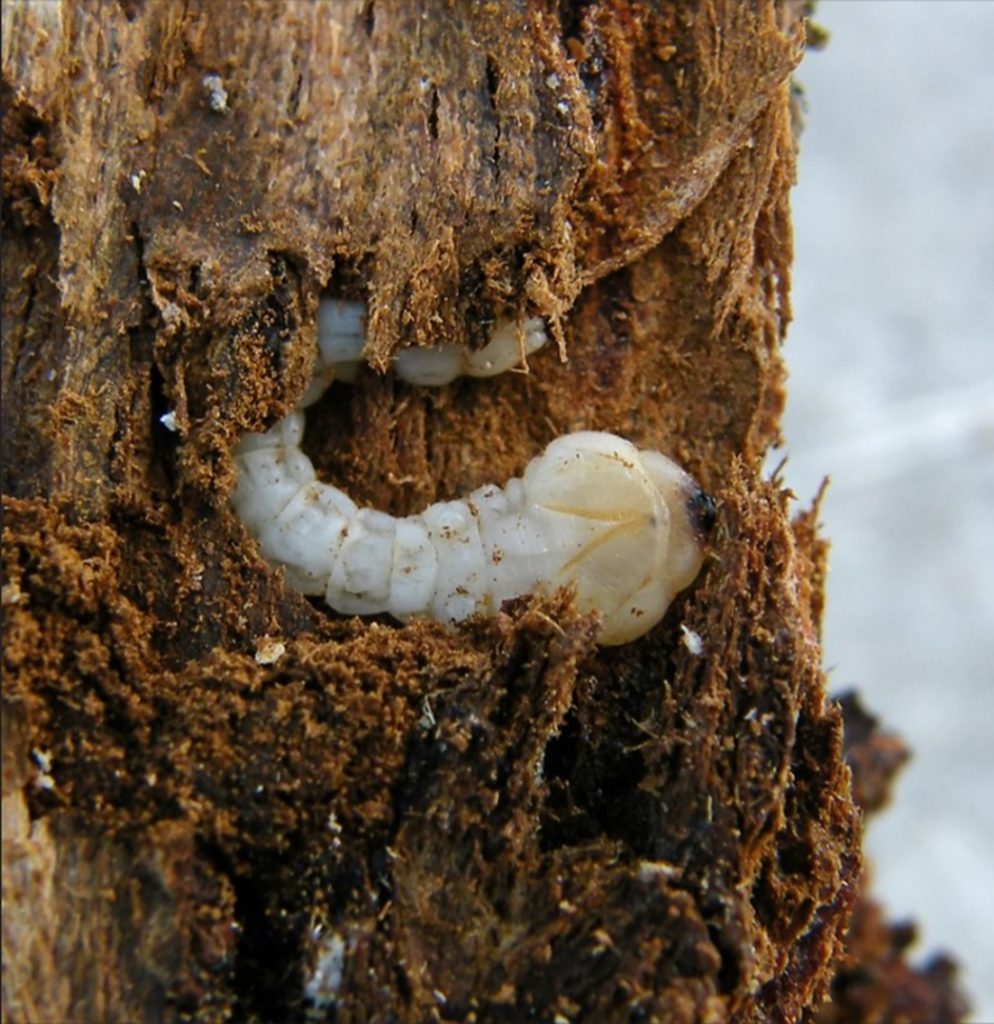
Cherry moth (Anthaxia candens) – Larva
Photo: D. Balogh
More information about the cherry blossom (Anthaxia candens)
Project plans
<JANA>
Land map
The land is owned by the Animal Husbandry Research Institute vvi. The entity's website can be found here https://vuzv.cz/
With his kind permission and approval, the project was.
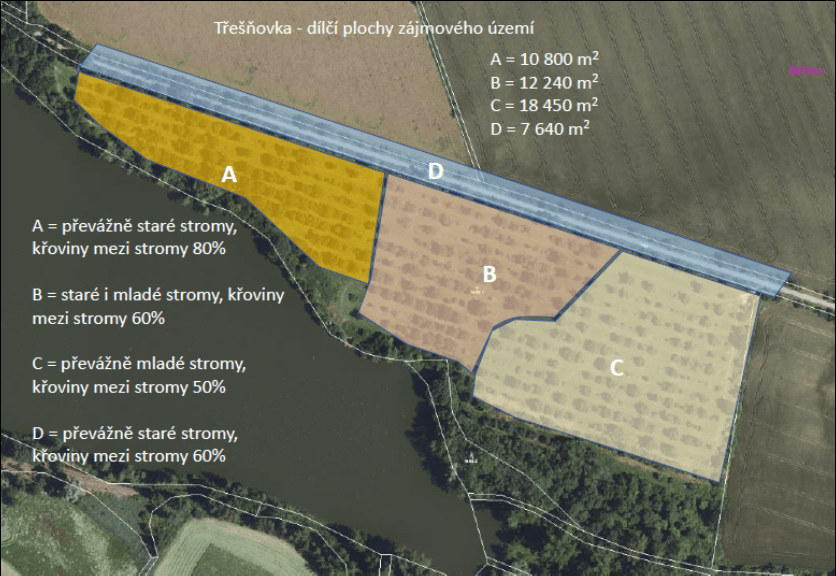
Cherry tree map
Photo: M. Lípa
Land survey at
One of the important steps of the project was the survey and identification of the varieties that occur on the land.
Here is a small quote from the survey, as proof of how diverse this area is:
Early varieties are complementary here and are mostly cockscombs. Semi-cartilaginous varieties are represented only by Lyons. Těchlovická is at the transition between early and late varieties.
Varieties that are less represented in open field plantings today include:
- Anonay
- Francis's
- Early Coburg
- Lyon Early
- German express
- Techlovická
- Big black cartilage
- Vitovka Molitorovská
If there is not enough space available for the complete propagation of all present varieties, I recommend planting at least 2-3 trees of these varieties. Due to the relatively short lifespan of cherries, these varieties are more at risk of extinction than the remaining ones from the mapped assortment.
Varieties:
- Hedelfingen
- Karešova
- Chestnut
- Napoleon's
- Bathtub
Further information
<JANA>
How did Čmeláci PLUS get involved in the project?
In Prague's Uhříněves - next to the Podleský Pond in Netuklá, there is a beautiful old cherry tree and a wonderful beetle - the cherry beetle (Anthaxia candens) - thrives in it.
It is a real beauty, but unfortunately it is very rare in our country, so it is becoming increasingly rare to meet it. It needs old cherry wood for its life, in which its larvae develop, and there are fewer and fewer such places.
There are many reasons, but unsurprisingly, many are caused by humans.
The current method of intensive fruit growing is more interested in the young, low trunks of modern fruit trees. As soon as they stop producing a sufficient harvest, they are immediately replaced with new ones.
Farmers are not interested in old trees and old varieties. Old trees produce little and need more care. In addition, old varieties of fruit trees form high crowns and it is more difficult to harvest the fruit there. Therefore, today's production orchards are mostly just tree stumps from which fruit is harvested..
Fruit growers are primarily interested in profit in order to succeed in the competition - yes, they have a hard time, but is nature to blame for all this? That is why they are not even interested in the important effect of large crowns of fruit trees, which create partial shade and prevent the soil beneath them from drying out, etc. In addition, honey plants grow in partial shade, which are loved by the sweet tongues of insects - not only bumblebees.
Fortunately, there are still orchards with old trees and people who take care of them. There are few of them, but meeting them is always like a balm for the soul.
One such place is a beautiful old cherry tree. The kind-hearted Mrs. Jana, as well as the owner of the land, are dedicated to its preservation. We are amazed by their courage and will with which they have embarked on this, because there is and will be a lot of work to be done.
In Netlucká třešňovka, the striped bumblebee, a species that is on the verge of extinction in our country, has been present for a long time, but its condition has deteriorated significantly in the last 10 years, the last recorded occurrence was about 4-5 years ago, but another rare species, the humen bumblebee (Bombus ruderatus), still occurs here. It is therefore not excluded that both species still survive here, but their population is on the verge of extinction. By sowing suitable plants, we would like to help these local populations develop again.
That's why we met in Třešňovka on Saturday, November 4, 2023 , to discuss possibilities for cooperation. Not only so that the cherry krait can thrive here, but also so that rare species of bumblebees that used to occur there can return to this place.
The meeting was very pleasant, there is a lot of room for cooperation. If everything works out, we will start this year and if it works out even better... but let's not get ahead of ourselves, everything is just at the beginning.
We would be happy to involve your skilled and hardworking hands in the work of sowing melliferous plants that we are planning on the land. As soon as the green light comes on, we will get started - Čmeláci Plus, Jakub Černý and you too, if you are not afraid of work.
In the meantime, take a look at the photos from this beautiful place and mark your calendar for the end of November. You can see for yourself that it's worth a little sweat.
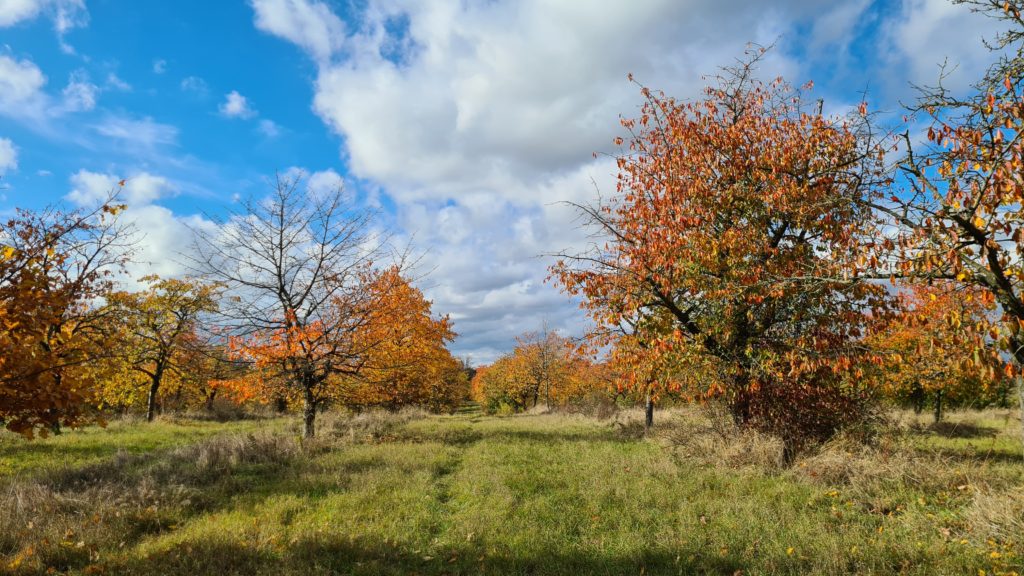
Cherry tree Uhříněves – Netluky
Photo: O. Hercog (4/11/2023)
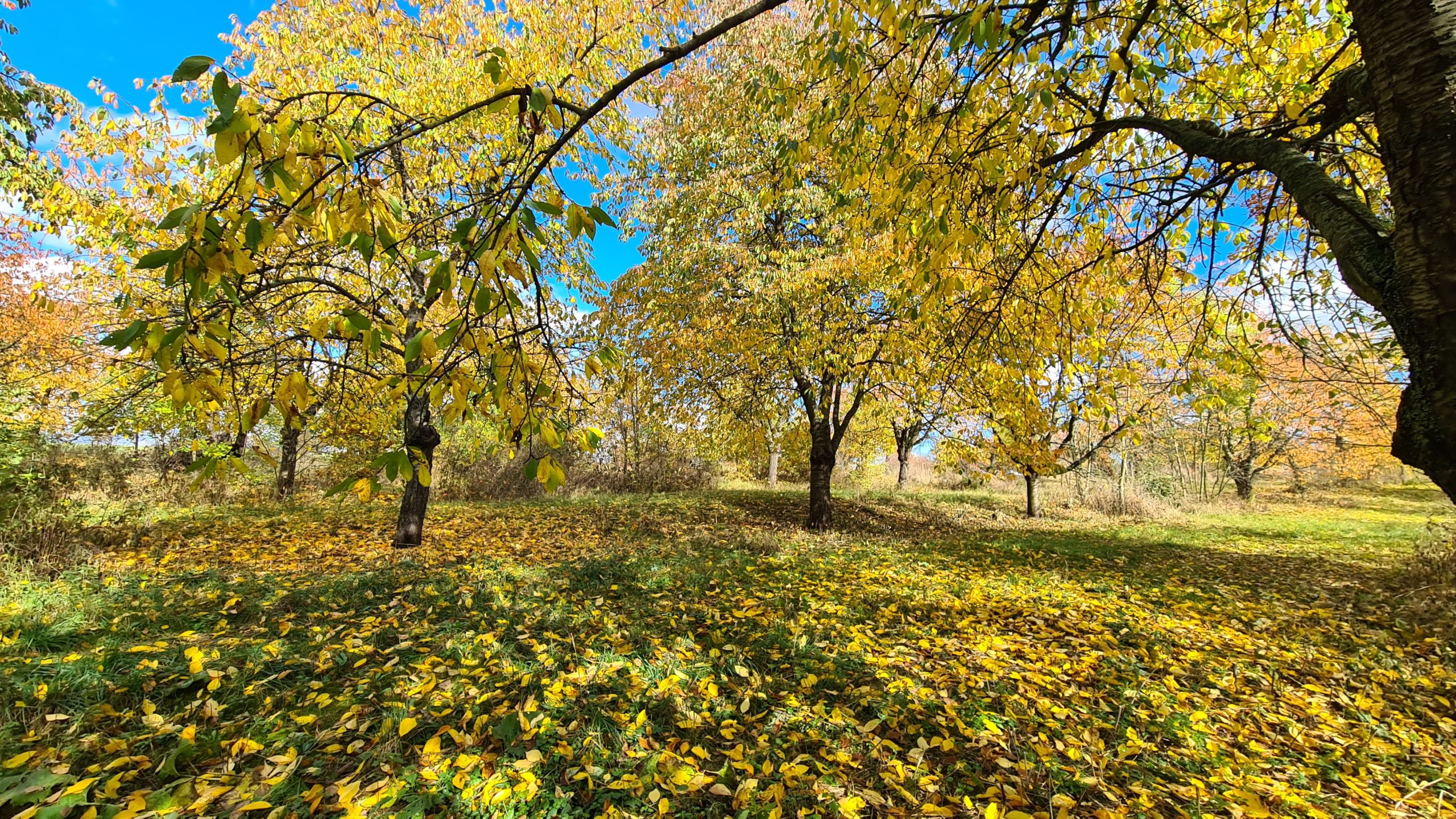
Cherry tree Uhříněves – Netluky
Photo: O. Hercog (4/11/2023)
One of the reasons why bumblebees thrive in the cherry orchard is the honeysuckle. Especially in the lower, wetter part, they thrive well. They even flower now in November. We also want to focus on the honeysuckle. Grass management will need to be adjusted because they do not like mulching, which suppresses them in some parts - for example, by the road on the border of the cherry orchard.
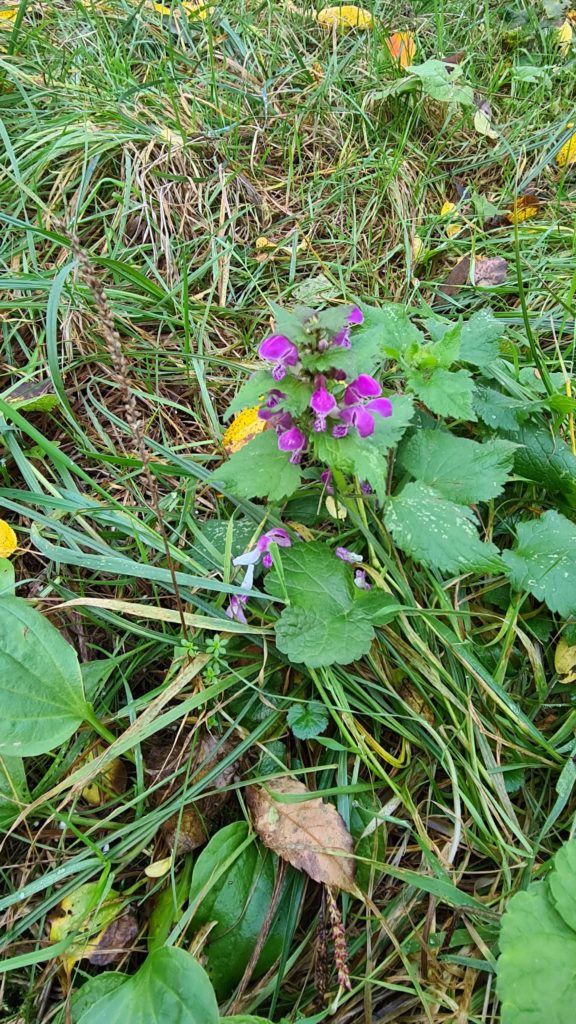
Cherry tree Uhříněves – Netluky – Spotted nightshade (Lamium maculatum)
Photo: O. Hercog (4/11/2023)
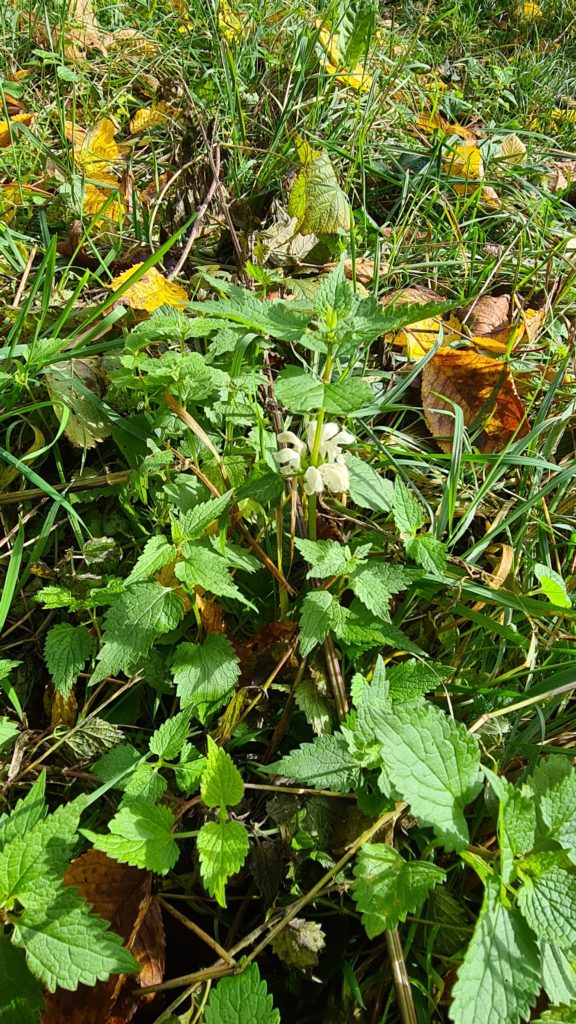
Cherry Blossom Uhříněves – Netluky – White Lamium (Lamium album)
Photo: O. Hercog (4/11/2023)
Be careful, the cherry tree sparrow lives here – do not disturb it!
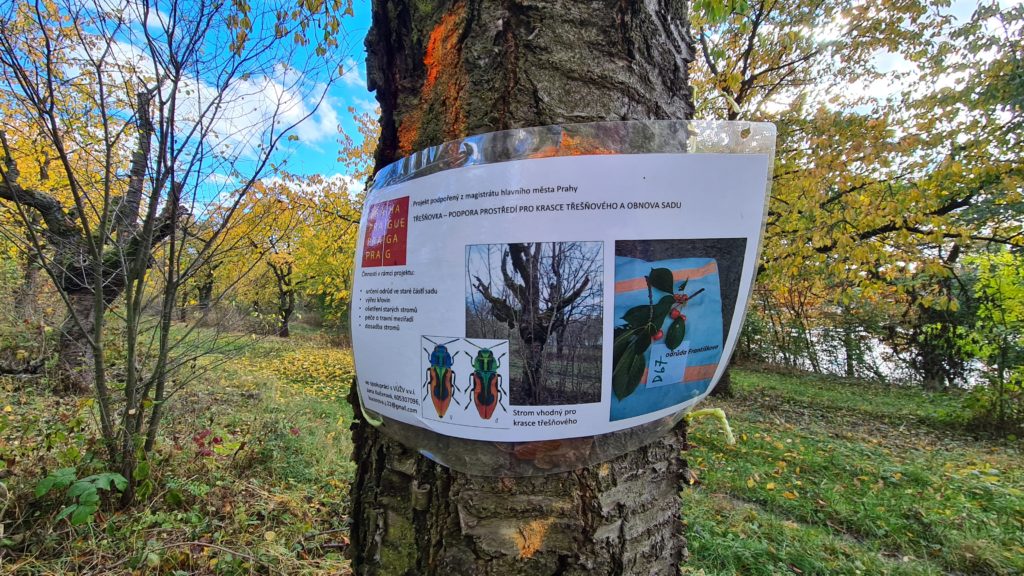
Cherry tree Uhříněves – Netluky
Photo: O. Hercog (19/11/2023)
.
Bumblebees that live, or will live again, in the cherry tree
Check out videos of bumblebees that have been found here, for example:
- Striped bumblebee (Bombus subterraneus)
- Humen bumblebee (Bomnus ruderatus)
or occur:
- Bumblebee (Bombus ruderaris)
- Wood bumblebee (Bombus sylvarum)
Jaromír Čížek, our friend and member of the Čmeláci PLUS zs association, has been monitoring this location for many years.
During that time, he observed the following species of bumblebees and wasps :
From the representatives of the genera Bombus and Psythirus (now also classified as Bombus):
- Striped bumblebee (Bombus subterraneus)
- Hume bumblebee (Bombus ruderatus)
- Wood bumblebee (Bombus sylvarum)
- Sand bumblebee (Bombus veteraneus)
- Eel bumblebee (Bombus ruderarius)
- Garden bumblebee (Bombus hortorum)
- Bumblebee (Bombus pratorum)
- Wood bumblebee (Bombus lucorum)
- Ground bumblebee (Bombus terrestris)
- Bombus agrillaceus
- Bombus rupestris (Bombus rupestris)
- Vestal bumblebee (Bombus vestalis)
- Wood bumblebee (Bombus sylvestris)
- Short-haired bumblebee (Bombus maxillosus)
A basic overview of bumblebee and wasp species in the Czech Republic can be found HERE
Čmeláci PLUS zs plans to participate in the project 2024-2026
The goal is to support Jana in the field of arboriculture, grass management and communication so that a diverse and sustainable biotope is created, suitable not only for the life of the cherry krait, but also for bumblebees. As well as for it to be a place for people and nature to meet.
Keep your fingers crossed, it will be a lot of work, but we are looking forward to it. We have references and experiences that we are happy to offer, see the project to support biodiversity of ČSOB in Prague Radlice
.
Ing. Jana Kučerová
She was born in Uhříněves, went to school and a scout group, and still enjoys living, working, spending her free time and cycling there. She studied landscape ecology and managed to gain experience in a wide range of nature conservation. She currently works as the head of the environmental department in the Prague 22 district.
In addition to Třešňovka, he is involved in beekeeping, gardening, and occasionally amateur theater.
.
Project team – Bumblebees PLUS
This is the main part of the project team. However, others are gradually joining the project..

Ondrej Hercog
Ing. Ondřej Hercog – Bumblebees PLUS zs.
He works in the field of IT and information security. He is actively involved in the protection and promotion of nature.
He was interested in nature from an early age. He was greatly influenced by his uncle, who was an inexhaustible well of answers to all things related to nature for him as a boy. This was followed by books by ET Seton, G. Durell and similar pieces, which he devoured and experienced. He often spent weekends and holidays in his uncle's huge garden - a garden full of flowers, insects and birds. It was almost the same adventures that the young Durell experienced. Then came hiking with the Neskenon Indian troop with elements of scouting and Woodcraft (League of Forest Wisdom).
Although he chose a technical education and job for his life, he is increasingly returning to nature, and bumblebees are one of those paths.
He is a founding member of the group and subsequently of the association Čmeláci PLUS zs, of which he is also the chairman. He actively promotes the activities of the association in the public and in the media.
Lives in Prague, Radlice
You can find the Čmeláci PLUS association at www.cmelaciplus.cz , on Facebook Čmeláci PLUS or on You Tube Čmeláci PLUS

Michal Plundra
Ing. Michal Plundra – Garden and landscape architect, lecturer of ecological educational programs.
Graduated as a gardener at the Secondary Vocational School of Horticulture in Mělník.
Agricultural University of Suchdol (horticulture and landscape design), also majoring in ecology.
Hobbies focused on nature, especially gardening, permaculture, herb gardening and education in these areas.
Design and implementation of gardens, dendrological surveys, arboriculture and landscape care, tutoring for other entities such as the Kokoza association (community gardens), the Tereza educational association (Eco-school, Globe program), the Vrátkov Eco-center. Reporter of garden topics in the Prima receptáře program.

Vojtech Kostir
Bc. Vojtěch Koštíř – Prague Pasture
He is studying biology at the Faculty of Science of Charles University. In 2016, he co-founded the Prague Pasture association, which combines community grazing of sheep and goats with the care of valuable protected areas. Today, the association also focuses on species protection of butterflies (e.g. the blue or rock butterfly) and the care of an old orchard with a community apiary.
He also works as an editor for the TV show "Don't give up!", where he draws attention to important causes and problems related to the environment. He manages to get young people interested in biology excited about nature at lectures and excursions for high school students.
How did the project perform in individual years?
Our project is planned for several years. Here you can see how it has been, or rather is, successful.
Take a look with us at what we did and experienced during the project!