



Project Blog
COMING SOON
What you will learn here
- How was the project started
- What are his goals
- What was achieved
- What's new
- What are we planning
Date of last update: 28/11/2023
About the Project – Introduction
How did it start?
The project to restore the cherry orchard has two sources: emotional and practical. It is difficult to separate them; on the contrary, they merge into a single stream that has directed effort and time into the cherry orchard.
I have long perceived the area as a beautiful, ever-changing landscape and a reminder of family and local stories. Then, the cherry orchard became one of the main sources of spring pasture for my bee colonies. At the same time, over time, I gained practical and professional work experience in nature conservation, which I wanted to somehow use in the place where I live and work. I managed to gain the owner's approval for the idea of restoring the orchard – the Research Institute of Animal Production, public research institution – and successfully submitted an application for a two-year grant from the Prague City Hall within the „Programme for the Support of Projects to Improve the State of the Environment in the Capital City of Prague for the Year 2022“.“
In Třešňovka, various opportunities and experiences have come together, such as education in landscape ecology, a focus on nature conservation, beekeeping, and gardening. The implementation of activities was supported by experienced and tenacious employees, helpful experts, persistent volunteers, and patient members of the wider family.
Project objectives
The occurrence of the cherry jewel beetle (Anthaxia candens) in the locality is documented by the survey „Faunistic study of dominant beetle families in selected traditional orchards in Prague“ (Horák J., Boža P., Koloničný L. & Pavlíček J., 2020). According to the Red List of Threatened Species of the Czech Republic, it is classified as endangered. The cherry jewel beetle was therefore selected as a flagship species for the purposes of this project, as other saproxylic insect species (perhaps not as beautiful or interesting) are also associated with similar biotopes.
Note
Saproxylic insects, whose lives are bound to dead wood, form a highly endangered group within our fauna. This includes, for example, our largest beetle, the stag beetle, a number of beautiful longhorn beetles and jewel beetles, but also small pseudoscorpions and many dipterans and hymenopterans.
The project focuses on the purposeful support of suitable habitats for the cherry sulphur beetle, along with other management measures aimed at supporting other insect species associated with grassland communities and increasing biodiversity in agricultural landscapes in general.
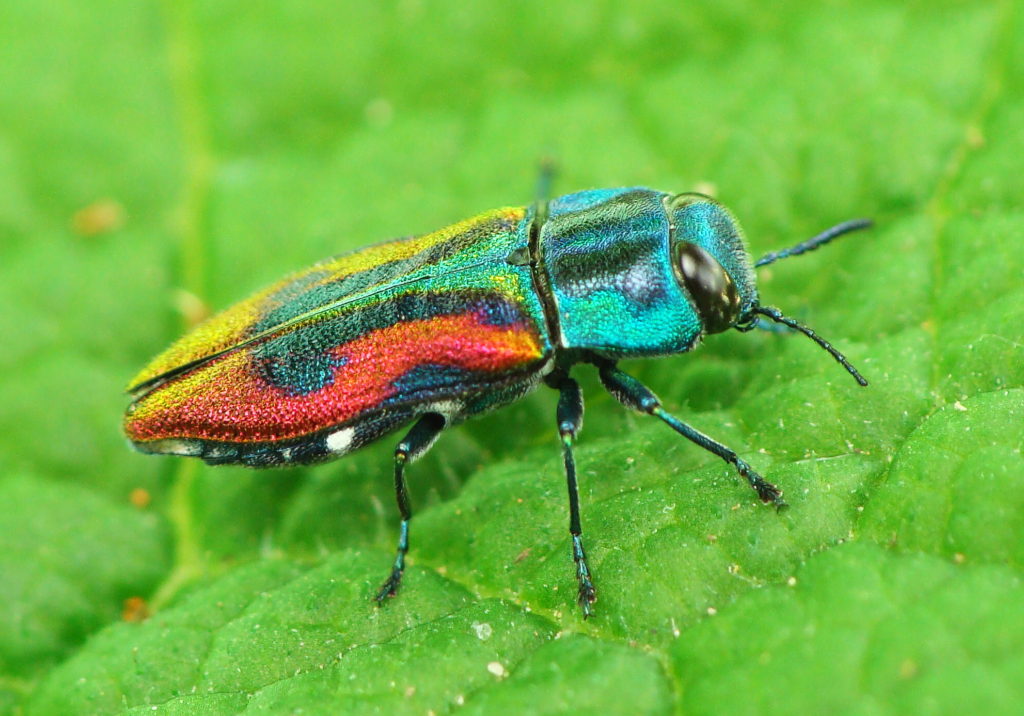
Bumblebees PLUS – Cherry jewel beetle (Anthaxia candens)
Photo: I. Antušek
.
Project plans (for the years 2024...?)
The continuation of the intention should focus on maintaining the measures taken. It will definitely be necessary to reduce the shoots of cut-back shrubs and regrowth (rosehips, ash). The planted cherry trees also deserve care; irrigation and formative pruning will need to be provided for them. It would be appropriate to arrange for the grafting of finds of old varieties. We are already arranging cooperation with a specialised facility for this professional task. We also want to focus on the grass and herbaceous vegetation in the orchard. We will plan suitable methods and timings with regard to species composition and fodder value. We will consider and discuss the possibility of grazing, with all the benefits and complications that setting up and operating grazing entails. Fortunately, we have someone to turn to and from whom we can draw good ideas. An entomological survey focused directly on bumblebees or species associated with decaying wood would also be a suitable outcome.
The project and its surroundings…
The project is set in an interesting environment. Take a look for yourselves, it is quite important for understanding the context.
.
Of Uhříněves
Uhříněves (German: Aurschinewes) is a municipal district and cadastral area of 1027.1 hectares, forming the majority of the Prague municipal part Prague 22. Since 1866, Uhříněves was a market town, and from 1913 to 1974, it was a town.
The history of Uhříněves dates back to the 13th century. The oldest records originate from around 1227, when it appears under the name Vgrinewez in a list of locations. Another mention is in a charter from 1228, when Uhříněves is recorded as belonging to the monastery of St. George at Prague Castle. At that time, it was written of as Ugrina ves. It likely received its name from its founder, a certain Ugrim, who settled here and founded a settlement.
In 1622, Prince Karl I (1569–1627) of Liechtenstein purchased the Uhříněves estate (Germanised: Auřinowes) in the post-White Mountain confiscations. In 1850, it was a municipality in the Říčany district. Between 1869 and 1890, it was a municipality in the Český Brod district. In 1898, it was still a major estate owned by the Liechtenstein family. Between 1900 and 1910, it was a municipality in the Žižkov district. Between 1921 and 1950, it was a municipality in the Říčany district. Between 1961 and 1970, it was a municipality in the Prague-East district. In 1992, it became a city district of Prague 10.
Uhříněves underwent its greatest development in the 19th century. In 1866, it became a market town, developing both agriculture and industry. A steam mill was built in 1850, a local brickworks in 1866, and a local sugar refinery in 1868. The construction of the Prague – České Budějovice railway line, built in 1870, connected Uhříněves to its surroundings. The influx of population led to the construction of new houses, grand villas, and also a new school, for example. At that time, Uhříněves had around 2,600 inhabitants. Cultural and social life, as well as sport, also developed. New associations and clubs were formed. In 1913, the market town of Uhříněves was elevated to the status of a city, and a year later, the city's coat of arms, designed by academic painter Jindřich Bubeníček, was approved, which is still used today as the coat of arms of the Prague 22 municipal district.
In 1920, within the scope of land reform, the Uhříněves and Netluky farm with the Podlesek mill was nationalised and leased as a school farm for the agricultural department of the Czech Technical University in Prague; in 1923, it was purchased by the Ministry of Education and Enlightenment. The UHŘÍNĚVES II. Agricultural School Enterprise continued to be managed by the Ministry of Education and Enlightenment as a state-owned enterprise.
At approximately 9:25 AM on April 25th, 1945, American fighter aircraft, known as "Jabo" (ground attack aircraft), attacked a column of German refugees located on Přátelství Street, between the sugar factory and the Square of Anti-Fascist Fighters. The number of casualties is unknown. Two local residents also died and two were injured.
Following February 1948, changes were also made to the School Agricultural Enterprise, where the Ministry of Agriculture organised training courses for JZD (Unified Agricultural Cooperative) members. In 1953, the Research Institute of Animal Production (now the Uhříněves farm) was moved here.
Read more HERE on Wikipedia, or on the official website of Prague 22 HERE.
Uhříněves is not just a district. In its vicinity, there are many interesting places with beautiful and protected nature. You can read about this, for example HERE

Prague 22 – Uhříněves
About the municipality of Netluky
Netluky is a small, predominantly agricultural settlement within the Prague district of Uhříněves. It lies on a flat ridge between the Rokytka and Říčanka streams, by the road leading from the eastern part of Uhříněves to Hájek, Koloděje, and Běchovice.
In the year 1386, the village of Pnětluky is mentioned here. The name is likely derived from forestry activities, i.e., cutting stumps.
In the early 16th century, it belonged to the Dubeč estate. In 1639, the village was plundered by Swedish troops and was never re-established. In 1667, it was attached to Uhříněves.
As late as the 17th or early 18th century, the Liechtenstein family established a Baroque courtyard on the site of the original village. The oldest known depiction of the courtyard and its surroundings is on A. B. Klausner's map from 1715–1718. The courtyard was rebuilt into its current form around the mid-18th century, with no further changes to the floor plan. The dominant feature of the courtyard is the former distillery with its factory chimney. A small settlement was re-established near the courtyard in the early 20th century.
According to 19th-century maps, Netluky lay along the road to Dubec, which ran along the western side of the farmstead; the present-day road around the eastern side of the farmstead to Hájek did not yet exist, although a network of field paths criss-crossed the landscape. To the north of the farmstead lay a pair of ponds – the larger, more easterly of which was abolished.
Until 1918, the estate within the former Uhříněves demesne was owned by the Liechtenstein family, from whom it passed into state ownership. In 1920, the Uhříněves and Netluky estates, along with the mill in Podlesek, were leased for twenty years by the University of Agriculture at the Czech Technical University in Prague. However, on 21 February 1923, the university purchased the homestead from the state. The estate was used for student practical training.
The distillery was only built in 1935 as part of the farm of the University of Agriculture and Forestry, thanks to a generous donation from the Cooperative of Agricultural Distilleries. The construction of the distillery was particularly pushed forward by Professor Antonín Nýdrle from 1920 onwards, but it was hindered by the provisions of the 1919 spirits law, which prohibited the establishment of new agricultural distilleries in beet-growing regions; the new spirits law of 1932 relaxed this condition. The distillery designer was the construction department of the Agricultural Association, led by Prof. Dr. Theodor Petřík.
A field airfield was activated here in September 1938. Field Squadron 42 was located here from 14th September to 5th October.
In 1953, the farmstead complex was transferred to the Research Institute of Animal Production, which built an additional complex of new buildings south of the original farmstead.
You can read more about the municipality HERE
The locality benefits greatly from the presence of the equestrian club. JK VÚŽV Uhříněves A pasture for horses. The riding club of the Research Institute of Animal Production in Uhříněves was re-established around 1976. However, it was built upon the previous estate of the Linstenspteins and the University of Agriculture, see above.
Where there are horses, there is clover, where there is clover, there are bumblebees. That equation works quite reliably.
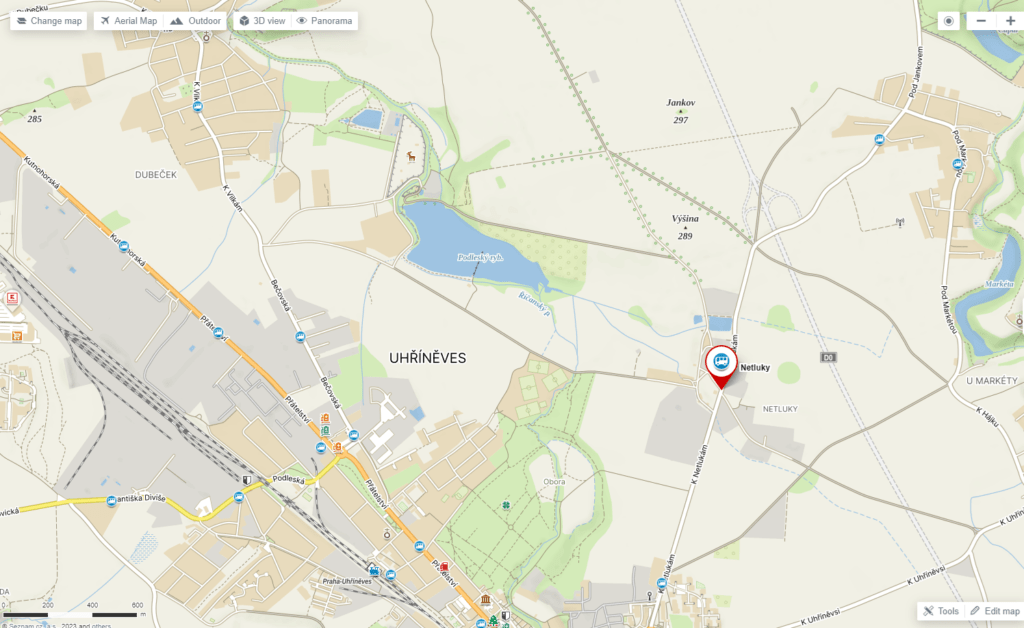
Netflix
Source: Mapy CZ
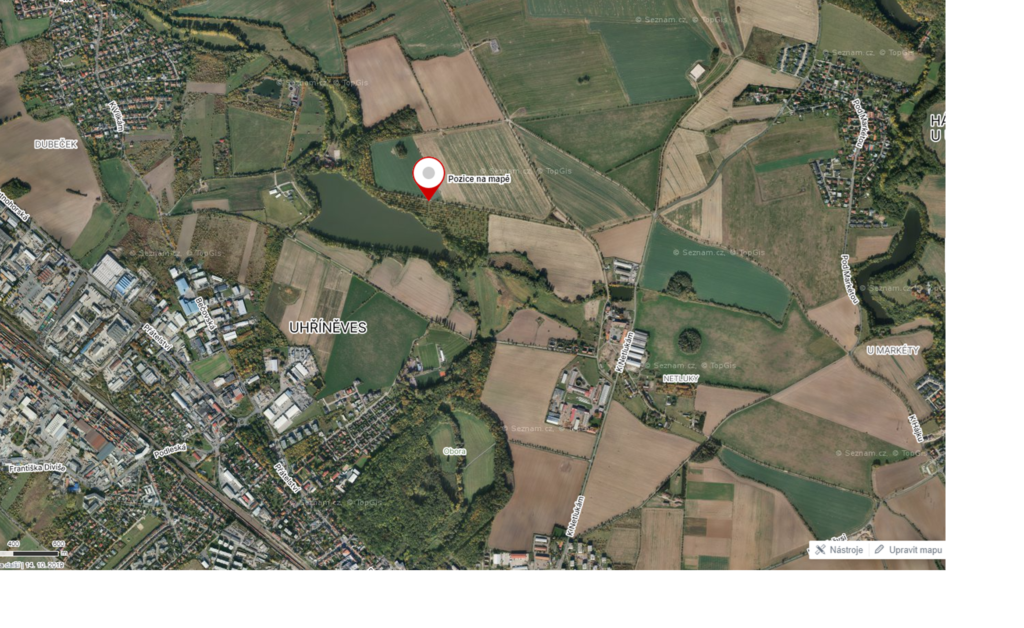
Cherry tree Netluky
History of the cherry tree in Netluky
It's always interesting to look at history and see how it has changed over time. The Dvě Prahy website is a good example of this. There, you can look at maps and aerial photographs.
In our case, you can see that the cherry orchard hasn't changed much. It's just started to overgrow as fruit growing has ceased in it. It also hasn't helped that it's freely accessible. Not all visitors treat it well. Originally, there was fencing here, but that disappeared over time…
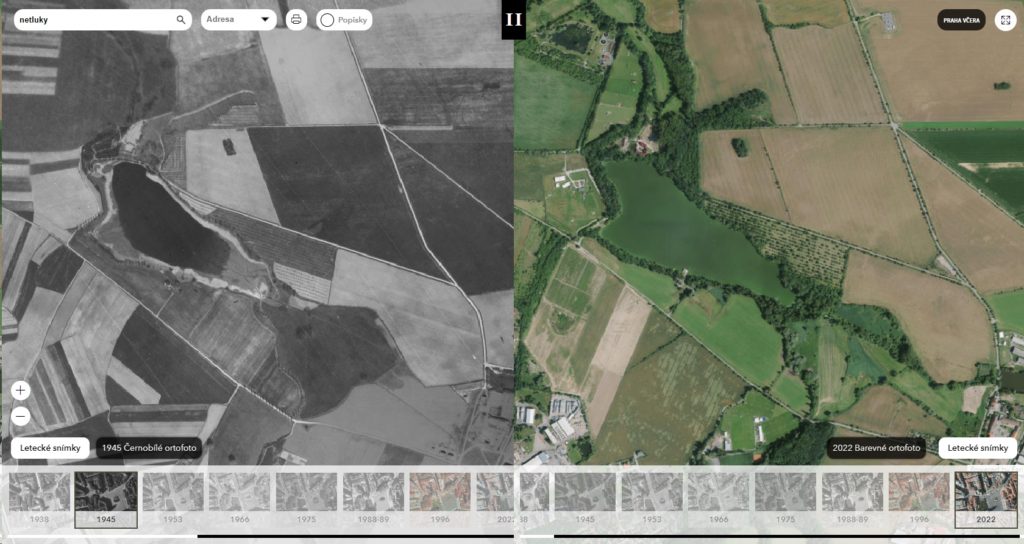
Cherry-plum Netluky – Source Two Thresholds
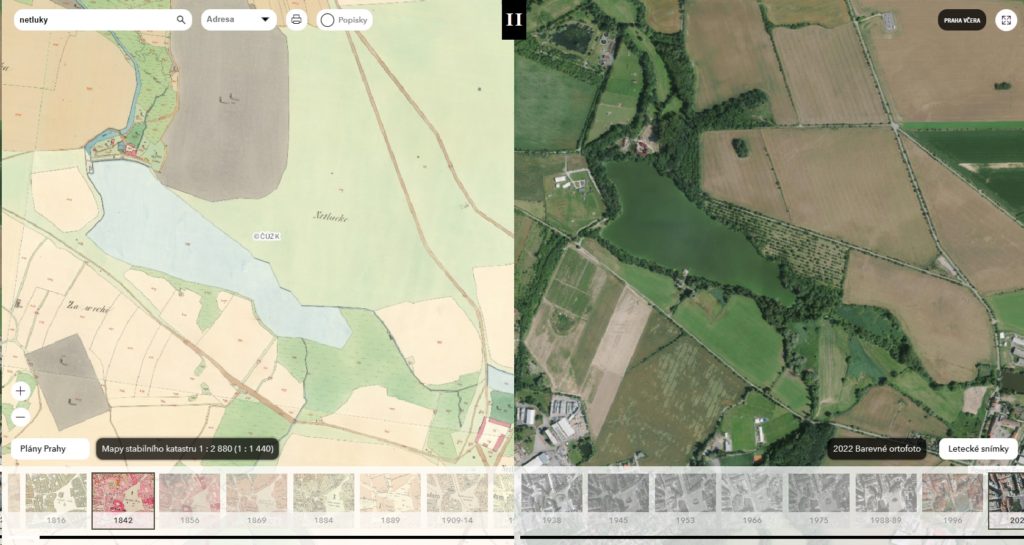
Cherry-plum Netluky – Source Two Thresholds
.
Look at the cherry tree from a bird's/drone's eye view. Vikitan
About the Scarlet Buprestid (Anthaxia candens)
The cherry jewel beetle (Anthaxia candens Panzer, 1787) is a striking, brightly coloured beetle of the genus Anthaxia with pronounced sexual dimorphism.
Description
This is a jewel beetle, whose colouring is among the most beautiful of beetles in the Czech countryside. The jewel beetle's body size is approximately 7-12 mm.
Bílý describes the appearance of *Anthaxia candens* in his key as follows [2]: The elytra are red with a black saddle-shaped spot on the suture; in front of this spot is a blue-green triangular field occupying only the area around the scutellum; the structure of the scutellum is formed at its lateral margins by oval foveae with large central grains; in the middle of the scutellum, this structure transitions into a network of sharply fine wrinkles bent backwards; between these wrinkles are fine dots; the head and lateral margins of the scutellum are blue, the middle of the scutellum and the triangular field near the scutellum are greenish-blue, the saddle-shaped spot on the red elytra and two spots on the scutellum are black.
Occurrence
It can be found in areas ranging from eastern Spain across France, Italy, Switzerland and central Europe towards Ukraine and the Balkans, excluding Greece.
In the Czech Republic, its numbers have noticeably declined in recent years, especially in Bohemia, and it is common in the warmer regions of central and southern Moravia.
In Bohemia, it is found more abundantly in the surroundings of Prague, in the Pardubice region, Hradec Králové region, in South Bohemia e.g. in the Křemže basin, in the surroundings of the Husinec reservoir and in the Netolice region.
Biology
- Larva
The larvae most commonly develop in the bark of sour cherries (*Prunus cerasus*) and sweet cherries (*Prunus avium*) [3]. Entomologists also frequently report larval development in blackthorn (*Prunus spinosa*) or mahaleb cherry (*Prunus mahaleb*) [4][5], and less commonly in the bark of other fruit trees. The habitat of *Anthaxia candens* is old, unmanaged cherry orchards, avenues, and solitary stems. It prefers sunlit parts of trees. Pupation of the larvae takes place in August, and the adults overwinter in pupal chambers, which they leave at the end of April and beginning of May. They become active on cherry and hawthorn blossoms. The larval development period is most often two years. - Adults
Adults of Anthaxia candens are generally encountered from May to June. Most often in steppe-like biotopes with sufficiently old trees. We often see them on nourishing plants, which they also use for laying eggs. Among the common nourishing plants are old solitary cherry trees (Prunus avium), which are well-lit for most of the day; they can also be found in cherry orchards. Other nourishing plants, as with the larvae, include, for example, sour cherry (Prunus cerasus), Mahaleb cherry (Prunus mahaleb), and common apricot (Prunus armeniaca). Adults lay their eggs under the bark of trunks or thicker branches, and the larval development here then takes approximately 2 years. Since the larvae pupate towards the end of summer and subsequently hatch into an adult individual, which overwinters under the bark of the tree, adults can be found even during winter.
Presence detection
Oval exit holes in the trunks and branches of old cherry trees. The exit hole is oval, 3.8 – 5.2 mm wide, 2.4 – 3.3 mm high, averaging 4.4 x 2.7 mm. It differs from other species of the genus *Anthaxia* by being slightly larger. It occurs together with *A. nitidula* on Rosaceae, where the exit hole is 3.2 – 3.8 mm wide and 1.9 – 2.6 mm high, averaging 3.5 x 2.25 mm. The exit holes are on the sunlit southern side.[3]
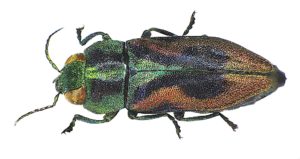
Cherry jewel beetle
Photo: Wiki
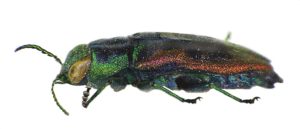
Cherry jewel beetle
Photo: Wiki
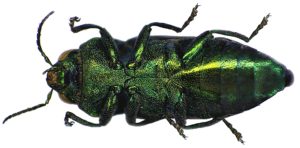
Cherry jewel beetle
Photo: Wiki
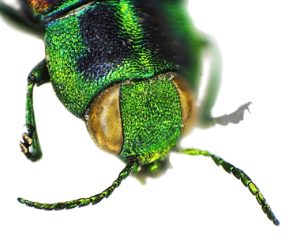
Cherry jewel beetle
Photo: Wiki
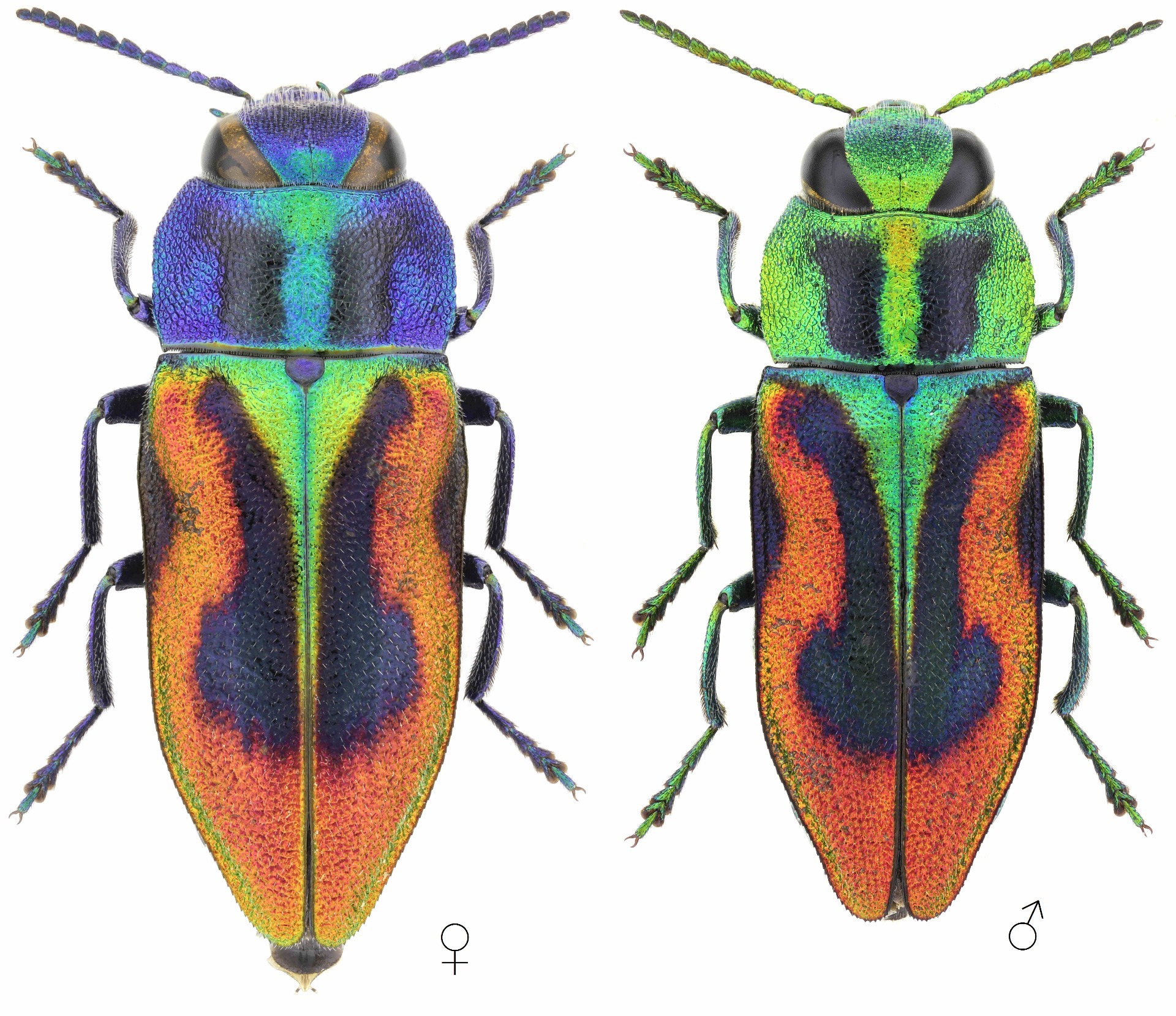
Cherry beetle (Anthaxia candens)
Photo: Treasures of Prague
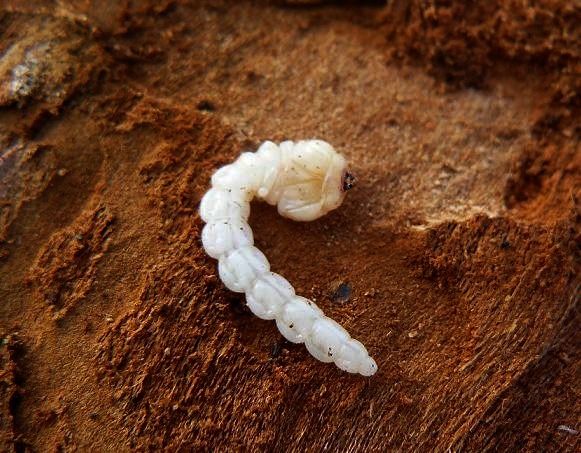
Beech jewelled beetle (Anthaxia candens) – larva
Photo: O.
Machač
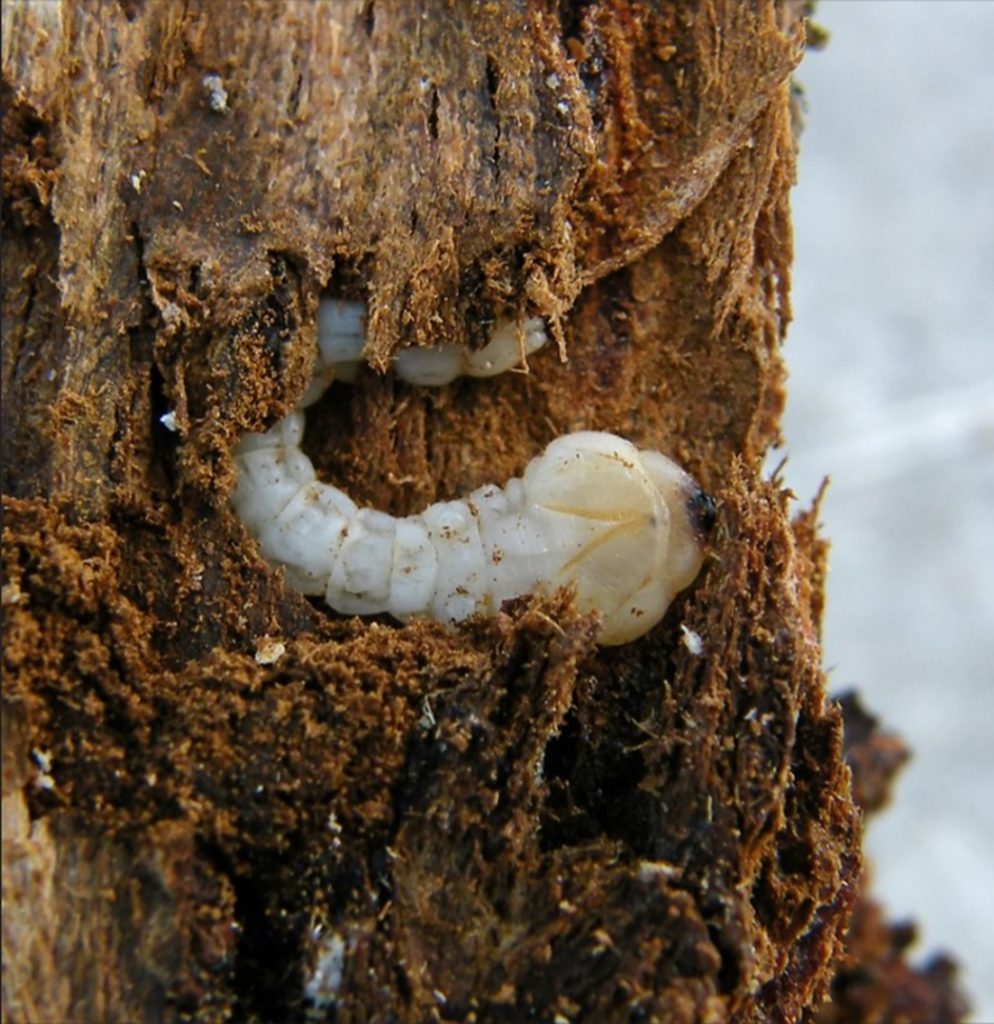
Beechwood Buprestid (Anthaxia candens) – Larva
Photo: D. Balogh
Further information on the cherry jewel beetle (Anthaxia candens)
Project plans
<JANA>
Land mapu
The land is owned by the Research Institute of Animal Production, v.v.i. You can find the entity's pages here https://vuzv.cz/
With his kind permission and consent, the project was undertaken.
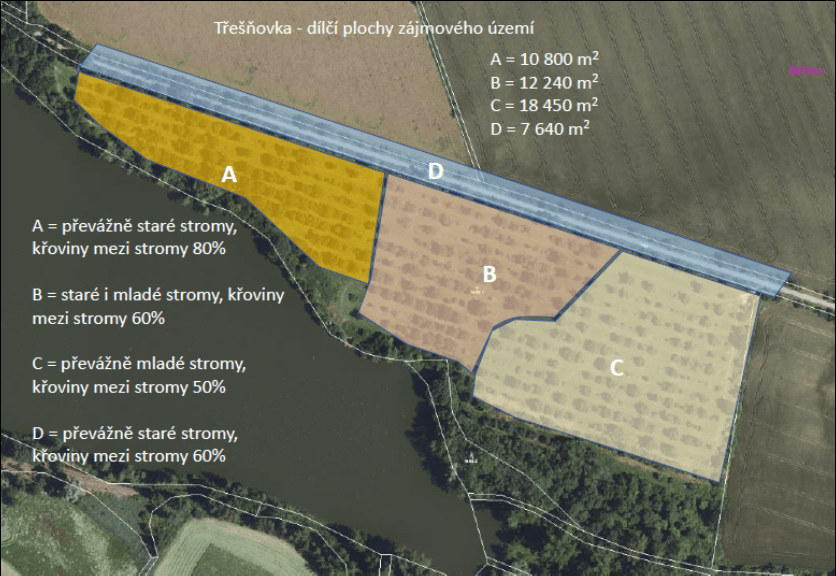
Cherry tree map
Photo: M. Lípa
Land surveyu
One of the important steps of the project was the survey and identification of the varieties found on the plot.
Here is a small quote from the survey, as evidence of how diverse this area is:
Early varieties are supplementary here and are mostly heart cherries. Partial-stone varieties are only represented by the Lyon early. At the transition between early and late varieties is Těchlovická.
Among the varieties that are now less represented in open field plantings are:",
- Anayong
- Francis
- Koburská raná
- Lyon Early
- German Camomile
- Těchlovice
- Large black tooth
- Mealworm beetle
If there isn't enough space for all the present varieties to fully propagate, I recommend planting at least 2-3 trees of these varieties. Given the relatively short lifespan of cherry trees, these varieties are more at risk of extinction than the remaining ones from the mapped assortment.
Varieties
- Hedelfingen
- Karešova
- Chestnut Tree
- Napoleonic
- Van
Further information
<JANA>
How did Bumblebees PLUS get involved in the project?
In Prague's Uhříněves – next to Podleský Pond in Netukly, there's a beautiful old cherry orchard, and in it thrives a magnificent beetle – the cherry jewel beetle (Anthaxia candens).
He's a real beauty, but unfortunately, they're declining rapidly in our country, which is why encounters with them are becoming increasingly rare. They need old cherry wood for their development, and such places are becoming fewer and fewer.
There are several reasons, but surprisingly, humans cause a lot of it.
The current method of intensive fruit farming is more interested in young, low-statured modern fruit trees. As soon as these stop yielding a sufficient harvest, they are immediately replaced by new specimens.
Farmers are not interested in old trees and old varieties. Old trees bear little fruit and require more care. Furthermore, old varieties of fruit trees create high crowns, making the fruit more difficult to harvest. For this reason, today's production orchards are mostly just tree stumps from which fruit is extracted…
Fruit growers focus primarily on profit to succeed in competition. Yes, they have it tough, but is nature entirely to blame? Therefore, they don't even consider the important effect of large fruit tree canopies, which create shade and prevent the soil beneath them from drying out, etc. Furthermore, in partial shade, honey-producing plants grow, which are favoured by the delicate palates of insects - not just bumblebees.
Fortunately, there are still areas with old trees and people who care for them. There aren't many of them, but meeting them is always a balm to the soul.
One such place is precisely this beautiful old cherry orchard. Mrs. Jana, a true enthusiast, is dedicatedly working towards its preservation, as is the landowner. We take our hats off to their courage and will with which they've embarked on this, because there is and will continue to be a great deal of work involved.
The striped bumblebee, a species on the verge of extinction in our country, used to be found in Netlucká třešňovka for a long time. However, its numbers have significantly worsened over the last 10 years. The last recorded occurrence was about 4-5 years ago, but another rare species, the large earth bumblebee (Bombus ruderatus), is still found here today. Therefore, it is not impossible that both species are still surviving here, but their populations are on the brink of extinction. By sowing suitable plants, we would like to help these local populations to develop again.
That's why on Saturday 4/11/2023 They met in Třešňovka and discussed possibilities for cooperation. Not only so that the beautiful cherry blossoms could flourish there, but also so that rare species of bumblebees, which used to be found there, would return to this place.
The meeting was very pleasant, with great scope for collaboration. If everything goes to plan, we'll get started this year and if it goes even better... well, let's not get ahead of ourselves, everything is only just beginning.
We would be happy to involve your capable and hardworking hands in our planned planting of nectar-rich plants on the land. As soon as we get the green light, we'll go for it – Bumblebees Plus, Jakub Černý, and also you, if you're not afraid of hard work.
In the meantime, take a look at the photos from this beautiful place and make sure you have time in your diary for the end of November. You can see for yourselves that it's worth a bit of effort.
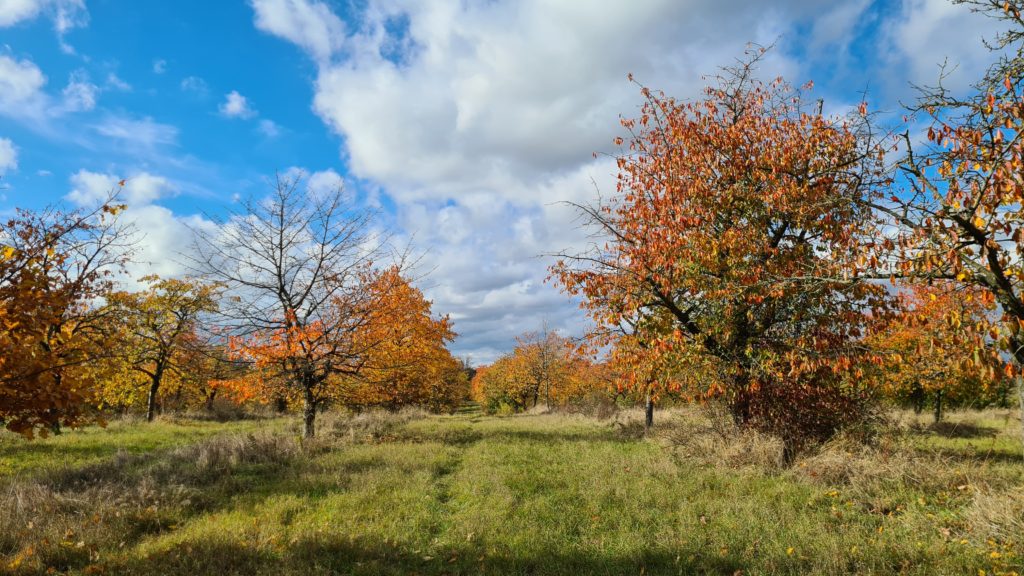
Cherry Orchard Uhříněves – Netluky
Photo: O. Hercog (04/11/2023)
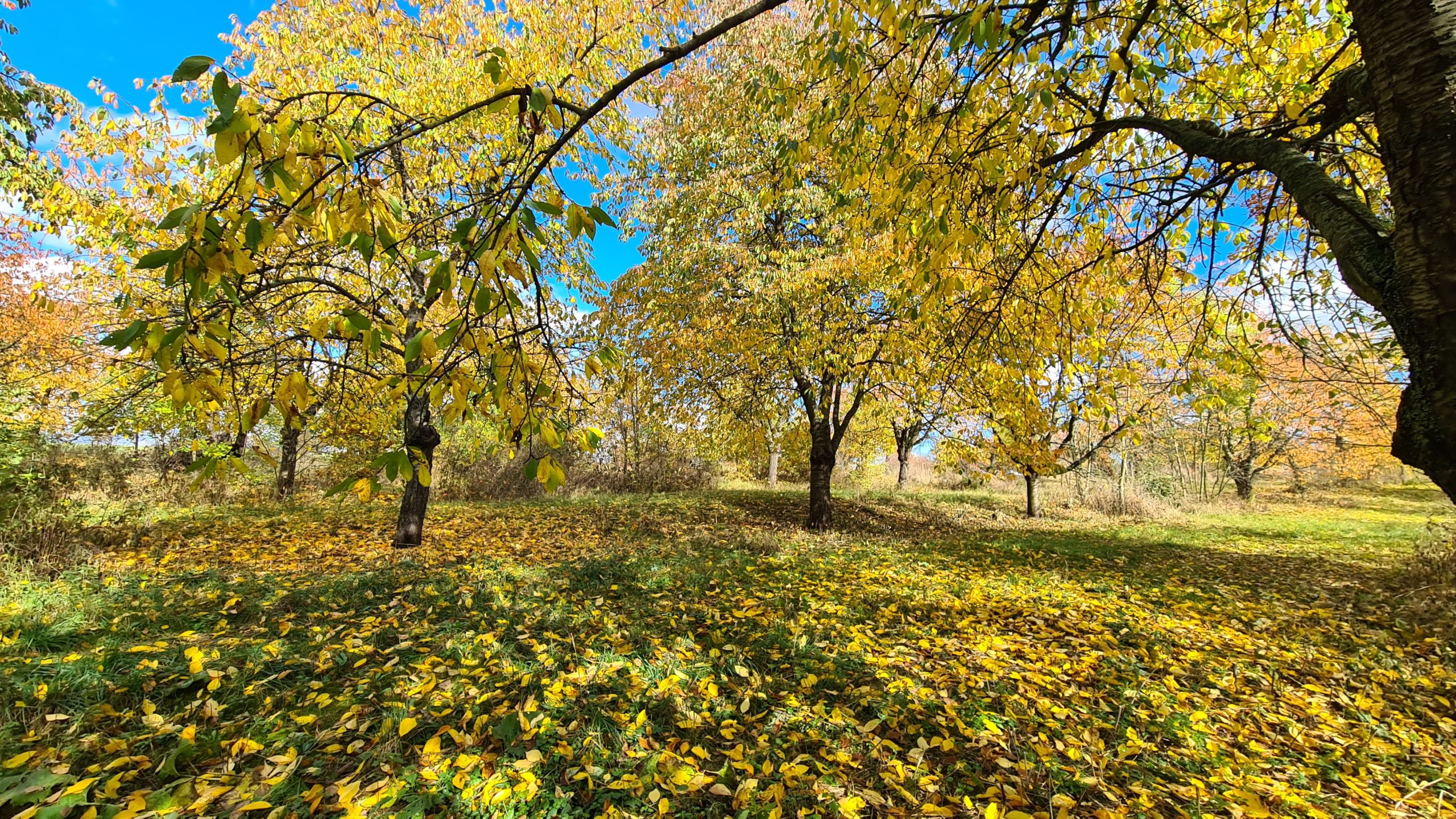
Cherry Orchard Uhříněves – Netluky
Photo: O. Hercog (04/11/2023)
One of the reasons why bumblebees thrive in the cherry orchard is due to dead-nettles. They do particularly well, especially in the lower, moister parts. They are even flowering now in November. We also want to focus on dead-nettles. It will be necessary to adjust the grass management, as they don't like mulching, which suppresses them in some areas – for example, by the path on the edge of the cherry orchard.
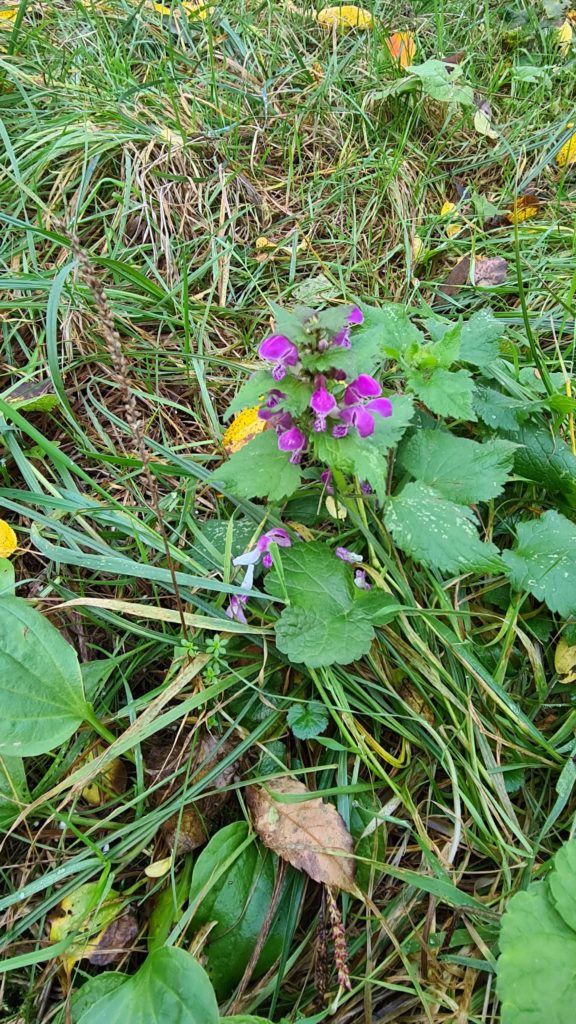
Cherry Orchard Uhříněves – Netluky – Spotted Dead-nettle (Lamium maculatum)
Photo: O. Hercog (04/11/2023)
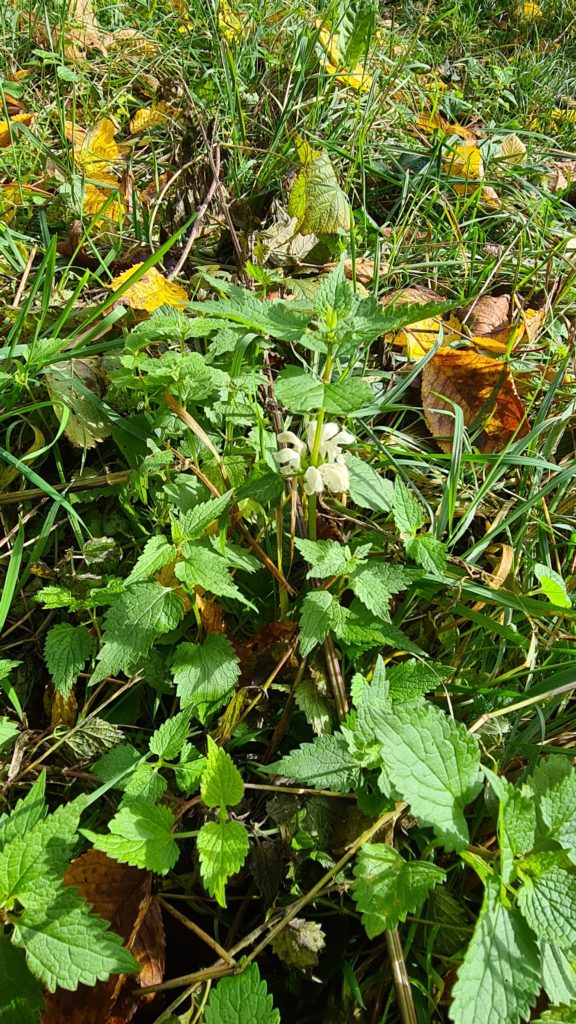
Cherry orchard Uhříněves – Netluky – White Dead-nettle (Lamium album)
Photo: O. Hercog (04/11/2023)
Warning, the cherry borer lives here – do not disturb!
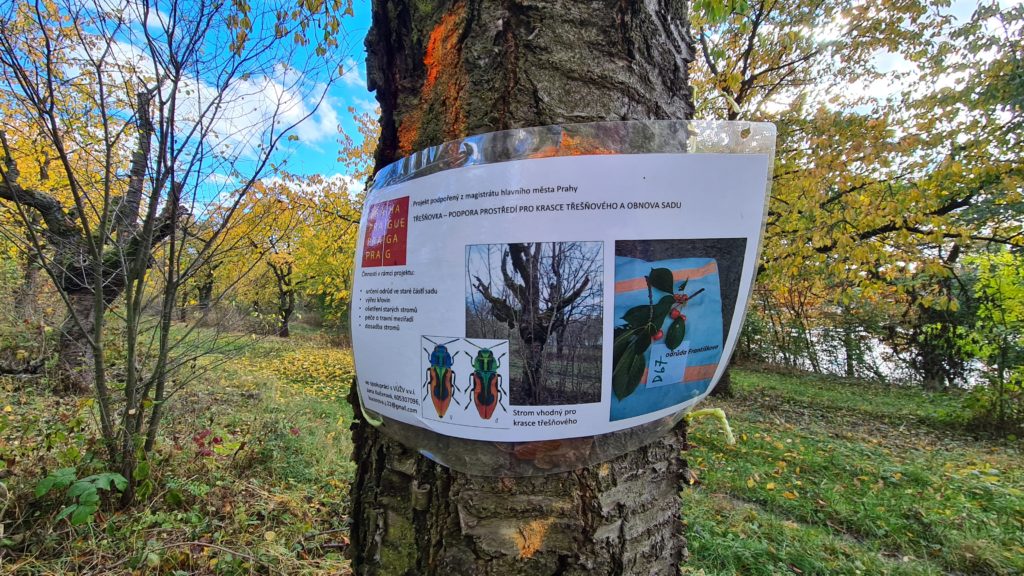
Cherry Orchard Uhříněves – Netluky
Photo: O. Hercog (19/11/2023)
.
Bumblebees that live, or will live, in the cherry orchard
Take a look at videos of bumblebees that occurred here, for example:
- Buff-tailed bumblebee
- Early bumblebee
or occur:
- Field bumblebee
- Shrill carder bee (Bombus sylvarum)
Jaromír Čížek, our frienda member of the Čmeláci PLUS z.s. association has been monitoring this locality for many years.
During that time here observed the following species of bumblebees and cuckoo bumblebees:
From representatives of the genus Bombus and Psythirus (today also classified as Bombus):
- Buff-tailed bumblebee
- Buff-tailed bumblebee
- Shrill carder bee (Bombus sylvarum)
- Field bumblebee
- Buff-tailed bumblebee
- Garden bumblebee
- Common carder bee (Bombus pascuorum)
- White-tailed bumblebee (Bombus lucorum)
- Buff-tailed bumblebee
- Bombus agrillaceus
- Vestigial bumblebee (Bombus rupestris)
- Vestal cuckoo bumblebee (Bombus vestalis)
- Forest cuckoo bumblebee (Bombus sylvestris)
- Short-haired bumblebee (Bombus maxillosus)
Here you can find a basic overview of bumblebee and bumblebee-like species in the Czech Republic HERE
Čmeláci PLUS z.s. are planning to participate in the 2024-2026 project.
The aim is to support Jana in the areas of arboriculture, turf management, and communication, in order to create a diverse and sustainable habitat suitable not only for the life of the cherry bee-eater, but also for bumblebees. Likewise, it should be a place for people and nature to meet.
Keep your fingers crossed for us, there will be a lot of work involved, but we are looking forward to it. We have references and experience that we are happy to offer, see ČSOB Biodiversity Support Project in Prague, Radlice
.
Ing. Jana Kučerová
She was born in Uhříněves, attended school and a scout troop there, and also enjoys living, working, spending her free time, and cycling there. She studied landscape ecology and has gained experience in a wide range of nature conservation. She currently works as the head of the environmental department at the Prague 22 municipal district.
Besides Třešňovka, he is involved in beekeeping, gardening, and occasionally amateur theatre.
.
Project team - Bumblebees PLUS
This is the main part of the project team. However, others are gradually joining the project...

Ondřej Hercog
Ing. Ondřej Hercog – Bumblebees PLUS z.s.
I work in IT and information security. I am actively involved in nature conservation and promotion.
He was interested in nature from a young age. He was greatly influenced by his uncle, who was an inexhaustible source of answers for him as a boy on all things related to nature. This was followed by books by E. T. Seton, G. Durrell and similar works, which he devoured and experienced. Weekends and holidays were often spent in his uncle's enormous garden – a garden full of flowers, insects and birds. It was almost the same adventures that young Durrell experienced. Then followed hiking trips with the Neskenon Indian troop with elements of scouting and Woodcraft (Woodcraft League).
Although he chose a technical education and profession for his life, he is returning to nature more and more, and bumblebees are one of those paths.
He is a founding member of the group and subsequently the association. Bumblebees PLUS z.s. of which he is also the chairman. He actively promotes the society's activities in public and in the media.
He lives in Prague in Radlice
The association Bumblebees PLUS can be found at www.cmelaciplus.cz, and Facebook Bumblebees PLUS or on YouTube Bumblebees PLUS

Michal Plundra
Ing. Michal Plundra – Garden and landscape architect, lecturer on ecological education programmes.
A qualified gardener from the Secondary Vocational School of Horticulture in Mělník.
The Czech University of Life Sciences Prague in Suchdol (Garden and Landscape Design), also the field of Ecology.
Nature-focused hobbies, primarily gardening, permaculture, herbalism, and education in these areas.
Designing and implementing gardens, dendrological surveys, arboriculture and landscape care, lecturing for other entities such as the Kokoza association (community gardens), the Tereza educational association (Eco-School, Globe programme), Ekocentrum Vrátkov. Reporter for garden topics on the programme Prima receptáře.

Vojtěch Koštíř
Bc. Vojtěch Koštíř – The Prague Pasture
He studies biology at the Faculty of Science, Charles University. In 2016, he co-founded the association Pražská pastvina (Prague Pasture), which combines community grazing of sheep and goats with the care of valuable protected areas. Today the association also focuses on the species protection of butterflies (e.g. Meadow Brown or Rock Grayling) and the care of an old orchard with a community apiary.
He also works as an editor for the TV show „Nedej se!“ (Don't Give Up!), where he highlights significant environmental issues and causes. He manages to inspire young people interested in biology about nature through lectures and excursions for high school students.
How did the project perform in individual years
Our project is planned for several years. Have a look at how he's doing, or rather, how he's doing.
Come and see with us everything that we have done and experienced as part of the project!