



Peculiarities of the life of the social insect, bumblebees
What you will find here
Here we will collect interesting articles and information about the lives of bumblebees.
This will be the kind of information where a simple link is not enough, but it needs to be translated or commented on.
We would also be grateful for your tips, which will help us keep this section interesting and beneficial for you.
Contents
- Bumblebees use an economy mode when flying with a heavy load, and also their heads.
- Tractable bumblebees
Bumblebees use an economy mode and also their heads when flying with a load.
ÚVOD ČM+
Bumblebees are our familiar flying teddy bears, but at the same time, they are the strongest insects in the hymenopteran world.
According to classical theory describing flight in the atmosphere, bumblebees are unable to fly due to their weight, power, and wing area. Yet, they do fly, and how!
It wasn't until scientists applied theories and models of turbulent flow to their flight that they realised bumblebees could actually fly. This greatly reassured us all. 🙂
To make matters worse, bumblebees can fly even with a load almost equal to their own weight. This is because they fill their crop with nectar as an energy source for the nest – for the larvae, the queen, and the other workers. Likewise, bumblebees carry pollen baskets on their hind legs. These are often so large that they look less like baskets and more like loaves of pollen. You can easily recognise a bumblebee laden like this in the air. Its flight is noticeably different – soft and buoyant. Its landing on the hive entrance is also accompanied by a „thump“. If it were possible, we would probably also hear it sighing loudly before it gets itself together and crawls into the hive.
A new study by scientists at the University of California now explains how bumblebees manage such a load. The study also describes the new finding that bumblebees are much more flexible in their behaviour than one might expect from such small insects. They are therefore not some kind of miniature robots, as it might seem and as we might assume from the capacity of their brains and nervous systems.
Scientists count and measure, but we know better. Those of you who spend hours by the beehive observing bumblebees know very well yourselves that bumblebees are not robots. You know that they are wonderfully intelligent creatures and that their behaviour is sometimes surprising. You also know that the behaviour of bumblebees is one of many reasons why one can become so infatuated with them, and why this infatuation (bombusophily) is so easily contagious.
But now, seriously, scientists, unlike us, work with facts; unlike us, they cannot afford to get emotional or make unsubstantiated assumptions. Let's look at an article published on 5 February 2020 in ScienceDaily. We have freely translated the text and are now presenting it to you.
We wish you an interesting read. When you see a bumblebee flying, loaded to the brim, you will already know how this little creature actually „does it“.
If you don't like long articles, at least check out Interesting video study of bumblebee flight
Bumblebees use an economy mode when flying with a heavy load, and also their heads.
Written using the article „Bumblebees carry heavy loads in economy mode“ – ScienceDaily 5.2.2020
Bumblebees are the strongest creatures in the insect world. They can load and carry a load almost as heavy as themselves.
A study published on 5 February in Science Advances describes how they manage this, and also that bumblebees are much more flexible in their behaviour than would be expected of this type of insect.
„They can carry 60, 70 or even 80 per cent of their body weight. For humans, that would be an enormous burden even just when walking,” says researcher Susan Gagliardi from the University of California. “We were interested in how much effort they have to expend to carry food and supply their nests.”
S. Gagliardi and Stacey Combes, a lecturer in the Department of Neurobiology, Physiology and Behaviour, measured the energy that bumblebees need to fly. They monitored this in a specially designed chamber, creating a spherical space. They attached small pieces of solder wire to the bumblebees to provide them with a suitable load.“
“We placed bumblebees in a small enclosure and measured the carbon dioxide they produced during flight. Bumblebees primarily burn sugars when flying, so we’re able to measure how much sugar they consume during flight,” says S. Gagliardi.
Scientists also used a high-speed camera during the experiment to observe the flapping and movements of their wings. „Bumblebees fly in a way that is significantly different from the flight of an aeroplane,“ says S. Combes. „In an aeroplane, air flows smoothly over the wing or rotor blade. Bumblebees, however, move their wings at a high angle of attack to the airflow, which causes turbulence around the wings. This creates much greater lift than smooth airflow. However, at the same time, the lift is unstable because the air vortices break down quickly. Bumblebees are able to maintain their flight by moving their wings rapidly.“
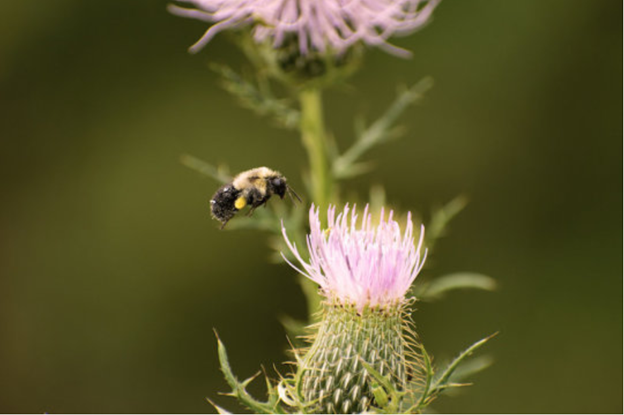
Photograph for the article „Bumblebees carry heavy loads in economy mode“Bumblebee hovering nearby
thistle
© R.J. Godlewski
Two flight modes
Bees burn nectar that they have collected during flight, so they should gradually become lighter during flight and consume less energy.
To their surprise, however, S. Combes and S. Gagliardi discovered that if the bumblebees were more heavily burdened, they required less energy per unit of load. „The more they are laden, the more economical their flight is, which doesn't make sense from an energy perspective,“ says S. Combes.
On closer inspection, scientists found that bumblebees have two different ways of dealing with the increasing load.
If they are more heavily loaded, they increase the amplitude of their wing beats. This is not enough to compensate for their high weight. To make up for this difference, bumblebees must increase their wing-beat frequency. All of this creates greater lift, but at the same time, increased energy consumption.
Bumblebees have a second, alternative, somewhat different flight mode which allows them to carry greater weight whilst expending less energy when they increase their wing beat frequency.
It's not yet clear what exactly this „economic regime“ causes, it's probably due to how their wings rotate backwards between individual flaps. But it's something that bumblebees decide for themselves how to perform.
„It turns out that it's up to them to choose and they will decide on the flight regime themselves, according to the relevant weight,“ says S. Combes.
„When bumblebees are lightly loaded or are in a relaxed state, they are more likely to increase their wing-beat frequency. When they are more heavily loaded, they switch to this rather mysterious economical mode and produce enough force to cope with the load with only a small increase, or even a decrease, in wing-beat frequency.“
Flight economics and stability
If bumblebees can save energy during flight, why don't they use this economical mode for the entire duration? It's not clear, however, it's quite possible that the high wing-beat frequency is advantageous in terms of the power they have available, for example, for maintaining stability in turbulent air or when avoiding obstacles (it's a bit like downshifting to a lower gear in a car – CM+ note).
„Our work has changed the way we view insects,“ says S. Combes. „When we first began researching this area, we tended to see bumblebees merely as little machines. We assumed they would flap their wings one way when unloaded and another way when carrying a load. We also thought that a particular bumblebee would fly the same way every time. However, we came to realise that it is the bumblebee’s decision which flight mode it chooses. We even found that the same bumblebee can choose a different way of tilting its wings every day.“
Source:
Materials provided by University of California – Davis. Original written by Andy Fell. Note: Content may be edited for style and length.

Tractable bumblebees
On our website www.cmelaciplus.cz you will find a description of bumblebee behaviour in the wild and in hives (bumblebee houses), which breeders prepare and offer them.
We are proceeding there from standard behaviour patterns of bumblebees, which are seemingly the same and which can be utilised in breeding. An example of this is how bumblebees learn to pass through a protective flap. This was designed by A. Krenz and modified by M. Stuchl to protect the bumblebees in the hive (bumblebee nest).
It's unnatural for bumblebees – they don't encounter anything similar in nature. However, it doesn't take long and the bumblebee queen gets used to the touch of the moving part of the flap, lifts it and enters the hive. So she's doing something she wouldn't do normally in nature. The workers will learn it too.
Look interesting inVideo from the BBC Earth workshop on their Facebook pages. Although it's a compilation of several separate parts, it's very interesting.
Videos demonstrating the bumblebees' ability to learn are available on Youtube.
From our perspective, bumblebees have small brains, but they know how to manage their capacity. Apparently, they are also very trainable and perform feats in the laboratory environment that they certainly wouldn't learn in the wild. They learn them under laboratory conditions, and these are entirely different experiences and practices that they cannot gain in nature. They learn to do things that ultimately bring them benefit and reward in the form of nectar. Thanks to this, they can transport a ball, „play football,“ or get to the right place where they were taught by humans that they will find food.
It is therefore clear that we still do not know everything about bumblebees. Examples of new findings on bumblebee flight and their ability to learn new things demonstrate this.