



Bumblebee Life Cycle – Basic Information
The life cycle of a bumblebee has its specifics and differs quite radically from that of bees, to whom it is simultaneously so close.
In bumblebee colonies, everything begins in spring and ends in winter. Over several months, the queen bee will establish a nest, manage the creation of several generations of workers and then sexual individuals – new queens and males. The queen bee later dies, as do the workers and males – the nest dies out. Only fertilised queen bees survive the winter, who will establish a new nest in spring, and a new generation will come into being.
This is precisely why bumblebees do not produce large stores of honey, because they do not use it. People ask: „What are bumblebees for?“. How is that question unnecessary! But we will explain that later.
The lives of bumblebees are fragile and, among other things, are threatened due to their specific life cycle. Bumblebees must repeatedly search for a nesting site and establish a nest in the spring. Sexual individuals must find suitable partners within a limited time and mate with them.
Even if they succeed, they are not out of the woods and must constantly fight for survival with other queen bumblebees, with cuckoo bumblebees, with parasites, and with adverse weather and fate.
Let's take a look at their life cycle today, so we can get clear on what the bumblebee life cycle actually looks like.
Also, watch the beautiful film The secret life of bumblebees, which will show you the secrets and pitfalls of their life cycle in a clear form.
Oh.
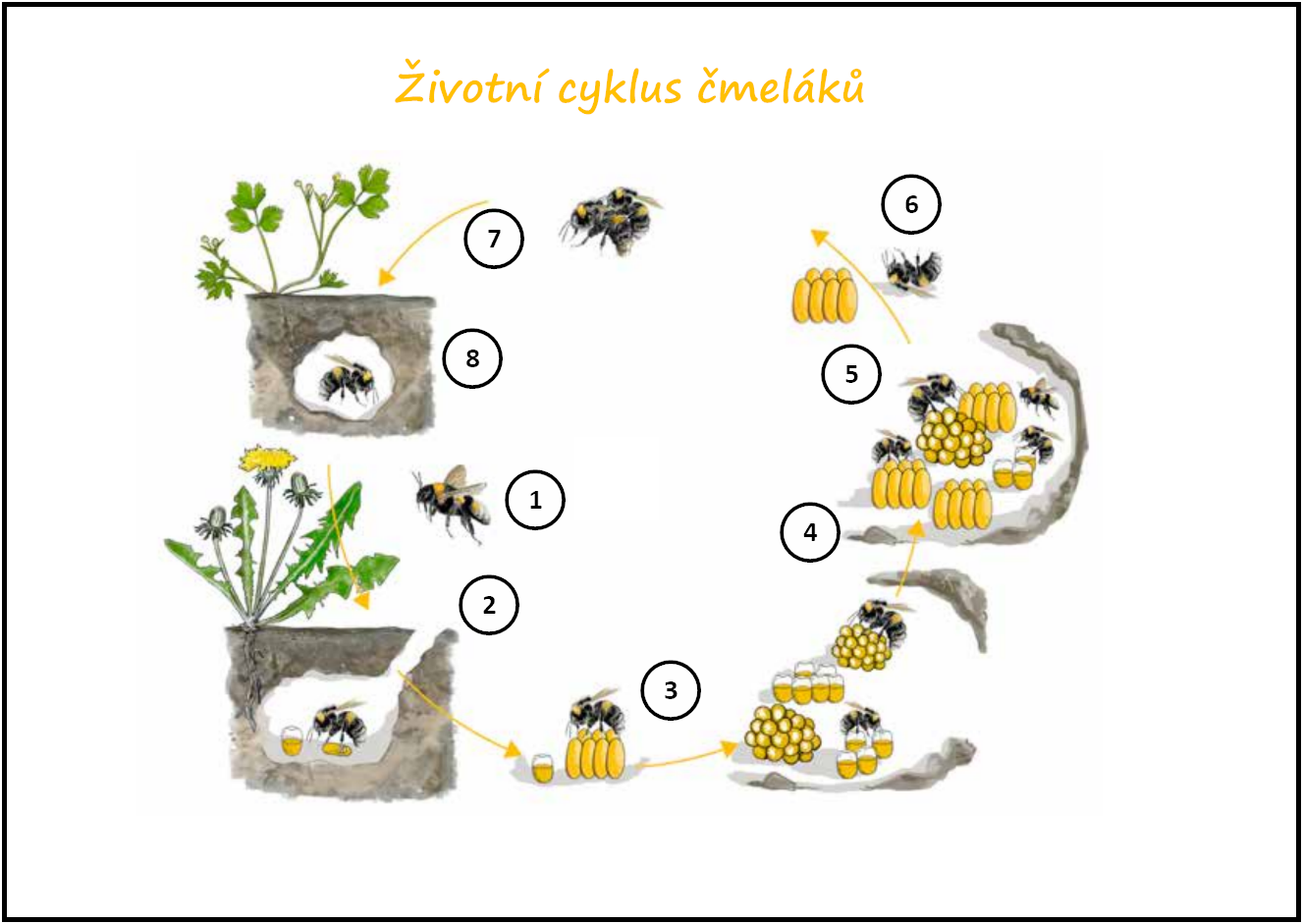
Bumblebee Life Cycle Source: Sikora A., Michołap P., Kadej M., Sikora M. Tarnawski D. 2018 „Bees in the City: Bumblebees of Wrocław“, Publ. Association Nature and Man.
The queen mother awakens
The queen bee is waking up and looking for a nesting site.
2. Nest building
The queen bee is building a nest.
3. Caring for the first generation of workers
The mother queen lays eggs and takes care of the first generation of workers herself (solitary phase).
4. Nest growth
The first workers hatch in the nest and help to gather food.
The queen bee is solely dedicated to laying eggs and caring for her offspring. Under normal circumstances, meaning if the workers provide sufficient food, she no longer leaves the nest. The queen lays the eggs from which new generations of workers are born.
5. Birth of sexual individuals – new mothers and males
The nest will strengthen to such an extent that it is able to provide enough food for new mothers and males. The males fly out of the nest and do not return there.
New mothers mate with unrelated males outside the nest. Within a short period, they leave the nest and hibernate buried in the ground (so-called hibernaculum).
6. The mother queen (founder) is weakening and dying
The founding queen is weakening and dying.
In the nest, workers lay eggs from which a few males are born.
7. The nest disappears
Males leave the nest, seeking mothers to mate with. The males gradually die. The workers age and die, new workers are not born.
The nest is disappearing and succumbing to decay (parasites, mould).
8. Overwintering of mothers - future founders of a new generation
In the land, fertilised new mothers – future queen mothers – sleep. How they manage, where they overwinter, you will learn about in in a separate article.
More information on the life cycle of bumblebees can be found HERE