



The bumblebee life cycle – more information
In chapter The life cycle of bumblebees We learned about the basic life cycle of bumblebees. Here you can learn more about the life of bumblebees and about, How it works in a bumblebee nest.
With the kind permission of Ph.D. A. Votavová, we have used the text from her publication „Bee keeping and support for bumblebees in gardens and in the city“However, we have significantly expanded this with insights and experience from Mr Jaromír Čížek, as well as other experiences and observations.
The life cycle of a bumblebee has its specifics and differs fundamentally from bees, though bumblebees are closely related to them. With bumblebees, everything begins in spring and ends in winter. Only fertilised queens survive the winter, and in the spring, these queens give rise to a new generation. This is precisely why bumblebees do not create large honey reserves, as they do not use them.
The lives of bumblebees are still under threat, as they must repeatedly search for a nesting site, establish a nest, and find mates. Even if they succeed, they are not out of the woods and must fight for their very existence throughout their life cycle to bring everything to a successful conclusion.
Bumblebee romance? Oh, come on… Let's take a closer look at their life cycle.
From the details we provide, you will see that the centrepiece of a bumblebee nest is the queen – the true ruler. Her presence and strength give the nest order and structure. The queen manages this through physical strength, but also chemically via her pheromones, which control the entire nest. As soon as the queen weakens and her pheromones weaken along with her, everything in the nest changes – order and harmony are replaced by disharmony, a loss of the nest's cohesion as a family, and instead of a familial idyll, internal conflict arises.
For this reason we rightly call mother „"Mother - Queen“and we will strictly adhere to this naming convention. For interest – the queen bee does not have such a role in a bee’s nest. If she weakens/dies, a bee swarm can raise a new queen. A lower degree of socialisation among bumblebees has made the queen mother an irreplaceable centre of the bumblebee family.
You'll read about this in the following text, as well as about the interesting facts of the individual phases of their life cycle.
Some details about bumblebee life are very important to their keepers. Therefore, we describe the process of a bumblebee nest in considerable detail. The instructions for keepers will provide solutions on how to address these specific details in their beekeeping.
Don't forget to watch the beautiful film The secret life of bumblebees, which will show you the secrets and pitfalls of their lives in a clear form.
Warning – watching this film is not without risks though – you could easily develop a hard-to-shake addiction to bumblebees (bombusophilia). 🙂
We will describe the details of bumblebees’ lives in the following chapters, and we will continue to update these as well.
Oh.
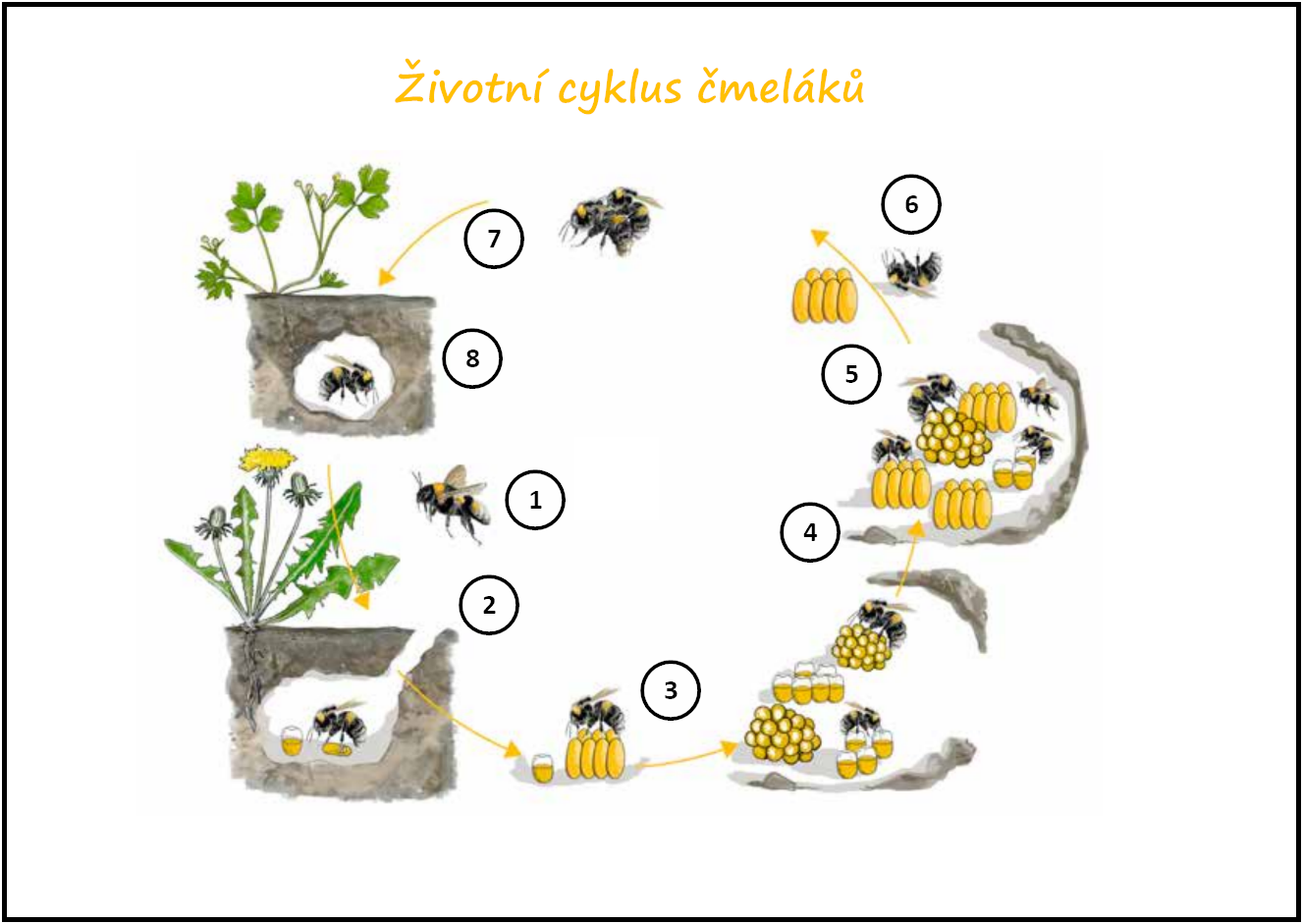
The life cycle of bumblebees – Source: Bees in the city of Wrocław Bumblebees
The queen mother awakens
In spring (March – May), when the soil warms up, the queen bee awakens from her winter sleep and visits early-blooming plants such as goat willow, dead-nettle, fumeworts, etc. Here she replenishes her energy reserves after long months of hibernation. Simultaneously with regaining energy, the queen bee waits for suitable conditions to establish a nest. Instinct (as well as a practical view of the matter) does not allow her to establish a nest when temperatures are low (she would not be able to warm the larvae of her offspring in it) and, at the same time, without enough food, she would not be able to feed them.
Interesting fact
- Mothers of different bumblebee species wake up at different times so that they timely catch the flowering time of their preferred plant species (e.g. dead-nettle).
- Bumblebee queens (see bumblebee parasites) hibernate at a greater depth so that the warmed soil wakes them up later, allowing them to find their corresponding host bumblebee species optimally when they are already in the stage of the first generation of workers.
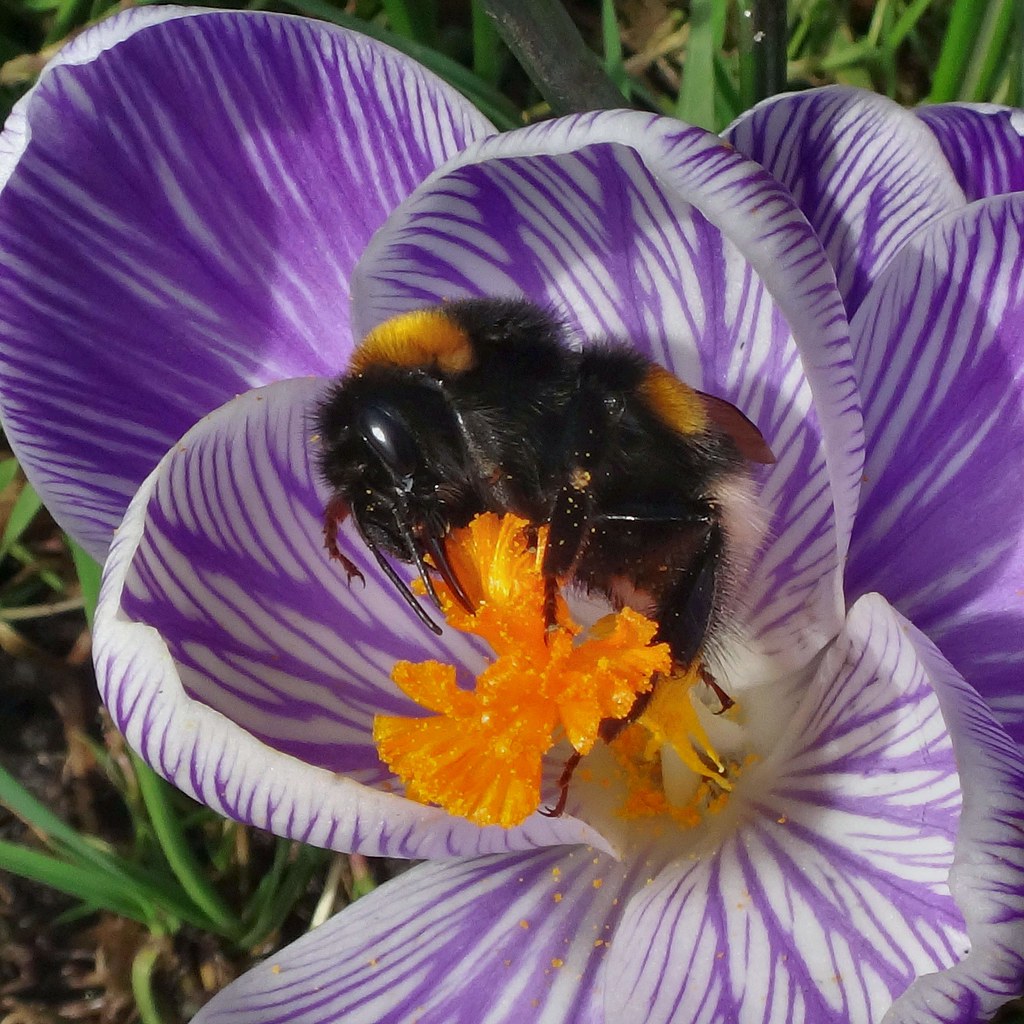
Bumblebee mother in spring – garden bumblebee (B. hortorum) – Photo Flićker
2. Nest building and solitary phase
When the queen mother recovers from hibernation and finds that conditions are favourable, she will gradually start looking for a place to establish a nest. Sometimes these phases can overlap. Thus, the queen mother will just survey the terrain and gradually return to interesting places when the right time to establish a nest arrives.
Interesting fact
- We can recognise the queen by her short search flight above ground – it doesn’t settle on flowers, but crawls into mouse holes and other holes in the ground, or into various openings, and then leaves them again to flit off and try another cavity
- Mothers of some species reliably return to the place where their nest was.
Nests can also be established in various abandoned dwellings of small mammals and birds that contain some heat-retaining material.lining).
Bumblebees are adapted to cold climates. They have dense fur or can regulate their temperature partially through muscle shivering. Unlike other insects, they can therefore be active even in low temperatures or bad weather. They are capable of managing cooler temperatures to a certain extent, even better than high temperatures. When building their nest, they anticipate that it will be exposed to cold in the spring, so it is necessary to provide thermal protection so that their brood can develop successfully within the nest. Therefore, queen bumblebees seek out cavities where thermally insulating nesting material is available. This is a difference, for example, from bees, which seek out empty cavities.
Bumblebees build their nests in various locations in nature. Either in the ground in rodent burrows, in hollows in rocks/walls, in piles of stones, in hollow trees, or in heaps of old dry grass.
If they nest near humans, they may make use of bird boxes, insulated spaces under the eaves of houses, an old blanket, or a piece of leather on a balcony, etc. They are not put off by glass wool either (see examples of rocky bumblebees in wall insulation). However, it could also be an upturned flower pot or a compost heap – in other words, places that remind the queens of natural nesting conditions. Each species prefers slightly different conditions and nesting sites; you can find out more about this later in the bumblebee species catalogue on our website.
When the mother queen finds a suitable location, she creates a small cavity in the lining, the walls of which she coats with nectar and wax to maintain the necessary temperature. It is indeed a small chamber, just large enough for the mother to turn around in, to lay the foundation of the wax structure of the nestworkwhich it can heat itself to the temperature required for larval development. The queen behaves energetically economically and knows well why. One reason among others is that the queen establishes her nest in the imaginary centre of the bedding, where she expects the least possible heat loss. The importance of nest thermal insulation is demonstrated by the following fact. Early bumblebee species require a sufficient amount of bedding, while later species can manage with a smaller amount of heat-retaining material.
The queen bee makes wax in wax glands on her abdomen, so-called. Exudates.The Vosk then spreads it across the bottom of the chamber with its bare, warm belly. It creates a firm surface – wax mat. Then they will build wax jug, into which it brings Nectar z květů. Nektaru zahuštěnému ve volátku a upravenému pomocí enzymů z ústních žláz se říká med. medicine. It is similar to bee honey and serves the same purpose – a food store. For a bumblebee queen, it is a reserve for the night and unfavourable days. Bumblebees use the sweet nectar as „fuel“ and power source – without it they can’t survive more than a few hours.
The mother queen will arrange the nesting material (lining) in a chosen nest for her own needs, but she is unable to procure such material herself and bring it into the nest. This applies to most species common in our country. Many a queen therefore cannot find a suitable shelter for the nest at all. If she finds a bad spot, which might get soaked or where the brood goes cold, she will abandon the nest after such a disaster. Either she dies herself, or she tries to invade an already established nest of another queen, where after a mutual fight, one of the rivals is either driven out or killed.
Interesting fact
- Sometimes, more than one dead queen can be found in a nest, with one living one – the victor. Occasionally, a situation arises where more than one queen bee establishes a nest, sometimes even of different species. However, this situation doesn't last long as the queens will eventually meet. This encounter and cohabitation then ends in a fight and the death of the weaker one. Sometimes, however, mutual injury and the death of both queens can also occur.
- Jaromír Čížek repeatedly observed that more dead queens and one victorious queen – usually of the largest late species – were found in and around the attractive natural nesting site.
- Common „flatmates“ in nests are mothers of the field bumblebee (Bombus pascuorum), which stand no chance in a fight with a larger species. Therefore, they are only temporary flatmates.
The queen bee is still alone – we're talking about so-called. single phase. The same bee – controls the nesting cavity, builds the wax structure of the nest, carries nectar, warms the eggs and subsequently feeds the hungry larvae. When moving outside the nest, it is threatened by enemies of bumblebees and can easily become food for birds (shrikes, sometimes tits, and from rarer species, for example, bee-eaters).
Into all of this, she must contend with the attempts of bumblebee queens of the same/different species to take over her nesting site.
Because of this, the solitary phase often ends in the destruction of the nest.
3. Care of the first generation of workers – the end of the solitary phase
Shortly after the mother found a nesting site and built a honey pot, she laid the first eggs (6–10) do Mischief from wax to a wax pad, which it then also seals with wax. This wax formation is called cell.
Is he already collecting pylon, which brings to the nest in the form of Pollen masks on its hind legs.
The pond mainly serves as source of protein, but also other substances that are essential for the development of the foetus. Besides the queen's flight pattern, the presence of pollen baskets on her hind legs is a clear signal that the queen is already nesting.
The chicks will hatch from the fertilised eggs in 3–5 days chucks, which the mother warms with her own body to the required temperature of 29–30°C and feeds them a mixture of pollen and nectar that she still collects daily.
Bumblebees are among the insects with complete metamorphosis and the development of individuals has four stages.
First stage It is an egg that is white, slender, slightly curved and 2–3 mm long. Usually, there will be more than one egg in a cell/case.
Second stage It is a white, legless, rather plump, and C-shaped larva that gradually grows. Large larvae, from which queens will hatch, can be 1.5–2 cm long at the end of the larval stage.
The larvae are always hidden in the wax casing in case. The mother opens the feeding case and then seals it with wax, protecting the larvae. Feeding holes only appear on older larvae.
Interesting fact
- According to the way the larvae are fed, bumblebees are divided into two groups
1. „Pocket makers“, translated as „Pocket builders“, creating wax pockets that adhere to the larvae's waxy coating. Pollen is then deposited directly into these pockets by the females, from where the larvae collect it themselves. This results in an uneven food supply and a greater variation in adult size, with some workers being almost as large as queens.
2. „Pollen storers“, translated as „pollen stores“..., the pods do not form and feed the larvae directly through an opening in the wax casing. Unlike the first group, they form pollen stores in pollen dishes. With this group, the difference in the size of queens and workers is usually clearly visible.
Third stage it begins with the larva weaving a silken cocoon around itselfcocoon), within which it gradually closes up and ceases to accept food. While forming the cocoon, the larva slowly rotates on its side. At the end of this stage, the larva stands upright with its head upwards. The cocoon obtains its typical oval shape. The mother-queen (or later a worker) scrapes wax debris from the original wax casing from its surface with her mandibles and recycles it for the construction of the wax sheath for other larvae. That is why Light yellow cocoons and not dark like other waxy casings with larvae and eggs.
Safely within the cocoon, the larva moults for the last time and becomes a puppet, which already has distinct signs adult – the head, limbs and other body parts are visible. This process is called metamorphosis. This stage It takes approximately 10 days.
The last fourth stadium is adult. He bores through the top of the cocoon with his mandibles. Lid, which it crawls out of. Sometimes the worker bees help it. The empty cocoon is then used by the worker bees as storage for pollen and honey.
So that an adult can more easily push through a small opening in the cocoon, its body is still soft. It is also not fully pigmented and is mostly whitish-grey in colour. The cuticle hardens and pigmentation develops over 24 hours, during which time the individual is most often found on the surface of the nest. Here, it has sufficient air to harden its body and wings, and at the same time has a chance of not being irreversibly damaged by the movement of other individuals in the nest.
Development time from egg to hatched adult worker is not fixed, as it is e.g. in honeybees, but depends on the species and external conditions, especially temperature. However, usually last 19–30 days.
Interesting fact
- Sometimes you can find individuals of different colours in a nest. If these are light-coloured individuals, or „uncoloured bumblebees“, then you've likely had the good fortune to find a bumblebee less than a day old.
Once the first generation of larvae cocoons, the mother queen can immediately start laying more eggs. These are often laid on top of the cocoons, where you can easily recognise new clutches. Again, she lays them in wax casings. Here the eggs hatch into larvae, they grow, the casings enlarge, they separate into individual casings and subsequently into individual cocoons – the cycle repeats and the nest grows. The wax work (nest) thus gradually grows in height and width. It is usually irregular – do not expect the construction of comb like that of bees.
Interesting fact
- According to the size of the cocoons, the sex of the larvae found inside can be estimated. The largest cocoons, distinctly separated from each other, are the maternal cocoons – from them, new mother queens, the largest individuals in the nest, will be born.
- Drone cocoons are usually smaller than queen cocoons and are often in clusters/columns.
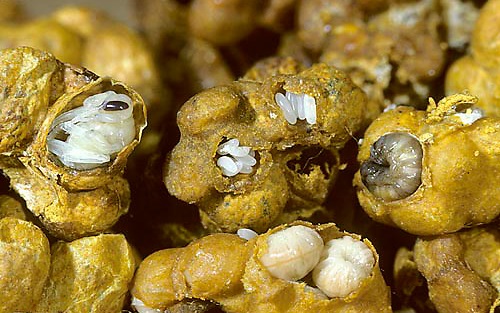
Larvae of the bumblebee Bombus impatiens (various stages) – Photo: Kuhn Photo
4. The nest is growing – end of the solitary phase
As soon as the first workers hatch in the nest, The solitary phase is ending. As soon as the worker ants are able to forage for food, the queen bee begins to focus solely on laying eggs and caring for the offspring.
It no longer flies out of the nest, except in very critical situations where the nest is threatened by a lack of food. This could be, for example, a significant drop in outdoor temperatures and a reduction in the number of flowers of so-called nectar-producing plants, the loss of several first-generation workers, or damage and weakening of the nest.
The establishment of a new generation depends on the queen, therefore she does not expose herself to unnecessary risk by leaving the nest, nor does she participate in the defence of the nest against an enemy attack. At such a moment, she instinctively hides beneath the nest. This is logical – her role is irreplaceable and the premature end of her life equals the end of the nest.
Interesting fact
- If a solitary queen bee is disturbed (especially in the early stages of nest development), she may permanently abandon the nest. Such a queen then usually becomes a so-called "wandering queen". She pretends to be looking for a new nesting site, sometimes trying to infiltrate other nests, but she will no longer establish a new nest and offspring.
The period during which The hen is laying eggs, from which more and more workers hatch takes approximately a month and a half since the first generation of workers hatched. During this time, their nest will produce several dozen to hundreds of individuals, depending on the species. Some workers focus on caring for the brood and the nest, others gather food (foragers).
The nest will gradually strengthen to be able to provide enough food for new queens and males (drones).
Interesting fact
- The workers also often differ in size. The first generation of workers is usually very small, but as the number of workers and thus the individuals caring for the nest increases, their size also grows. Therefore, you may observe a large variability in the size of individuals in the nest. The basic rule for identifying queens is their size, which significantly exceeds that of other individuals.
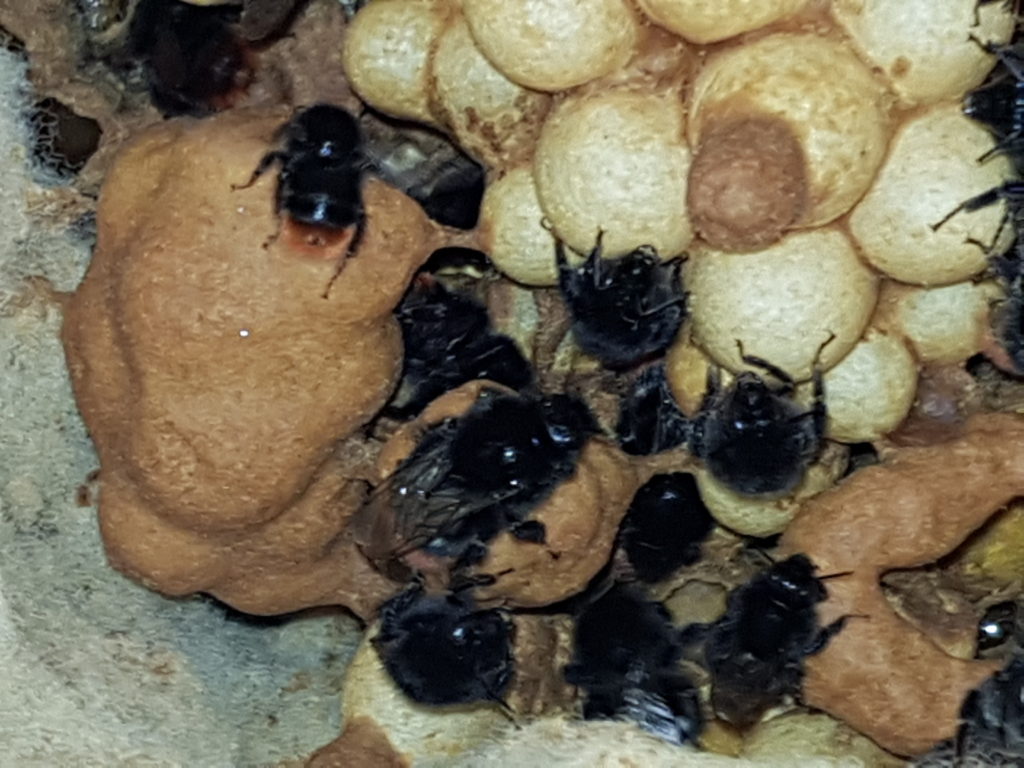
Red-tailed bumblebee nest (Bombus lapidarius) – Photo: O. Hercog
5. Birth of sexual individuals – new mothers and males
Once the worker production stage is complete, several changes occur within the nest. This is a period of reversals and the end of the romantic phase of the nest's peaceful growth. The pattern of these changes is not entirely identical across all species. Here, we will describe the course of development and changes in the nest of the buff-tailed bumblebee (Bombus terrestris).
The first change this is that all larvae, which come from fertilised eggs from the mother, and from which workers have hatched so far, start to be fed a greater amount of food so that new queen mothers hatch from them. This is the aim of the bumblebee's efforts, as they will then ensure the continuation of the species.
Interesting fact
- Similarly to bees, worker bees and future queens hatch from the same (fertilised) eggs. Their designation as worker or queen is primarily determined by how the larvae are fed.
After a few days of hatching, the new queen bees leave their natal nest and begin to search for males outside the nest to mate with unrelated individuals. They return to their natal nest at night, where they wait out the darkness and any adverse weather conditions.
During this period, the mother queens also build up sufficient fat reserves, which they need for successful hibernation – they fatten themselves up.
Interesting fact
- Queens mate, with exceptions, with only one drone (depends on the species)
- Males (drones) can mate multiple times, unlike drone bees, for whom mating means the end of their lives.
- The relationship between new queens, of which there can be several dozen in a nest, is friendly towards their mother and towards each other. Rivalry between mothers only arises in the spring at the start of the next season, when two mother-queens (even if they are sisters) can no longer tolerate each other in the same nest.
Once the queen mothers have mated, it's time for farewells. Before they leave their birth nest for the last time, they fill their honey crop with honey and leave it permanently. This usually happens within ten days of their birth.
Interesting fact
- Mated queen bees often become so well-fed that their departure from the nest is complicated – they are so heavy that they sometimes only manage it after several attempts and need to climb to a higher place to fly.
- A mated queen can be recognised relatively safely by the fact that she is always accompanied by mites of the genus Acarina in her nest before she leaves. These mites then travel with the queen to her hibernation site and subsequently to the nest that the queen will establish in the spring of the following year.
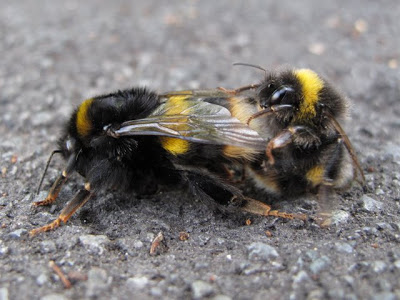
Bee mating – Photo BugBlog
Interesting fact
- Cases have been recorded where some young queen ants behave like workers, helping to care for the brood in their native nest. The future of such queens is unknown, but they presumably fail to fulfil their queenly mission, meaning they do not mate and establish a new generation. They may become 'old maids' – they do not find a male in time and gradually become less attractive due to a decrease in their pheromone levels.
- Similarly, young queen mothers can also be found in the nest, and they do not leave the nest. They may have some (often invisible) damage, and nature no longer counts on them.
- Breeders have sometimes observed situations where young queens of certain species (e.g., the field Common carder bee – *Bombus pascuorum*) have tried to hibernate in their natal nest.
- Unmated females do not survive the winter in the wild, or at least it is not known for them to have done so.
Second changea in the community is that the queen mother, who has so far only laid fertilised eggs, will also start laying unfertilised eggsHaploid eggThese hatch into males, or drones.
These two changes, when a bumblebee nest begins to raise sexual individuals, are called point of no return (switch point) signifikantní nevratné změny v hnízdě.
Third shift This consists of a change in the colony's behaviour. The founding mother-queen has, until now, truly ruled the nest with her pheromones, managed its affairs, and imposed order with her dominant behaviour. However, the production of her pheromones declines with age, and the harmony of the nest begins to dissipate. In the workers, this leads to the development of their ovaries, which the mother-queen's pheromones had successfully prevented until now.
The workers, who up until this point have been diligently caring for the queen's offspring, gradually „rebel“. Restlessness can be seen and heard throughout the nest – the nest buzzes strongly, and the workers scurry about restlessly. The signs of disharmony are therefore very clear and resemble the state when a bumblebee attacks the nest (see bumblebee parasites and enemies).
The workers continue to care for all the larvae in the nest, but they begin to compete with each other, and also with their own mother, for the chance to lay their own (unfertilised) eggs. Physical attacks between workers, and between workers and the mother, occur, along with the stealing and eating of others' eggs, often during the process of them being laid. The romance of the nest is therefore definitively in the past.
This period is called competitive phase and persists until the nest dies in the summer, or in the autumn.
Interesting fact
- If the workers manage to lay and defend their eggs, only males (drones) hatch from them. This is because they are unfertilised eggs (the workers have not mated). The workers are, in effect, giving birth to their own brothers. Paradoxically, this is most successful with weaker workers, who subtly lay their eggs somewhere on the edge of the wax comb of the nest. In the centre of the comb, the strong, dominant workers fight amongst themselves for status, consuming each other's eggs in an effort to promote „their own bloodline“, even though they are sisters.
6. The queen mother (founder) weakens and dies
Sometimes during the competitive phase, the old mother queen dies. Her role is over and it's time for her to leave. She is exhausted, weary from the escalating attacks of the workers, whom she has gradually ceased to control with her pheromones. Although seeing the mother leaving the nest is one of the most powerful moments a bumblebee keeper can experience, it is not sad. The mother has succeeded and is returning to nature, with which she will soon merge.
Interesting fact
- The rivalry between the worker ants is such that if the queen mother does not leave the nest herself, they are capable of dragging her out of the nest, or even killing her within the nest.
- The departing mother queen is visibly worn out, often with bald patches, with chewed wings, and crippled.
7. The nest is disappearing
The last males, born from worker eggs, leave the nest and seek out females in the wild to mate with. Males in the wild gradually die off, They live for around one month..
The workers in the nest are ageing and dying, the fledglings are gradually disappearing, not returning from flights – new workers are no longer being born. The workers can continue to exist for several weeks after the mother's departure and keep the nest alive before they die in the nest of old age. However, none of them will survive the winter, just like the males (drones). The only ones who will survive are the fertilised young queens. This will close the bumblebee nest cycle.
The nest decays and deteriorates – becoming mouldy, or possibly cleared out by cuckoo bee parasites. This creates a space where, for example, rodents might bring in new material, which can then be used again the following season by another bumblebee family.
Interesting fact
- Although we consider parasites like the Greater wax moth (Aphomia sociella) to be pests to bumblebees, their role as a clean-up crew should be appreciated here. Their larvae consume a large part of the wax structure as well as dead bumblebees within the nest.
- Under favourable conditions, some bumblebee species can establish a second generation of nests. However, it is not known how many second-generation queens manage to bring their nests to a successful conclusion, nor how many of their daughters manage to mate in the wild and survive until the following spring.
8. Overwintering of queens—future founders of a new generation
Young queen bumblebees, after mating and leaving their natal nest, find a place to overwinter (a hibernaculum). Very often, they find such a place at the edge of a wood, sometimes in dry compost, etc.
However, it is always a place with material that allows them to hide underground (e.g. pine needles, dry loose soil). The mothers hope that rainwater or melting snow will not wash them out, as the hibernaculum is just a cavity in the ground with no thermal protection.
Young queen mothers begin hibernation as soon as possible after mating. They do not expose themselves to unnecessary risk of injury or loss of life. This means that mothers sometimes hibernate from as early as July until March/April of the following year.
Interesting fact
- Cases have been recorded where a mother wakes up during the summer and returns to her native nest in an attempt to draw energy as easily as possible from the remaining honey stores.
- Under laboratory conditions, the mother can also be hibernated for 12 months.
- Maternity queens overwinter in the ground, below the frost line. The chemical composition of their blood during hibernation, however, allows them to survive complete freezing of their bodies.
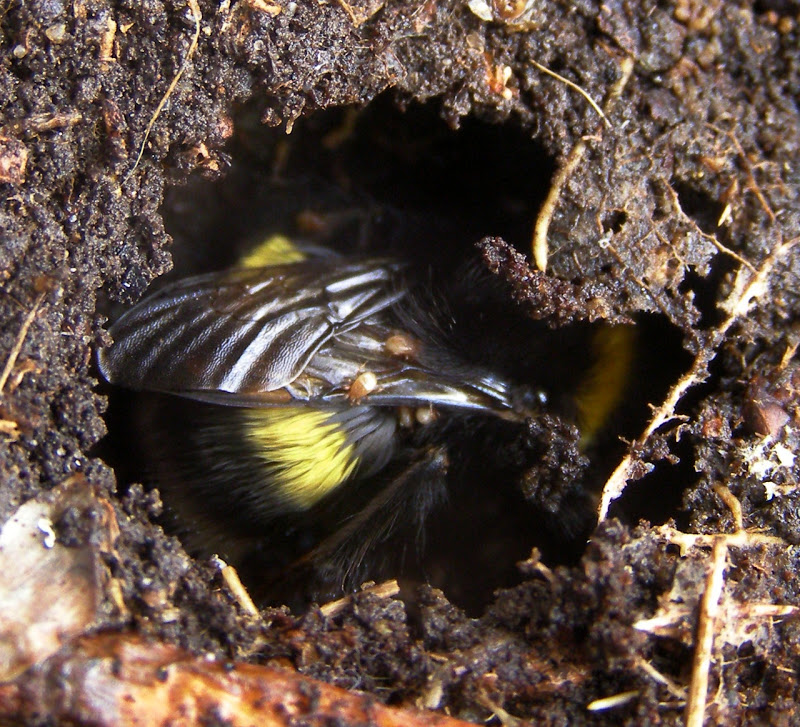
Bumblebee queen in hibernation