



Introduction
The significance of the lining in a beehive and the colony's life cycle
What places and locations do bumblebees seek for nesting, as described in the chapter? The life cycle of bumblebees. .
You can read more about the places where specific species nest in the chapter . .
All these places have one thing in common, however – bumblebees will only nest where they can find suitable material in the cavity to build their nest. This sets them apart from honeybees, which in the wild always build their nests in empty cavities.
When building a nest, bumblebees account for the fact that it will be built in the cold and therefore needs to be thermally protected so that their brood can develop successfully in the nest. Therefore, they seek out cavities where thermally insulating nesting material is available – thermal lining.
Interesting fact
- Only a few species of bumblebee that nest on the ground are able to gather nesting material from nearby and accumulate it at the nesting site (not bring it from a greater distance). For example, the field bumblebee (Bombus pascuorum).
- This one can nest in a heap of dry grass and moss, which it uses as lining. It anticipates that its nest might be damaged by some external influence, and therefore its workers can return material to the nest and cover it. Other species can't even manage that.
Bumblebees therefore need this lining to keep their brood (offspring) at the right temperature; this is absolutely essential for their development. The heat-retaining lining primarily insulates the wax structure of the nest (the comb) from the cold, but it can also insulate it to some extent from high temperatures. At higher temperatures, physics comes into play – the evaporation of water from the surface of the lining lowers its temperature.
This is why the mother queen instinctively establishes her nest mostly in the imaginary geometric and „temperature“ centre of the brood volume, as this is where she expends the least energy in maintaining the correct brood temperature.
If there is a small volume of bedding in the nest (a small nest volume, or little bedding), the nest can experience temperature fluctuations. This is just as bad as the nest becoming too cold or too hot. Nests with a good thermally insulating construction provide an advantage, along with good bedding, to bumblebees and their keeper.
You can read about the thermal insulation and construction of the hive in the chapter
Interesting fact:
- The bumblebee queen sometimes establishes her nest in insulation at the bottom of a hive. This occurs when she finds the necessary “thermal comfort” there.
- Take a look at this interesting study by Jaromír Čížek, who created different temperatures on the base of a bumblebee nest in the laboratory and observed which temperature conditions the queen chose. You’ll find the article later
- In laboratory breeding, heat-retaining bedding is not used at all; the temperature in the bumblebee enclosure is regulated to ensure optimal development.
As the nest grows, bumblebees expand the nesting cavity, remove material from it, reinforce the roof of the nesting cavity with wax, and so on. As soon as a gap appears in the nesting material, they immediately cover it and prevent the escape/entry of heat. Simply put, they constantly work with the nesting material as a „duvet“.
Because the queen bumblebees are still working on lining the nest, they are best suited to a material that they can easily chew through, which does not contain long fibres, is soft and gentle. The worker bees create „curls“ with the lining material by scraping it under themselves with their feet, and are able to transport material in this shape both inside and outside the nest.
As they enlarge the nesting cavity for their growing brood, they carry the nest lining to the surface of the nest. If there is no more room, they will carry it out of the nest and drop it in flight. Sometimes they simply push it out.
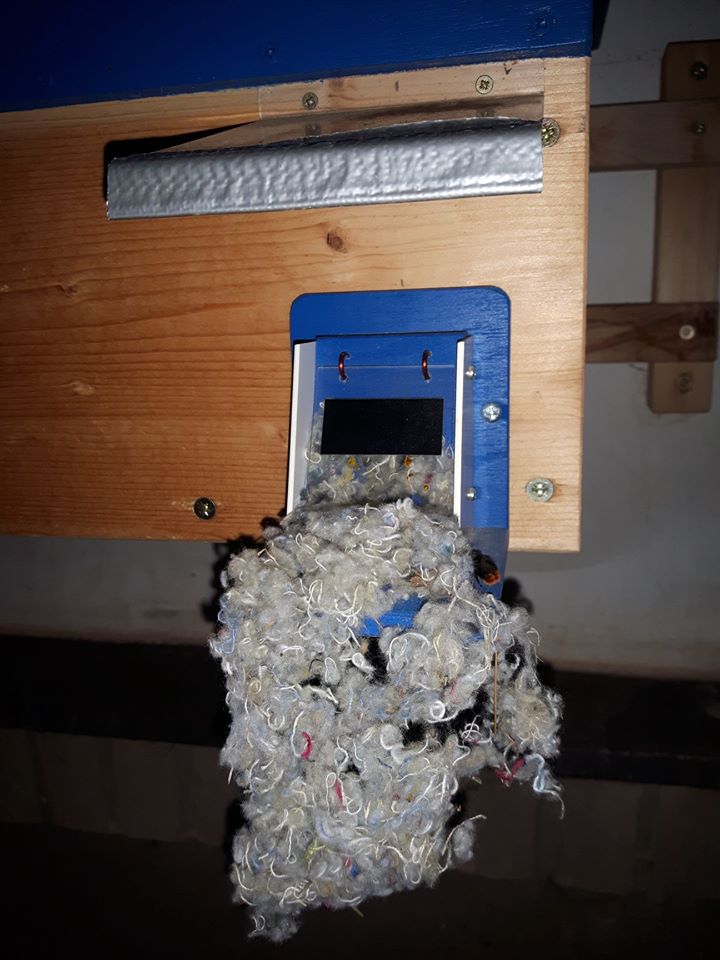
Bumblebees transport lining out of the hive – photo. O. Hercog
Interesting fact
- Sometimes the worker bees can bring out so much material that it looks like something out of the fairy tale „Little Pot, Cook!“. We most often observed such activity at night and with strong nests of buff-tailed bumblebees.
- Sometimes the female workers seal off sections with lining at night. Plugged ventilation opening. Cork then, when it's on The operation of the hive will remove it. It does the same when the nest is weak and it is cold outside.
In some older guides, you will read that it is advisable to remove the lining at higher temperatures. However, practice shows that this is not a suitable solution, and it is better to leave enough lining to provide protection for the bumblebees and only check that it does not cover the ventilation opening in the hive.
Recommendation
- Do not remove the lining from the nest on hot summer days – it still protects the nest and provides thermal insulation
What material to use as a heat-retaining lining in a bumblebee nest
Different breeders use different materials. The right material but must always meet the following parameters:
- The key is the airiness and fluffiness of the material, where air serves the function of insulation, just like in a sleeping bag.
- It must be dry.
- It must not be greasy or mouldy.
- It must not contain chemistry, nor be chemically treated or washed in it. Therefore, it must not be synthetic fabric.
- The material must not smell (rot, mould, chemicals, etc.).
- It must not contain long fibres or threads that bumblebees could get tangled in.
- The material must not fall into the cells in the nest, where it would hinder the development of the offspring.
- Bumblebees need to chew through materials, which is why natural materials are suitable.
Interesting fact
- Remember that bumblebees navigate their nest primarily by scent. Any scent other than that of the nest makes it difficult for them to orient themselves within it, and this is one of the reasons why they will avoid a nest with an offensive smell.
- Rod hlodavců it is an attractant only for species that live in the burrows of small mammals, so it is not a universal „lure“ for all bumblebees
As the most suitable and readily available known material, we find 100% raw natural cotton. For example, a product currently on the market is designated Lintran.
This is an eco-friendly filling material made from 100% cotton. It is designed for use as filling in soft toys, dolls, cushions, beanbags, etc., or as natural bedding for small pets. It is non-toxic, safe and environmentally friendly. It is a Czech product.
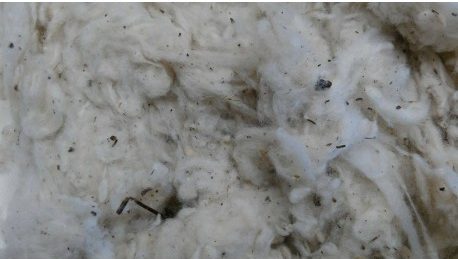
Lintran in the quality sold
Although raw cotton is very soft, it needs to be thoroughly torn into small pieces before use, see # Lining modification before use. In any case, long fibres must not remain in the raw cotton either.
We tested successfully processed sheep's wool. The preparation for that is rather laborious – it must be thoroughly degreased (washed in curd soap), dried, shredded, and cut. But then it works wonderfully and is a durable and reusable ecological material.
The cutting board should ideally be light-coloured, so that any parasites are visible and the clean and dirty parts can be distinguished.
You can read about preparing sheep's wool in the section Sheepskin lining.
Some breeders use Mecha so they put it at the bottom of the hive in the corners. Bumblebees sometimes defecate here, and the moss dries these spots. The moss acts antiseptically and prevents the development of mould. However, we would like to note that forest moss is protected by law. Therefore, you can use dry moss from your garden, perhaps raked up during autumn maintenance. The moss should be free of soil, dust, and grass remnants. Also, bear in mind that a number of invertebrates live in moss.
Moss can also be placed on the top side of the lining. However, bumblebees will chew (shred) the moss, and if you are inspecting the nest, pieces of moss will fall into the open cells of the wax comb containing nectar and pollen stores, which is undesirable.
Warning
- When you decide to use moss, please use it only on the top of the lining, but do not use it in the entire nest. Use raw cotton / sheep's wool as filling. Otherwise, the moss will fall into the cells and the brood in the nest, and that is not good.
- Moss from chemically treated lawns cannot be used as a range of chemical substances work by contact and the substance can remain contained within the moss.
Examples of unsuitable materials:
We do not recommend adding clay, sand, wood shavings, or sawdust. Such material would spill into the workpiece (into open wax cells). We may occasionally read this in various advice columns, but it is outdated. Furthermore, the material does not meet the basic condition of good thermal insulation.
Horse or sheep hair, and dog or similar fur are also unsuitable. Such material, once cut, turns into stiff spikes and is harmful to bumblebees – we've tested it. Bumblebees cannot process such material into curls and work with it (see previous text). .
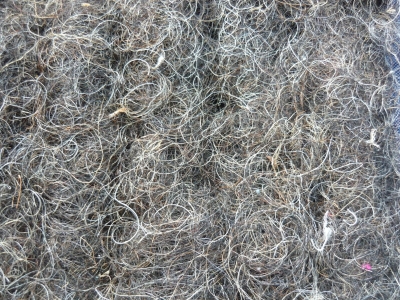
Horsehair is an unsuitable material
Internet source
FOTO HAMMER – bristles
Another disadvantage of these materials is that along with fur, you often carry moths and insects that feed on skin and fur remnants into the nest. These creatures pose no threat to bumblebees, but the nerves of the beekeeper are certainly at risk – you are then faced with the question of identifying the species of parasite or its larva and whether it is indeed a parasite or just a fellow lodger of the nest… You can read about fellow lodgers in bumblebee nests. .
Even plain cotton wool won't do – they're just dangerous fibres. Cotton wool would need to be very thoroughly cut and prepared like Lintran if no other material were available.
Grass and hay are also unsuitable. We found that they tend to encourage the development of moulds that grasses carry. Paper is also unsuitable, especially printed paper – it contains printing ink and is also prone to mould.
We also shouldn't use any synthetic materials. This is because bumblebees diligently process the lining when building their nest, tearing and chewing it, which doesn't work very well with artificial materials.
Definitely do not use glass wool, even though bumblebees sometimes nest in it. Wood wool, blankets, or furry skins are not suitable. Such material would make it impossible for you to carry out an inspection.
PHOTO RECYCLED FABRIC
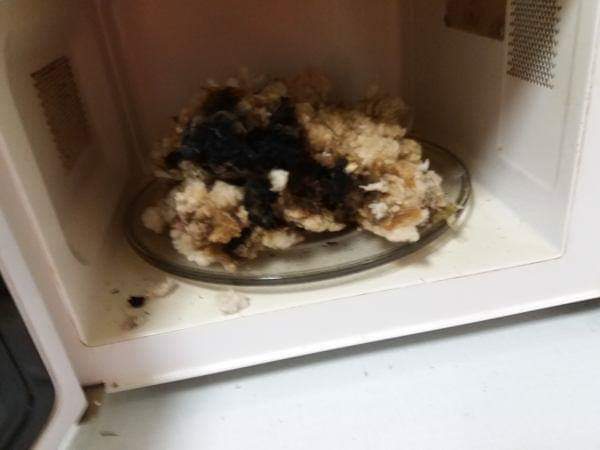
Last year's liner – sanitising in a microwave, too intense heating…
Photo – author at the request of his wife and domestic peace are not included...