



DIY polystyrene bumblebee nest construction guide
What you will learn here:
- Advantages and disadvantages of polystyrene hives
- Fundamental construction design of a beehive
- Analysis of the knowledge and equipment required to decide whether or not to proceed with construction
- Detailed constructional design
- preparation of a hive for the season and specifics of its use during breeding
Contents
- Advantages and disadvantages of polystyrene beehives
- Hive characteristics
- Video guide on preparing the beehive for the season and user recommendations for care during beekeeping
- Fundamental structural design
- Minimum technical skill required for successful hive construction, or should I attempt to build it?
- List of materials
- List of tools
- In-house construction procedure
- Attachments – cutting drawing and video documentation of the workflow
Last updated: 17/04/2026
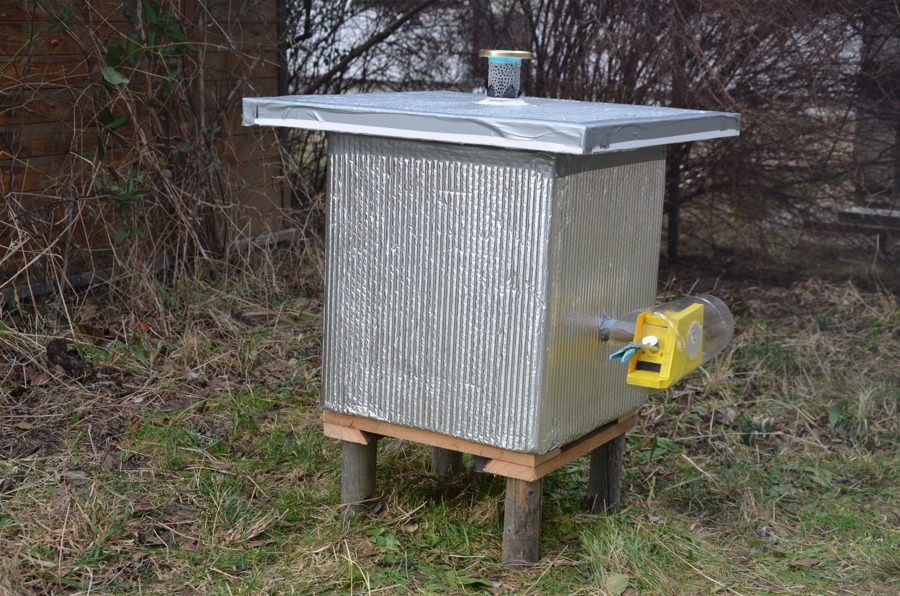
Advantages and disadvantages of polystyrene beehives
Advantages
- Easy construction design
- High construction accuracy and hive tightness
- Excellent protection against parasite ingress while maintaining the construction.
- Ageing stability, hive lifespan
- Low weight compared to other hive types of the same size
- With correct construction, excellent thermal insulation properties, which allow the hive to be placed anywhere in the garden. (full shade not necessary)
Disadvantages
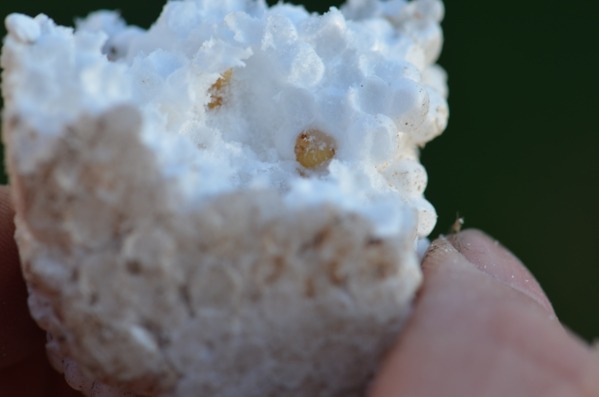
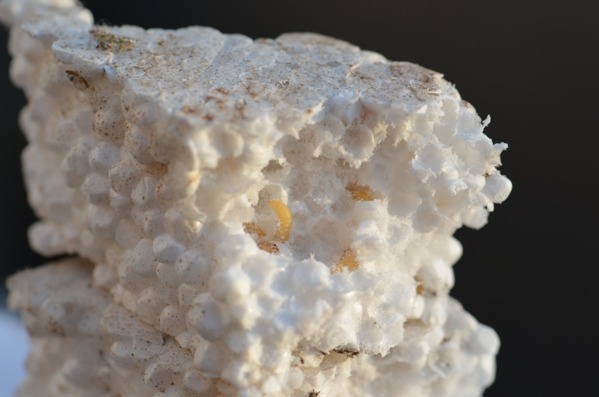
- Polystyrene is a nutrient material for the most common bumblebee parasites – the larvae and caterpillars of Antherophagus pallens (nigricornis) and Aphomia sociella.
- Lower impact and drop resistance compared to wooden construction.
- The walls cannot be repaired with heat/flame; water is used.
- Wool must be stored out of reach of rodents in places where food is scarce for them. It can be left outdoors all year round.
- The initial price costs are rather higher compared to the wooden version.
Hive characteristics
Insulation properties:
- A multi-layered wall system with a sealed air pocket ensures maximum thermal insulation properties. The wall composition, from the outside to the inside, is: an aluminium reflective foil for radiant heat, insulating bubble wrap, a protective concrete render of 3-4mm, 30mm layers of polystyrene, a 20mm sealed air pocket, 30mm of internal polystyrene layers, and an internal concrete render with a minimum thickness of 4-5mm. This is a multi-layered system with an overall width of almost 90mm.
- Internal concrete plaster protects the polystyrene, acts as a strong thermal mass for moisture, which improves the microclimate. External plaster protects the perimeter structure and guarantees its stability.
- The system is hermetically sealed apart from construction openings; it does not undergo thermal or moisture expansion.
- In case of a very cold spring or spring frosts, a warming gel pad (a bag with gel which gradually releases heat after warming up) is placed on the top grate. This way, the hive can safely maintain its internal temperature for at least 12 hours without the need for additional heating or other thermal protection, moving the hives to rooms, etc.
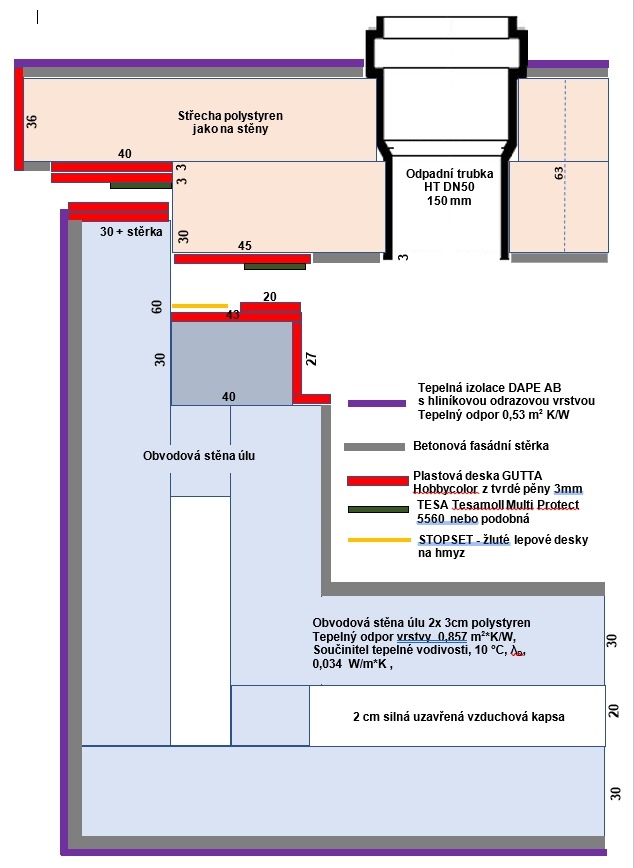
Hive layer diagram
Internal fittings are missing
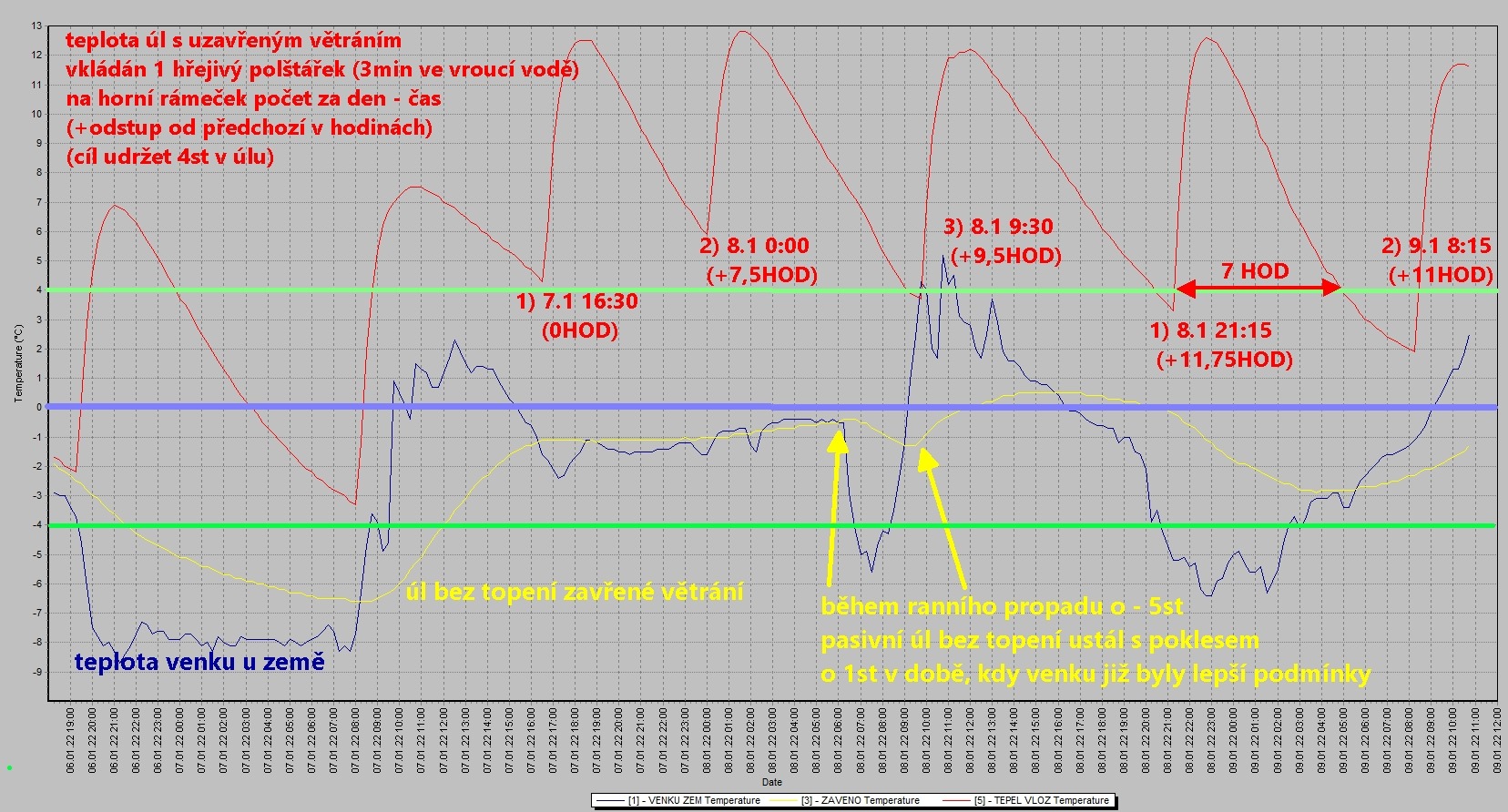
Testing hive behaviour during frost in January.
One gel insert heated for 3 minutes in boiling water.
With three shifts of 8 hours each, it was possible to maintain a temperature above 4°C in the hive even in January.
Anti-parasitic and sanitary protection:
- Breeding takes place on a fine wire mesh, where condensation water, small waste and some parasites (typically mites, larvae of Antherophagus nigricornis and fly pupae) fall through to the floor, which has a sloped waste channel in the centre with the possibility of cleaning even during the colony's lifetime. The mesh also serves as a bumblebee lift for deep nest inspections.
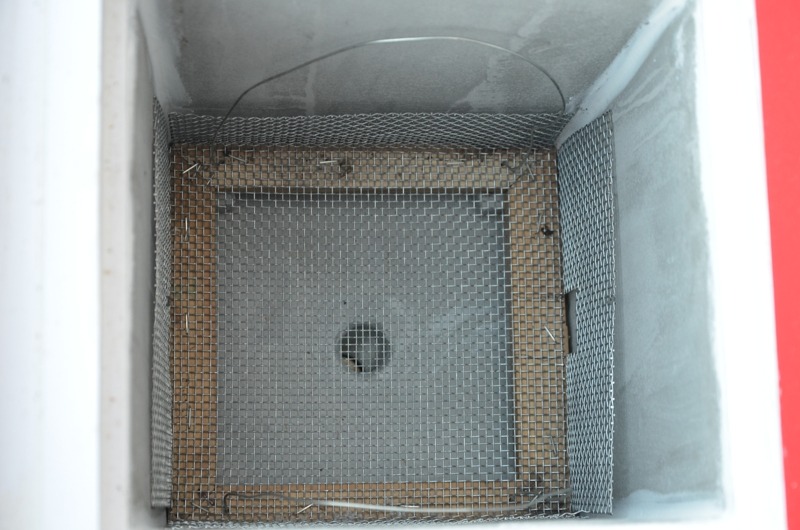
brooder grid
unique combination of a breeding mat and a safe lift for nest inspection
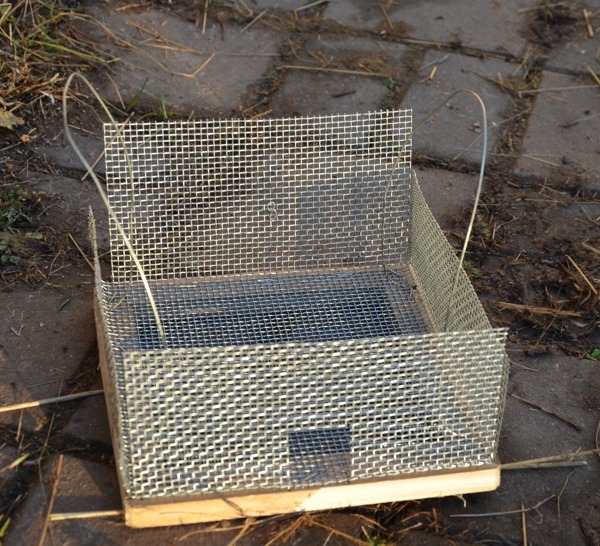
The nesting grate also serves as a safe bumblebee lift
Here outside for a check
- Roof access is provided by a stepped lock-type structure with multiple protections, including a sticky trap. The pest would thus have to overcome several obstacles. The system eliminates odour leakage (scent trails). The upper protective mesh prevents bumblebees from entering the ventilation.
- Ventilation protected by an interchangeable Uhelon 53S mesh, supplemented by a fine mesh for protection against larger pests.
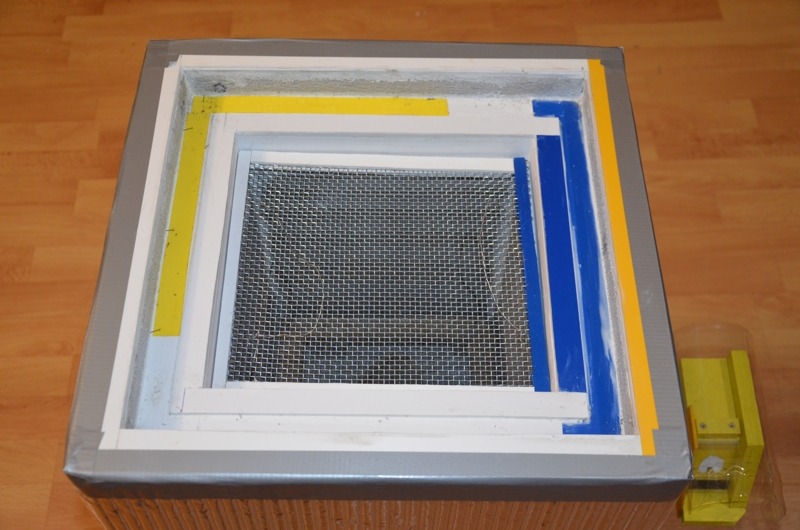
top hive solution
Castle protection, yellow sticky tape indicated in the corner
Nesting net
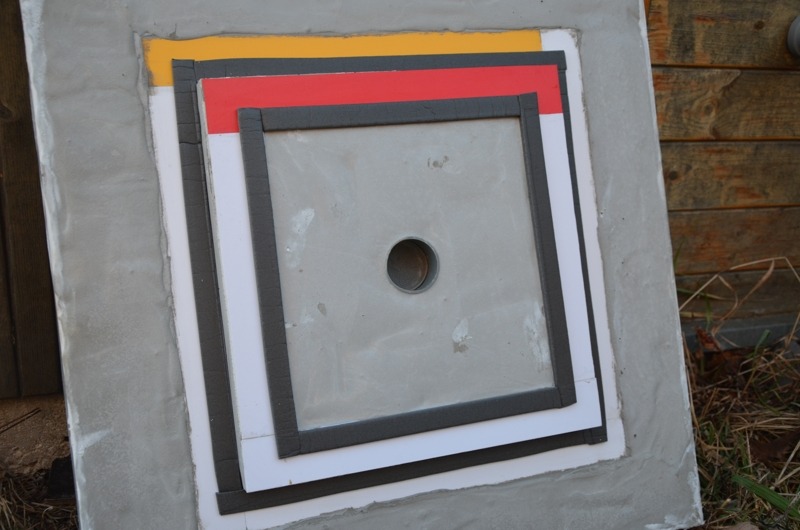
Roof finish
Multiple protection
- All passages made of smooth, easy-to-clean parts, accessible even during colony operation.
- Interior space as accessible as possible, cube-shaped for easy maintenance, cleaning, and inspection.
- All internal components removable.
- The feet of the lower grid of the 2x2x2cm cube made of residual polystyrene serve as an accumulator for Antherophagus nigricornis larvae (they are disposed of after the season).
- Minimum length corridor for optimal maintenance. The pipe system is designed to be firmly gripped by hand in case of stiff couplings (this prevents the pipe from loosening in the hive). The clear and straight design prevents the risk of the corridor becoming blocked and allows for easy cleaning even during the season.
- After the season, the inner hive is filled with water and left to stand until all parasites and mites have drowned. The inner walls are easily cleaned with a dish sponge.
Hive ventilation
- Ventilation routed through the roof for maximum efficiency and easy cleaning during the colony's lifespan. All ventilation components are easy to survey, dismantle, and quickly clean, even during the colony's lifespan.
- Open top grille providing ventilation protection, can be supplemented with an external grille with activated carbon for night-time hive cooling with the roof open.
- Underground drainage channel connectable to a hose laid underground, serving as an earth conduit (cooled air) to increase ventilation efficiency when needed.
- Ventilation system designed to operate across the largest possible area of the hive. (bottom – roof without the possibility of bumblebees blocking it).
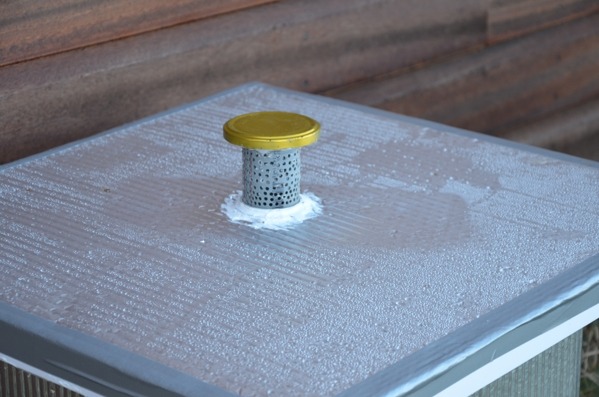
hive ventilation
easily fully cleanable during breeding
With a trap for parasites and at the same time protection of the activated carbon from both sides
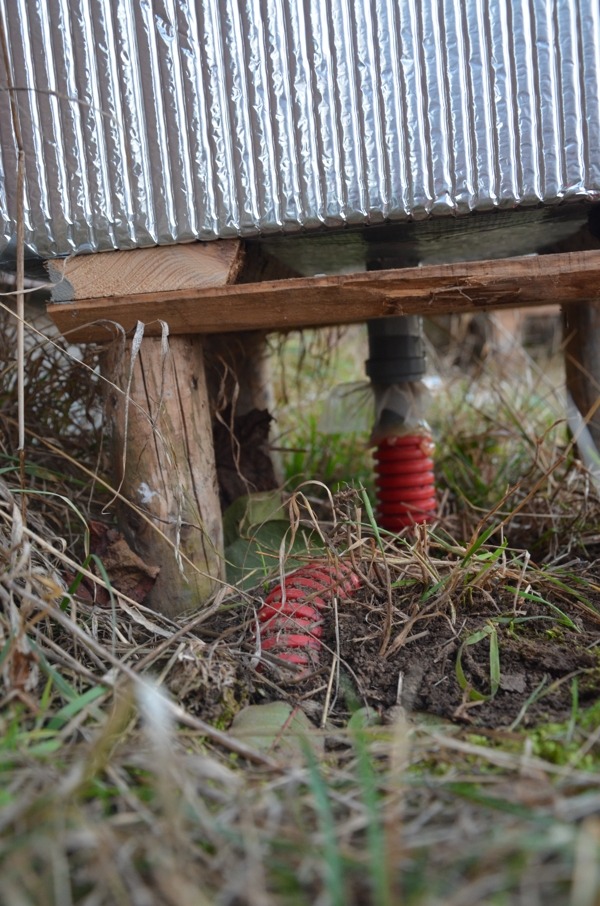
Bottom waste pipe
connected to a ground heat exchanger for cooling the hive during tropical summers
Fundamental Construction design
- All polystyrene parts must be covered except for the side edges of the inner lid
- Internal walls must be skimmed with facade plaster/cement-based adhesive. This is an absolute necessity for the internal construction of the beehive, at least in 2-3 layers with a total thickness of at least 4-5mm.
- Twice the above applies to the execution of the hive's internal bottom.
- The external walls must also be rendered with a cement-based façade render. A thinner layer, in at least two coats, will suffice here.
Warning
If a breeder doesn't want to or can't perform thorough hive scraping, polystyrene hive unsuitable for breeding, or rather, it's a single-use polystyrene bait. For the next season, the polystyrene A poorly protected wall becomes a pantry and storehouse for bumblebee parasites, which will destroy the colony in its solitary phase the following year. Such a hive is therefore more of a bumblebee trap and a completely unnecessary investment and effort for the beekeeper. Polystyrene protection is absolutely essential.
Many of our observations have demonstrated that the larvae of the bumblebee parasite Antherophagus pallens (nigricornis) and the caterpillars of Aphomia sociella both feed on polystyrene and use it as a shelter at the same time. Badly applied render, or render that is too thin, allows parasites to burrow into the polystyrene wall, which they then consume – it is directly food for them. It is impossible to get them out of the wall and they are devaluing the wall. In the following year, these parasites then threaten the colony right at its most vulnerable stage – the solitary queens. It doesn't matter what type of polystyrene construction is used (grey, white, red, green). The parasites don't care how the polystyrene is compacted or finished.
- It was designed based on Karel Kučera's experience with beekeeping in these types of hives. The design incorporates solutions for a number of risks (increased humidity, lack of breathability) and challenges encountered from these beekeeping practices, as well as insights gained from keeping bees in traditional wooden hives. To fulfil the expectations, it is necessary to adhere to the construction design of the walls and openings, and to maintain the material quality.
- In contrast, the dimensions can be adjusted to the available size of the polystyrene boards.
Minimum technical skill required for successful hive construction
Or should I start building?
The aim is not to deter potential builders, but to be fair and lay out all the cards on the table. We all have different means and abilities, so it's good to consider, before buying materials and starting construction, whether our own skills will be sufficient to bring the project to a successful conclusion.
If we are in doubt, it is better to use our time differently, more effectively, without wasting money that could be spent on purchasing a ready-made product. When manufacturing a single beehive, especially if the constructor does not have much equipment (an overview is provided below), self-manufacturing does not represent a financial saving compared to purchasing a ready-made product – quite the opposite in fact, and the result could be rather disappointing for both the creator and successful bee keeping. We discuss the parameters of commercial beehives and how to choose a suitable hive in detail in the section for beginner bee keepers.
So what needs to be mastered for hive construction?
- measuring using set squares, orientation in a simple technical drawing, spatial reasoning
- straight, perpendicular, and precise sawing of boards, working with a mitre saw, cutting using a crosscut saw
- Hinges for large openings, 30mm diameter and above, with high precision
- Bonding larger areas
- Rendering smaller areas / repairs to damaged plaster
- working with wire / wire mesh – cutting or shearing, shaping, working with an angle grinder
- working with a hot glue gun
- plastic pipe processing – cutting, grinding
- the ability to assemble a simple wooden frame and make a simple table
List of materials needed to produce one beehive
The bolded items are material parameters that must be adhered to
- 3k polystyrene 30mm strength board, dimensions 1250 x 600mm TECHNONICOL CARBON ECO F, thermal resistance of layer 0.857 m2Thermal conductivity, 10 °C, λD, 0.034 W/m·K, compressive strength at 101°C and 3°C with a compressive load of 200 kPa, grooved façade panels
- 50,000 construction nails, approximately 6cm in length
- 1kx polystyrene glue without a foaming effect Used universal adhesive Roxolid UNI FI-X 180kg/m2
- 1kg acrylic filler for dry construction on plasterboard Soudal
- 1ks Textile Waterproof Adhesive Tape for Exterior Use 50mm x 5m 3M
- 1000 DN 32mm overflow pipe 1000 mm length
- 1 pc HT 90° elbow DN 32
- 1000 Internal plug for HT sewage pipe DN 32mm
- 1000 DN 50mm soil pipe 150mm length male – female
- One screw-on (jam) lid from a 1-litre jar (e.g. for honey, pickles)
- 1kg Polystyrene Adhesive WEBER CZ 700 25 kgcement-based facade adhesive render)
- 1 piece planed wooden lath 15 x 30 2000 mm spruce
- 2 silver staples for staple gun 8-10mm staple height
- Galvanised wire mesh, 3.15×0.8mm mesh x 300 mm 600 mm (beekeeping supplies)
- 2 sheets insect mesh aluminium or galvanised 150mm x 150mm (or 1 sheet 200mm x 200mm approx)
- 1000 Plastic board GUTTA Hobbycolour from rigid foam 500 x 1500 3 mm smooth, white (smaller boards acceptable, but with corresponding surface area)
- 1000 Plastic board GUTTA Hobbycolour of rigid foam 500 x 250 x 3 mm smooth, coloured
- Thank you Uhelon 53S approx. 150 x 150mm
- Two pieces of thin-walled plastic packaging (ideally black, e.g. from parcel packaging) 150x150mm
- 4-5 hot glue sticks diameter 11mm
- 1 thermal role DAPE AB vapour barrier insulation (4.8 m²/W) Thermal resistance 0.53 m²K/W2 To/from,
- 1bal Window and door rubber seal Tesa Multi Protect 4m, 20mm:5mm or equivalent – straight rectangular profile width 10-20mm height 3-5mm
possible, but untested alternatives: CONTEGA FIDEN EXO 15 mm x 3-6 mm x 8 m
Self-adhesive polyethylene tape, draught, dust and thermal bridge sealing tape, PE tape, grey, width 12mm, thickness 5mm, length 15m, density 29 kg/m3
if tapes are used with a maximum height of 3mm Is it then necessary to place the tape against each other on both sides in this case (hive edge and roof)?
DEN BRAVEN Self-adhesive window and door sealing tape 9mm x 3mm - 1000 Protective flap for a bumblebee house with a Cor-Ten hinge – oak connectable to a 32mm HT pipe
- Chemopren extrem adhesive 1kg
- 1000 x PET bottle (Pepsi and similar) 2.5l clear
- Corrugated pipe (duct for underground cable laying, red) 40mm, length 3m
2 small screws (0.4-0.3mm thickness and 10mm screw height)
Overview of workshop equipment used
These are not strict requirements, but rather an insight into what's needed, and it can certainly be done differently, or with the help of tools for greater work efficiency. However, it is necessary to consider your workshop equipment, as the purchase of some tools solely for the construction of a hive would in many cases already exceed the purchase cost of commercially available hives of the highest quality.
- Steel angles 30-70cm, fixed
- Jigsaw
- Carpentry clamps 60cm wide 4 pcs
- glue gun for tubes of adhesive
- hot glue gun
- Hole saw for holes 28-32mm and 46-48mm (preferably smaller rather than larger)
- Drill
- cordless screwdriver / drill. An electric one can also be used if it has speed control.
- Drywall spatula (smooth)
- Spatula
- Spiral mixer (spiral whisk) with protective ring, for mixing adhesives, bonding mortars and grouts
- Knife / Saw / Saw blade
- Wide skinning knife (whittling knife)
- scissors
- Stapler
- Angle grinder with a metal cutting disc
- Sandpaper for masonry, grit 120 and 180
- Small hammer
- File or grinder
Construction guide
For ease and understanding, we have prepared a complete video tutorial from the very beginning, step-by-step, which is divided into a total of 20 parts due to its size. We recommend watching them before purchasing, so you will get an idea of whether the construction is within your capabilities and time and space constraints. Rather than cutting corners on the construction, it is better to buy a commercially tested product.
As the parts follow each other, so do the individual tasks, unless stated otherwise in the video. We strongly recommend starting a little unconventionally with the construction of the base for the hive. The reason is simple: the base is needed not only for the final fitting but also during the construction of the entire hive from the stage when you install the waste opening and the outer corridor of the hive.
All videos can be found on our YouTube channel, and there are also links to Ulozto where you can conveniently download the video tutorials to your home.
A cutting list is included along with a checklist of the necessary materials (almost everything can be purchased at Hornbach, though many components can be bought cheaper at smaller specialist shops, so we definitely do not prefer this retailer, we are only stating where we obtained the material).
The entire playlist from getting acquainted with the hive to step-by-step construction
Cutting plan and video documentation of the workflow



 Subscribe