
Bumblebee life cycle – more information
In the chapter Life Cycle of Bumblebees we learned about the basic life cycle of bumblebees. Here you will learn a little more about the life of bumblebees and what happens in a bumblebee nest .
With the kind permission of Ph.DA Votavová, we used the text from her publication " Breeding and Support of Bumblebees in Gardens and in the City " as a basis. However, we significantly expanded it, primarily with the knowledge and experience of Mr. Jaromír Čížek, as well as other experiences and observations.
The life cycle of a bumblebee has its own specifics and is fundamentally different from that of bees, to which bumblebees are so close. For bumblebees, everything begins in spring and ends in winter. Only fertilized queens survive the winter, which give rise to a new generation in spring. This is why bumblebees do not create large reserves of honey, because they do not use it.
The life of bumblebees is constantly at risk because they have to search for a nesting site, build a nest, and find partners over and over again. Even if they succeed, they are not successful and have to fight for their lives throughout their entire life cycle to bring everything to a successful conclusion.
Bumblebee romance? But come on… Let's take a closer look at their life cycle.
From the details we will provide you, you will see that the center of the bumblebee nest is the mother - the real queen. Her presence and strength give the nest order and order. The mother can arrange it with physical strength, but also chemically with her pheromones, with which she controls the entire nest. As soon as the mother weakens and her pheromones weaken with her, everything in the nest changes - order and harmony are replaced by disharmony, loss of cohesion of the nest as a family, and instead of a family idyll, there is an internal struggle.
That is why we rightly call the mother " mother-queen " and we will stick to this name consistently. For the sake of interest - the queen bee does not have such a role in the bee nest. If she weakens/dies, the swarm of bees can raise a new mother. The lower level of socialization in bumblebees from the mother-queen has created an irreplaceable center of the bumblebee family.
You will read about this in the following text, as well as interesting facts about the individual phases of their life cycle.
Some details of the life of bumblebees are very important for their breeders. Therefore, we describe the operation of a bumblebee nest in quite detail. The instructions for breeders will provide solutions on how to deal with these details in breeding.
Don't forget to watch the beautiful film The Secret Life of Bumblebees , which will show you the secrets and pitfalls of their lives in a clear way.
Warning – watching this film is not without risks – you can easily develop a difficult-to-remove addiction to bumblebees (bombophilia). 🙂
We will describe the details of the life of bumblebees in subsequent chapters, and we will continue to update them.
O.
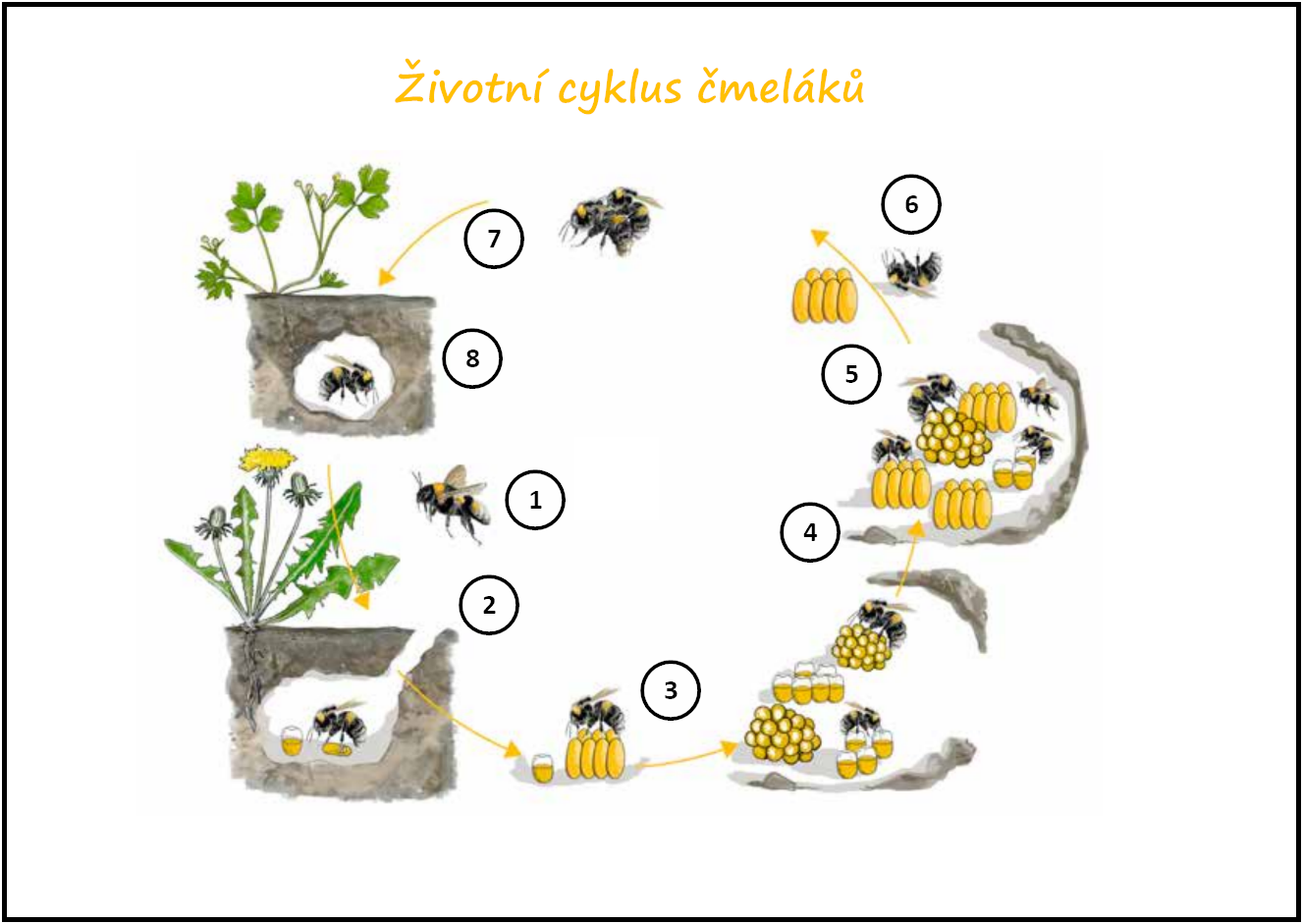
The life cycle of bumblebees - Source: Pszczoły w mięści Trzmiele Wrocławia
1. The Queen Mother Awakens
In the spring (March – May), when the soil warms up, the queen mother wakes up from her winter sleep and visits early flowering plants such as willow, sedge, sedges, etc. Here she restores her energy reserves after long months of hibernation. At the same time, by regaining energy, the queen mother waits for suitable conditions to build a nest. Instinct (and practical considerations) will not allow her to build a nest when the temperatures are low (she would not be able to warm the larvae of her offspring in it) and at the same time, without enough food, she would not be able to feed them.
Interesting fact
- Mothers of different bumblebee species wake up at different times to catch the flowering time of their preferred plant species (e.g., honeysuckle)
- Mother bumblebees (see bumblebee parasites) hibernate at greater depths so that the warmed soil awakens them later and they can optimally catch the appropriate species of bumblebees as early as the first generation of workers
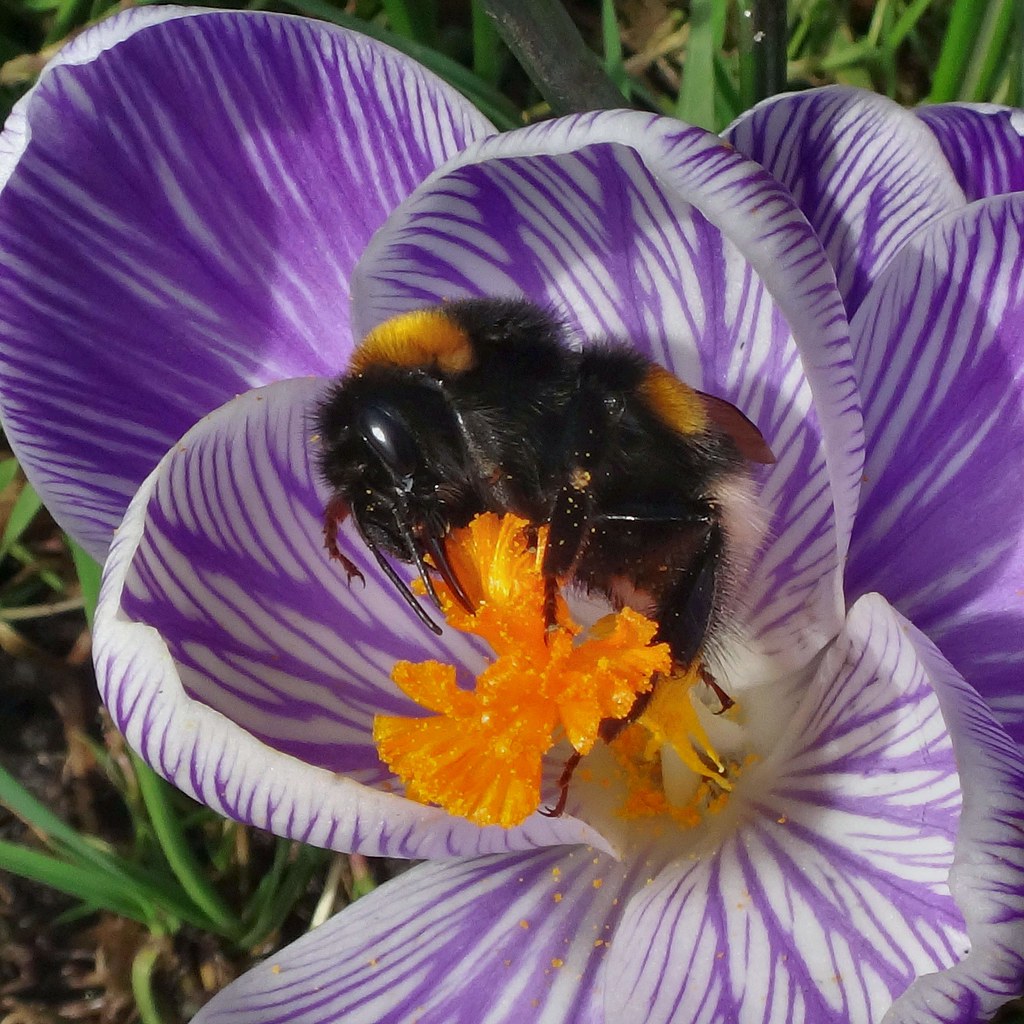
Mother bumblebee in spring – garden bumblebee (B. hortorum) – Photo Flićker
2. Nest establishment and solitary phase
When the queen bee recovers from hibernation and finds that the conditions are favorable, she gradually begins to look for a place to build a nest. Sometimes these phases can overlap. That is, the queen bee just looks around and gradually returns to interesting places when the time is right to build a nest.
Interesting fact
- We can recognize a searching queen mother by her low search flight above the ground – she does not sit on flowers, but crawls into mouse and other holes in the ground, or into various openings, and leaves them again to fly away and try another cavity.
- Mothers of some species reliably return to the place where their natal nesting site was
Various abandoned dwellings of small mammals and birds that contain some heat-retaining material ( lining ) can also be a place to establish a nest.
Bumblebees are adapted to cold climates. They have thick hair or control partial thermoregulation through muscle tremors. Unlike other insects, they can therefore be active even in low temperatures or bad weather. They are able to handle colder temperatures to a certain extent, even better than high temperatures. When building a nest, they expect it to be exposed to cold in the spring and therefore it is necessary to protect it thermally so that their offspring in the nest can develop successfully. Therefore, queen mothers look for cavities in which thermally insulating nesting material is available. This differs from, for example, bees, which look for an empty cavity.
In nature, bumblebees build their nests in various places. Either in the ground, in rodent holes, in rock/wall cavities, in a pile of stones, in tree cavities, or in a pile of old dry grass.
If they nest near humans, they can use birdhouses, a space with thermal insulation under the roof of houses, an old blanket, or leather on a balcony, etc. They don't mind glass wool either (see examples of bumblebees in thermal insulation of walls). But it can be an upturned flower pot, or compost - that is, places that remind the queens of natural nesting conditions. Each species prefers slightly different conditions and places to nest, you will learn more about this later in the catalog of bumblebee species on our website.
When the queen mother finds a suitable place, she creates a small cavity in the lining, the walls of which she coats with nectar and wax to maintain the necessary temperature. It is really a small chamber, just big enough for the queen to turn around in, build the foundation of the wax structure of the nest ( work ) and which she can heat herself to the temperature needed for the development of the larvae. The queen behaves in an energy-efficient manner and knows very well why. Among other things, this is why the queen builds her nest in the imaginary center of the lining, where she expects the least heat loss. The following fact proves that thermal insulation of the nest is important. Early bumblebee species need a sufficient amount of lining, while later species can manage with a smaller amount of heat-retaining material.
The queen bee produces wax in wax glands on her back as so-called exudates . She then spreads the wax across the bottom of the chamber with her bare and warm belly. This creates a solid surface – a wax pad . She then builds a wax jug into which she pours nectar from flowers. Nectar thickened in the nectary and modified with enzymes from the oral glands is called honey . It is similar to honey from bees and serves the same purpose – a food supply. In the queen bee, it is a supply for the night and adverse days. Bumblebees use sweet nectar as “fuel” and a source of energy – they cannot survive more than a few hours without it.
The mother prepares the nesting material (lining) in the selected nest for her own use, but she is not able to procure such material and put it in the nest herself. This applies to most of the species common in our country. Many queen mothers therefore do not find a suitable shelter for the nest at all. If she finds a bad place, which may get wet or the brood will get cold in it, she will abandon the nest after the disaster. She will either die herself or try to enter the already established nest of another queen, where one of the rivals is either driven out or killed after a duel.
Interesting fact
- Sometimes you can find several dead mothers in the nest and one alive – the winner. Sometimes a situation occurs when several mothers-queens, sometimes even of different species, establish a nest in the nest. However, this situation does not last long and one day the mothers meet. The meeting and coexistence then ends with a fight and the death of the weaker of them. Sometimes, however, mutual injuries and deaths of both mothers occur
- Jaromír Čížek repeatedly observed that in an attractive natural nesting site and its surroundings there were several dead mothers and one victorious one – usually of the largest late species
- Common "roommates" in nests are the mothers of the field bumblebee (Bombus pascuorum), which have no chance in a fight with a larger species. Therefore, they are only temporary roommates.
The queen mother is still alone – we are talking about the so-called solitary phase . Alone – she prepares the nest cavity, builds the wax structure of the nest, carries nectar, warms the eggs and then feeds the hungry larvae. While moving outside the nest, she is threatened by the enemies of the bumblebees and can easily become food for birds (the titmouse, sometimes the titmouse, from rarer species, e.g. the wren).
All of this must reflect the efforts of mothers of the same/different species of bumblebees to take over her nest site.
Because of this, the solitary phase very often ends with the demise of the nest.
3. Caring for the first generation of workers – the end of the solitary phase
Soon after the mother has found a nesting site and built a honey jar, she lays her first eggs (6–10) in wax cup a cell .
It is also collecting pollen , which it brings to the nest in the form of pollen grains on its hind legs.
Pollen serves mainly as a source of protein , but also other substances that are necessary for the development of the fetus. In addition to the way the queen mother flies, the presence of pollen grains on her hind legs is a clear signal that the mother is already nesting.
The laid eggs hatch into larvae , which the mother warms with her own body to the required temperature of 29–30 °C and feeds with a mixture of pollen and nectar, which she collects every day.
Bumblebees are insects with complete metamorphosis , and the development of individuals has four stages .
The first stage is the egg, which is white, slender, slightly curved and 2–3 mm long. There are usually several eggs together in a cell/case.
The second stage is a white, legless, plumper, C-shaped larva that gradually grows in size. The large larvae that will become queens can be up to 1.5–2 cm long at the end of the larval stage.
The larvae are always hidden in a waxy covering in a case . The mother opens the case to feed and then closes it with wax, thus protecting the larvae. Only in older larvae do feeding holes appear.
Interesting fact
- According to the way the larvae are fed, bumblebees are divided into two groups:
1. "
Pocket makers ", which pockets that fit on the wax cover of the larvae. The pollen is then placed directly into these pockets by the females, from where the larvae take it themselves. The result is an uneven food supply and a greater dispersion in the size of adults, with some workers being almost as large as queens. 2. " Pollen storers " , which do not create pockets and feed the larvae directly through an opening in the wax cover. Unlike the first group, they store pollen in pollen cups. In this group, the difference in size between queens and workers is usually clearly visible.
The third stage begins with the larva forming a fibrous cocoon around itself in a wax case , gradually closing itself in it and stopping feeding. While forming the cocoon, the larva slowly rotates in a sideways position. At the end of this stage, the larva stands up with its head up. The cocoon takes on its typical egg-shaped shape. The queen mother (or later the worker) scrapes off the waxy remains of the original wax shell from its surface with her mandibles and recycles them for building the wax cases of other larvae. That is why the cocoons are light yellow and not dark like other wax cases with larvae and eggs.
In the safety of the cocoon, the larva sheds its skin for the last time and becomes a pupa , which already has clear signs of an adult - the head, limbs and other body parts are visible. This process is called metamorphosis . This stage lasts approximately 10 days .
The last, fourth stage is the adult . It uses its mandibles to bite the lid , through which it climbs out. Sometimes the workers help it. The workers then use the empty cocoon as a reservoir for pollen and honey.
In order for the adult to crawl through the small opening in the cocoon more easily, its body is still soft. It is also not fully pigmented and is mostly white-gray in color. The cuticle hardens and the coloration occurs only after 24 hours, when the individual most often stays on the surface of the nest. Here it has enough air to strengthen its body and wings and where it also has a chance of not being irreversibly damaged by the movement of other individuals in the nest.
The length of development from egg to adult worker hatching is not fixed, as is the case with honey bees, but depends on the species and external conditions, especially temperature. However, it usually takes 19–30 days .
Interesting fact
- Sometimes you can find differently colored individuals in the nest. If they are light colored individuals, or "uncolored bumblebees", you were probably lucky and found a bumblebee that is less than a day old.
After the first generation of larvae has pupated, the queen bee can immediately start laying more eggs. She often lays these on the tops of the cocoons, where you can easily recognize the new laying. She again lays them in wax cases. Here, the larvae hatch from the eggs, grow, the cases enlarge, separate into separate cases and then into separate cocoons - the cycle repeats and the nest grows. The wax work (nest) gradually grows in height and width. It is usually irregular - do not expect the construction of the work like that of bees.
Interesting fact
- The size of the cocoons can be used to estimate the sex of the larvae they contain. The largest cocoons, which are significantly separated from each other, are maternal cocoons - from them new queen mothers, the largest individuals in the nest, are born.
- Drone cocoons tend to be smaller than the parent cocoons and are often in clusters/columns
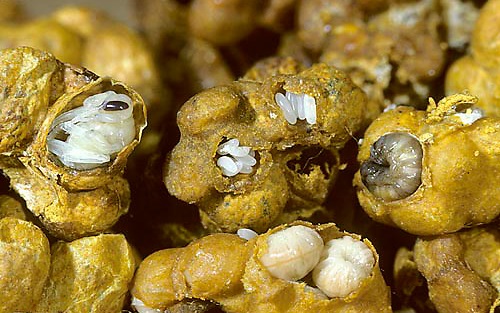
Bumblebee larvae Bombus impatiens ((various stages)) – Photo: Kuhn Photo
4. The nest is growing – the end of the solitary phase
Once the first workers hatch in the nest, the solitary phase ends. As soon as the workers are able to gather food, the mother queen begins to devote herself solely to laying eggs and caring for the offspring.
It no longer flies out of the nest, except in very critical situations when the nest is threatened by a lack of food. This may be, for example, a significant drop in outdoor temperatures and a decrease in the number of flowers of so-called honey plants, the loss of several first-generation workers, or damage and weakening of the nest.
The establishment of the new generation depends on the mother-queen, so she does not expose herself to unnecessary risk by staying outside the nest, nor does she participate in the defense of the nest from enemy attack. At such a moment, she instinctively hides under the nest. It is logical - her role is irreplaceable and the premature end of her life is equal to the end of the nest.
Interesting fact
- If the queen mother is disturbed during her solitary period (especially at the beginning of nest development), she may leave the nest permanently. Such a queen mother then usually becomes a so-called wanderer. She appears to be looking for a new nesting site, sometimes trying to penetrate other nests, but she will not establish a new nest and offspring
The period during which the mother lays eggs , from which more and more workers hatch, lasts approximately a month and a half from the hatching of the first generation of workers . During this time, the nest produces several dozen to hundreds of individuals, depending on the species. Some workers are dedicated to caring for the brood and nest, others collect food (flying insects).
The nest gradually strengthens to the point where it is able to provide enough food for the new mothers and males (trunks).
Interesting fact
- The workers also vary in size. The first generation of workers is usually very small, but as the number of workers and therefore individuals caring for the nest increases, their size also increases. That is why you can see a great variability in the size of individuals in the nest. The basic rule for determining the mothers is their size, which significantly exceeds the other individuals
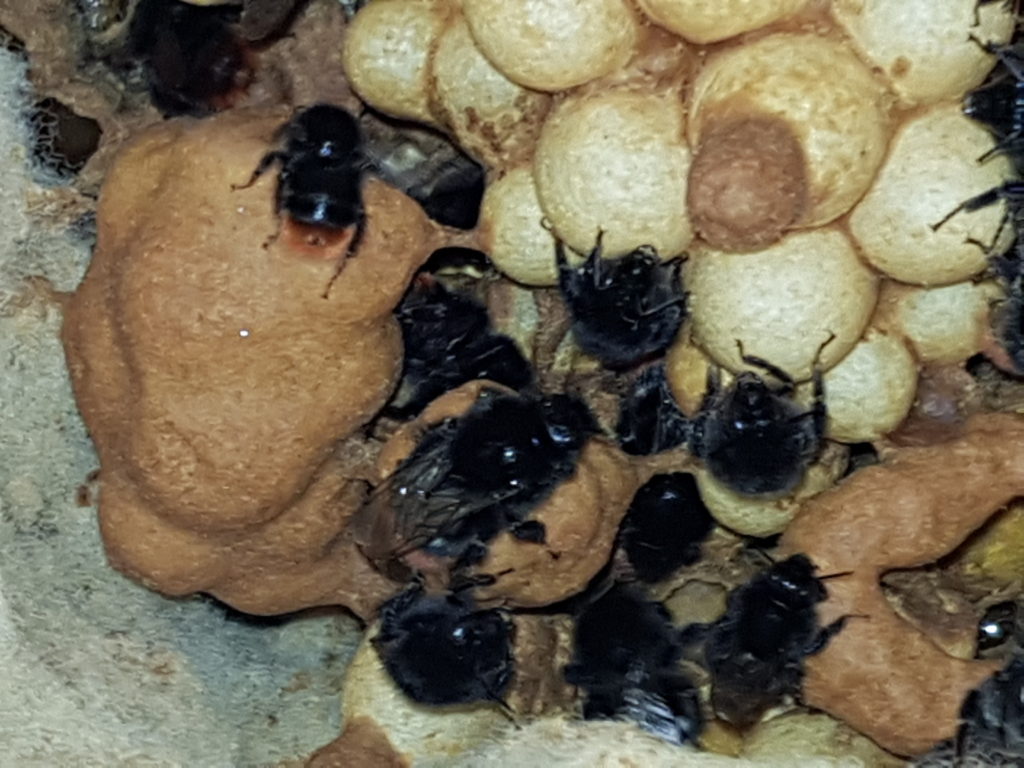
Nest of a rock bumblebee (Bomnbus lapidarius) – Photo: O. Hercog
5. Birth of sexual individuals – new mothers and males
After the worker production stage, several changes occur in the nest. This is a period of upheaval and the end of the romantic phase of peaceful nest growth. The pattern of these changes is not entirely identical in all species. Here we describe the course of development and changes in the nest of the bumblebee (Bombus terrestris).
The first change is that all the larvae that come from fertilized eggs from the mother, and from which workers have hatched so far, will begin to be fed with more food so that new queen mothers will hatch from them. This is the goal of the bumblebee's efforts, because they will then ensure the continuation of the species.
Interesting fact
- Similar to bees, the same (fertilized) eggs hatch into workers and/or future queens. Their determination as worker/queen is primarily determined by how the larvae are fed.
A few days after hatching, the new queens leave their natal nest and begin to look for males outside the nest to mate with unrelated individuals. They return to their natal nest at night, where they wait out the darkness and possibly adverse weather.
During this period, queen mothers also build up large enough fat reserves, which they need for successful hibernation - they fatten up.
Interesting fact
- Queens mate with only one drone, with some exceptions (depending on the species)
- Males (drones) can mate multiple times, unlike drone bees, for which mating means the end of life
- The relationship of the new queens, of which there can be several dozen in a nest, is friendly towards the mother and each other. Rivalry between the mothers occurs only in the spring at the beginning of the next season, when two queen mothers (although they may be sisters) can no longer coexist in the same nest
Once the queen mothers have mated, it is time to say goodbye. Before leaving their nest for the last time, they fill their nest with honey and leave it for good. This usually happens within ten days of their birth.
Interesting fact
- Mated queens often become so fat that their flight from the nest is complicated – they are so heavy that they sometimes only succeed after a few attempts and need to climb to a higher place to fly
- A mated queen mother can be recognized fairly reliably by the fact that before leaving the bumblebee nest, she is "occupied" by the always present Acarina mites. These mites then enter the mother's hibernacula and subsequently the nest that the queen mother will establish in the spring of the following year
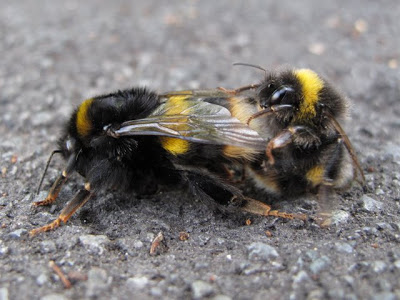
Bumblebee mating – Photo BugBlog
Interesting fact
- There are cases where some young queen mothers behave like workers and help with brood care in the natal nest. The further fate of such queens is unknown, but they probably do not fulfill their mission as queens, i.e. they do not mate and do not establish a new generation. They may become old maids - they do not find males in time and gradually cease to be attractive due to a decrease in the level of their pheromones
- Likewise, young queen mothers can be found in the nest that do not leave the nest. They may have some (often invisible) damage and nature no longer counts on them
- Breeders have sometimes recorded a situation where young queen mothers of some species (bumblebee – Bombus pascuorum) tried to hibernate in their natal nest
- Unmated mothers in the wild do not survive the winter, or are not known to have done so
The second change in the community is that the queen mother, who has only laid fertilized eggs until now, begins to lay unfertilized eggs ( haploid eggs ). These hatch into males, or drones.
These two changes, when a bumblebee nest begins to raise sexual individuals, are called points and represent fundamental irreversible changes in the nest.
The third change is in the behavior of the colony. The founding queen mother has until now truly ruled the nest with her pheromones, directing its progress and setting the order with her dominant behavior. However, her pheromone production decreases with age and the harmony of the nest is lost. This leads to the development of ovaries in the workers, which until now the queen mother's pheromones have successfully prevented.
The workers, who have been caring for the mother's offspring together until now, gradually "rebell". The unrest can be seen and heard throughout the nest - the nest is buzzing loudly, the workers are running around restlessly. The manifestations of disharmony are therefore very clear and resemble the state when a bumblebee attacks the nest (see parasites and enemies of bumblebees).
The workers continue to care for all the larvae in the nest, but they begin to compete with each other, and with their own mother, for the opportunity to lay their own (unfertilized) eggs. There are physical attacks between workers and their mother, stealing and eating other people's eggs, often even during their laying. The romance of the nest is definitely a thing of the past.
This period is called the competition phase and lasts until the nest is destroyed in summer or autumn.
Interesting fact
- If the workers manage to lay and defend their eggs, only males (drones) are born from them. These are unfertilized eggs (the workers did not mate). The workers actually give birth to their own brothers. Paradoxically, this is mainly achieved by the weaker workers, who inconspicuously lay their eggs somewhere on the edge of the wax structure of the nest (the hive). In the center of the hive, strong dominant workers fight for position among themselves, eating each other's eggs in an attempt to assert "their blood", even though they are sisters.
6. The Queen Mother (Founder) weakens and dies
Sometimes during the competition phase, the old mother queen dies. Her role is over and it is time to leave. She is exhausted, tired of the escalating attacks of the workers, whom she has gradually lost control of with her pheromones. Although the sight of the mother leaving the nest is one of the most powerful moments a bumblebee keeper can experience, it is not sad. The mother has succeeded and returns to nature, with which she will soon merge.
Interesting fact
- The rivalry between the workers is such that if the mother queen does not leave the nest herself, they are able to drag her out of the nest, or even kill her in the nest
- The departing queen mother is visibly worn out, often with bare areas without hair, with bitten wings, and is lame.
7. The nest is disappearing
The last males born from the worker eggs leave the nest and look for mothers in the wild to mate with. Males gradually die in the wild, living for about one month .
The workers in the nest age and die, the flight females gradually disappear and do not return from the flight – new workers are no longer born. The workers can exist for several weeks after the mother leaves and keep the nest alive before they die of old age in the nest. However, none of them survive the winter, nor do the males (the drones). The only ones who survive are the fertilized young queens. This closes the cycle of the bumblebee nest .
The nest disappears and is subject to decay - mold, or possibly bumblebee parasites clean it up. This creates a space where, for example, rodents can deposit new material and it is used again by another bumblebee family the next season.
Interesting fact
- Although we consider parasites such as the bumblebee mite (Aphomia sociella) to be pests of bumblebees, their role as a clean-up crew needs to be appreciated. Their larvae will consume much of the wax structure and dead bumblebees in the nest
- Under good conditions, some bumblebee species can establish a second generation of nests. However, it is not known how many second-generation mothers will successfully complete their nests and how many of their daughters will be able to mate in the wild and survive until the following spring
8. Hibernation of the mothers-to-be founders of the new generation
After mating and leaving the nest, young queens find a place to hibernate (hibernaculum). Very often, they find such a place at the edge of the forest, sometimes in dry compost, etc.
However, it is always a place with material that allows them to hide underground (e.g. pine needles, dry loose soil). The mothers hope that they will not be washed away by rain or melting snow, as the hibernaculum is just a cavity in the ground without any thermal protection.
Young queen mothers begin hibernation as soon as possible after mating. They do not expose themselves to unnecessary risk of injury or loss of life. This means that mothers hibernate sometimes from July to March/April of the following year.
Interesting fact
- There are recorded cases where the mother will wake up during the summer and return to her natal nest in an attempt to draw energy from the remaining honey supply as easily as possible
- In laboratory conditions, they can hibernate their mother for up to 12 months
- Young queen bees hibernate in the ground above freezing. The chemical composition of their blood during hibernation allows them to survive a state of total body freezing
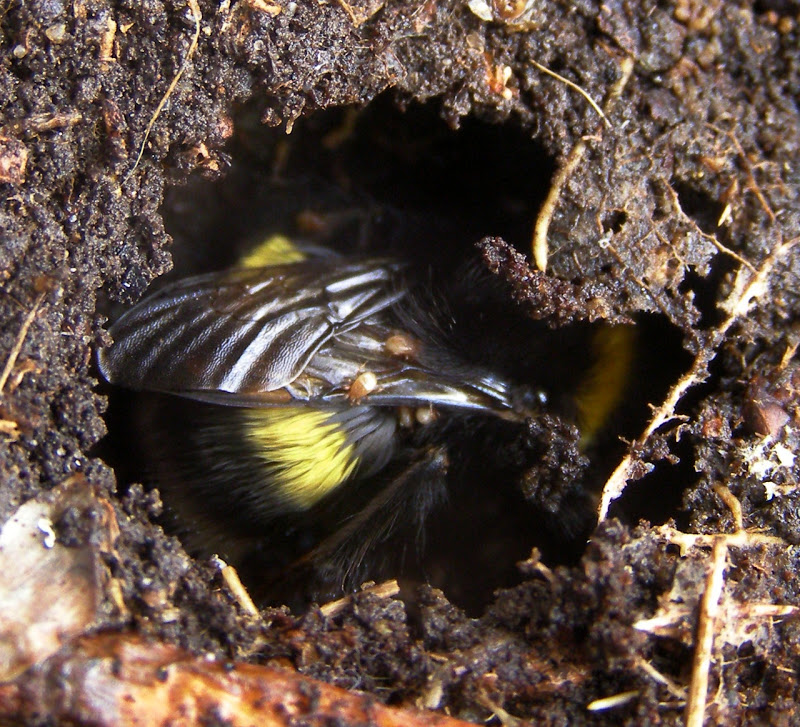
Mother bumblebee in hibernation