
Bumblebee life cycle – basic information
The life cycle of a bumblebee has its own specifics and is quite fundamentally different from that of bees, to which it is also so close.
In bumblebees, everything begins in spring and ends in winter. Within a few months, the queen mother establishes a nest, is responsible for the emergence of several generations of workers and then sexual individuals – new mothers and males. The queen mother later dies, as do the workers and males – the nest disappears. Only fertilized queen mothers survive the winter, and in the spring they establish a new nest and a new generation is created.
This is why bumblebees don't make large reserves of honey, because they don't use it. People ask, "What are bumblebees for?" How pointless that question is! But we'll explain that later.
The life of bumblebees is fragile and is therefore endangered, among other things, due to their specific life cycle. Bumblebees must search for a nesting site and build a nest again and again in the spring. Males must find suitable partners and mate with them within a limited time.
Even if they succeed, they still don't win and have to constantly fight for their lives with other bumblebee mothers, with bumblebees, with parasites, and with adverse weather and fate.
Let's take a look at their life cycle today to clarify what the life cycle of bumblebees actually looks like.
Also watch the beautiful film The Secret Life of Bumblebees , which will show you the secrets and pitfalls of their life cycle in a clear way.
O.
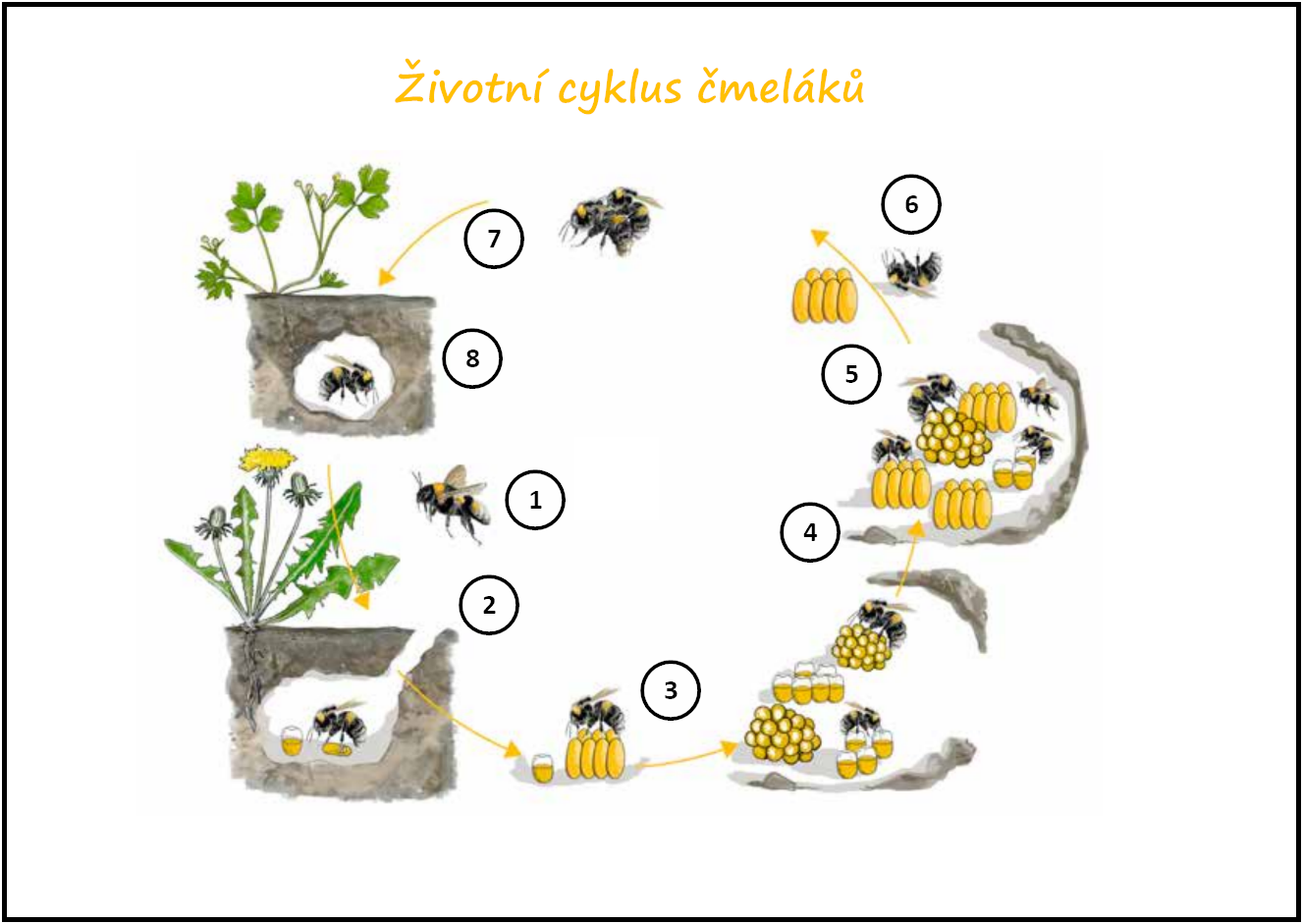
Life cycle of bumblebees Source: Sikora A., Michołap P., Kadej M., Sikora M. Tarnawski D. 2018 "Pszczoły w mięści: Trzmiele Wrocławia", Wyd. Stowarzyszenie Natura i Człowiek.
1. The Queen Mother Awakens
The queen mother wakes up and looks for a nesting site
2. Nest building
The queen mother is building a nest.
3. Concern for the first generation of workers
The queen mother lays eggs and takes care of the first generation of workers herself (solitary phase).
4. Nest growth
The first workers hatch in the nest and help gather food.
The queen bee only lays eggs, cares for the offspring, and under normal circumstances, i.e. if the workers provide enough food, she does not leave the nest. The mother lays eggs, from which new generations of workers are born.
5. Birth of sexual individuals – new mothers and males
The nest becomes strong enough to provide enough food for the new mothers and males. The males fly out of the nest and never return.
New mothers mate with unrelated males outside the nest. Within a short time, they leave the nest and hibernate buried in the ground (called hibenaculum).
6. The Queen Mother (Founder) weakens and dies
The queen mother, the founder of the nest, weakens and dies.
In the nest, the workers lay eggs from which the last few males are born.
7. The nest is disappearing
Males leave the nest, looking for mothers to mate with. Males gradually die. Workers age and die, new workers are not born.
The nest is dying and subject to decay (parasites, mold).
8. Wintering of the mothers-to-be founders of the new generation
Fertilized new mothers – future queen mothers – sleep in the ground. How they manage to do this and where they overwinter, you will learn about in a separate article.
More information about the life cycle of bumblebees can be found HERE