
Peculiarities of the life of social insects bumblebees
What you will find here
Here we will collect interesting articles and information from the life of bumblebees.
This will be information where it is not enough to just insert a link, but it needs to be translated or commented on.
We would also be happy to receive your tips that will help us keep this section interesting and useful for you.
CONTENTS
Bumblebees use their heads and power mode when flying with cargo
INTRODUCTION ČM+
Bumblebees are our familiar flying bears, but at the same time the strongest in the kingdom of hymenoptera.
According to the classic theory that describes flight in the atmosphere, bumblebees cannot fly due to their weight, power, and wing area. Yet they fly, and how!
It was only after scientists applied theories and models of turbulent flow to their flight that they suggested that bumblebees could actually fly. This reassured us all immensely. 🙂
To make matters worse, bumblebees can fly with a load that is almost equal to their own weight. This is because they fill their wings with nectar as a source of energy for the nest – for the larvae, the queen and other workers. Bumblebees also carry pollen grains on their hind legs. These are often so large that they look not like grains but like loaves of pollen. You can easily recognize a bumblebee loaded like this in the air. Its flight is noticeably different – soft and swinging. Even its landing on the hive is accompanied by a “thud”. If it were possible, we would probably hear it take a loud breath before it gathers itself and then climbs into the hive.
A new study by scientists at the University of California, Berkeley, now explains how bumblebees manage to cope with such a load. The study also describes new findings that bumblebees are much more flexible in their behavior than one would expect from a small insect. So they are not some miniature robots, as we might think and as we might assume from the capacity of their brain and nervous system.
Scientists calculate and measure, but we know our stuff. Those of you who sit for hours by the hive and watch bumblebees know very well that bumblebees are not robots. They know that they are amazingly intelligent creatures and that their behavior is sometimes surprising. They also know that bumblebee behavior is one of the many reasons why you can go crazy about bumblebees and why this craze (bombophilia) is so easily transmitted.
But seriously, scientists, unlike us, work with facts, they cannot afford emotions and unfounded assumptions, unlike us. Let's take a look at the article published on February 5, 2020 in ScienceDaily. We have freely translated the text and now present it to you.
We hope you have an interesting read. When you see a bumblebee flying with its fuel tank full, you will know how this little creature actually "does it".
If you don't like long articles, at least watch this interesting video study of bumblebee flight
Bumblebees use economy mode and their heads when flying with heavy loads.
Written with the use of the article "Bumblebees carry heavy loads in economy mode" - ScienceDaily 5.2.2020
Bumblebees are the strongest insects in the insect kingdom. They can carry and carry loads almost as heavy as themselves.
A study published February 5 in Science Advances describes how they do this and also shows that bumblebees are much more flexible in their behavior than one would expect from this type of insect.
“They can carry 60, 70 or even 80 percent of their body weight. That would be a huge burden for humans just walking,” says researcher Susan Gagliardi of the University of California, Berkeley. “We were interested in the effort they have to put into carrying food and providing for the nest.”
S. Gagliardi and Stacey Combes, an associate professor in the Department of Neurobiology, Physiology and Behavior, measured the energy required for bumblebees to fly. They observed this in a specially designed chamber, where they created a sphere-shaped space. They attached small pieces of solder wire to the bumblebees to create the appropriate load
"We put bumblebees in a small space and measured the carbon dioxide they produce while flying. Bumblebees mainly burn sugars when flying, so we can measure how much sugar they consume during the flight," says S. Gagliardi.
The researchers also used a high-speed camera to track the flapping and movement of their wings. "Bumblebees fly in a way that is very different from the way an airplane flies," says Combes. "In an airplane, the air flows smoothly over the wing, or the rotor blade. But bumblebees move their wings at a high angle of attack to the flowing air, which swirls around the wings. This creates much more lift than a smooth flow of air. At the same time, the lift is unstable because the air vortices break up quickly. But bumblebees are able to maintain their flight by rapidly moving their wings."
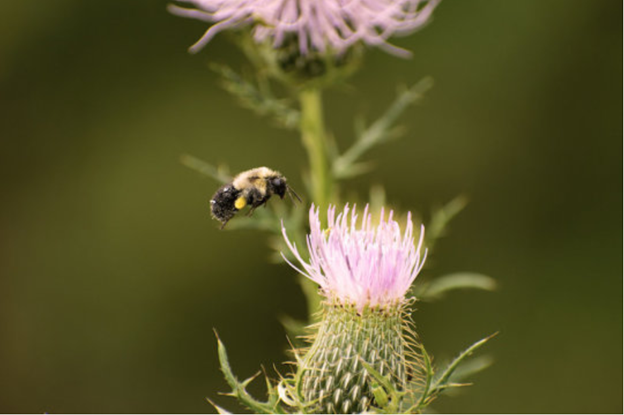
Photo for the article "Bumblebees carry heavy loads in economy mode"Bumblebee hovering near
a thistle
© RJ Godlewski
Two flight modes
Bumblebees burn the nectar they have collected during flight and should therefore become gradually lighter during flight and thus consume less energy.
To their surprise, Combes and Gagliardi found that when the bumblebees were more heavily loaded, they needed less energy per unit of load. "The more loaded they are, the more economical their flight is, which doesn't make sense from an energetic point of view," Combes says
Upon closer inspection, the researchers found that bumblebees have two different ways of dealing with the increasing load.
When they are under more load, they increase the amplitude (stroke) of their wing flaps. But this is not enough to compensate for their high weight. To compensate for this difference, bumblebees must increase the frequency of their wing flaps. All this creates more lift, but also consumes energy.
Bumblebees have a second, alternative, somewhat different flight mode that allows them to carry more weight while expending less energy by increasing the frequency of their wing flaps.
It's not yet clear what exactly causes this "economy mode," but it's likely the way their wings curl back between each beat. But it's something the bumblebees decide how to do.
"It turns out that this is their choice and they decide for themselves the flight mode, according to the relevant weight," says S. Combes.
"When bumblebees are lightly loaded or at ease, they are more likely to increase their wingbeat frequency. When they are more loaded, they switch into this somewhat mysterious economy mode, producing enough force to handle the load with only a small increase or even decrease in wingbeat frequency."
Flight economics and stability
If bumblebees can conserve energy during flight, why don't they use this economy mode throughout the flight? It's not clear, but it's quite possible that the high frequency of wing flapping is advantageous in terms of the power they have, for example for maintaining stability in turbulent air or avoiding obstacles (it's kind of like downshifting to a lower gear in a car - note ČM+).
"The work has advanced our understanding of insect perception," says S. Combes. "When we started our research in this area, we tended to see bumblebees as little machines. We thought they would flap their wings one way when they were not loaded and another way when they were carrying 50% of their load. We also thought that a particular bumblebee would fly the same way every time. But we came to realize that it is up to the individual to decide which way to fly. We even found that the same bumblebee can choose a different way to flap its wings every day."
Source:
Materials provided by University of California – Davis. Original written by Andy Fell. Note: Content may be edited for style and length.

Docile bumblebees
On our website www.cmelaciplus.cz you will find a description of the behavior of bumblebees in nature and in hives (bumblebee hives) that breeders prepare and offer for them.
We start there from standard patterns of behavior of bumblebees, which are seemingly the same and which can be used in breeding. An example is how bumblebees learn to pass through a protective flap. This was designed by A. Krenz and modified by M. Stuchl. to protect bumblebees in a hive (bumblebee hive).
It is unnatural for bumblebees – they do not encounter anything like this in nature. But it does not take long for the mother-queen bumblebee to get used to the touch of the moving part of the flap, lift it and come to the hive. So she does something that she does not normally do in nature. The workers learn the same way.
Check out this interesting video from BBC Earth on their Facebook page . It's a compilation of several separate parts, but it's very interesting.
Other videos demonstrating bumblebees' ability to learn are available on YouTube.
From our perspective, bumblebees have a small brain, but they know how to manage its capacity. Apparently, they are also very docile and in a laboratory environment they do tricks that they certainly would not have learned in nature. They learn them in laboratory conditions and these are completely different experiences and practices that they cannot get in nature. They learn to do things that will ultimately bring them benefit and reward in the form of wort. Thanks to this, they can transport a ball, "play football", or get to the right place where a person has taught them to find food.
It is clear that we still don't know everything about bumblebees. Examples of new findings about bumblebee flight and their ability to learn new things illustrate this.