Garden bumblebee (Bombus hortorum)
The page is under construction - we are adding more photos and videos describing this species
What you will learn here
- Information about individual bumblebee species
- You will receive a summary of information for the general public, schools and breeders
Last updated: X/1/2022
Description
Česky: Čmelák zahradní
Latin: Bombus hortorum
English: Garden bumblebee / Small garden bumblebee
Německy: Gartenhummel
Polish: Garden bumblebee
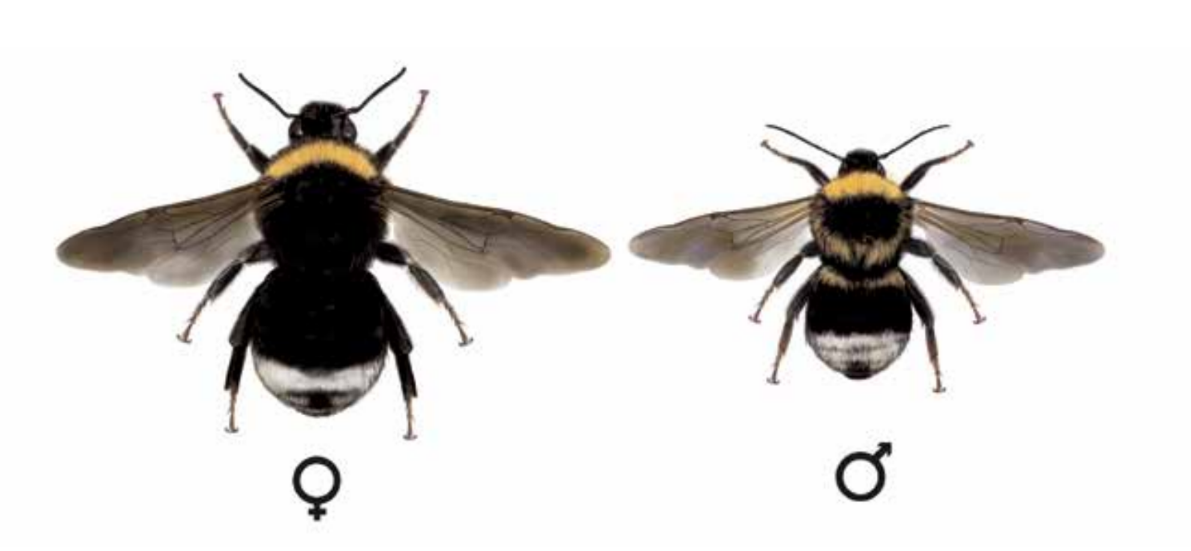
Image

Čmelák zahradní (Bombus hortorum)
Zdroj: Sikora A., Michołap P., Kadej M., Sikora M. Tarnawski D. 2018 „Pszczoły w mieście: Trzmiele Wrocławia“, Wyd. Stowarzyszenie Natura i Człowiek.
Color scheme
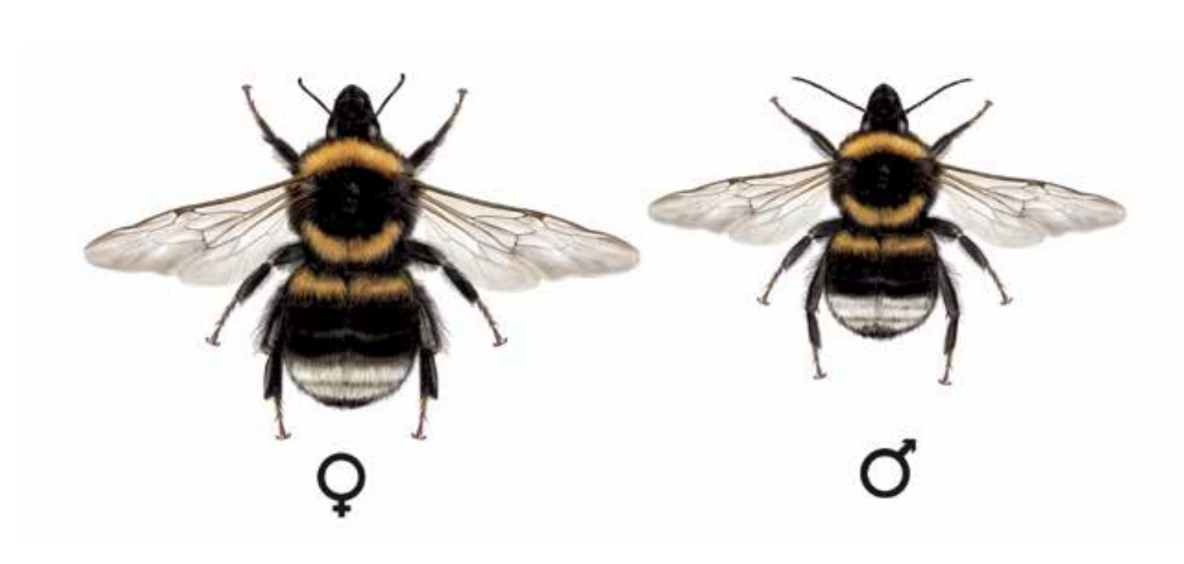
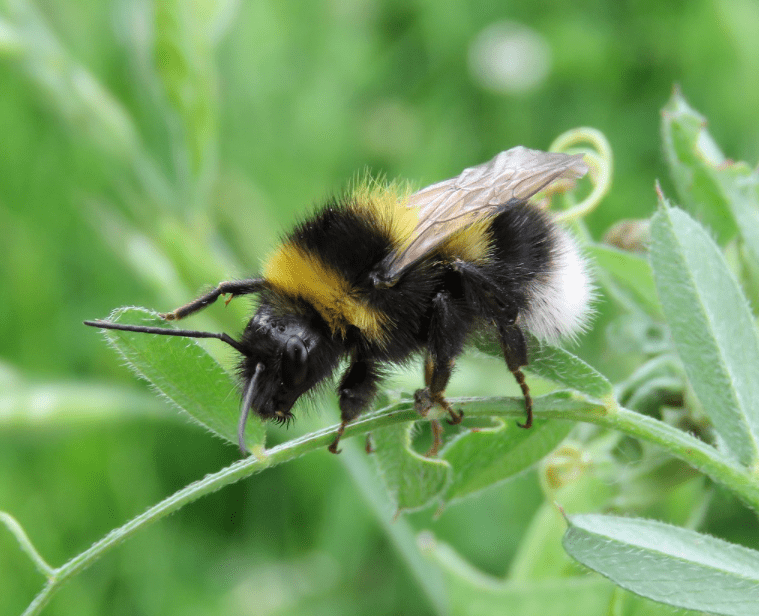
Basic scheme (queen and worker):
- Základní barva
– černá - Hlava
– černá - Hruď
– dva žluté proužek na předohrudi za hlavou a na konci hrudi – stejného odstínu
– barva proužku světle žlutá až tmavě žlutá
– hruď se je ježatá – různé délky chlupů
– druhý proužek je ve tvaru srpku měsíce (nemá rovnou přední hranu – směrem k hlavě)
Pozn. díky tom je někdy hruď popisována jako černým střede obklopený světle žlutými chlupy - Zadeček
– žlutý proužek na 1. a 2. tergidu (jeví se jako širší žluté proužek)
– proužky stejného odstínu žluté barvy jako na hrudi
– špička zadečku bílá, zřídka nahnědlé
– konec zadečku špičatý
– ochlupení ježaté a stejně dlouhé na zadečku a hrudi
– dark forms without distinct yellow elements on the chest and rump, to completely dark
Spolehlivě odlišení dělnice a matky podle barevného provedení je obtížné.
Rozhodující je velikost a případně chování v hnízdě (pokud je v něm matka přítomna).
Základní schéma (samec):
– barevné schéma podobné jako matka a dělnice
– žluté a bílé chlupy samců často zakrývají černé části těla, samci v dobré kondici se jeví jako prakticky žlutí a ve světle zlatí
- Hlava
– černá, výrazně dlouhá a prohnutá, připomínající tvarem koňskou hlavu
– temeno hlavy černě ochlupené
– výrazné kartáčky na straně kusadel v tmavohnědé barvě
– kartáčky vytváří dojem hranaté spodní části hlavy - Hruď
– výrazně dlouhá ježatá srst, vytváří dojem rozcuchaného čmeláka
– žlutý proužek na předohrudi za hlavou a na konci hrudi
– druhý proužek je ve tvaru srpku měsíce
– proužky stejného odstínu žluté citronové barvy
Zadeček
– žlutý proužek na 1. a 2. tergidu
– proužky stejného odstínu žluté žluté barvy jako na hrudi
– špička zadečku bílá, nebo nažloutlá
– konec zadečku špičatý
– tmavé formy bez zřetelných žlutých prvků na hrudi i zadečku, až zcela tmavé
– u tmavých forem světlější boky hrudi
U samců lze pozorovat postupnou ztrátu barev až do šedo žluté/šedé.
Rozdíl ve ztrátě barev mezi proužky není tak znatelný jako u matky dělnic.
Ztráty barvy souvisí s věkem.
V případě výskytu na Severu Evropy byly popisovány tmavší formy samců
Samci jsou dobrým indikátorem přítomnosti tohoto druhu v případě, že se vám nedaří tento druh spolehlivě detekovat podle matek a dělnic.
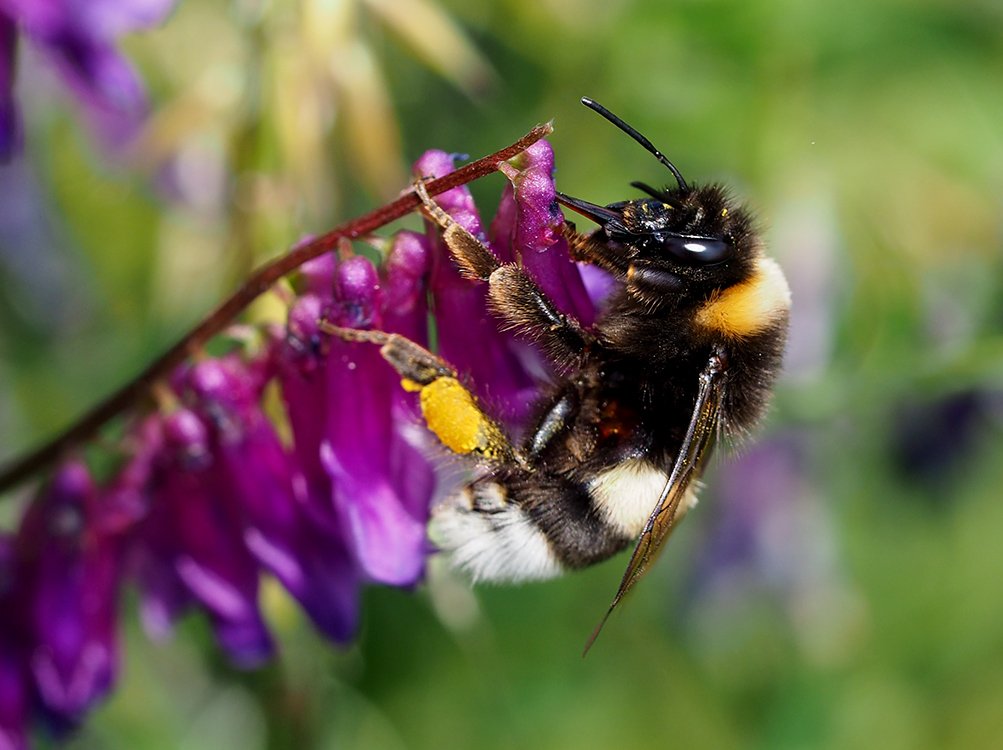
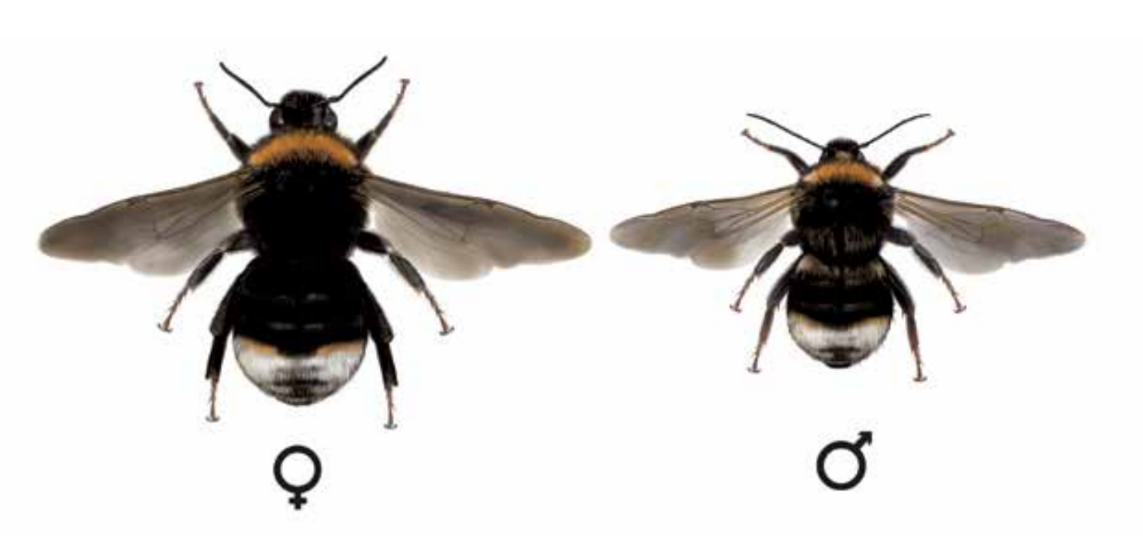
This photo shows the bristly fur of the garden bumblebee (B. hortorum). This feature is quite important and will help distinguish it from another similar species (see further text).
The typical long head is also clearly visible.

Čmelák zahradní (Bombus hortoru) – matka (queen)
Foto: S. Falk
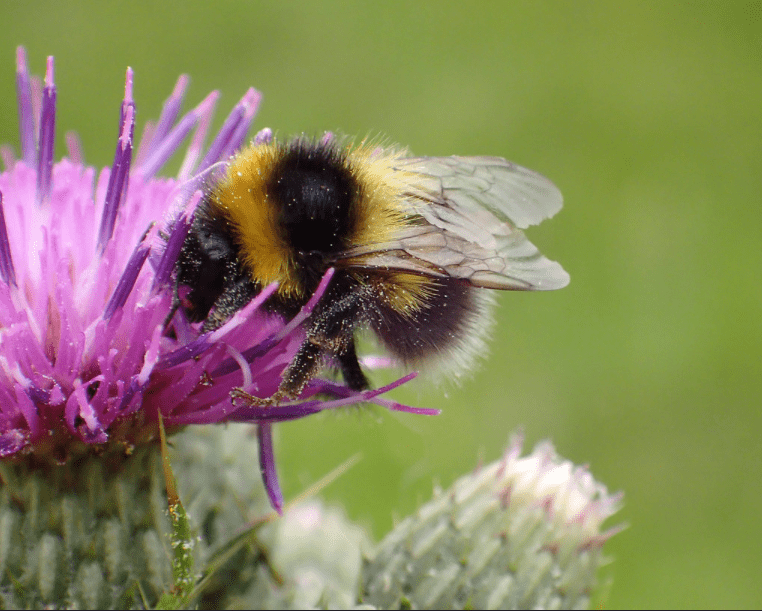
Čmelák zahradní (Bombus hortorum) – dělnice (worker)
Foto: S. Falk
Size
- Druh
– velký - Velikost
matka 17- 25 mm
dělnice 11 – 16 mm
samec 13 – 20 mm
Source Hymenoptera of the Czech Republic I., Academia 2017
Head
Velikost:
– výrazně dlouhá a prohnutá, připomínající tvarem koňskou hlavu (nejdelší ze všech druhů čmeláků v ČR)
Tvar:
– líce a hlava velmi dlouhé
– líce téměř dvojnásobně delší než široké
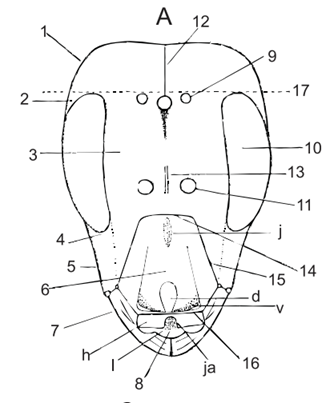
– jednoduchá očka leží na (supraorbitální) čáře,Vzdálenost oček je nejméně dvakrát tak velká jako jejich průměr – viz obrázek (shoda s čmelákem zemním)

Čmelák zahradní (Bombus hortorum) – matka (queen) – hlava (head)
Zdroj: J. May Čmeláci v ČSR
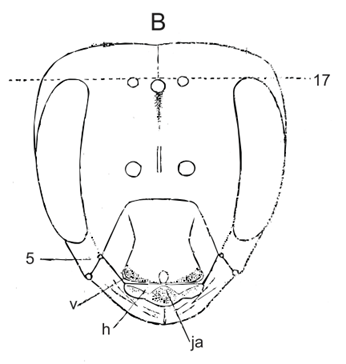
Čmelák hájový (Bombus lucorum) – matka (queen) – hlava (head)
Zdroj: J. May Čmeláci v ČSR
Here you can clearly see the shape of the head – short, stocky. Three simple eyes (ocelli) on the top of the head, the location of the antennae and the tongue protruding between the mandibles.
Antennae
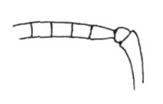
- The antennal segments are parallel
- Third antennal segment only slightly longer than fifth
- As with other bumblebee species, the male has long curved antennae
For those interested in details, we are adding more.
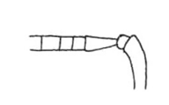
The antennal segments of the wood bumblebee (B. lucorum) are longer, for example compared to the antennae of the confused bumblebee (B. confusus).
Tyto druhy nezaměníte, ale porovnání tykadel je zajímavé. Jde o detail, který asi nepostřehnete u živého jedince, ale dost možná na dobré a zvětšené fotografii.

Čmelák hájový (Bombus lucorum) – tykadlo
Zdroj: Fauna Helvetica Apidae 1
Čmelák klamavý (Bombus confusus) – tykadlo
Zdroj: Fauna Helvetica Apidae 1
Language
- Long
- It is reported up to the length of the body
- délka jazyka matky: 9 – 10 mm
- délka jazyka dělnice: 8 – 9 mm
- dálka jazyka samce: 7 – 8 mm
- This species, thanks to its short tongue, often bites into the calyxes of plants, where it cannot reach with its tongue
Výhoda čmeláka zahradního je dlouhý jazyk
…
Čmeláci se naučili obejít handicap krátkého jazyka tak, že prokoušou kalich květu tak, aby se tam dostali i se svým, krátkým jazykem.
Této techniky využívají čmeláci zemní (B. terrestris) i čmeláci hájoví (B. lucorum) – oba druhy mají jazyk velmi krátký.
The plant provides them with nectar, but it is not pollinated - the bumblebee's body does not come into contact with the pistils. Note that especially in plants that have flowers with deep calyxes, the pistils are in a refined place. An example of this is the foxglove (Digitalis). The bumblebee dives into it and immediately has a pollen mark on its back. But bumblebees are clearly more refined than plants.
Body
- Matka
– tělo zavalitější
– nemá tak výrazné špičaté zakončení zadečku, jako například čmelák zahradní (B. hortorum) nebo čmelák rokytový (|B. hypnorum) - Samec
– tělo zavalitější než matka
– vejčité
– konec zadečku spíš do kulata, nebo seseknutý
Wings
Lights
Wingspan up to 37 mm
Feet
- Zadní pár nohou
– u samic a dělnic s košíčky na pyl
– ochlupení zadní strany zadních holení také nahoře dlouhé
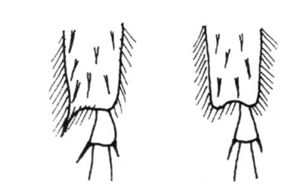
– střední nárt s trnem
– u samců zadní nárty na zadní hraně vlnovitě prohnuté ? obrázek?

Detail středního nártu zadního páru nohou – s trnem a bez trnu
Zdroj: Fauna Helvetica Apidae 1
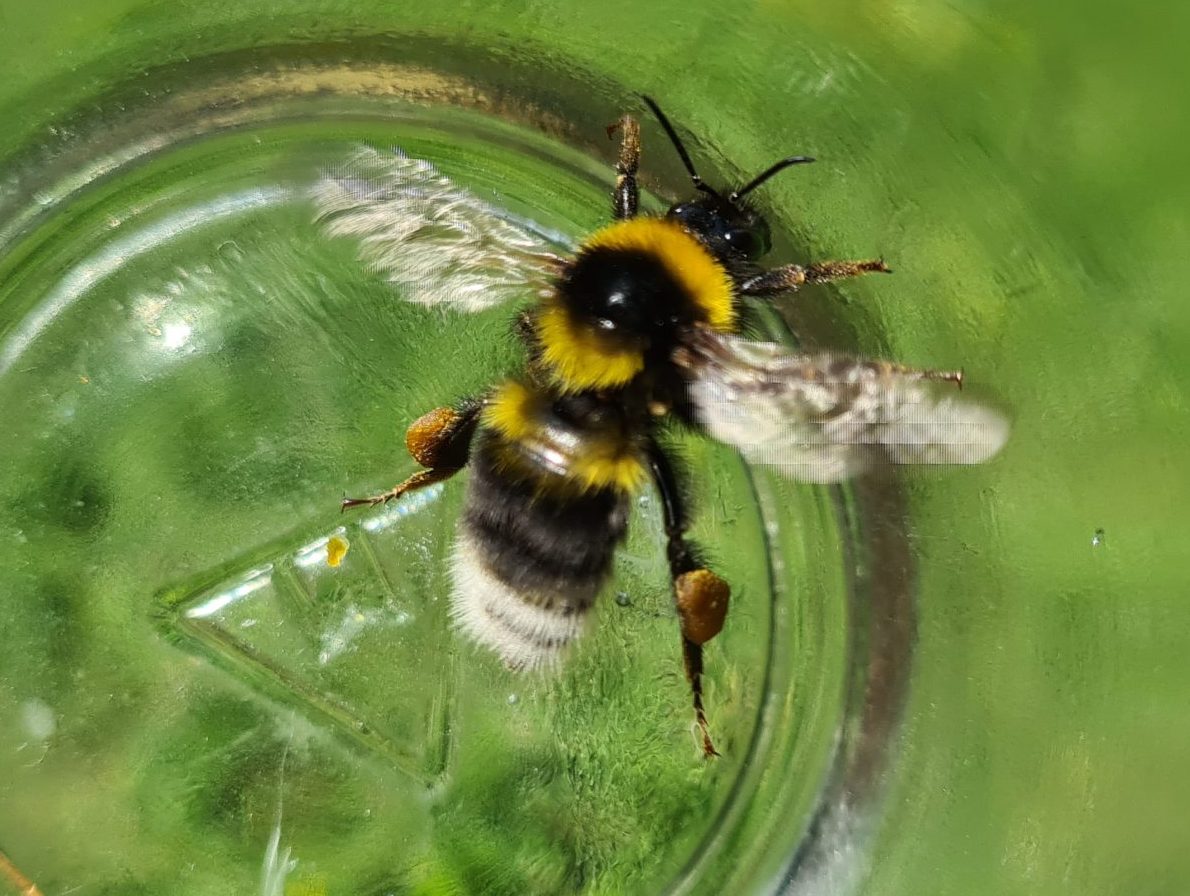
Na následující fotografii vidíte pylový košíček (pollen basket) na zadní noze matky čmeláka zemního.
Nárt bez trnu.
Na další fotografii jsou vidět pylové košíčky naplněné pylem.
Specific distinguishing features
<bude doplněno>
Photo
Mother

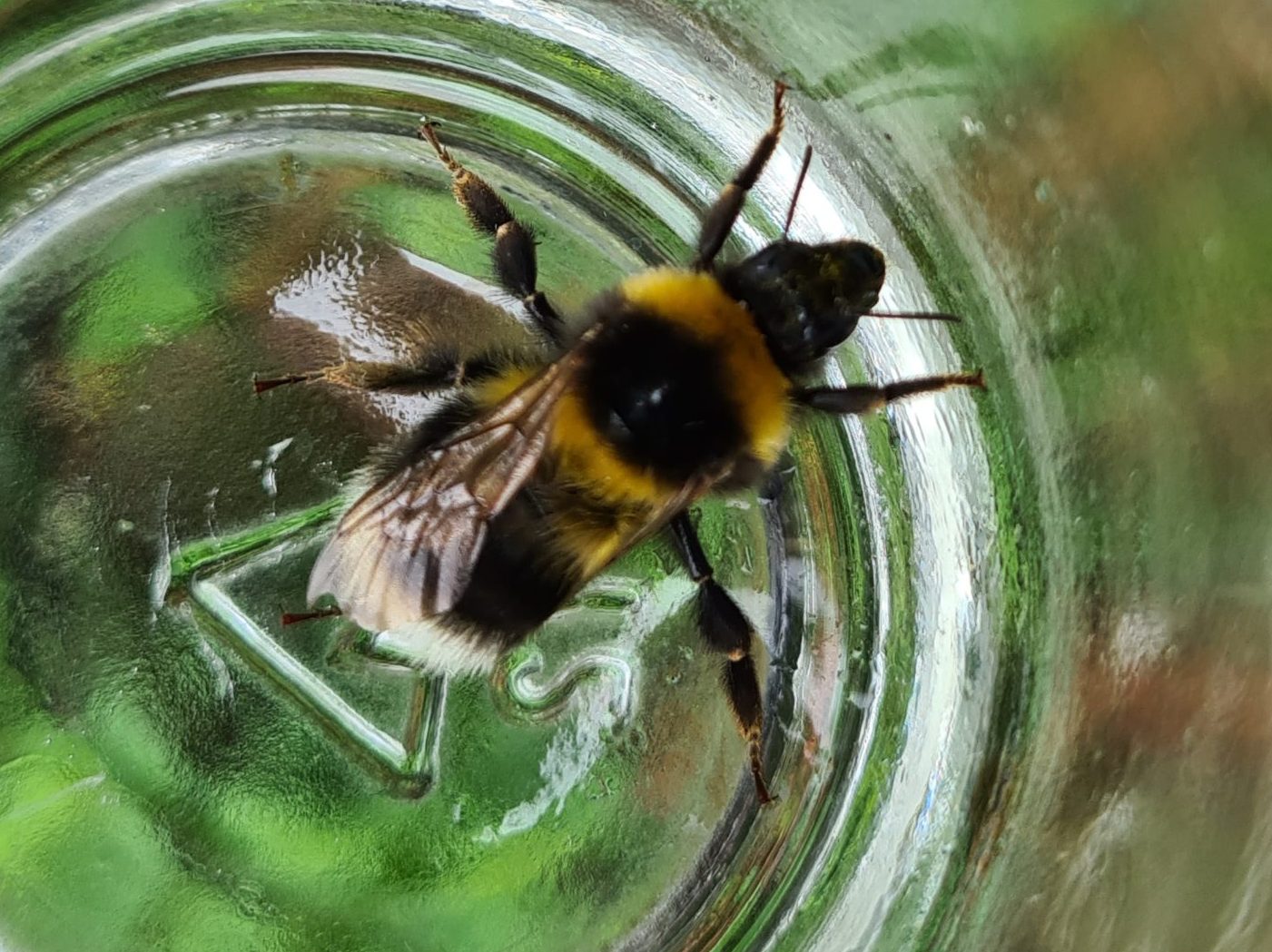
Čmelák zahradní (Bombus hortorum) – matka (queen)
Foto: O. Hercog 27/6/2021
Worker
It is difficult to distinguish between the mother and the worker of this species. The difference in size between the worker and the mother is obvious, the body shape and colors are the same.
In the case of a worker, you may also be confused by the gradually disappearing difference in shades of yellow stripes and the gradual fading of the stripe on the back – from light yellow to dirty yellow.
Like the mother, the worker has no yellow elements on its head.

Čmelák zahradní (Bombus hortorum) – dělnice (worker)
Foto: O. Hercog 29/8/ 2021
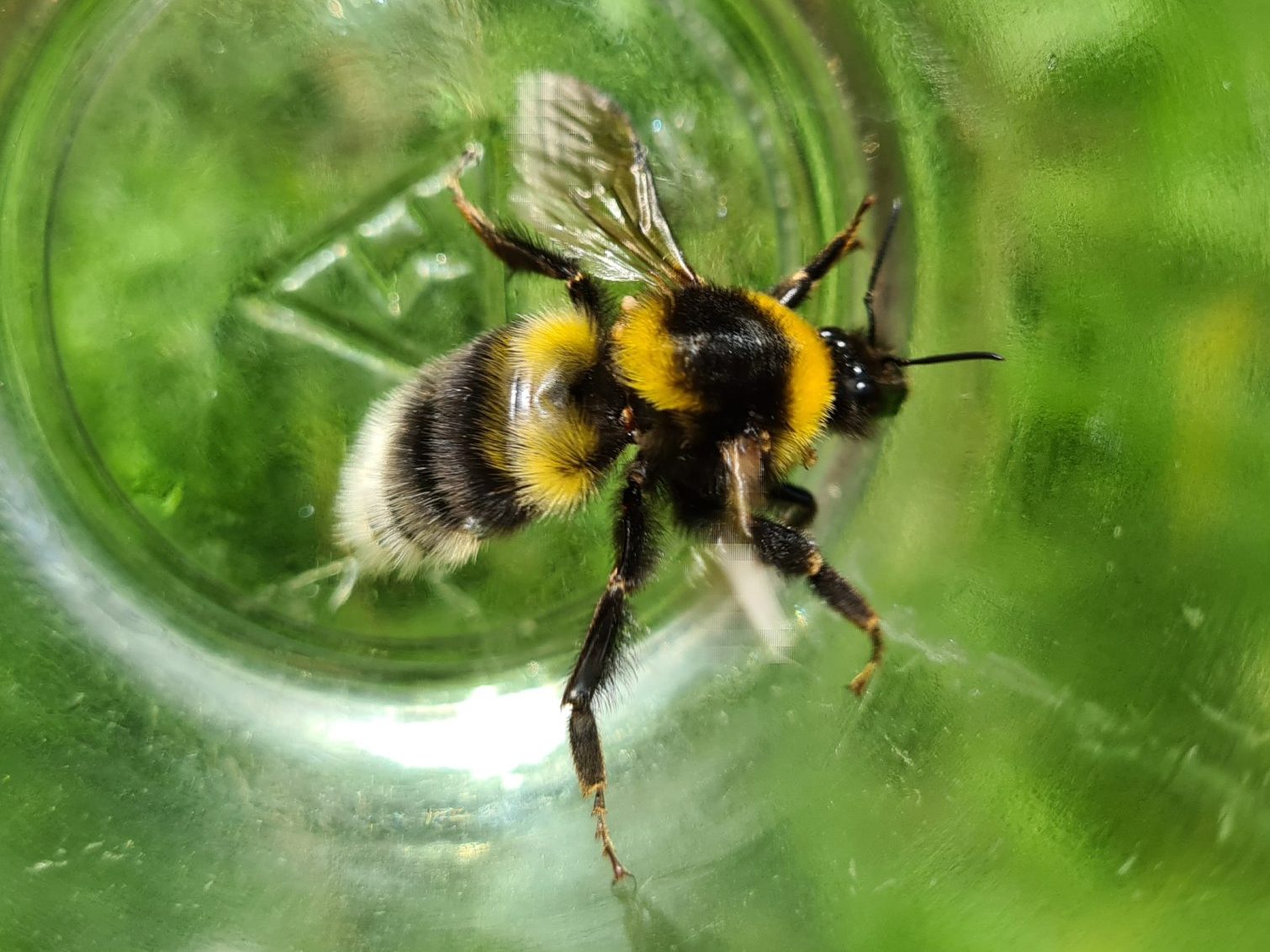
In the next photo you can see the color change of the worker. The stripe on the back has practically lost its yellow color.
L
Někdy vás může mást i velké „opotřebení“ jedinců, zvláště matek a dělnic. Někdy má dělnice druhý pásek prakticky bílý a zadeček, vč. pásku na něm, olysalý. To je dáno jejím věkem a pohybem v hnízdě, kde si chlupy odírá.
Takovou dělnici ukazuje další fotografie
.
Male
Males can be considered a “different species.” When in good condition, they are like shining golden balls.
Their head is covered in yellow hair, and the hair on their chest and rump sometimes almost covers the black color of their body.
Prozradí je i jejich tykadla, která jsou jako u většiny druhů delší, v normální situaci do oblouku (bez zalomení)
Kartáčky na kusadlech nejsou moc vidět, pokud se jim nedíváte do obličeje. Mají ale rudý/červenohnědý odstín a když o nich víte, tak si jich všimnete.

Čmelák zahradní – (Bombus hortorum – samec (male)
Foto: O. Hercog 18 /7/ 2021
Detail of the facial part of the head of a male wood bumblebee (B. lucorum). The mandibles are of a different color and widen the head at the bottom.
A detail you won't see in nature – the genitals of a male wood bumblebee (B. lucorum).
The genitalia of bumblebees are very specific, but generally typical for each species. In males, it is a key clue to species identification, alongside DNA analysis.
Video catalog
Mother
Mother of the wood bumblebee (B. lucorum). This mother would leave the nest and help with food gathering even when workers were present in the nest.
Apart from size, it is sometimes difficult to distinguish a mother from a worker.
Worker
A worker from a later generation – it is identified by its larger size, as it had enough food during its development.
This worker has practically the same shade of yellow on the chest stripe on the rump. The chest stripe is wide.
This worker already has a distinctly different shade of yellow in the chest stripe on the back – a sign that she is getting older. You won't notice the difference in a young worker.
This worker bee shows a gradual loss of color in the stripe on its back.
Na této dělnici je ztráta barvy proužku na zadečku markatní.
Video bylo natáčeno ve vyšší poloze, proto v nížině zde byl patrný časový posun a v září ještě poměrně velký pohyb dělnic.
Male
Here is a male wood bumblebee in full force and armor – beautiful yellow colors. You can also see its bright yellow crest on its head and face.
Typically colored male. His stripes become less bright as he ages (video filmed in August)
Its antennae are also clearly visible - longer and differently positioned. Its head is also visible during movement - rounder and shorter.
Similar species
- Ground bumblebee (B. terrestris)
- Wood bumblebee (Bombus lucorum)
- Double-headed bumblebee (Bombus cryptarum)
- Čmelák větší (Bombus magnus) <DOPLŇUJEME>
These species are distantly similar, as their light forms have two yellow stripes on the chest. However, since beginners confuse them, we include them here as well.
- Garden bumblebee (Bombus hortorum)
- Hume bumblebee (Bombus ruderatus)
How to distinguish it from similar species
Although the wood bumblebee is abundant in the Czech Republic, it is often confused with other species.
We will try to show you visible signs that can be a guide for its identification. However, reliable differentiation of these species is only possible under a microscope based on signs that are not visible to the eye. However, for a completely reliable differentiation, it is necessary to kill and dissect the individual. For example, determining the species of males is only possible based on the details of their genital organs. However, this does not coincide with our interests in protecting bumblebees. Therefore, in our catalogue we make do with signs that you can see with the eye and with limited accuracy.
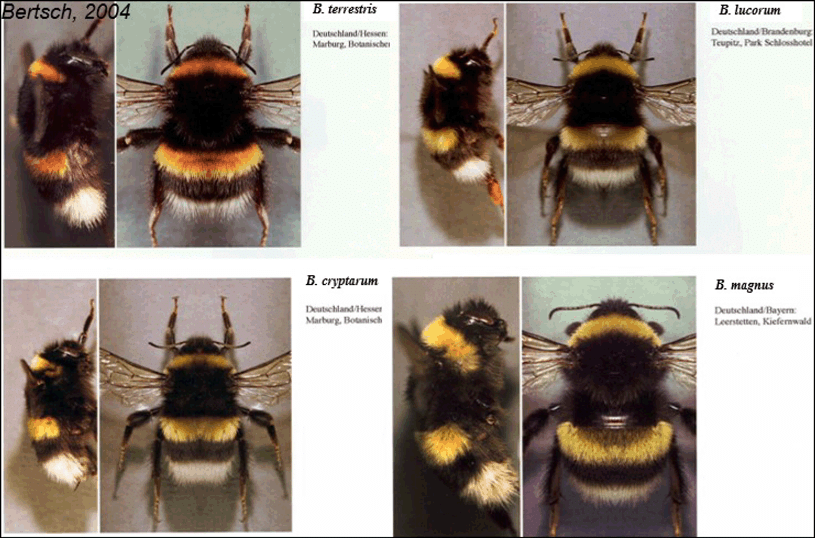
Následující fotografie srovnává druhy, které je možné snadno zaměnit. Přestože jde o fotografie matek nafocených v Irsku (druhy zde mají drobné barevné odlišnosti od stejných druhů ČR), pro srovnání typických znaků se hodí.
Sami vidíte, že rozlišení není vždy snadné.
After this species of bumblebee, the problem of identifying similar species was named the "Lucorum Complex"
In the following text, we will describe the signs and provide you with a guide to distinguishing them, without trying to overcome this complex - it is impossible.

Matky podobných druhů druhů – B.
terrestris-B. lucorum – B. magnus -B. crytptarum
Foto: Bertsch 2004
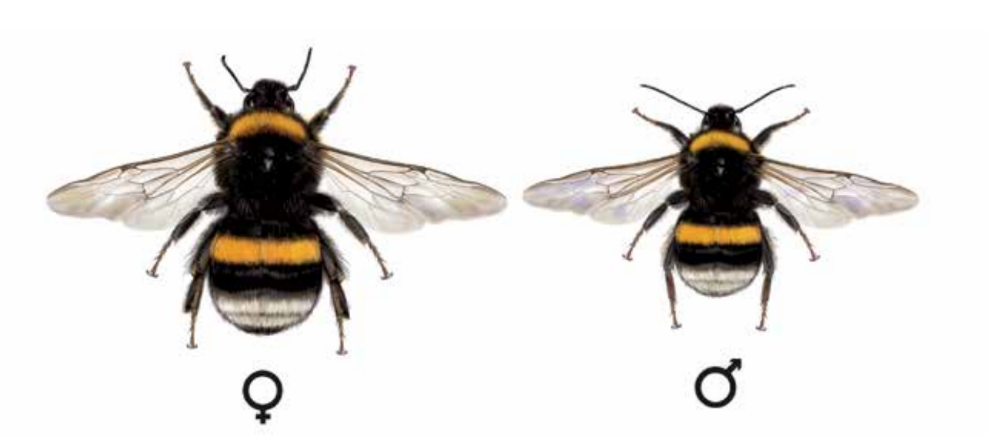
Ground bumblebee (Bombus terrestris)
- Na rozdíl od čmeláka hájového:
– větší velikost
– o trochu delší hlava
– matka a dělnice mají hlavu do výraznějsího klínu
– hlava je vždy černá, i u samců
– proužky jsou v různém odstínu (dělnice a matky)
– proužek za hlavou je slabší a tmavším odstínu žluté barvy (okrová)
– proužek za hlavou může být až jen neznatelně naznačen, či prakticky není vidět (tmavá forma)
Pozn. čmelák hájový (B. lucorum) tmavé formy nemá
– matka a dělnice neztrácí své barvy s časem
– samci mají velmi podobné zbarvení jako matka a dělnice, byť jasnější a silnější žluté proužky – oba prakticky shodného odstínu

Čmelák zemní (Bombus terrestris)
Zdroj: Sikora A., Michołap P., Kadej M., Sikora M. Tarnawski D. 2018 „Pszczoły w mieście: Trzmiele Wrocławia“, Wyd. Stowarzyszenie Natura i Człowiek.
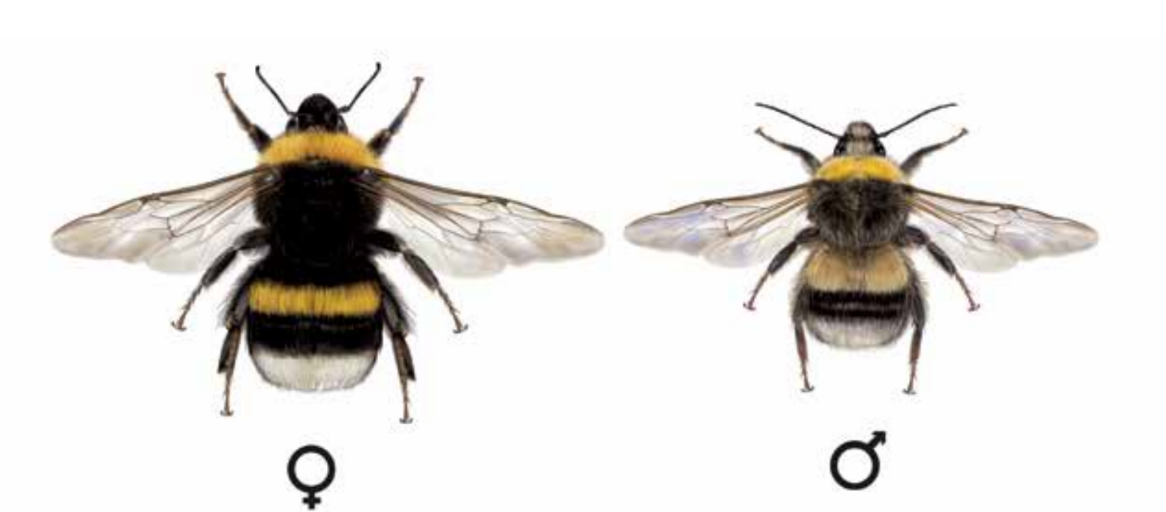
čmelák hájový – Bombus lucorum
Zdroj: Sikora A., Michołap P., Kadej M., Sikora M. Tarnawski D. 2018 „Pszczoły w mieście: Trzmiele Wrocławia“, Wyd. Stowarzyszenie Natura i Człowiek.
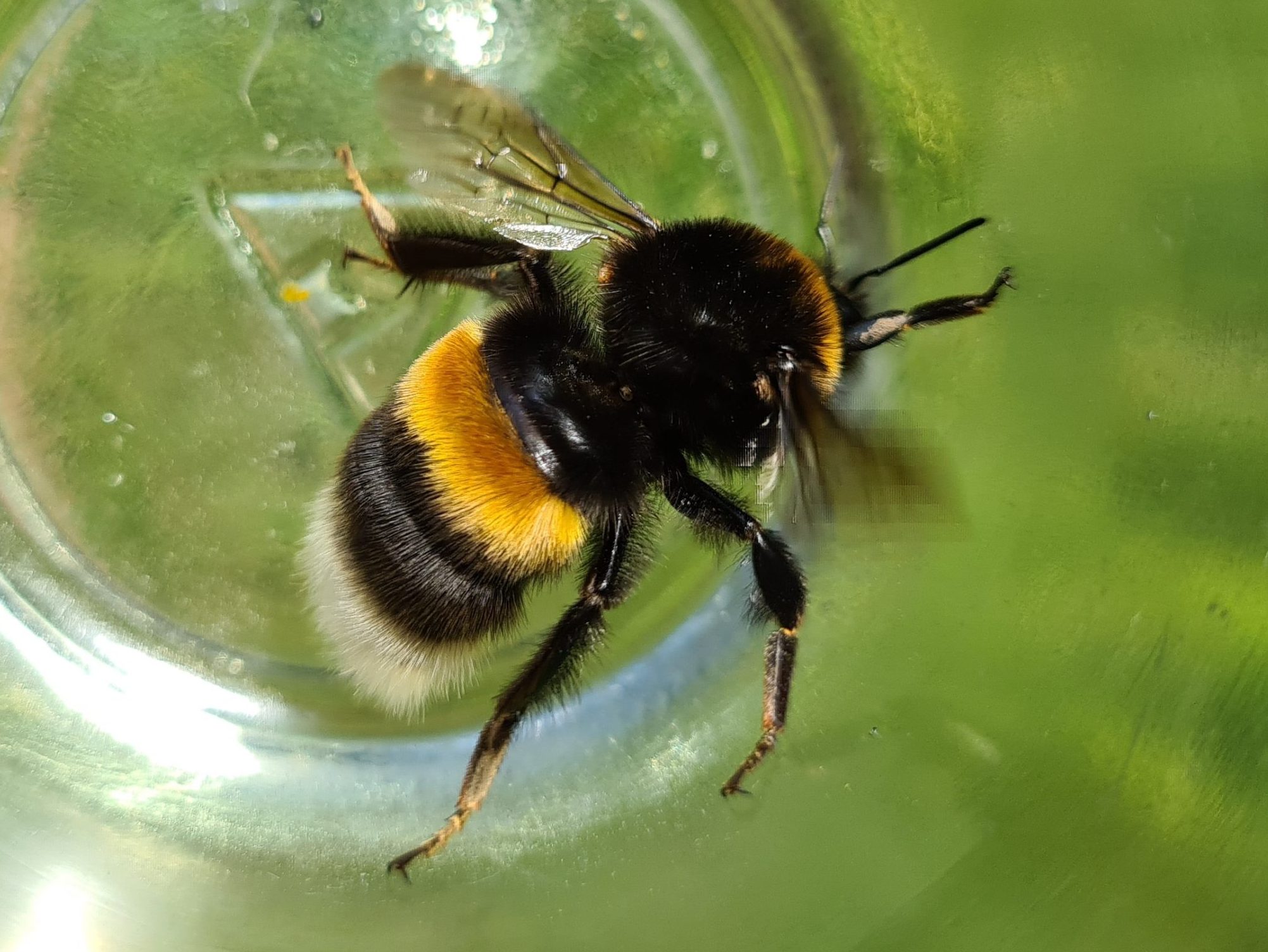
U matek a dělnice je dobrým vodítkem odstín žlutých proužků. U čmeláka hájového bude většinou shodný první i druhý proužek.
U čmeláka zemního je proužek na předohrudi za hlavou tmavší, než proužek na 2.tergidu.
Na těchto fotografiích je to dobře vidět.

Čmelák zemní (Bombus terrestris) – matka (queen)
Foto: O. Hercog 27/6/2021
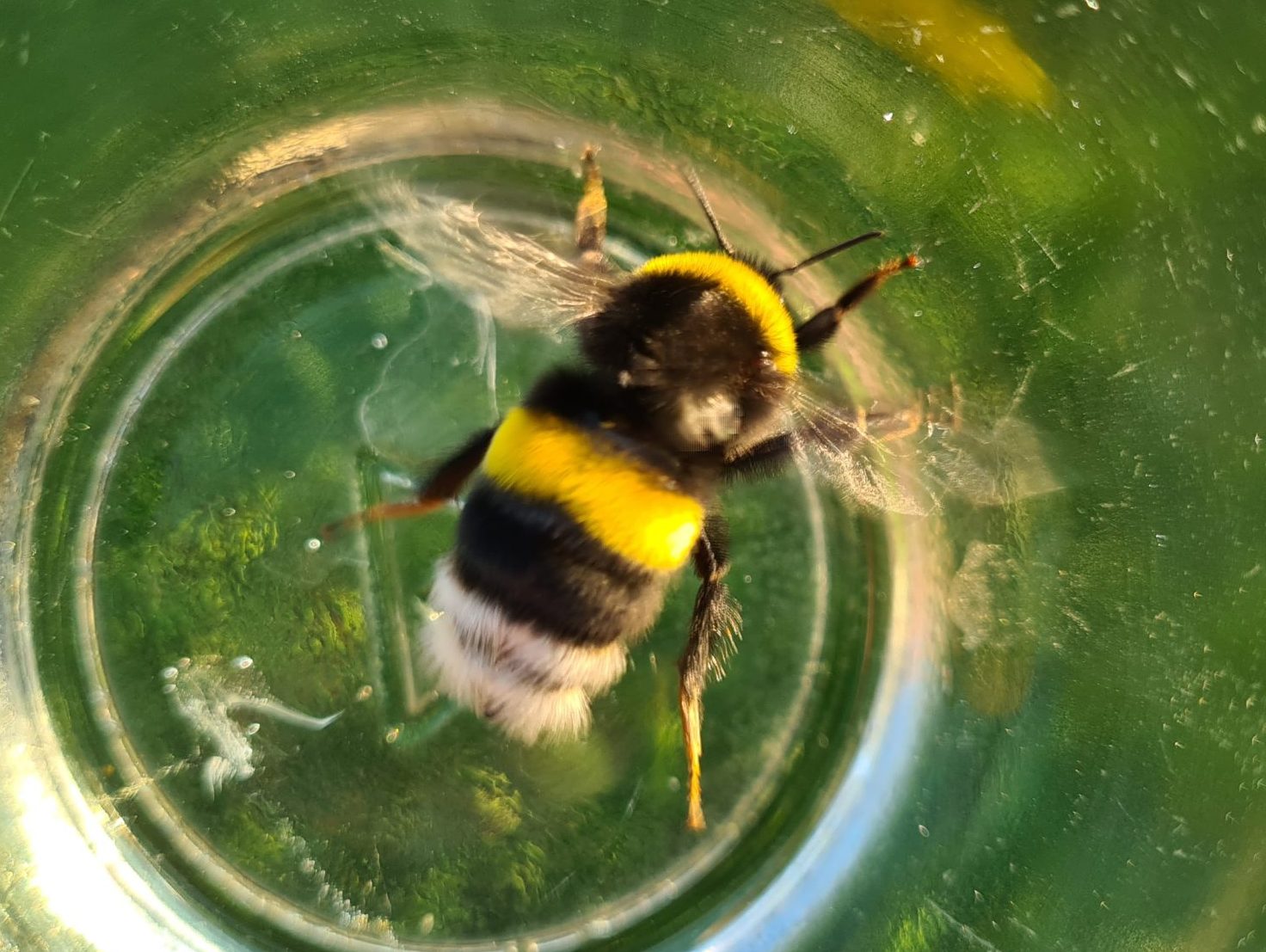
Čmelák hájový (Bombus lucorum) – matka (queen)
Foto: O. Hercog 16/ 6/2021
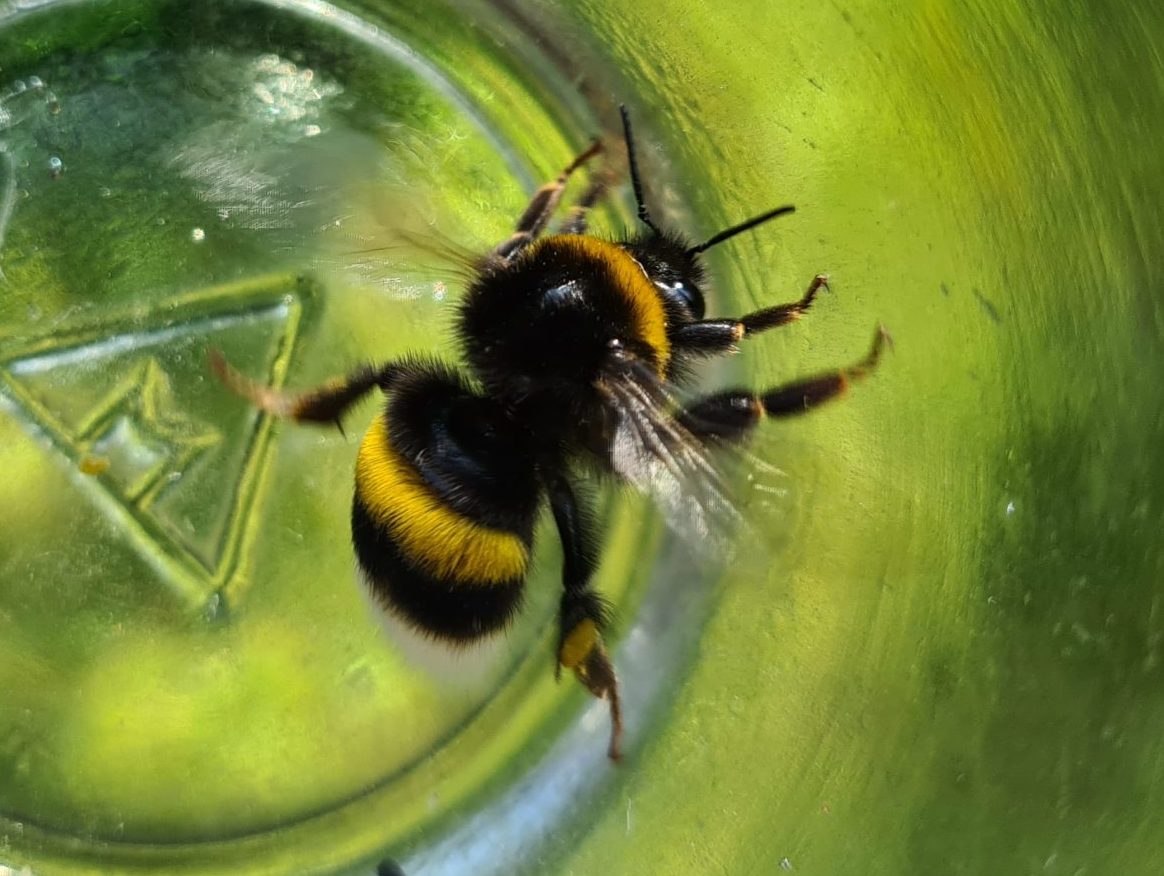
Unlike the ground bumblebee, the yellow stripes of the wood bumblebee can be observed fading to a dirty white color.
This effect is quite common in wood bumblebees and can help or complicate species identification - if you are not aware of it.

Ground bumblebee (Bombus terrestris) – worker – Photo: O. Hercog 03 07 2021
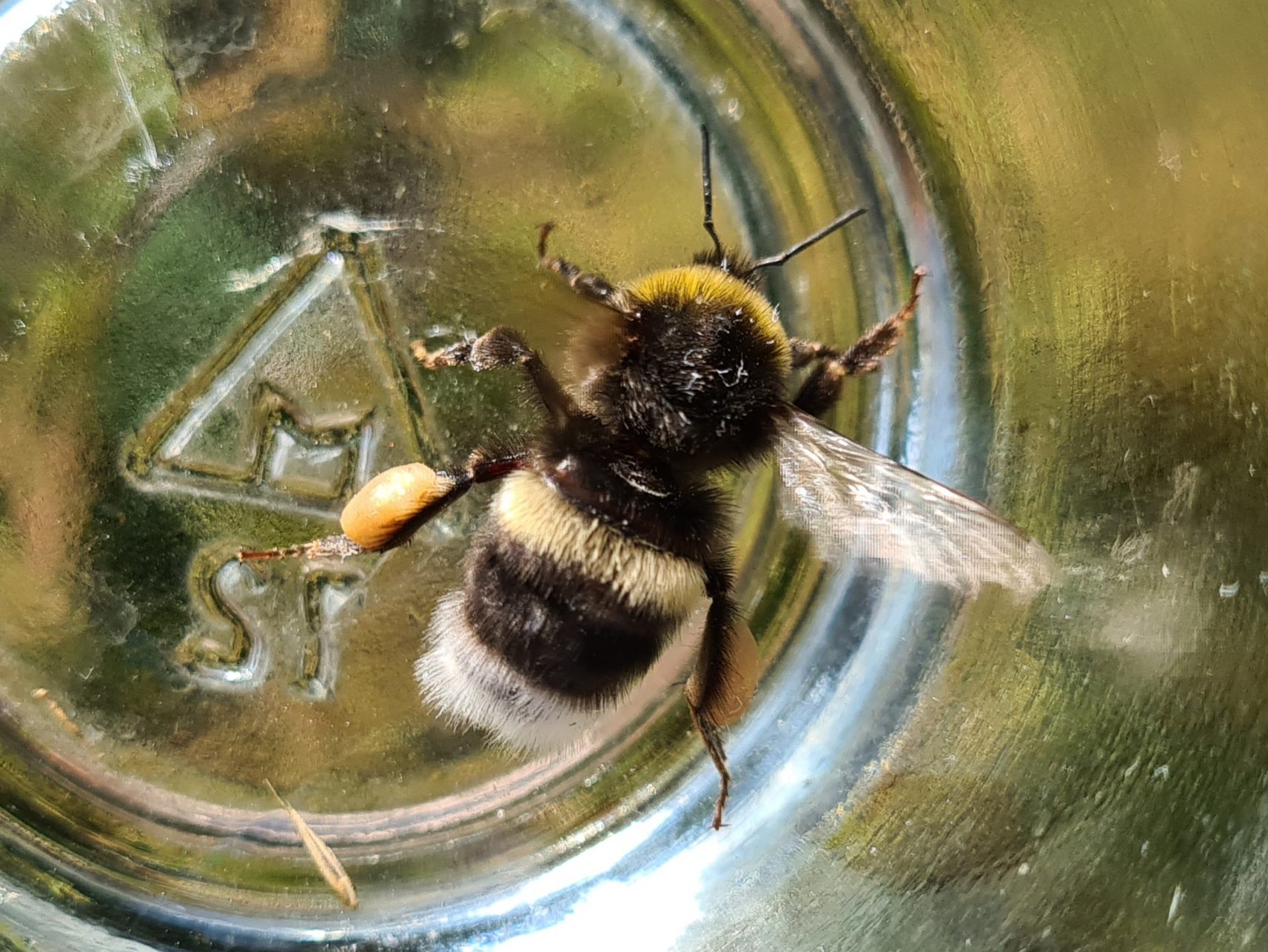
Čmelák hájový (Bombus lucorum) – dělnice (worker)
Foto: O. Hercog 05 09 2021
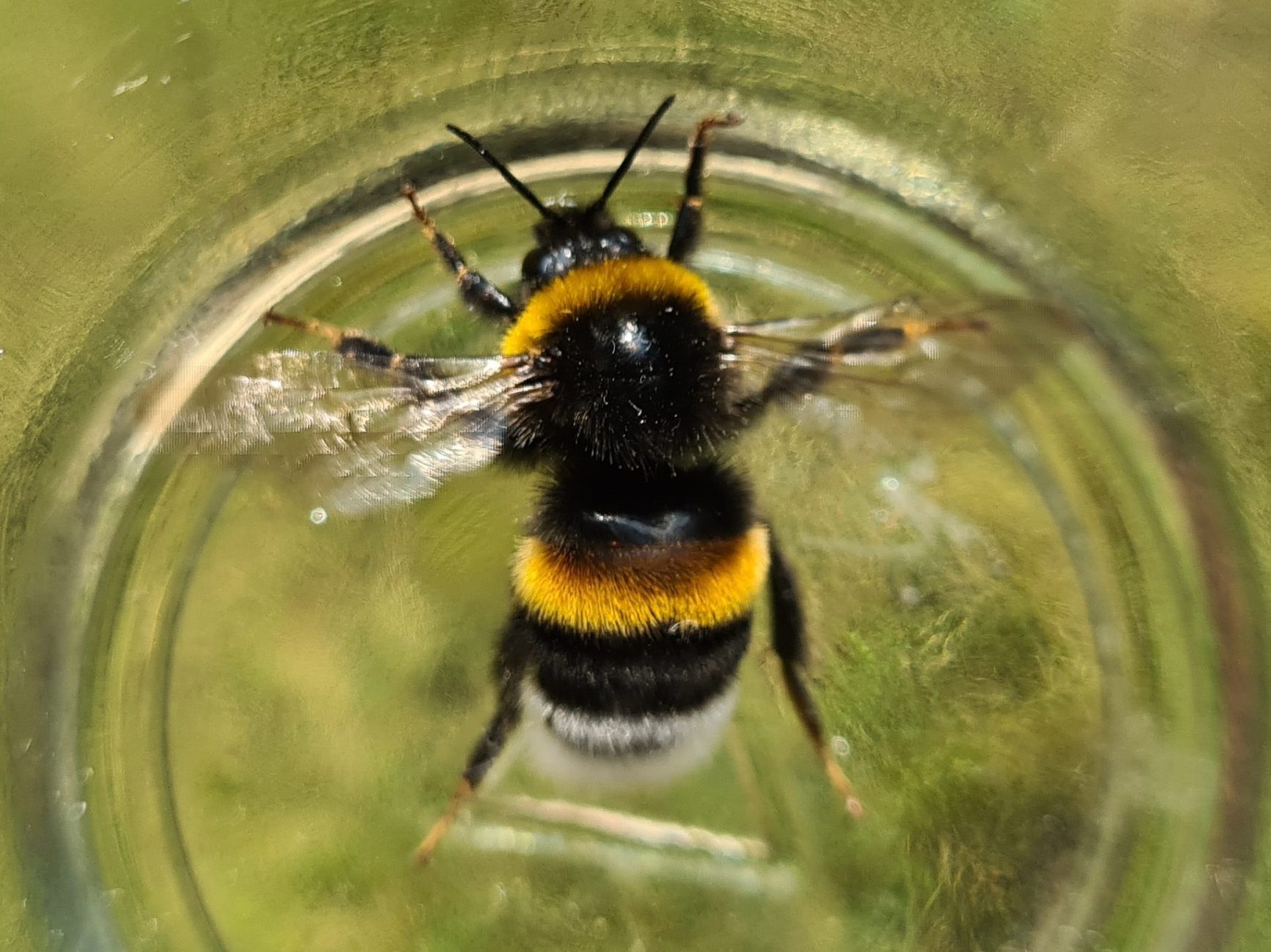
.
Male wood bumblebees are easy to recognize. They are very typical – the male is beautifully yellow and cannot be confused with the male ground bumblebee.
The male bumblebee is more similar to the large worker, but its yellow stripes are wider and brighter. Here too, however, the difference in shades is visible, although not as striking as in the mother and worker. It will help you to look at the hind legs without pollen cups and at the antennae.
The difference between the species is significant in males – the male ground bumblebee (B. terrestris) lacks yellow elements on the head and face.

Čmelák zemní (Bombus terrestris) – samec (male)
Foto: O. Hercog 24/7/2021
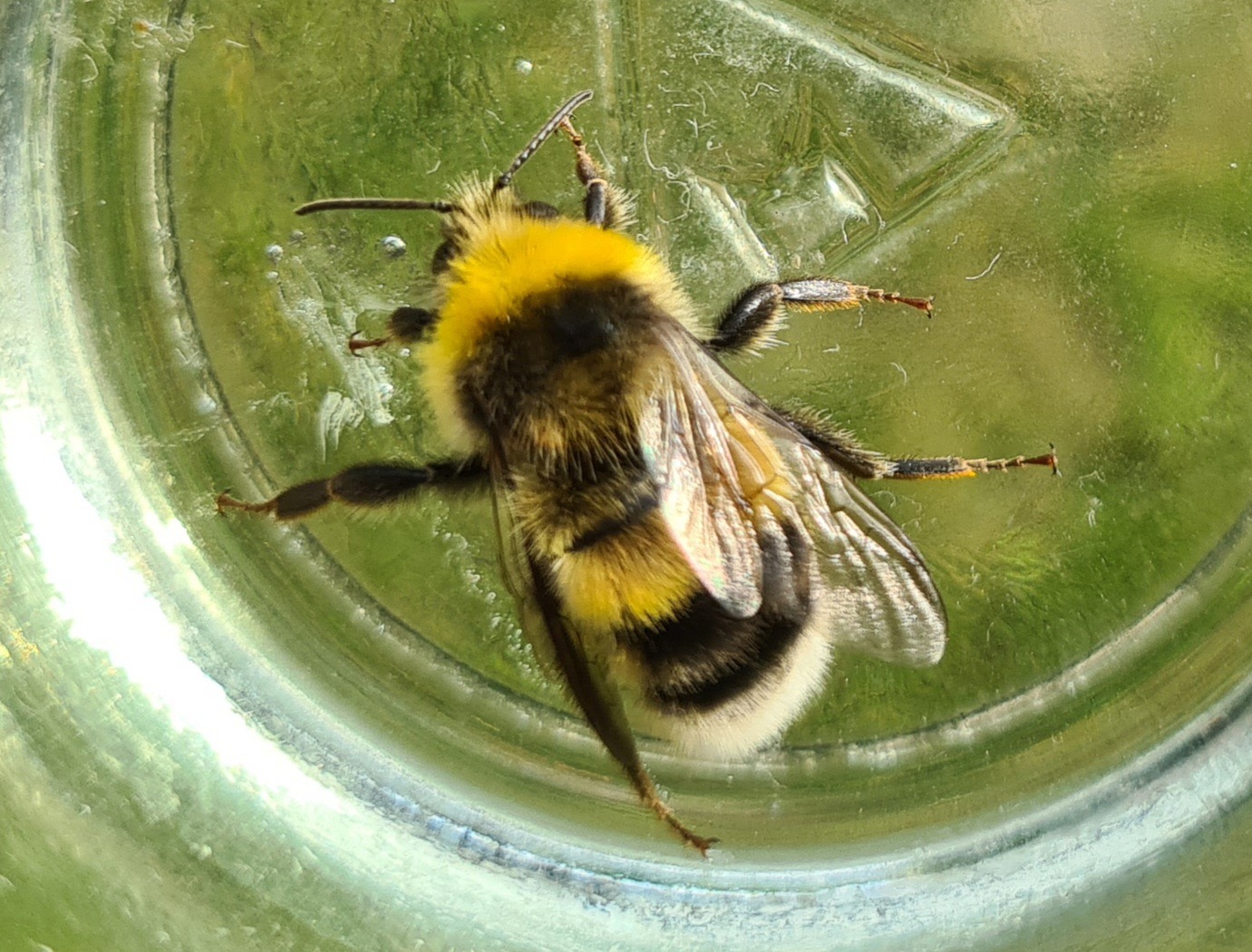
Čmelák hájový (Bombus lucorum) – samec (male)
Foto: O. Hercog 15/7/2021
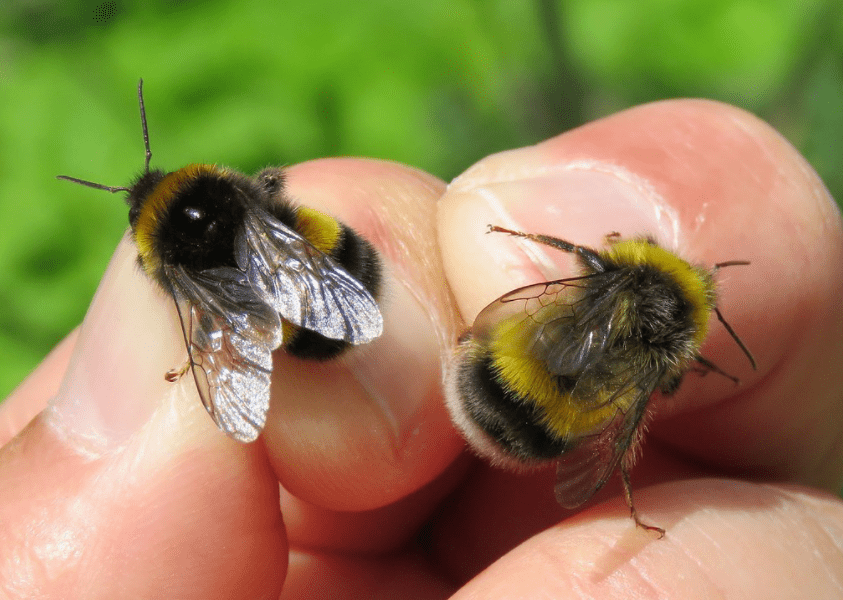
Čmelák zemní a hájový (Bombus terresris and lucorum)
B. terrestris vlevo
samec (male)
Foto: S. Falk
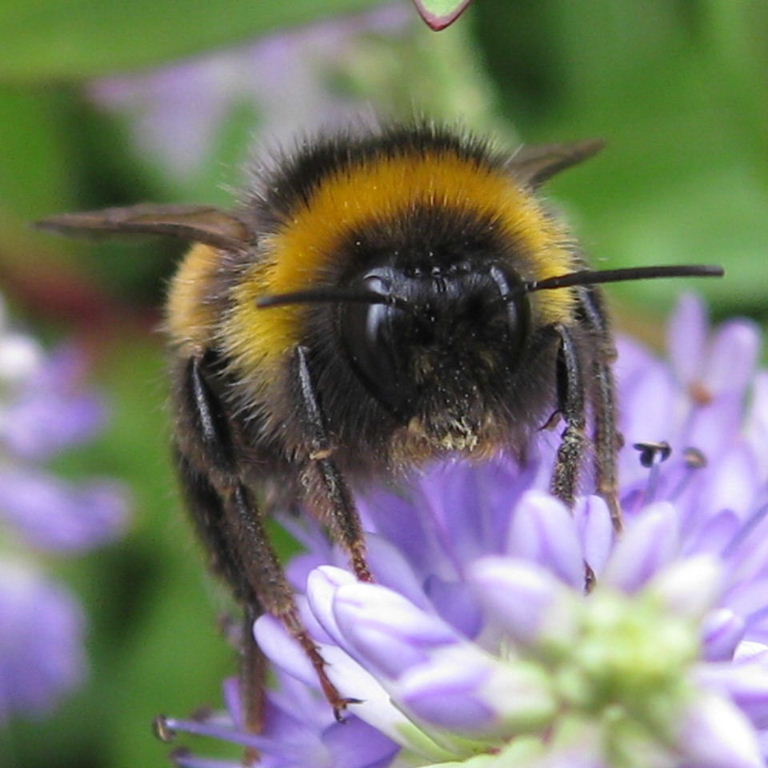
Čmelák zemní (Bombus terrestris) – samec (male)
Foto: Animal photos
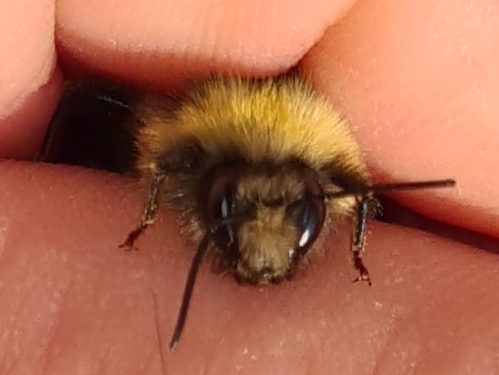
Čmelák hájový (Bombus lucorum) – samec (,male) hlava
Foto: O. Hercog 23 07 2021
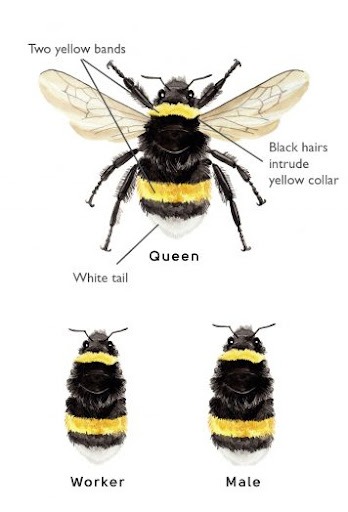
Čmelák podvojný (Bombus cryptarum) (anglicky cryptic bumblebee)
- You can read more about the double-headed bumblebee (Bombus cryptarum) HERE<PŘIPRAVUME>
The following text provides only information for comparison
- Poznámky k určení
– čmelák podvojný je nehojný druh a šance že ho potkáte je minimální, informace o jeho výskytu jsou řídké – máte malou šanci, že se s ním potkáte
– dá se zachytit ve vyšších polohách
– dlouho neměl české druhové jméno. Doc Ptáček ve zdrojovém článku časopisu Včelařství užívá české označení „čmelák norový“
- Na rozdíl od čmeláka hájového :
– máte malou šanci, že se s ním potkáte
– obtížně se rozeznají od čmeláka hájového a bez analýzy DNA to spolehlivě nelze
– pokud je znatelné, pak má na prvním proužku přerušení ve tvaru písmeme S
– samci jsou velmi podobní, bez pitvy a prohlídky např. pohlavních orgánů pod mikroskopem, jsou obtížně odlišitelní od ostatních podobných druhů
– velikost je menší
Poznámka: Diskuse o tom, zda se jedná o samostatný druh nebo jen o formu B. lucorum, nebyla dosud uzavřena – viz Complex lucorum

Čmelák podvojný (Bombus cryptarum)
Zdroj: Blooms for Bees

čmelák hájový – Bombus lucorum
Zdroj: Sikora A., Michołap P., Kadej M., Sikora M. Tarnawski D. 2018 „Pszczoły w mieście: Trzmiele Wrocławia“, Wyd. Stowarzyszenie Natura i Człowiek.
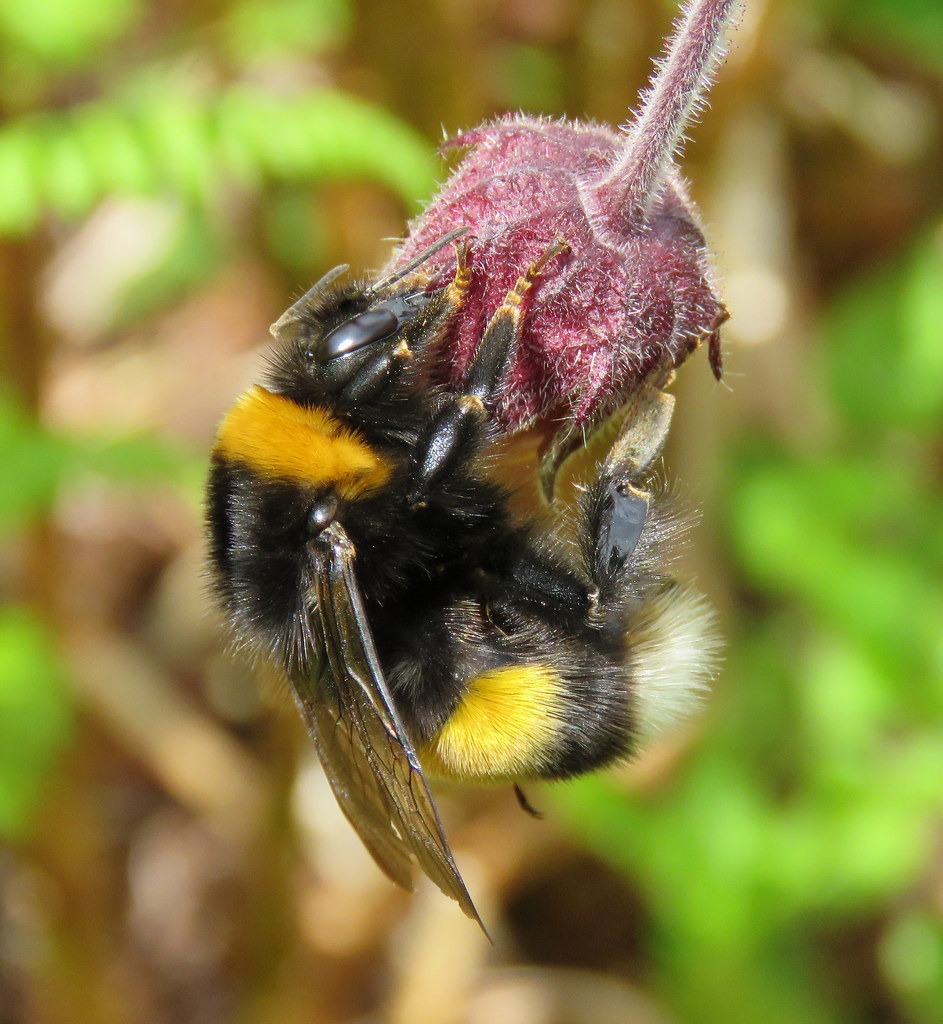
Čmelák podvojný (Bombus cryptarum) – matka (queen)
Foto: M. Tarm

Čmelák hájový (Bombus lucorum) – matka (queen)
Foto: O. Hercog 16/ 6/2021
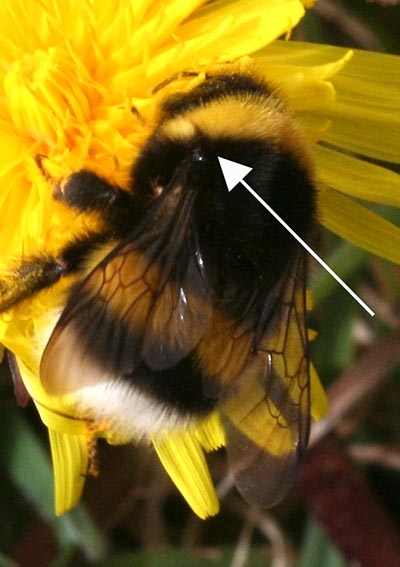
Interesting detail of the breast band of a mother bumblebee

Čmelák podvojný (Bombus cryptarum) – matka (queen)
přerušení žluté pásky na předohrudi
Foto: Donegal Wildlife
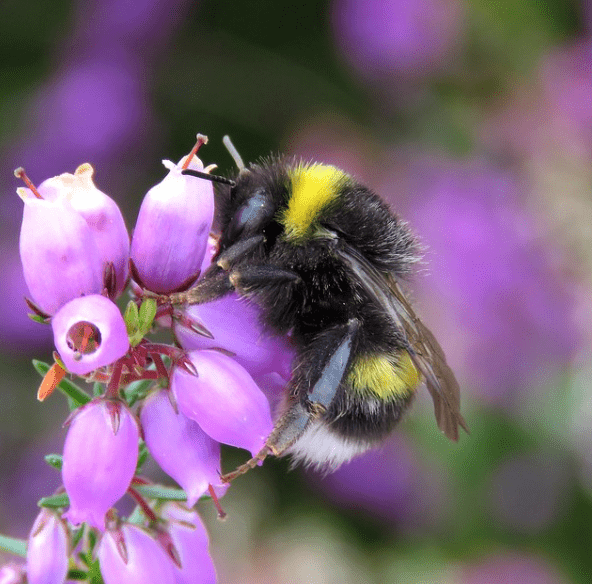
In our catalog, we will use the band on the bumblebee's back, which gradually fades and loses its shade/yellow color.

Čmelák podvojný (Bombus cryptarum) – dělnice (worker)
Foto: S. Falk 2019
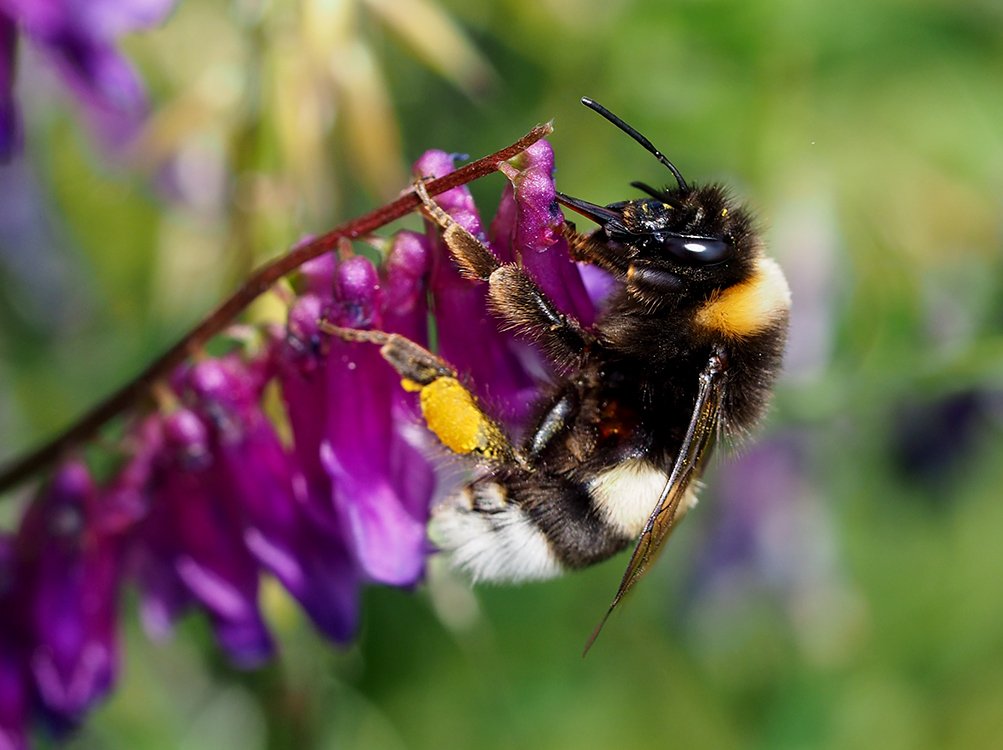
Ćmelák hájový – Bombus lucorum – děnice (worker
Foto: H. Kříženecká
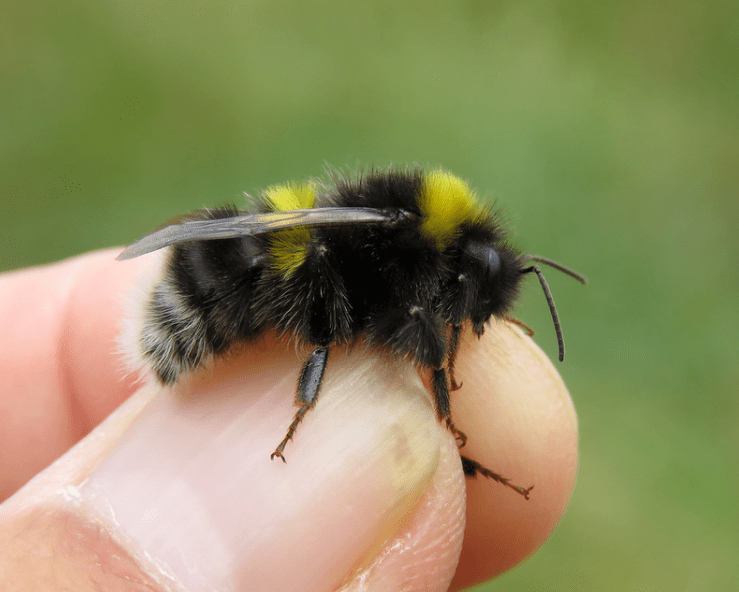
Čmelák podvojný (Bombus cryptarum) – samec (male)
Foto: S. Falk 2019
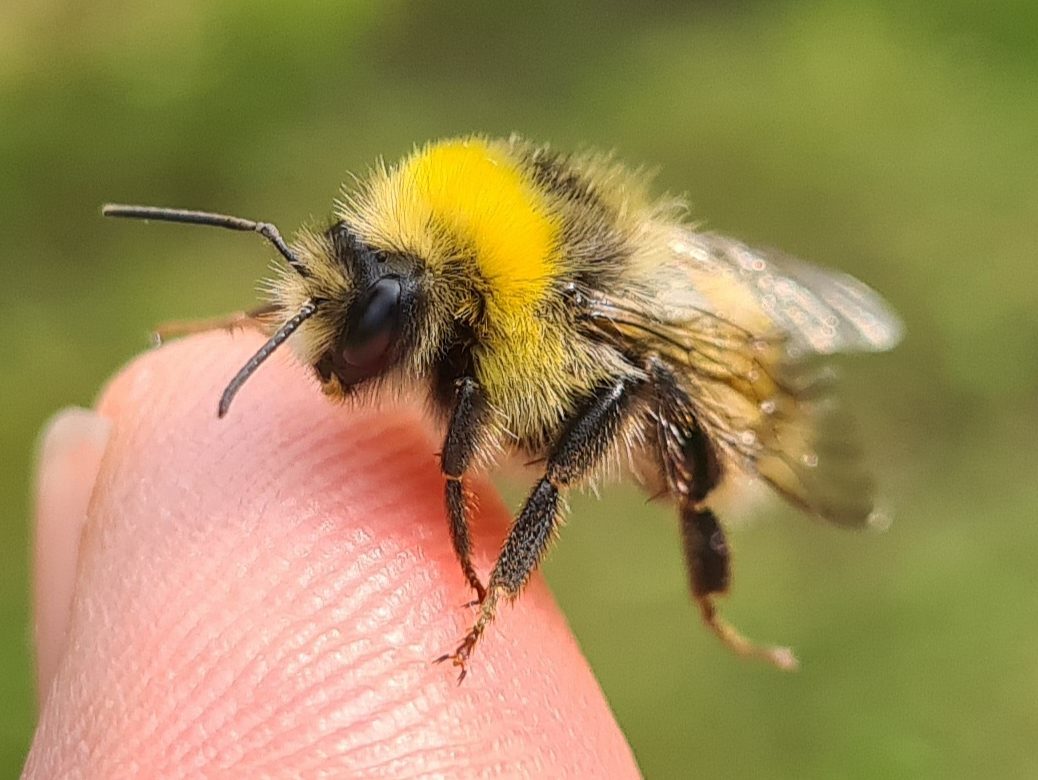
Čmelák hájový (Bombus lucorum) – samec (male)
Foto: O. Hercog 15/ 7/2021
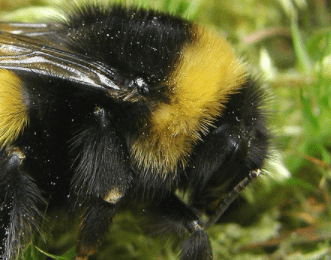
Greater bumblebee (Bombus magnus)
- You can read more about the greater bumblebee (Bombus cryptarum) HERE<PŘIPRAVUME>
The following text provides only information for comparison
Na rozdíl od čmeláka hájového:
– máte velmi malou šanci, že se s ním potkáte
– obtížně se rozeznají od čmeláka hájového a bez analýzy DNA to spolehlivě nelze
– žlutá páska B. magnus je protažena až pod křídla, to bývá poměrně typický a dobře pozorovatelný znak
– samci jsou velmi podobní, bez pitvy a prohlídky např. pohlavních orgánů pod mikroskopem, jsou obtížně odlišitelní od ostatních podobných druhů
Note: The discussion about whether this is a separate species or just a form of B. lucorum has not yet been concluded – see Complex lucorum

Čmelák větší (Bombus magnus) – matka (queen)- detail pásku na předohrudi
(collar)
Foto: S. Falk
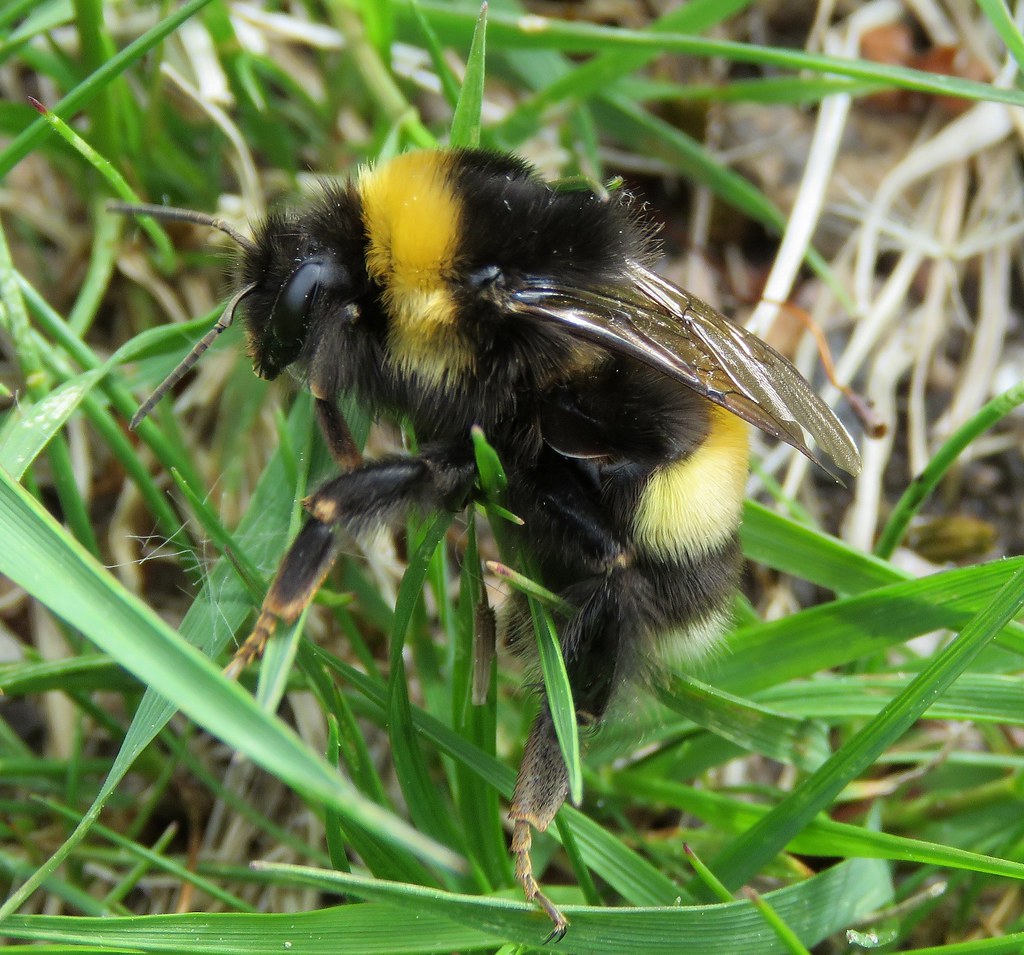
Čmelák větší (Bombus magnus) – matka (queen)
Foto: S. Falk
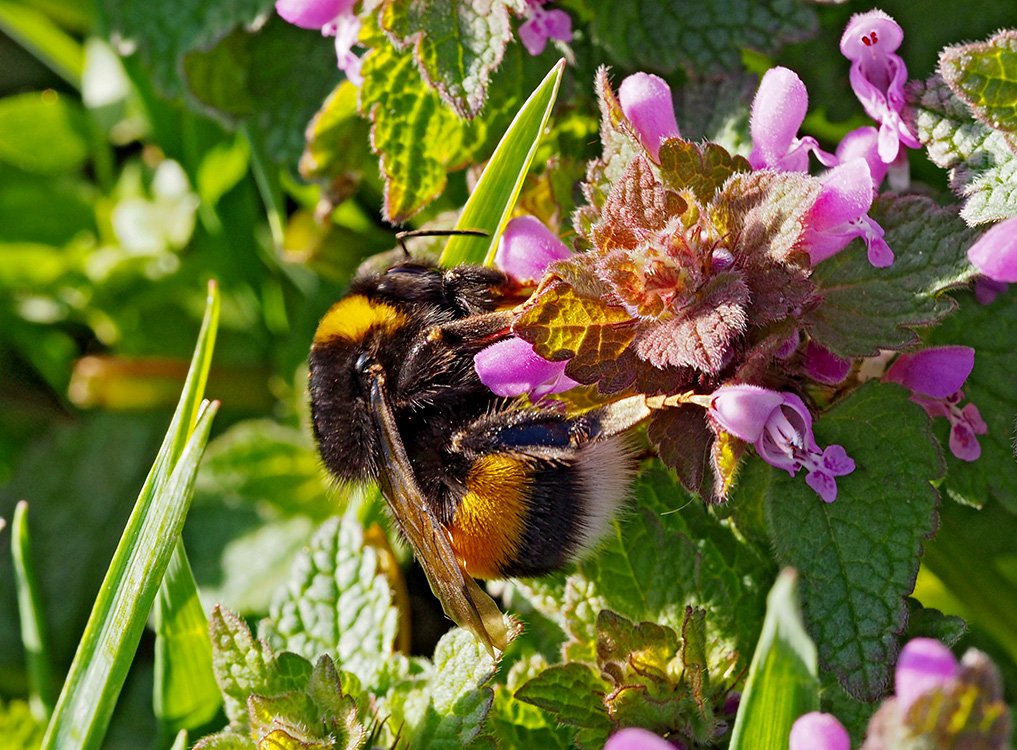
Wood bumblebee (Bombus lucorum) mother – queen – Photo Hana Kříženecká (2)
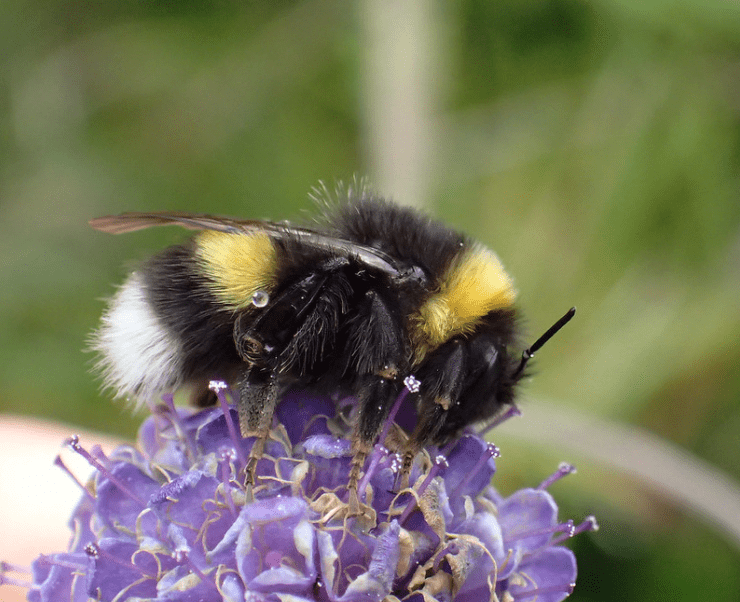
Čmelák větší (Bombus magnus) – dělnice (worker)
Foto: S. Falk

Ćmelák hájový (Bombus lucorum) – děnice (worker)
Foto: H. Kříženecká
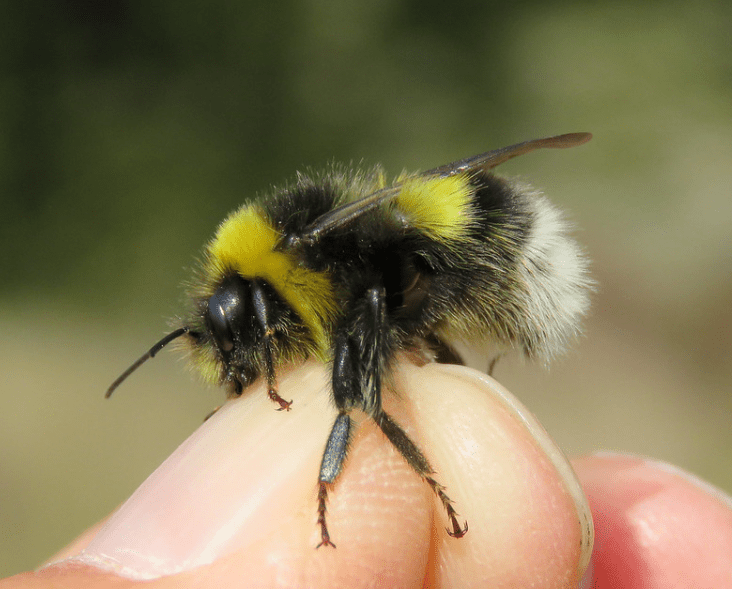
Čmelák větší (Bombus magnus) – samec (male)
Foto: S. Falk

Čmelák hájový (Bombus lucorum) – samec (male)
Foto: O. Hercog 15/ 7/2021
Čmelák zahradní (Bombus hortorum)
Čmelák humenní (Bombus ruderatus)
- You can read about the garden bumblebee (B. hortorum) HERE < UNDER CONSTRUCTION>
- You can read about the humen bumblebee (B. ruderatus) HERE < UNDER CONSTRUCTION>
Both species are very similar and it is not reliable to distinguish them reliably by color, therefore we will not discuss their species differences in this section and will only compare them with the wood bumblebee (B. lucorum).
- Na rozdíl od čmeláka hájového:
– hlava výrazně dlouhá a prohnutá, připomínající tvarem koňskou hlavu
– ježatější a delší chlupy
– dva proužky na hrudi
– první žlutý proužek na 1. tergidu zadečku
– všechny proužky stejně světlé žluté barvy a stejného odstínu
– některé variety prakticky černé, žluté prvky jen slabě naznačené, či prakticky nepoznatelné
– špičatý zadeček
– krmení larev prostřednictvím kapes (pocket makers)
– často zakládají druhou generaci

Čmelák zahradní (Bombus hortorum)
Zdroj: Sikora A., Michołap P., Kadej M., Sikora M. Tarnawski D. 2018 „Pszczoły w mieście: Trzmiele Wrocławia“, Wyd. Stowarzyszenie Natura i Człowiek.
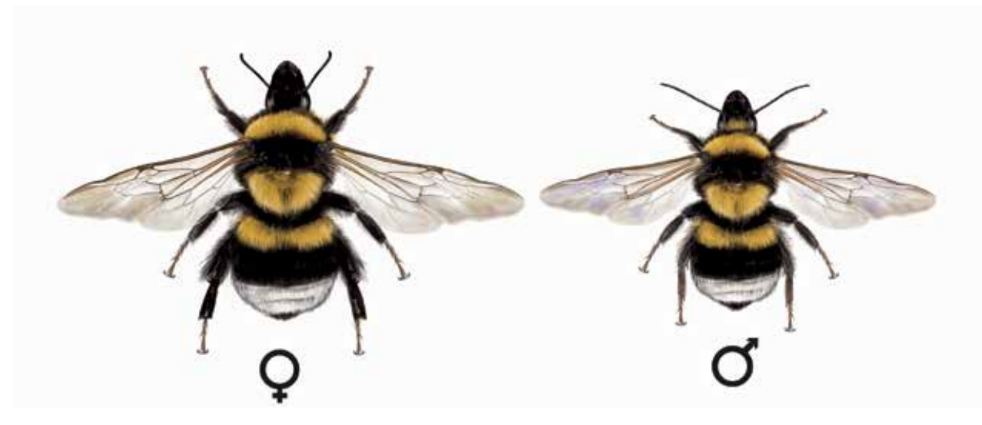
čmelák hájový – Bombus lucorum
Zdroj: Sikora A., Michołap P., Kadej M., Sikora M. Tarnawski D. 2018 „Pszczoły w mieście: Trzmiele Wrocławia“, Wyd. Stowarzyszenie Natura i Człowiek.
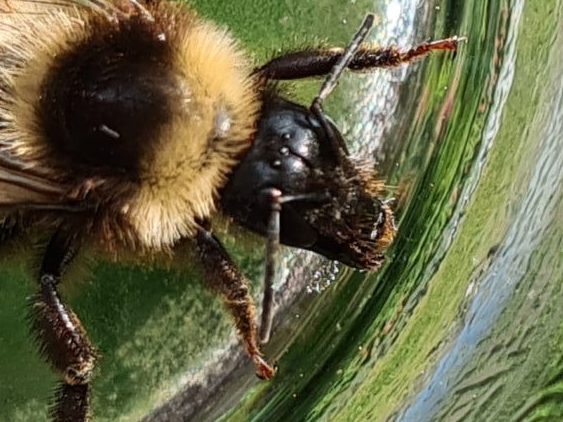
Čmelák humenníí (Bombus ruderatus)
Zdroj: Sikora A., Michołap P., Kadej M., Sikora M. Tarnawski D. 2018 „Pszczoły w mieście: Trzmiele Wrocławia“, Wyd. Stowarzyszenie Natura i Człowiek.

čmelák hájový – Bombus lucorum
Zdroj: Sikora A., Michołap P., Kadej M., Sikora M. Tarnawski D. 2018 „Pszczoły w mieście: Trzmiele Wrocławia“, Wyd. Stowarzyszenie Natura i Człowiek.

Čmelák zahradní (Bombus hortorum) – hlava dělnice (worker)
Foto: O. Hercog 29/8/2021
The two species can be distinguished very well in the photographs.
Všimněte si tvaru a postavení hlavy – čmelák zahradní (B. hortorum) má hlavu výrazně dlouhou a často „vystrčenou vpřed“.
Čmelák hájový (B.lucorum), jako čmelák s nejkratší hlavou mezi druhy čmeláků v ČR hlavu vesměs „skrývá“.
Also note that the garden bumblebee (B. hortorum) has two distinct stripes on its chest and its male does not have as pronounced yellow coloring as the male grove bumblebee (B. lucorum).
You really can't confuse these two species. It's similar to the common bumblebee (B. ruderatus), which is very similar to the garden bumblebee.

Čmelák zahradní (Bombus hortorum) – matka (queen)
Foto: O. Hercog 27/6/2021

Čmelák hájový (Bombus lucorum) – matka (queen)
Foto: O. Hercog 16/ 6/2021

Čmelák zahradní (Bombus hortorum) – dělnice (worker)
Foto: O. Hercog 29/8/ 2021

Čmelák hájový (Bombus lucorum) – dělnice (worker)
Foto: O. Hercog 5/9/2021

Čmelák zahradní – (Bombus hortorum – samec (male)
Foto: O. Hercog 18/7/ 2021
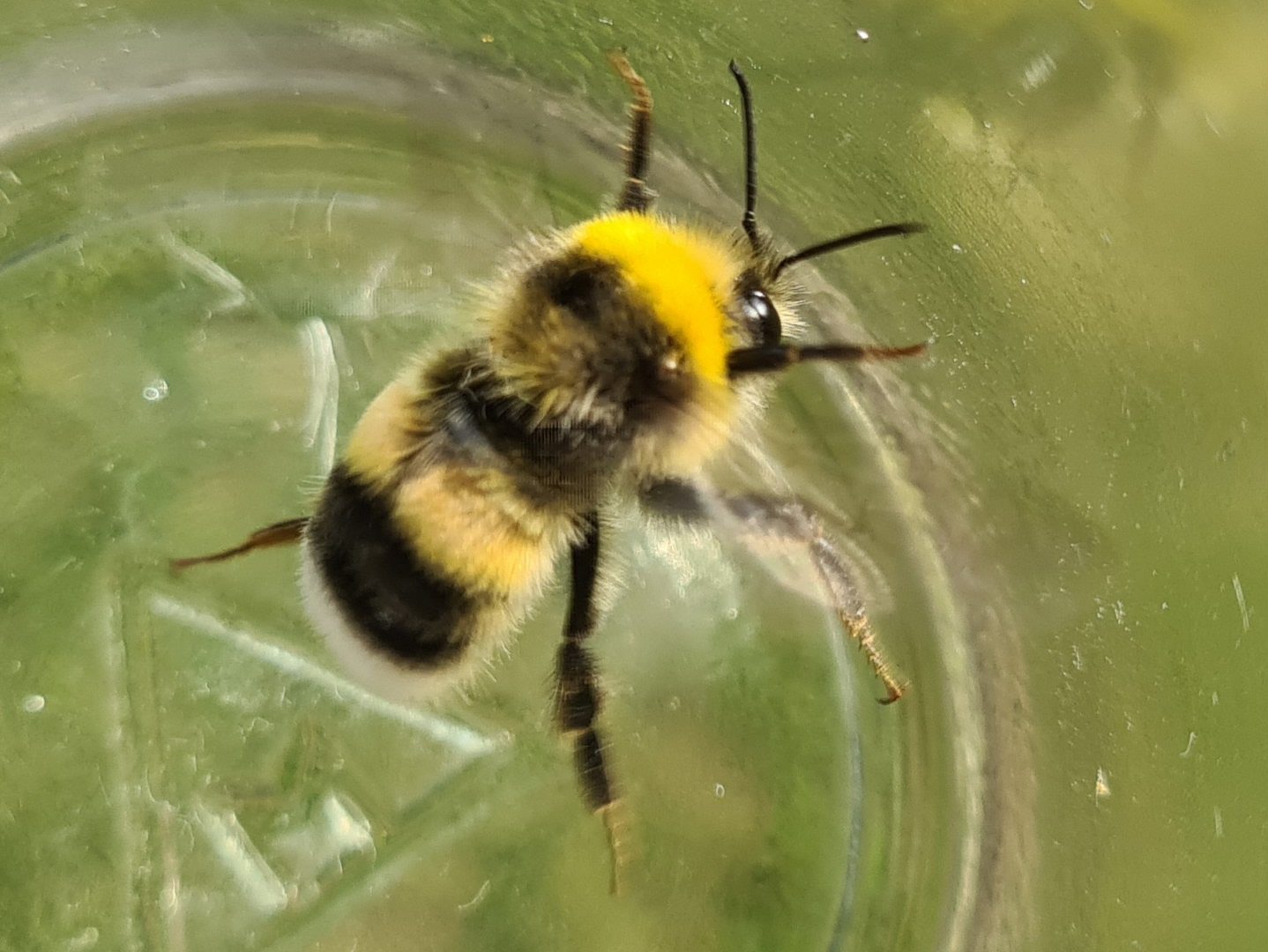
Čmelák hájový – (Bombus lucorum)- samec (male)
Foto: O. Hercog 15/7/2021
Occurrence
- It is a frequent inhabitant of mountainous areas, where it can be seen up to an altitude of 2000 m
- However, it has also spread to the lowlands, where it inhabits forested areas rather than open landscapes
- Hygrophilous and very abundant in forested landscapes
- You can find it practically throughout Europe, Asia Minor to the Pacific
- In northern Europe, it has been described as occurring as far as the Barents Sea, and in the south in Greece (but not in the Mediterranean Sea)
Habitat
- inhabits various environments
- prefers shady habitats but also heathlands
- It is often found in forests, including mountain forests – from there it penetrates into wooded mosaic landscapes
Life cycle
- Druh:
– ranný - Počet generaci v sezóně:
– jedna generace v sezóně (v laboratorním chovu může hnízdit také bez hibernace) - Matky-královny hledají hnízdiště:
– od poloviny března (podle teplot) - Zahnízdění matek:
– březen až polovina května - Nové matky královny se objevují:
– od poloviny června, ve vyšších polohách v červenci - Samci se objevují:
– od poloviny června
– samci se v hnízdě rodí až po mladých matkách, pak hnízdo produkuje samce až do svého zániku jako u druhu terrestris.
Poznámka: na rozdíl od čmeláka zemního (B. terrestris) se u tohoto druhu někdy objeví kokony mladých matek ještě v období produkce samců. Samci mohou pocházet z kladení matky i dělnic, jako u ostatních čmeláků. - Hnízdo končí:
– hnízda končí v závislosti na potravních zdrojích v nížině již počátkem července, ve vyšších polohách až v září. Jeho zánik bývá z pravidla rychlý.
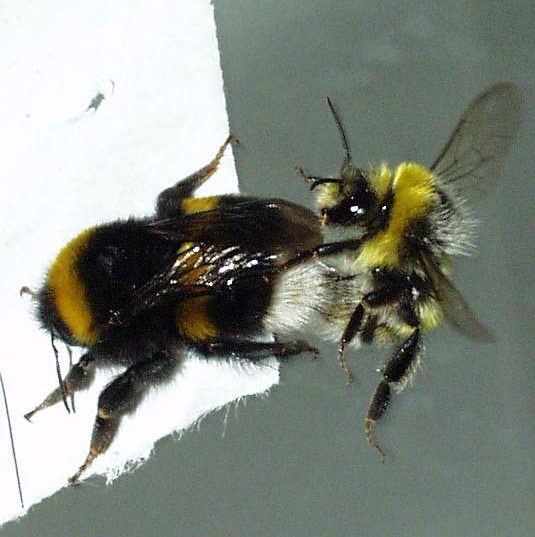
You often see photos/videos that the author claims are of mating.
But the male can only mate when the female extends her stinger and opens the sting chamber. The mother's stinger is curved and when extended, its tip points upwards. The male must be right behind it - it is not enough for him to sit on the female.
This is clearly visible in this photo of Mr. Doc. Ptáček.

Čmelák hájový – (Bombus lucorum) – páření (mating)
Foto: V. Ptáček
In wood bumblebees (B. lucorum), returns to the places where their mothers were born are not common, at least some breeders confirm this.
Je ale běžné, že se matka utká s matkou jiného druhu, která se zajímá o její hnízdiště. V takovém souboji vítězí většinou silnější jedinec. Velmi často ale takové souboje končí smrtí – jedné, nebo obou soupeřek.
Často je to čmelák zemní (B. terrestris) a čmelák skalní (B. lapidarius), který již osídlené hnízdo zabere a původní obyvatelku zabije, v lepčém případě zažene.
Jaromír Čížek describes cases where he found a large number of dead queens at an interesting nesting site, specifically at a nest of a rock bumblebee (B. lapidarius)
O návratech matek do rodných míst se dočtete ZDE
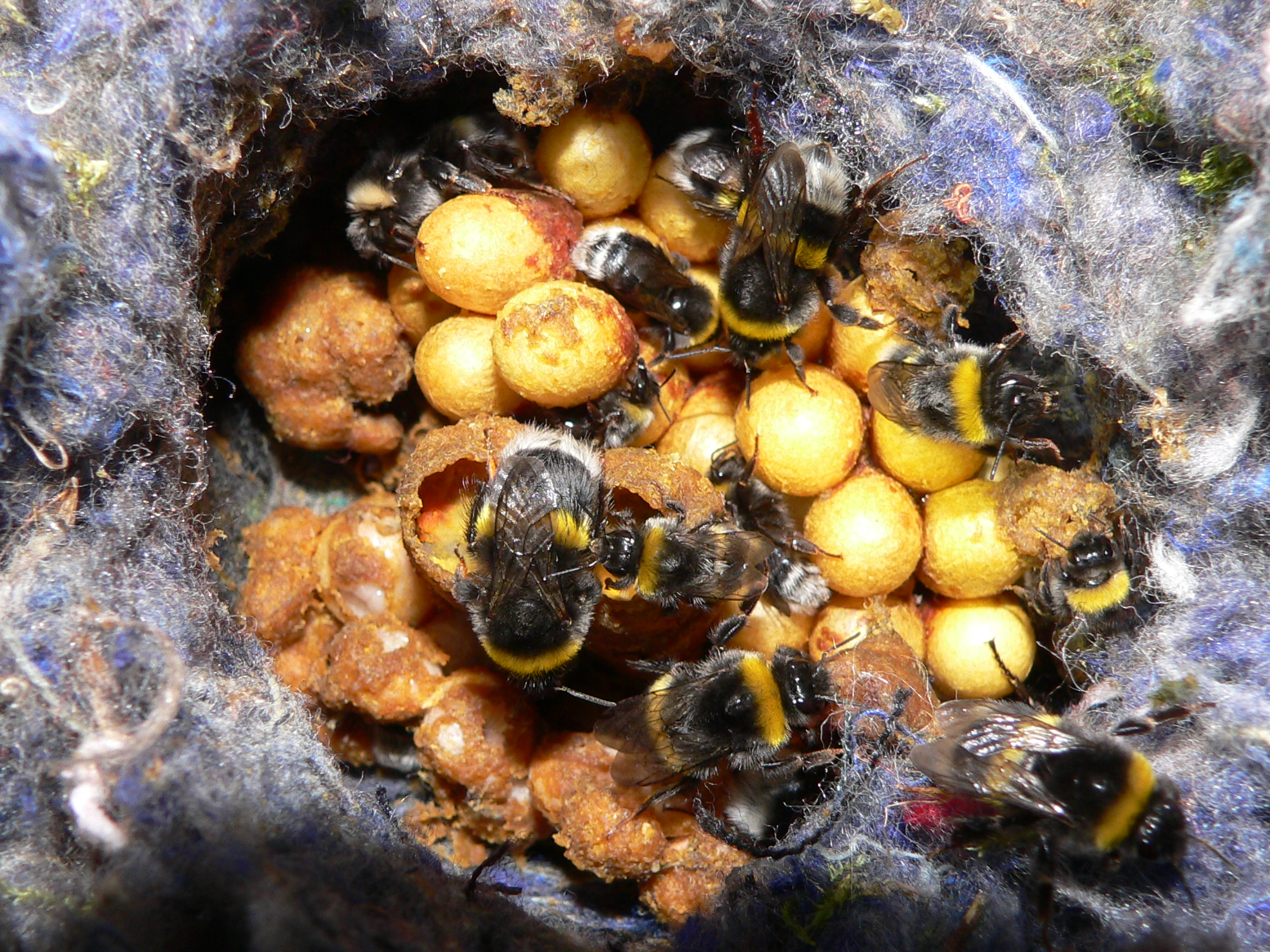
The following photo shows a view into the nest of a wood bumblebee (B. lucorum).
V hnízdě vidíte světlé žluté kokony, ze kterých se brzy narodí další jedinci. Také tam ve středu fotografie vidíte zásobnice pylu různých rostlin (směs barev). V levé dolní čísti vidíte vosková pouzdra s larvami. Pouzdra jsou vesměs otevřena, dělnice těmito otvory krmí larvy.
V levé části hnědý útvar. To jsou postupně se rýsující pouzdra larev, která rostou a již se osamostatňují.

Čmelák hájový (Bombus lucorum) – hnízdo (nest)
Foto: J. Čížek
Feeding the larvae
- Skladovači pylu (pollen stores) matka/dělnice strhávají pyl z pylových košíčků do zásobnic, vzniklých z prázdných kokonů, nebo jako voskové stavby uprostřed hnízda. Dle všeho čmeláci využívají více způsobů, jak si zásobárnu vytvořit. Podstatné ale je, že pyl skladují a ze zásobnic distribuují dál.
V zásobnicích pyl dusají a upravují kusadly, aby se zmenšila plocha styku s vzduchem. Zásobnice dělnice neuzavírají.
Tím chrání před oxidací a degradaci. Pro krmení larev ho zde odebírají a mísí s nektarem, směsí krmí larvy krmnými otvory.
Čmeláci hájoví jsou polylektický druh – nepreferují jen jednu rostlinu, ale široké spektrum různých kvetoucích rostlin. Proto se i v zásobnicích na pyl objevují různé barvy a odstíny pylu, které dělnice přinesly. Je to dáno tím, že čmeláci nespolupracují tak, jako včely, a každá dělnice sbírá pyl sama, aniž by si se sestrami předala informace o jeho zdroji.
Wood bumblebees like currant and raspberry flowers, but also lupine, huckleberries, fruit trees and willow catkins.
Nest location
- Hnízdí:
– nejčastěji podzemní hnízdiště v opuštěných hnízdech drobných savců hlodavců (hraboši)
– různé dutiny, někdy i velice hluboko pod zemí
– hnízdí ale i v dutinách zdí tam, kde najde hnízdo po drobných hlodavcích
Nest size
- Mostly medium nests
- Number of individuals 100 – 600
Visiting Pac-Man
Vestal bumblebee (Bombus vestalis)
Bohemian bumblebee (Bombus bohemicus)
O pačmelácích se dozvíte ZDE
How to distinguish a bumblebee from a wasp
Pačmelák panenský (Bombus vestalis), někdy také pačmelák letní
- Více se do pačmeláku panenském (B. vestalis) dočtete ZDE
- Na rozdíl od čmeláka hájového (B. lucorum):
– nemá kastu dělnic
– výrazná velká kulatá hlava
– absence žlutého pásku na 2.tergidu
– samice ani samci nemají na posledním páru pylové košíčky
– tmavá křídla
– za letu vydává výrazný chrčivý zvuk

Pačmelák panenský (Bombus vestalis)
Zdroj: Sikora A., Michołap P., Kadej M., Sikora M. Tarnawski D. 2018 „Pszczoły w mieście: Trzmiele Wrocławia“, Wyd. Stowarzyszenie Natura i Człowiek.
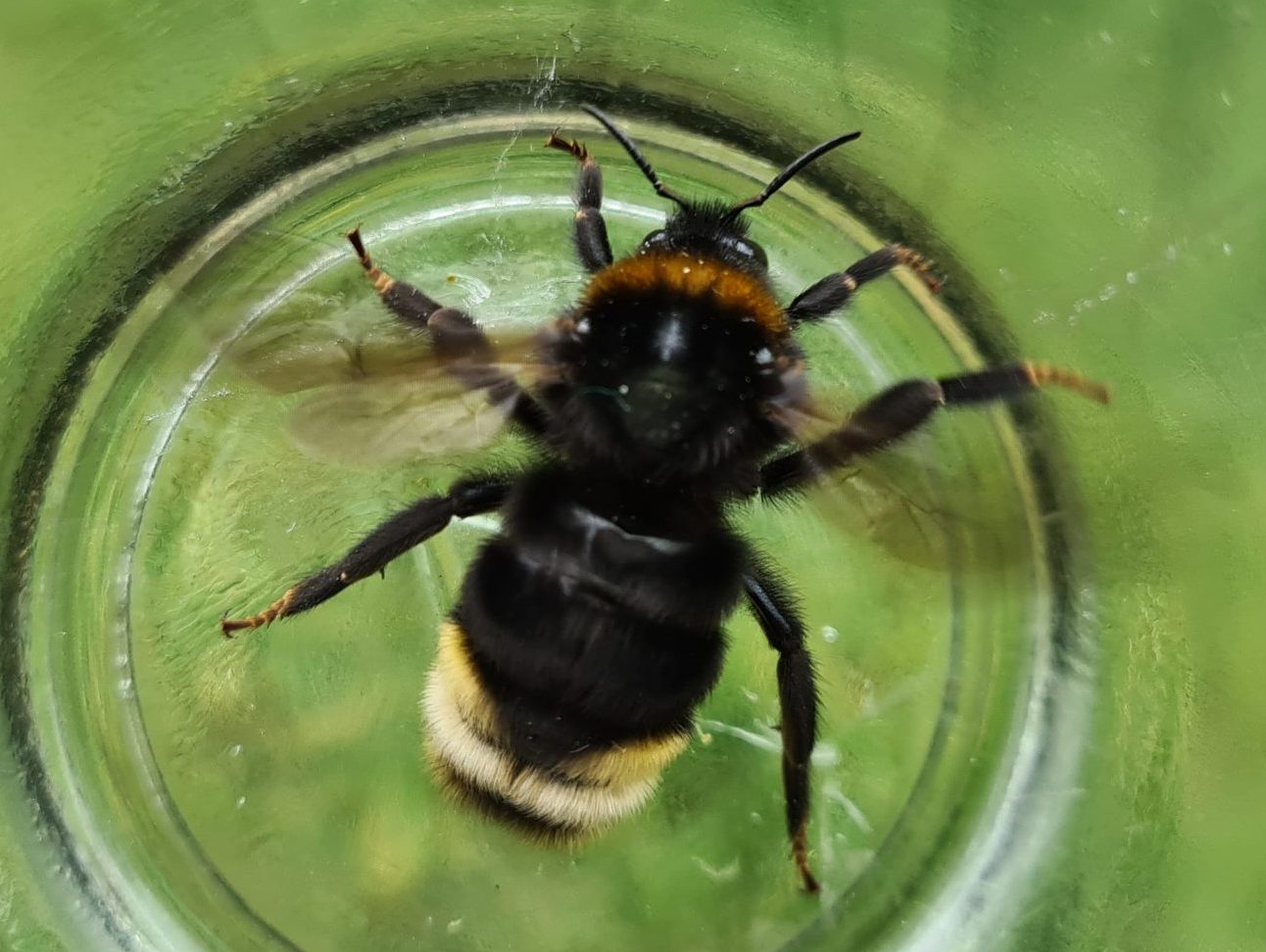
čmelák hájový – Bombus lucorum
Zdroj: Sikora A., Michołap P., Kadej M., Sikora M. Tarnawski D. 2018 „Pszczoły w mieście: Trzmiele Wrocławia“, Wyd. Stowarzyszenie Natura i Człowiek.
Note the differences in coloration and the typical head of the patchouli.

Pačmelák panenský (Bombus vestalis) – samice (female)
Foto: O. Hercog 01/08/2021
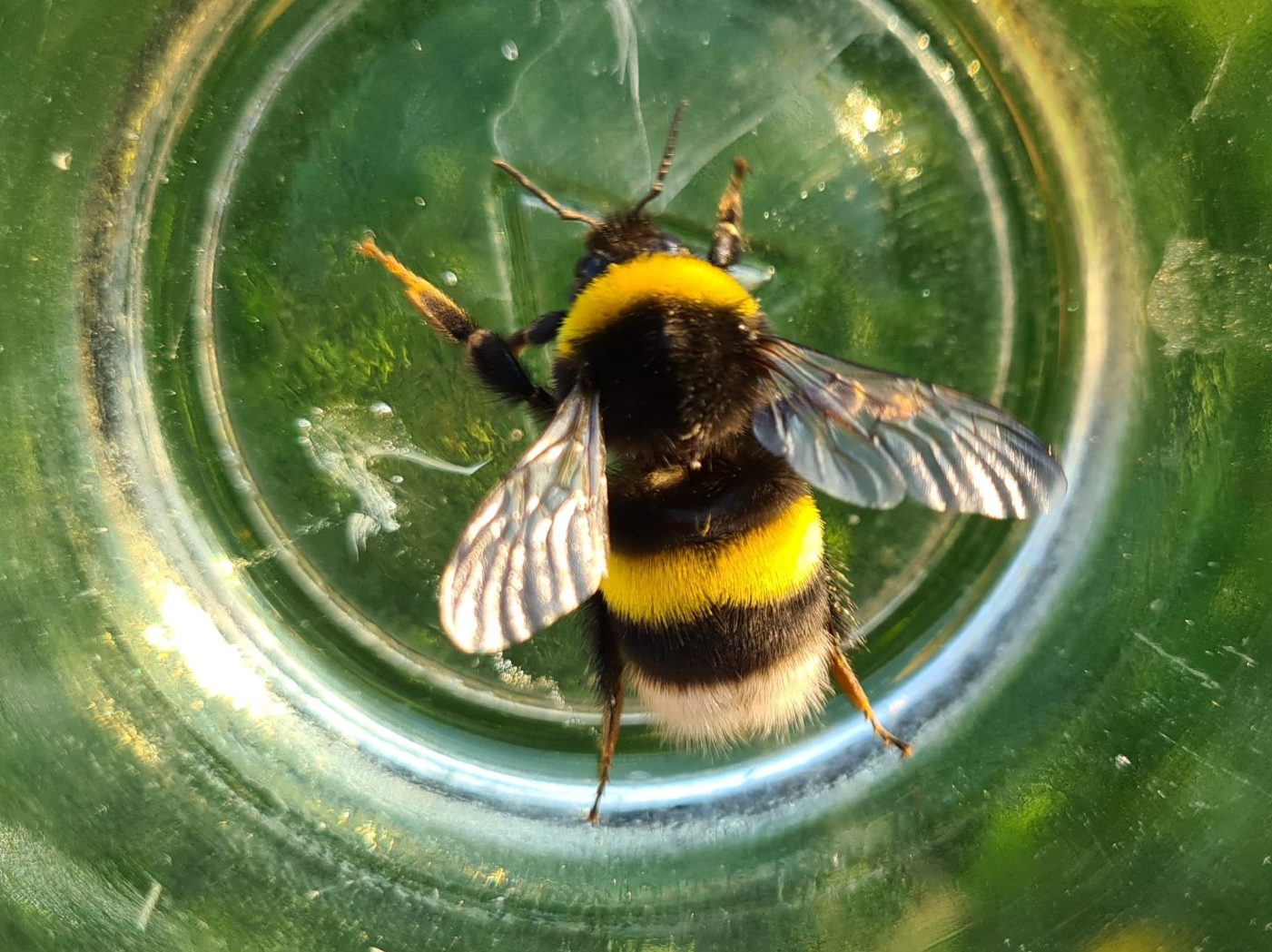
Čmelák hájový (Bombus lucorum) – matka (queen)
Foto: O. Hercog 16/ 6/2021
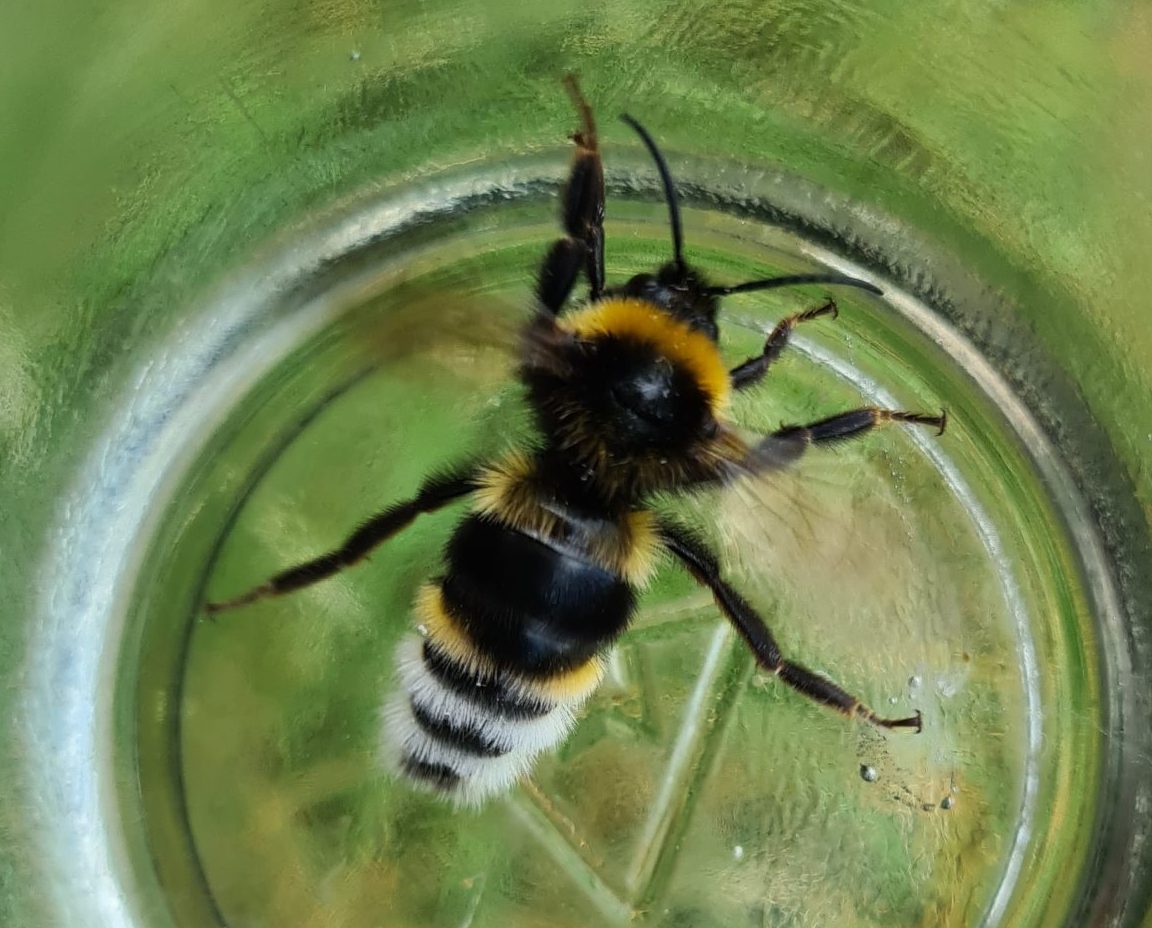
Pačmelák panenský (Bombus vestalis) – samec (male)
Foto: O. Hercog 24/7/2021

Čmelák hájový (Bombus lucorum) – samec (male)
Foto: O. Hercog 15/7/2021
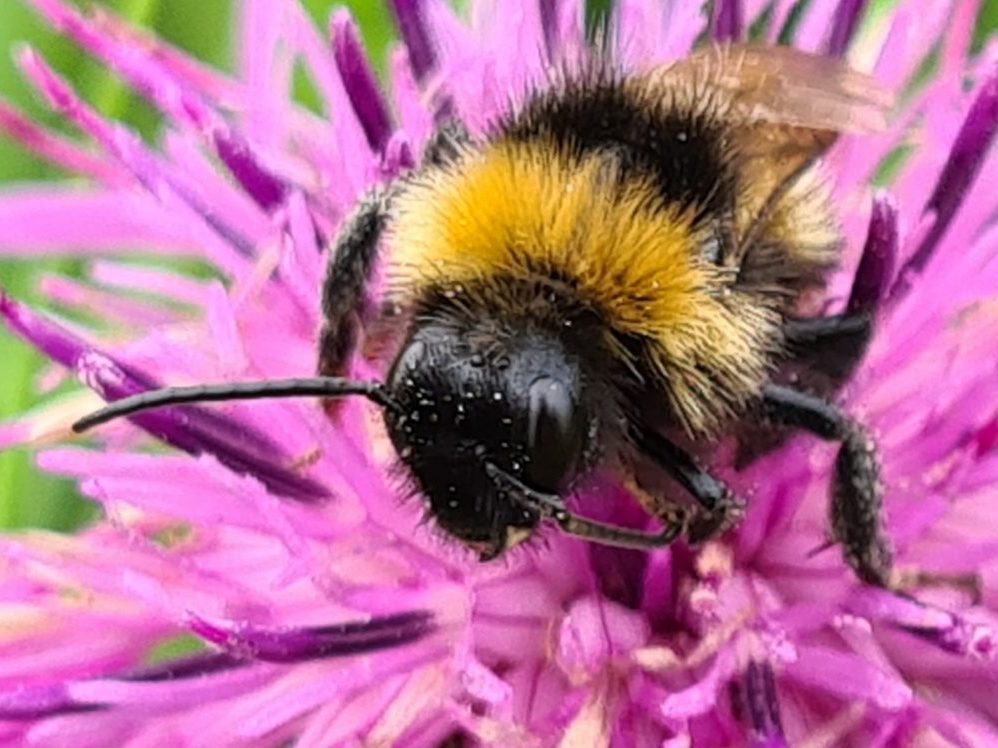
The head is in most cases a reliable sign to distinguish between a bumblebee and a wasp. You can see for yourself that the wasps have a large and robust head.

Pačmelák panenský (Bombus vestalis) – samec (male) – hlava (head)
Foto: O. Hercog 4/8/2021

Čmelák hájový (Bombus lucorum) – samec (male) hlava
Foto: O. Hercog 23 07 2021
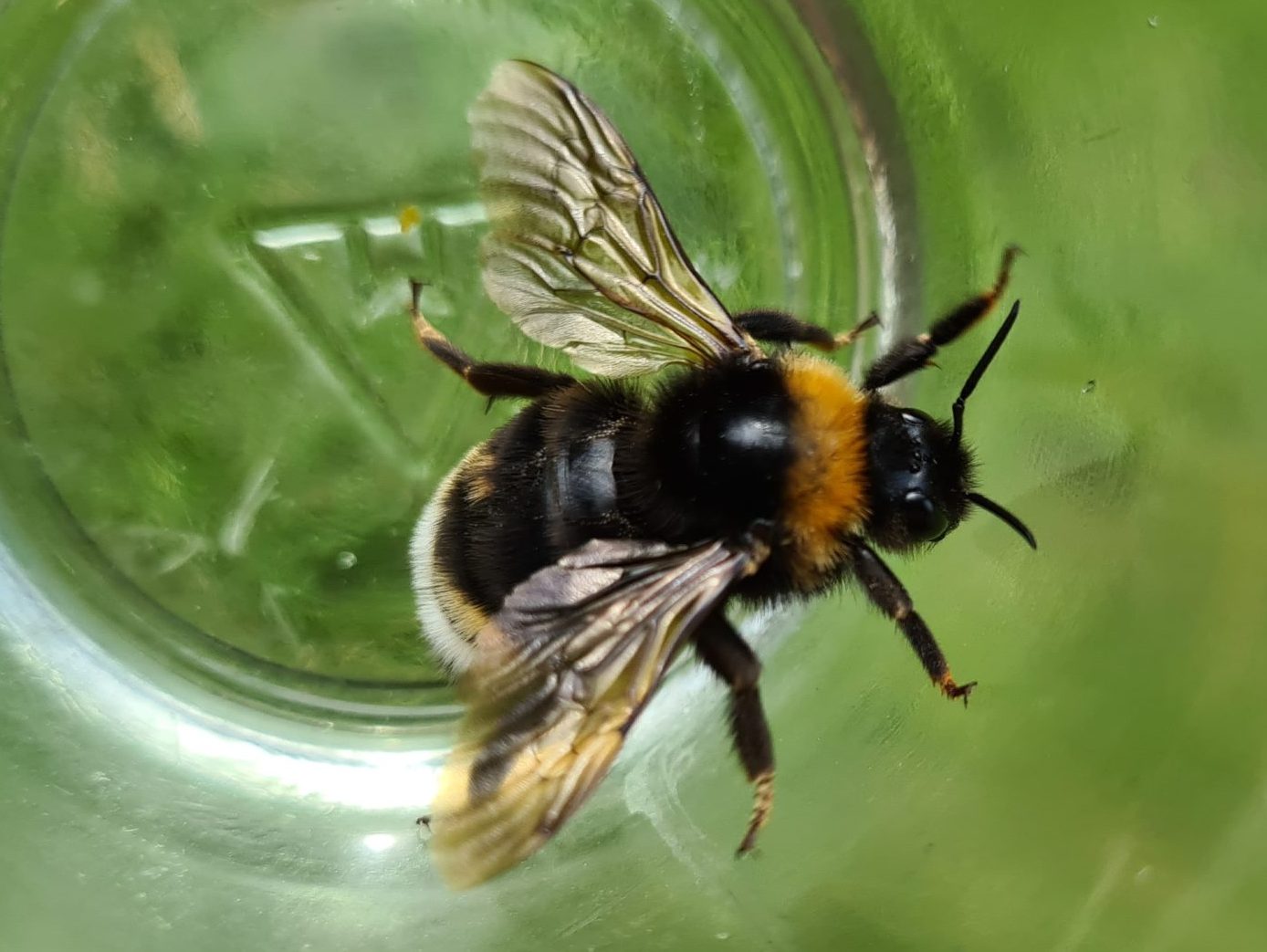
Pačmelák panenský (Bombus vestalis) – samice (female)
Foto: Ondřej Hercog 27/6/2021
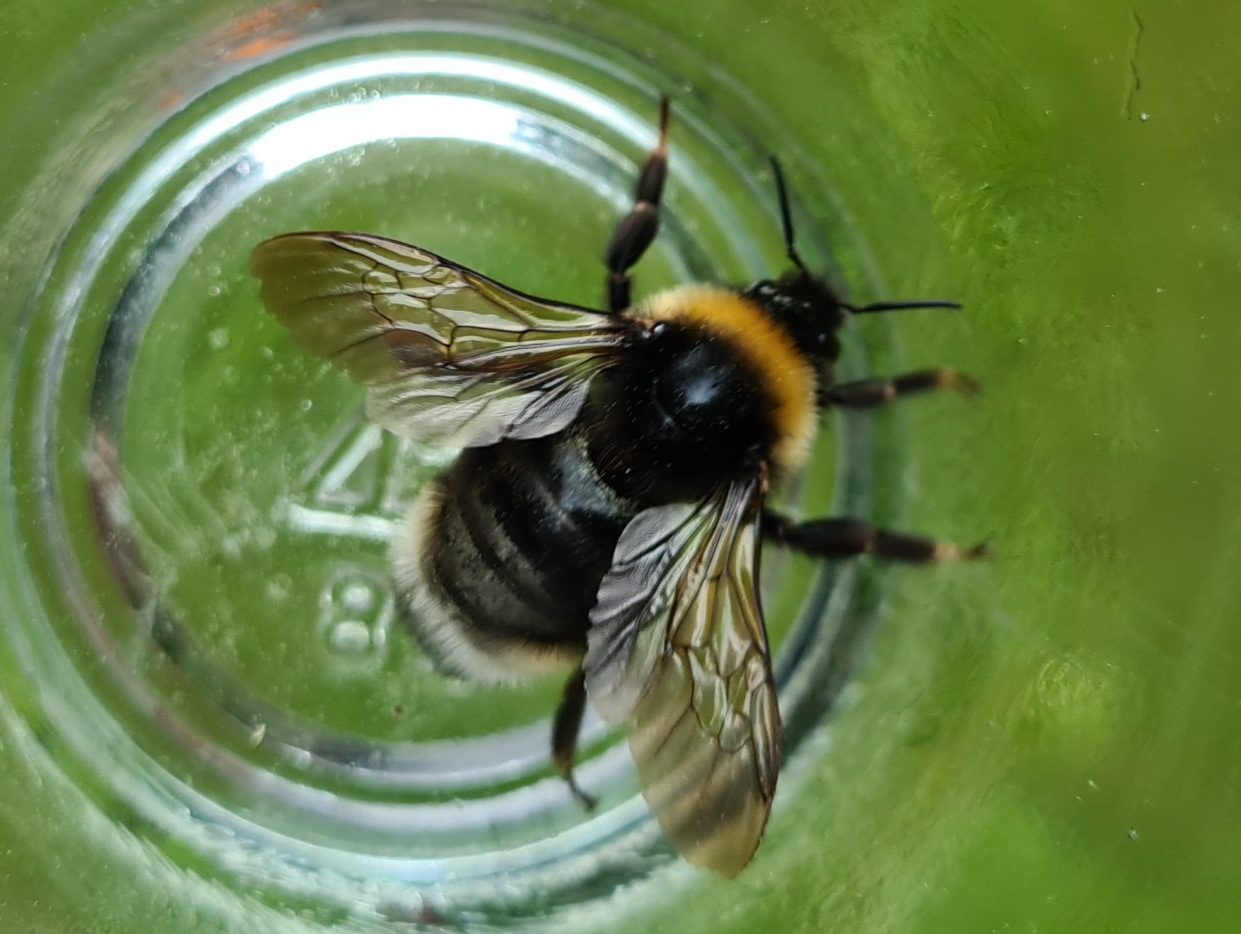
Bohemian bumblebee (Bombus/Psithyrus bohemicus)
- You can read more about Bohemian patchouli (B. bohemicus) HERE
- Na rozdíl od čmeláka hájového (B. lucorum):
– nemá kastu dělnic
– má výraznou velkou kulatá hlava
– absence žlutého pásku na 2.tergidu
– samice ani samci nemají na posledním páru pylové košíčky
– tmavá křídla
– za letu vydává výrazný chrčivý zvuk

Pačmelák český (Bombus bohemicus)
Zdroj: Sikora A., Michołap P., Kadej M., Sikora M. Tarnawski D. 2018 „Pszczoły w mieście: Trzmiele Wrocławia“, Wyd. Stowarzyszenie Natura i Człowiek.
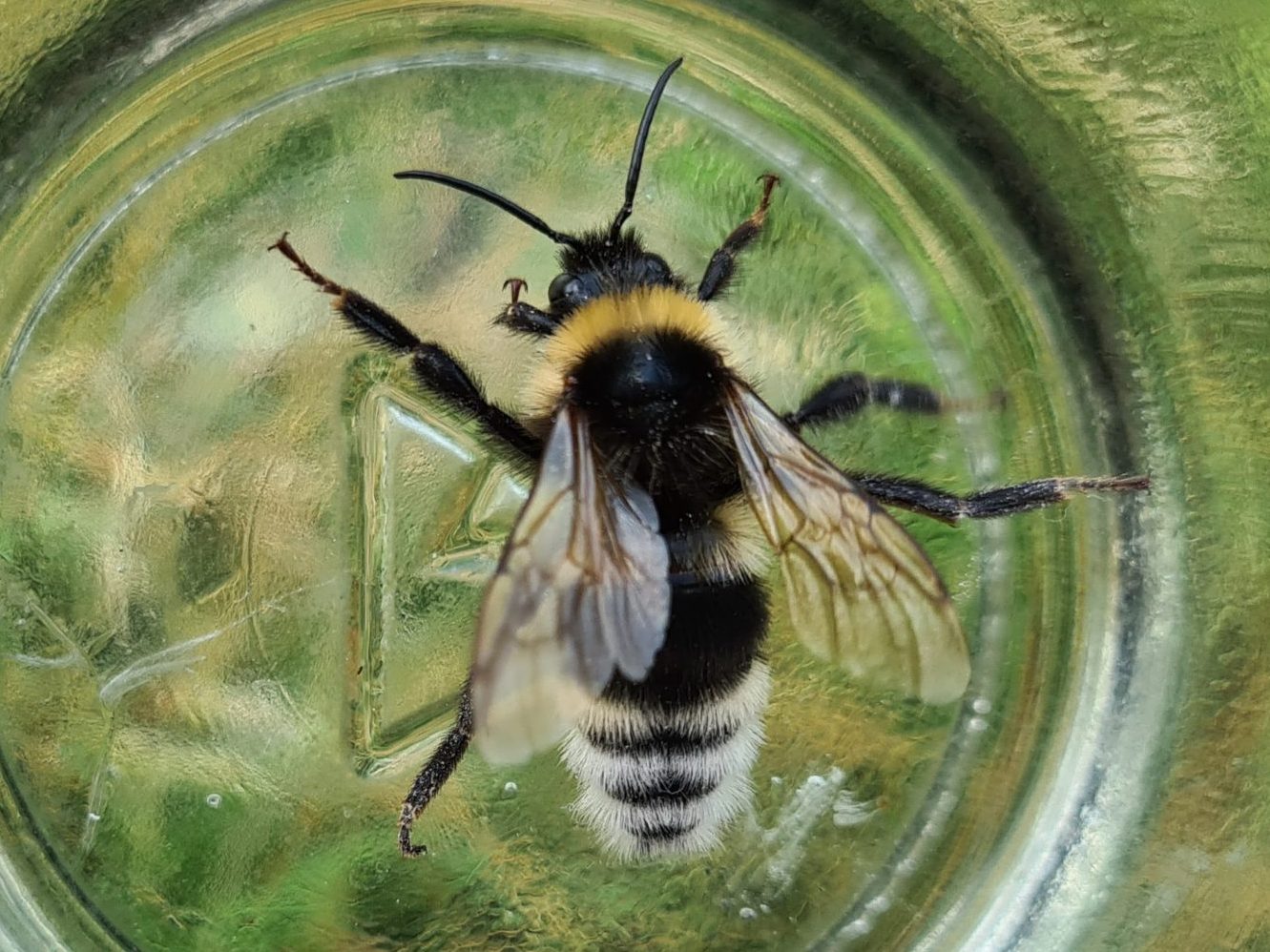
čmelák hájový – Bombus lucorum
Zdroj: Sikora A., Michołap P., Kadej M., Sikora M. Tarnawski D. 2018 „Pszczoły w mieście: Trzmiele Wrocławia“, Wyd. Stowarzyszenie Natura i Człowiek.
It's easy to tell a bumblebee from a bumblebee. But it's harder to tell the species of bumblebee..
But you can see in the photos that, for example, a female bumblebee and a mother bumblebee really cannot be confused.

Pačmelák český (Bombus bohemicus ) – samice (female)
Foto: O. Hercog 5/6/2021

Čmelák hájový (Bombus lucorum) – matka (queen)
Foto: O. Hercog 16/ 6/2021
It's a bit more complicated for males. The male bumblebee resembles some species of bumblebees - however, no male bumblebee in the Czech Republic resembles the male wood bumblebee (B. lucorum).
It is always good to look at the head of a pachyderm – its shape and size are typical.

Pačmelák český (Bombus bohemicus) – samec (hlava)
Foto: O. Hercog – 25/7/2021

Čmelák hájový – (Bombus lucorum)- samec (male)
Foto: O. Hercog 15/7/2021
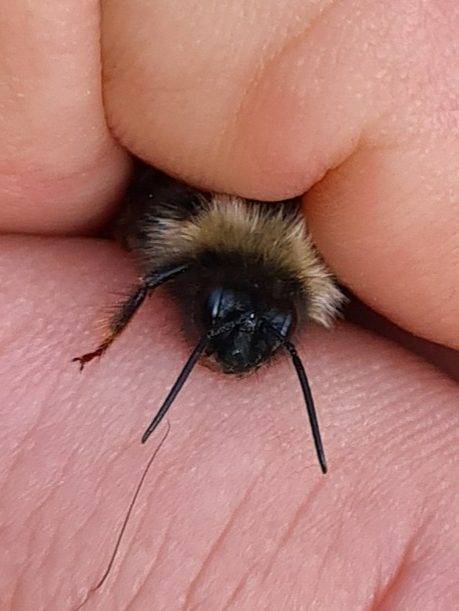
Here you can clearly see the plump head of the Bohemian waxwing (B. bohemicus) and also the fact that it is completely black.

Pačmelák český (Bombus bohemicus) – samec (male) – hlava
Foto: O. Hercog – 23/7/2021

Čmelák hájový (Bombus lucorum) – samec (,male) hlava
Foto: O. Hercog 23 07 2021
Breeding information
- Úlek
– doporučuje se větší úlek, odpovídající velkému hnízdu (ideálně vnitřní objem 12-15l) - Chodba
– chodba primárně dlouhá, může ale být i středně dlouhá (není zásadně rozhodující)
– úspěšně byli chováni v úlku s dlouhou chodbou (úlek v garáži, klapka vně na zdi) - Usazení
– úlky po usazení nepřijímá ochotně, chovatel často obsazuje na více pokusů - Návraty matek na jaře po hibernaci
– nejsou běžné (pozorování se liší) - Samousazení v úlku
– poměrně běžné
– běžné je napadení matkami větších druhů, napadení zabydlené matky a vzájemný souboj - Nároky na potravu
– nároční na kvalitní zdroj pylu
– doporučuje se příkrm v době, kdy se líhnou nové matky a létají se pářit takové matky dokážou vybrat zásoby v hnízdě a urychlit jeho zánik
- Zajímavosti k chovu:
– chov tohoto druhu není snadný – ne vždy se podaří
Interesting facts
- The shortest head of all our species (the longest is the garden bumblebee B. hortorum and the humen bumblebee B. ruderatus)
- In flight, they emit a higher pitched sound than ground bumblebees
- Relatively strong connection to vole nests
- Males are a good indicator of the presence of this species in case you are unable to reliably detect this species from queens and workers.
- It is relatively difficult to distinguish from the double-headed bumblebee (B. crypotarum) – some studies are hesitant about whether it is a different or the same species
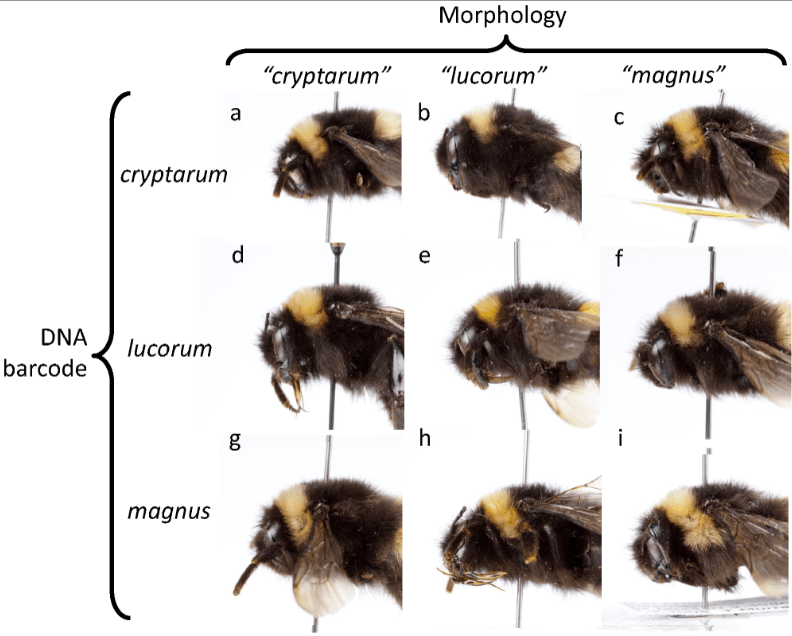
- Even distinguishing it from other species is not always easy and reliable without DNA analysis – see the illustrative image. It shows an overlay of color characters and DNA analysis of similar species
- This fact led to the term "Bombus lucorum complex" - defined by Scholl and Obrecht in 1983 as an explanation for the complex of three taxa (B. lucorum, Bombus magnus and Bombus cryptarum), which cannot be easily distinguished from each other even by their morphological characteristics
- B. lucorum in China is not the same species as B. lucorum in Europe. Analysis of the mandibular glands revealed differences. These can be used to differentiate, so it is not possible without chemical analysis.
- Zajimavý detail popisuje J, May a to detaily žihadla: „U samiček pačmeláků Ps. rupestris a Ps. barbutellus jsem .našel na každém bodlu pět háčků, na žahadlovém žlábku těsně za špičkou tři. Háčky jsou vyvinuté více než u samic B. lucorum, ale také jsou viditelné jen pod mikroskopem. Bezpochyby mají háčky na žlábku a bodlech všechny druhy čmeláků a pačmeláků. Na žlábku dělnic včely medonosné jsem háčky nenašel. Příčina toho, že čmeláci mohou použít žihadla několikrát, aniž se jim utrhne, není
tedy v tom, že žihadlo nemá háčky, nýbrž že jsou háčky krátké a tupé.“ Otestuje to také? 😀
Do you find it difficult to identify the type of bumblebee?
Don't despair, it's not something you can tell by eye, and as you can see from the following diagram, even DNA analysis in this case may not give a 100% answer.
In this case, it will help you that you are more likely to encounter the wood bumblebee (B. lucorum) than the double bumblebee (B. crypotarum) and very unlikely the greater bumblebee (B. magnus). The ground bumblebee (/B. terrestris) also belongs to the “Complex lucorum” group, but it is relatively easy to distinguish in our conditions. Although … 😀

"Complex lucorum" - Source Color Patterns Do Not Diagnose Species_ Quantitative Evaluation of a DNA Barcoded Cryptic Bumblebee Complex
Photos and videos
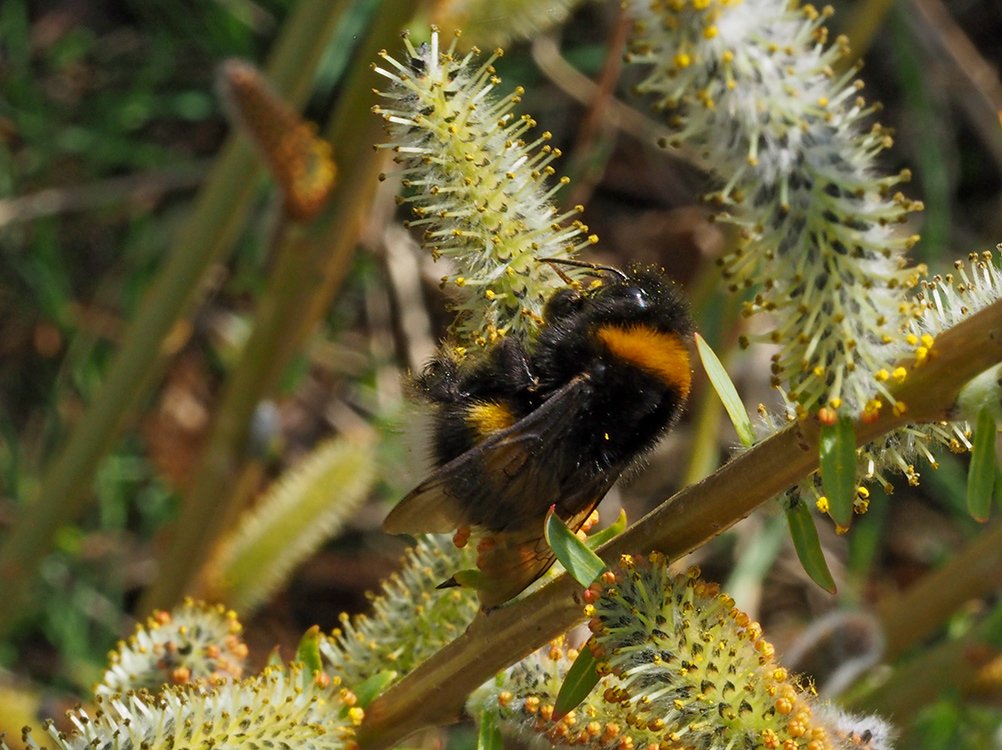
Beautiful photographs by Hana Kříženecká give us a glimpse into the world of the mother bumblebee (B. lucorum) as well as the workers and males.
You can still see the difference in the shades of the color stripes in this young queen. However, their yellow is brighter than that of the ground bumblebee (B. terrestris) and the stripes are also thicker.
Some photos can be confusing, depending on the light and color rendering. But the thicker stripe behind the head says it should be a wood bumblebee.

Čmelák hájový (Bombus lucorum) – matka (queen)
Foto: H. Kříženecká
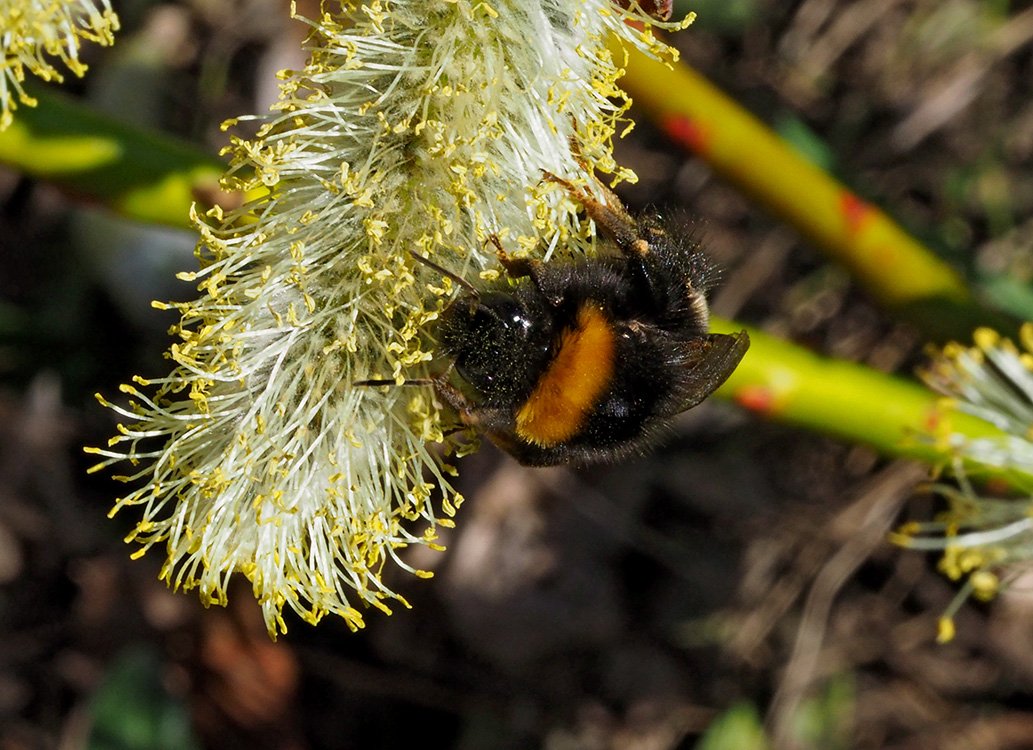
Čmelák hájový (Bombus lucorum) – matka (queen)
Foto: H. Kříženecká
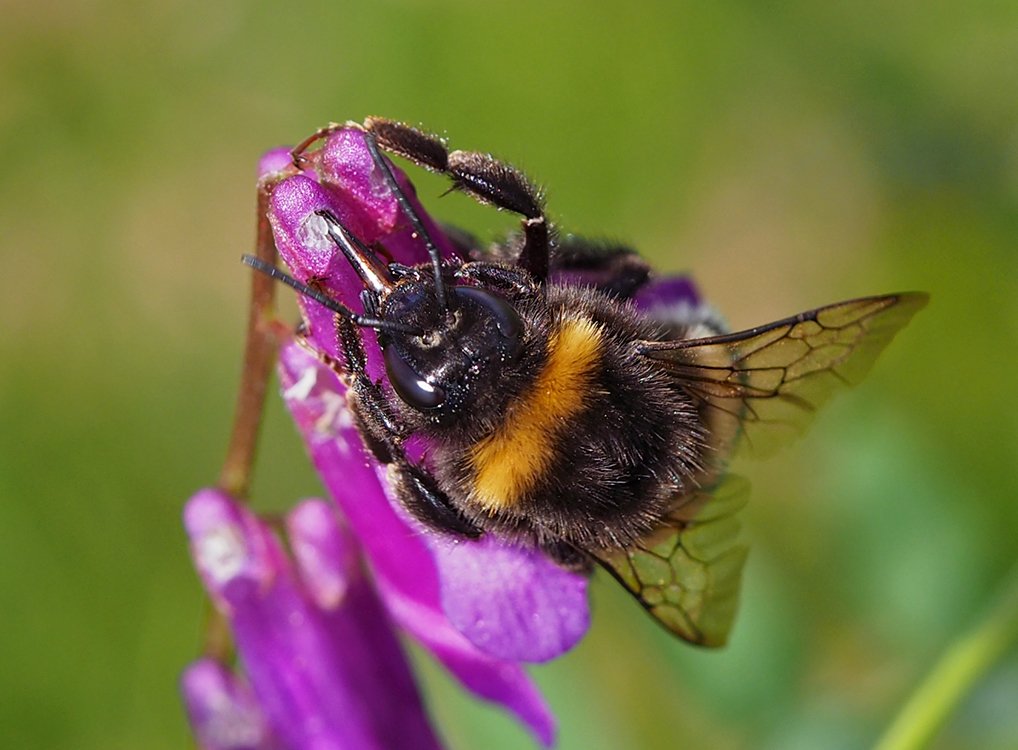
Here the stripe behind the head is clearly visible – it is stronger and brighter.

Čmelák hájový (Bombus lucorum) – matka (queen)
Foto: H. Kříženecká

Čmelák hájový (Bombus lucorum) – matka (queen)
Foto: H. Kříženecká
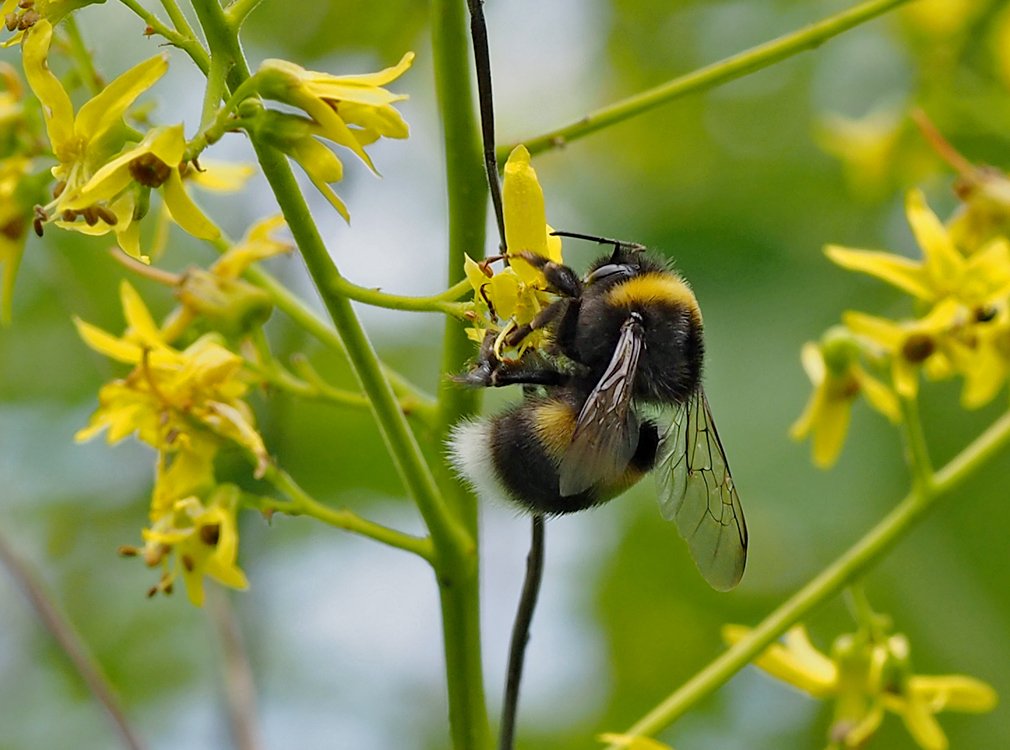
It is not easy to distinguish between workers and queens in the wood bumblebee (B. lucorum). Size can be a clue, but also the time of day when you observe the individual.
Changing the color of the yellow stripes will also help. Young queens have bright stripes, and you probably won't see an older queen with faded stripes outside - so she's probably a worker.
This piece is probably older, its yellow stripe on the back is faded.

Wood bumblebee (Bombus lucorum) – worker - Photo: H. Kříženecká
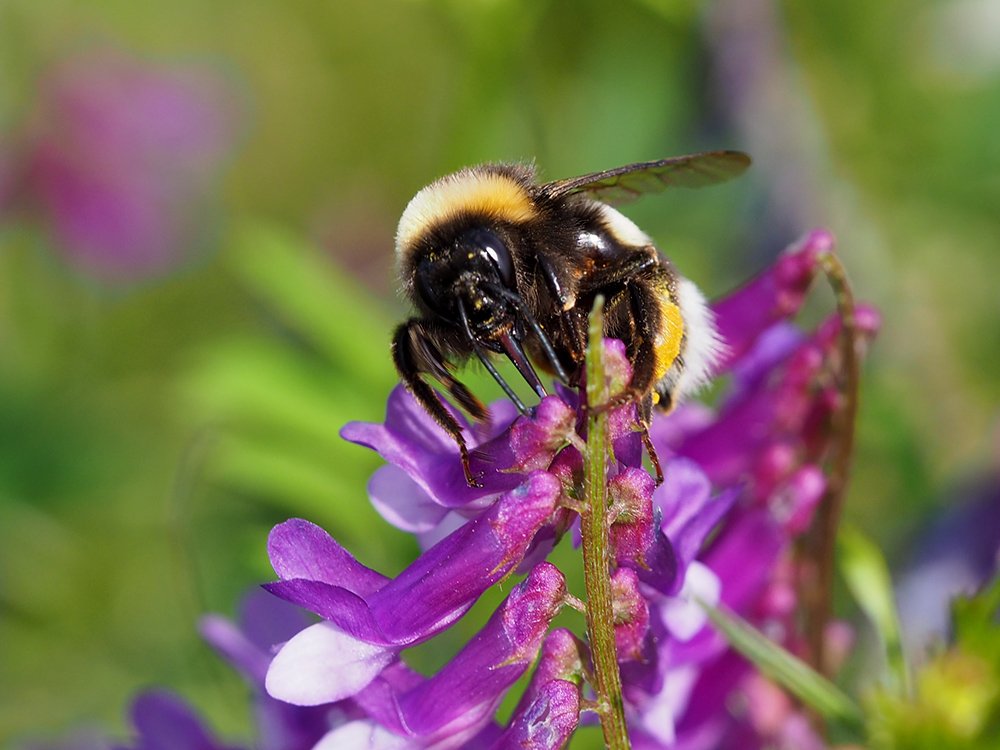
Wood bumblebee (Bombus lucorum) – worker - Photo: H. Kříženecká
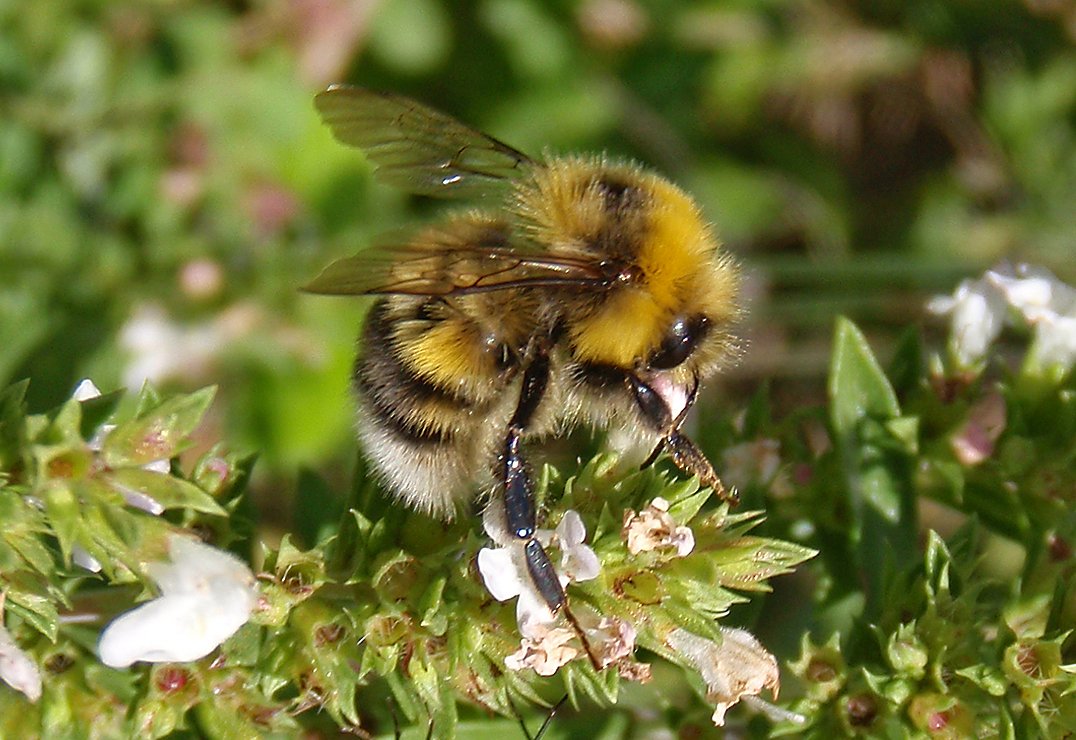
The males are truly handsome and elegant. Their bright colors are clear evidence that this is a nest of wood bumblebees (B. lucorum) and not ground bumblebees (B. terrestris). The males of these species are truly unmistakable.

Čmelák hájový (Bombus lucorum) – samec (male)
Foto: H. Kříženecká
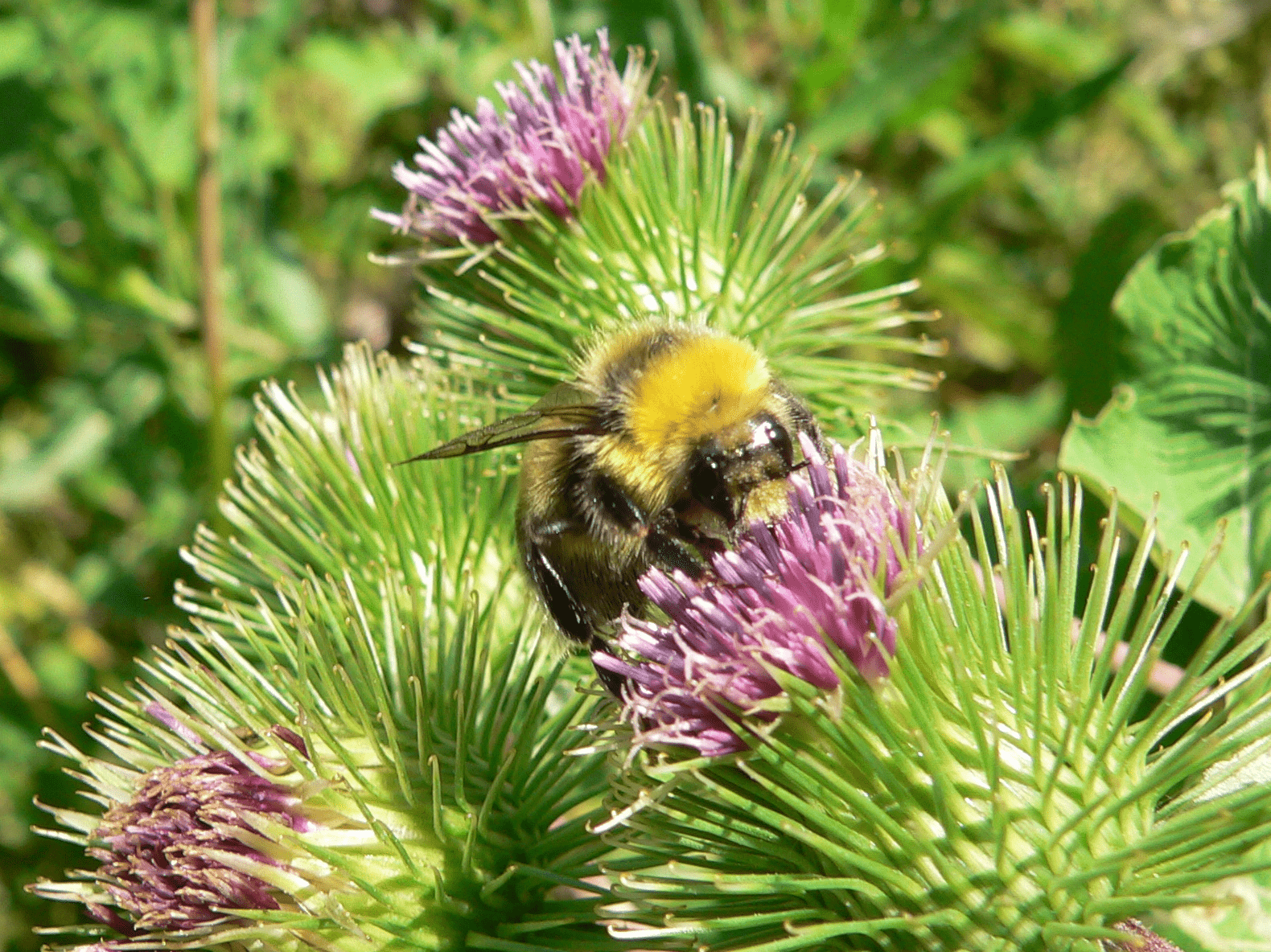
In these photographs, it is possible to observe the typical yellow elements of the male wood bumblebee (B. lurocum).
Note the facial features and the dense breast hairs and the stripe on the tergites of the rump.

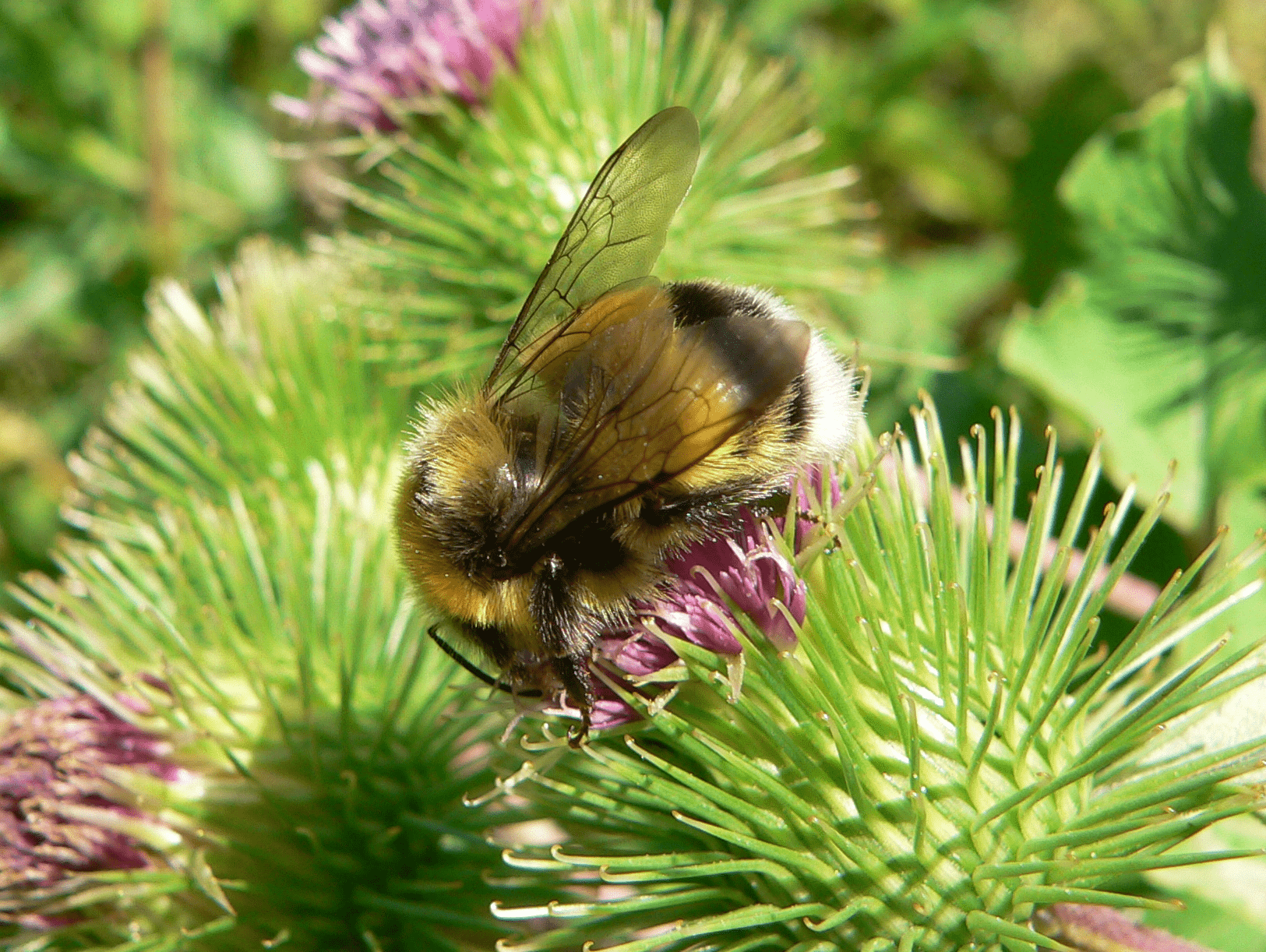
Čmelák hájový (Bombus lucorum) – samec (male)
Foto: J. Čížek
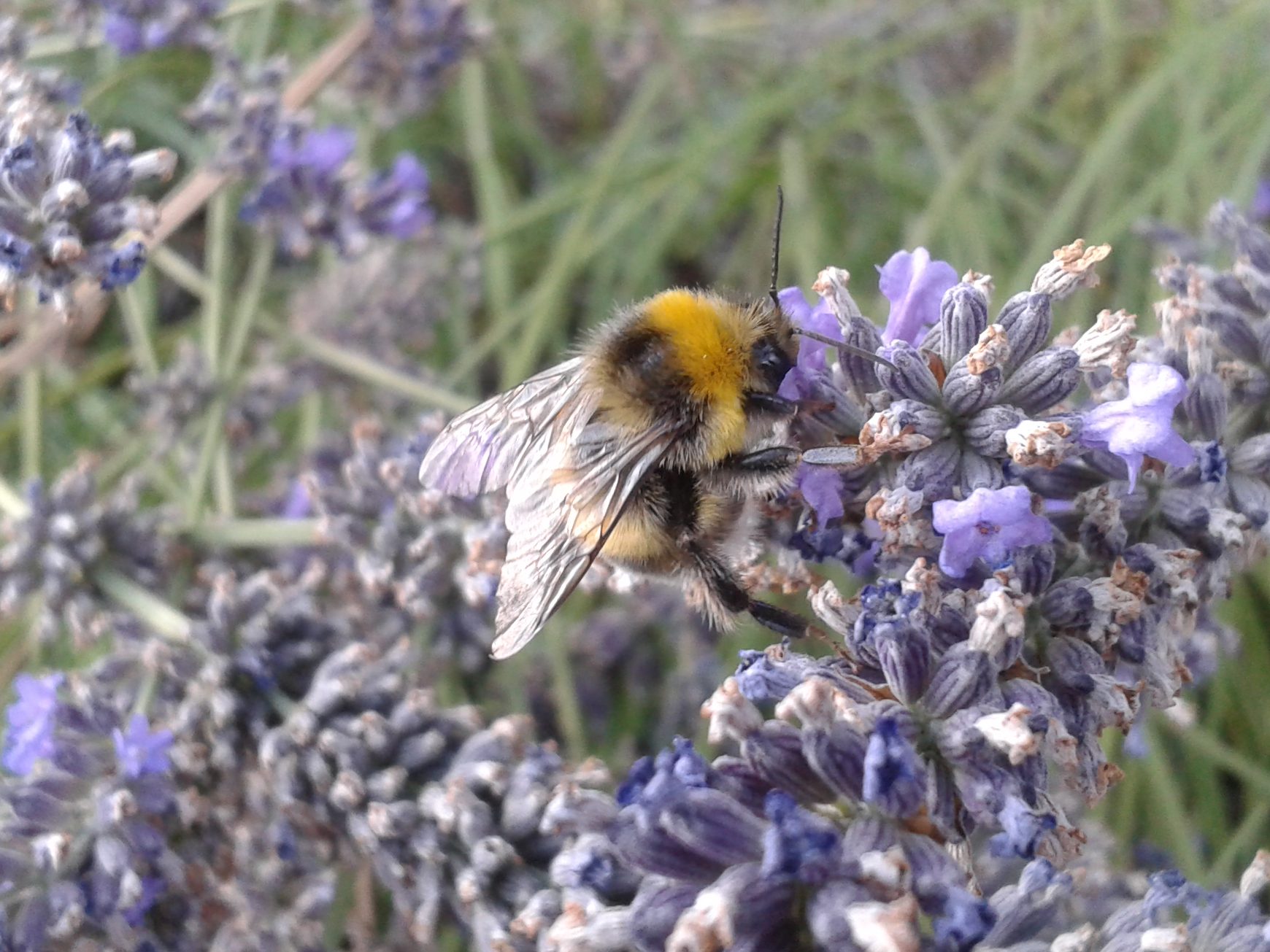
Čmelák hájový (Bombus lucorum) – samec (male)
Foto: J. Čížek
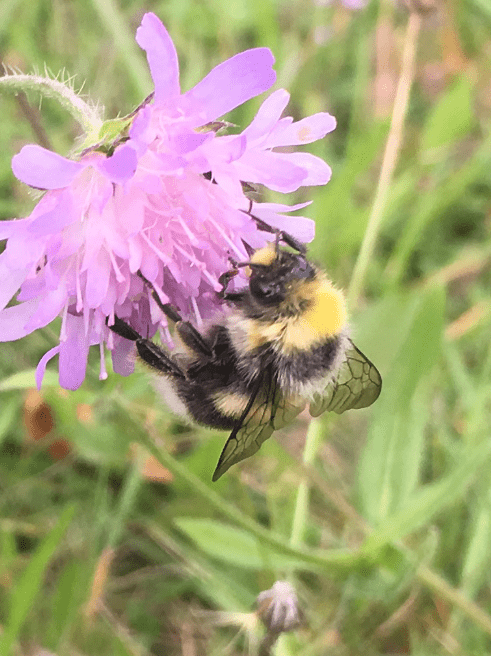
Here it is possible to observe how the male's fur gradually loses its golden color and becomes more gray.

Čmelák hájový (Bombus lucorum) – samec (male)
Foto: J. Frantl 1/8/2018
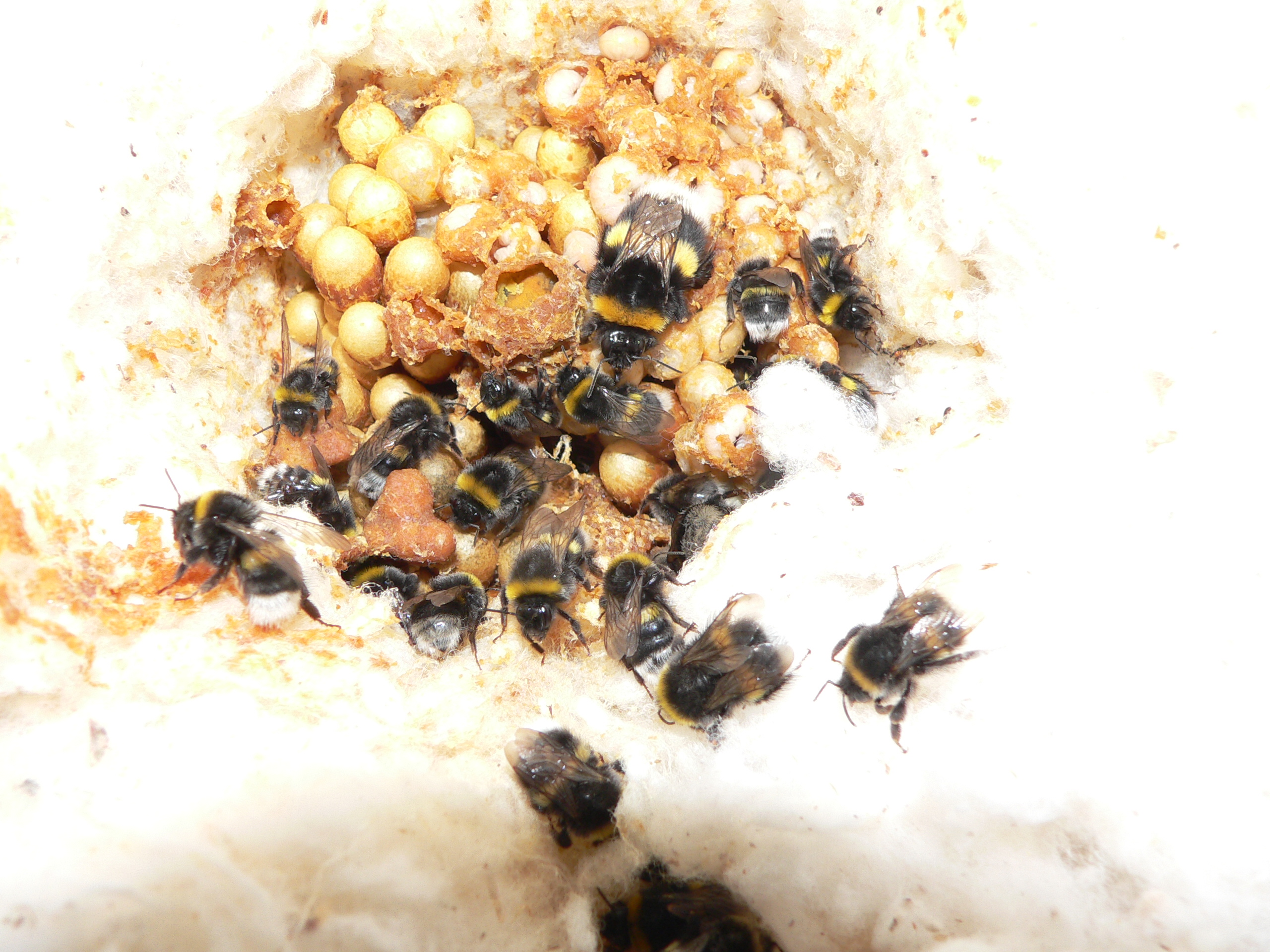
Čmelák hájový (Bombus lucorum) – samec (male)
Foto: J. Frantl 24/8/2019
Here are interesting shots of a bumblebee nest (B. lucorum).
The mother is recognizable at first glance by her size. Even her yellow stripe on her back is losing color... You can compare her with her daughters.
Here you can see the mounds of laying in the wax case (a darker shade of brown), the open cases with larvae and the yellow closed cocoons. The workers have stripped them of the wax and recycled it to build more cases.

Čmelák hájový (Bombus lucorum) – hnízdo (nest)
Foto: J. Čížek
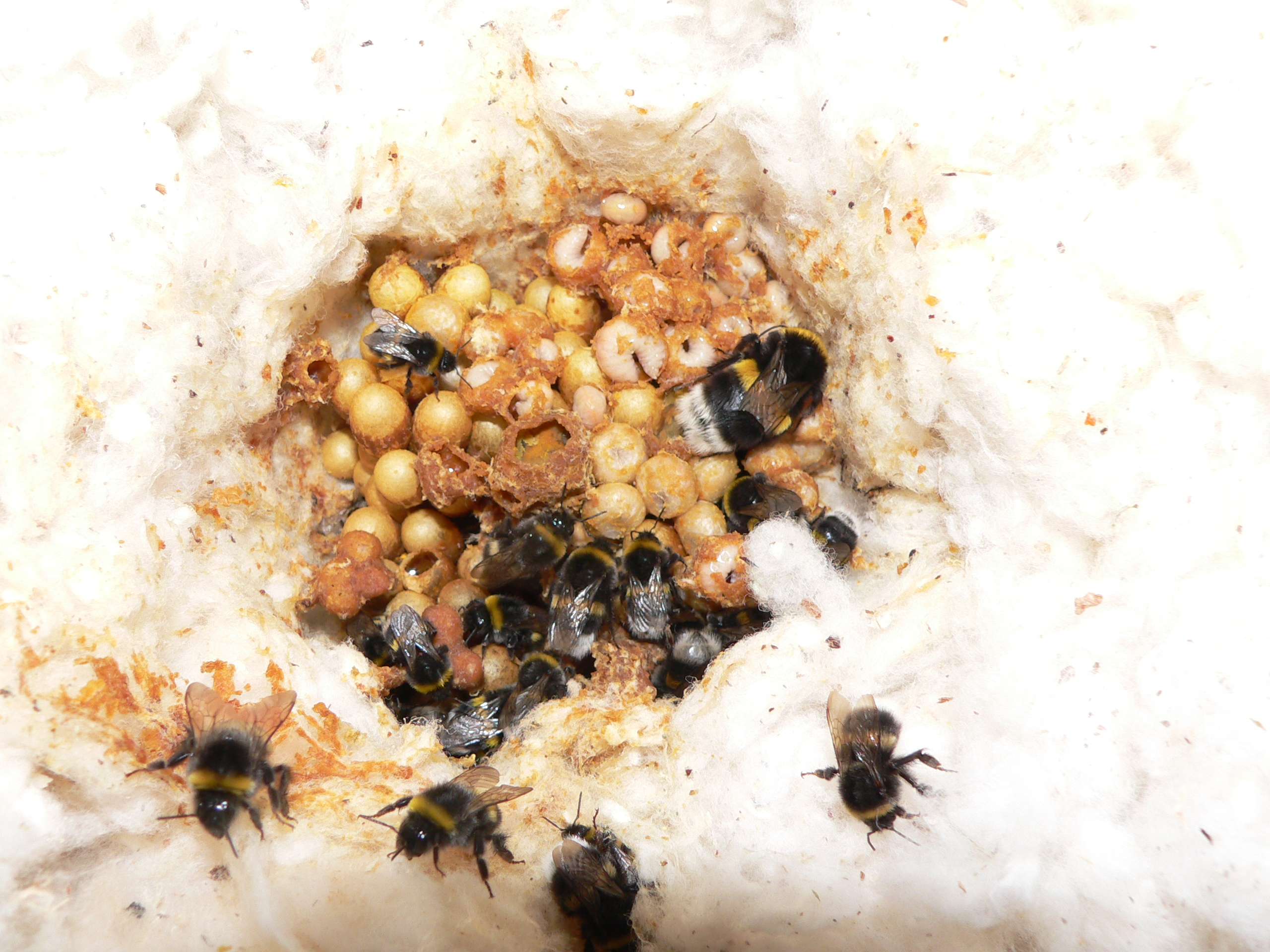
Čmelák hájový (Bombus lucorum) – hnízdo (nest)
Foto: J. Čížek
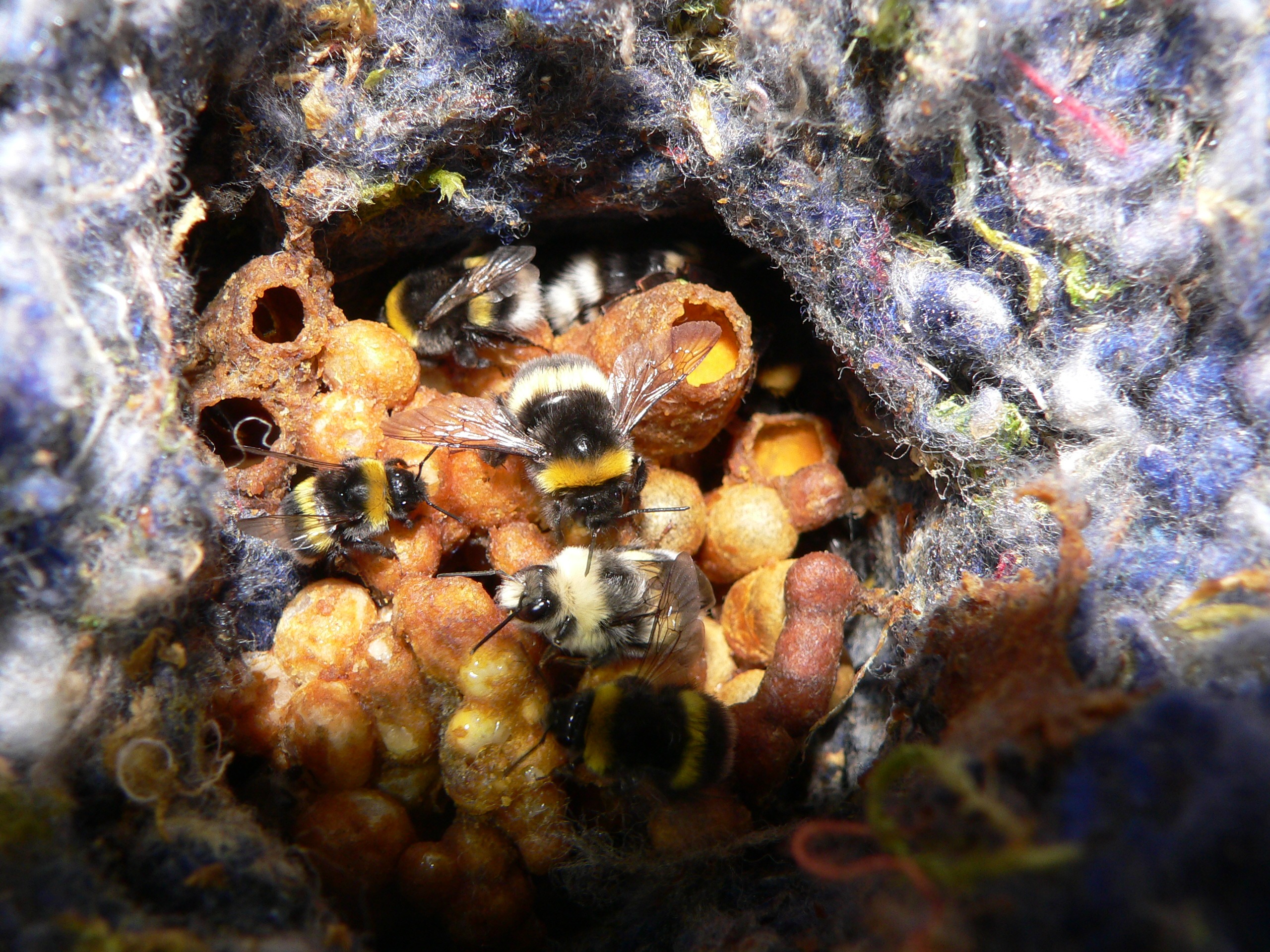
Here is a shot of a male on the nest. The male will soon leave it and will not return, so he will not even make an orientation flight - he will simply fly away. This is how nature reduces the chance of mating between related individuals.
This male is not even a day old. His colors are just being finalized. Bumblebees are born as gray individuals, the colors appear within 24 hours - due to the action of atmospheric oxygen.
You can also see reservoirs full of yellow pollen in this nest (top part of the photo).
A dark formation is visible in the lower right corner. These are the egg-laying mounds hidden in a waxy case. As the larvae grow, they divide into separate cases and complete their development in them.

Čmelák hájový (Bombus lucorum) – samec v hnízdě (male in the nest)
Foto: J. Čížek
In the next section you will find video samples documenting the life stages of wood bumblebees (B. lucorum)
Podívejte se i na videa na YouTube Čmeláci PLUS a na jejich doprovodný text.
This nest was built by wood bumblebees (B. lucorum) in a wall. The year before, mice had lived there and had prepared a good foundation for their nest. Maybe this will put small rodents in gardens on the white list, what do you think?
This was the best spot for bumblebees in the garden in 2019. It provided coolness and shade even when air temperatures exceeded 35°C
The same nest. The footage shows the workers leaving the nest for the first time and making an orientation flight.
It was necessary to wait a long time for these shots, the bumblebees were very shy and the presence of a curious person really bothered them. The girls were simply doing Zagorka..
A worker bumblebee (B. lucorum) returns with a load of pollen to the hive. The hive is located in a garage where the temperature is stable. The long corridor suits bumblebees of this species.
O umístění úlků pro čmeláky se dočtete ZDE.
The flap is equipped with transparent side panels to allow the passage of bumblebees through the flap to be filmed.
In this video, the worker bees are just learning to walk through the flap. She marks the position of the flap with a cake on the side so that the bumblebees can slowly get used to the procession under the moving part of the flap.
O tom, jak naučit čmeláky na takovou situaci, se dočtete ZDE.
The beautiful male is enjoying the beginning of summer. He was born in Prague, where the temperature is always a few degrees higher than the surrounding area. That is why the bumblebee season starts early here, but so does its end.
Dobromysl is very popular with bumblebees. Bumblebees with their short tongues feel right at home here. Males in particular have Dobromysl as their top choice.
Thistles also have shallow flowers and are therefore frequently visited by males of all species of bumblebees and bumblebees. Therefore, if you have roundworms and similar "weeds" growing in your area, give them space and once they bloom, use them as a bumblebee amphitheater.
Don't forget that thistle seeds are a food source for various songbirds. Your view of thistles will suddenly change.
Here, the male wood bumblebee (B. lucorum) plays the role of "bombus star"
The season was slowly ending in the lower elevations, but life was still alive in the Brdy Mountains. This worker bumblebee (B. lucorum) was busy finding the remaining heather flowers in the heathland.
The footage clearly shows the light stripe on her bottom – how it loses its color with age and ends up being practically white/gray-white.