
A solution for bumblebee breeders who are threatened by fights between last year's queens for the mother hive in the spring.
What you will learn here
- Why do bumblebee mothers return to their natal nest or hives (bumblebees)
- What species like to do this, which species does this affect?
- Why breeders are happy and wrinkled at the same time
- What to do in such a case
Last updated: 2/28/2024

In a nutshell
- Young mothers return to their natal nest: if the breeder managed to raise a new generation in the previous year, he should take this into account
- Joy and worry: when young mother-sisters meet in the hive, they will compete in the fight for it
- How is it in nature with returns: in nature they usually return to a nest that has been destroyed, so they look for young mothers in the surrounding area and therefore there are fewer fights over the nest
- Unnecessary losses: if the breeder leaves the brood in its original location, unnecessary losses will occur - only one mother will win
- Choose the right strategy: on our website you will find several strategies for dealing with maternal returns
English Abstract
- Young mothers – queens returning to their natal nest: if a breeder managed to raise a new generation in the previous year, he should take this into account
- Joy and worry: if young queens - sisters meet in a hatchling, they will compete for it
- How it is in nature with returns: in nature: quens they usually return to a nest that has succumbed to destruction, so young mothers search the surrounding area and therefore there are fewer fights over the nest
- Unnecessary losses: if the breeder leaves the brood in its original location, there will be unnecessary losses – only one mother will win
- Choose the right strategy: on our website you will find several strategies to deal with returning bumblebee queens
Contents
Introduction – Why and when do queens return to their natal nest?
What types of bumblebees return?
What happens when queens return and meet at the nest site?
What about the hives we offer to bumblebees?
How can a bumblebee keeper prevent their clash at the nest site?
What happens if you leave the hive and do nothing?
Solution options
Option 0 “No hive this season”
Option 1 “No hive at the original location”
Option 2 “Closed hive at the original location as an attraction”
Option 3 “Occupy the hive at the original location and move it elsewhere in time”
Option 4 – Controlling the use of the protective flap
Option 5 – Queen capture
When can a new hive be placed at the original location?
What if queens keep returning and the keeper no longer has hives or does not want to occupy them
? Conclusion
Introduction – Why and when do bumblebee queens return to their nest?
We have not yet found any study that would explain and describe this in detail. We can only state that the queen bumblebee mothers return to their natal nest in the spring .
This can be explained by the fact that mothers instinctively return to a place that suited their species and want to use what served them well in the previous season. It may also be a case of taking over the work already started (wax construction) in the case of bumblebees of the same species.
The condition for returning is that the mothers must successfully survive the winter in hibernation , find a food source in the spring, and then find the place where they were born.
They can reliably find the location of their mother's nest , unless its surroundings and landmarks, by which they remembered it, change dramatically.
If they find good conditions in the same place, i.e. a nesting cavity with a lining, they will settle there and build a nest.
The nest usually decomposes (mold, rot), or is consumed by parasites and commensals, or is removed by small rodents. If this does not happen and at the same time, if rodents/birds do not apply new lining , bumblebees will not occupy such a place and will go looking for another one.
If mothers meet in a suitable nesting site, they will fight to the death over it. However, this situation may not occur in nature.
The mothers return individually , depending on how they woke up . If the nesting site is not suitable for settlement, there is nothing to fight for.
Some species of bumblebees nest in such a way that their nest and nesting site disappear completely after the season , and therefore the mothers do not fight for such places. These are mostly representatives of smaller species, such as the field bumblebee (Bombus poascuorum) and the fallow bumblebee (Bombus ruderarius). These species often nest on the ground in a pile of grass or shallowly underground. Nothing remains of such nests after winter.
Unfortunately, many bumblebee queens often do not return and humans are to blame. Thanks to global warming, there is no real winter and this does not allow for good hibernation and prematurely awakened queens often die.
Similarly, humans directly affect . If they eliminate the borders and fences where bumblebees sometimes overwinter, they also eliminate the sleeping queens. This can be observed where such an area in your area has come under the "care" of developers - in the spring the decline of bumblebees is visible.
A slightly different case is when mothers accidentally find an already occupied nest site . This happens often, especially when a mother of a stronger species, such as the ground bumblebee (Bombus terrestris), finds an occupied mother of an early species, such as the meadow bumblebee (Bombus pratorum). If she finds a developed nest there, she is no longer interested in the nest site. If she finds a mother in the solitary phase (without workers), she may attack her. A similar thing can happen with the same species - the desire to occupy a suitable nest site is stronger for the mother than the fear for her own health and life .
A similar situation can occur in a hive that a beekeeper prepares for bumblebees. It can be a hive where bumblebee queens were born last year. This page is devoted to this issue.
However, it could be a new hive that the keeper has settled in and that another queen accidentally finds. This situation occurs quite often if the hive is placed on the ground. That is where the queens of most bumblebee species look for nesting sites.
Therefore, we recommend placing the hive at a higher height where such a situation does not have to occur, or moving the hive to such a height after settling in. So spend some time on tips and instructions for placing hives , it will be worth it.
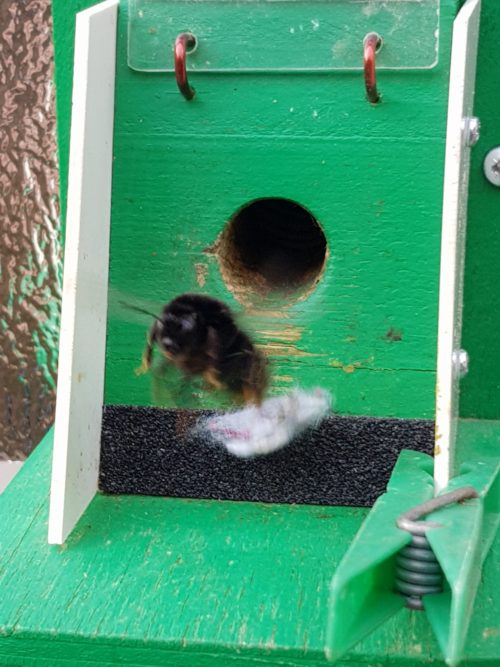
The mother rock bumblebee (Bombus lapidarius) has returned to the hive and is flying out of it for the first time.
Photo O. Hercog
What types of bumblebees are returning?
Most bumblebee return to their natal nest. However, there are species in which this phenomenon has not been observed, such as the wood bumblebee (Bombus lucorum).
According to our own observations, the champions in the return of mother bumblebees are: hypnotic (Bombus hypnorum), rock (Bombus lapidarius), garden (Bombus hortorum).
field bumblebees (Bombus pascuorum) also return , whose nesting sites are usually destroyed by the new season (see the nesting methods of this species). Therefore, there are no encounters and fights with them - they have no reason to do so.
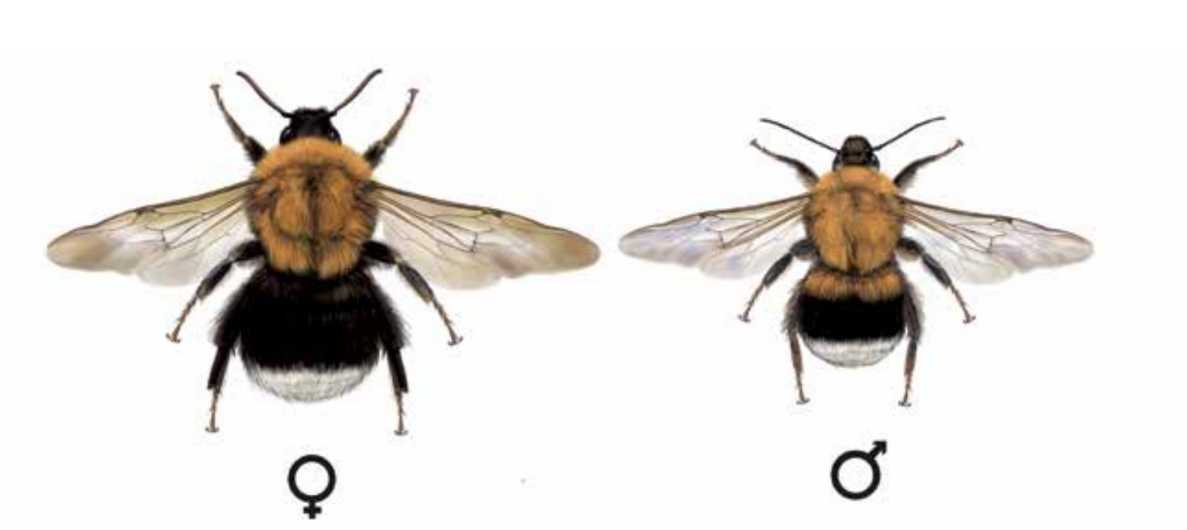
Bumble bee (Bombus hypnorum)
Source "Pszczoły w mięstrie Trzmiele Wrocławia"
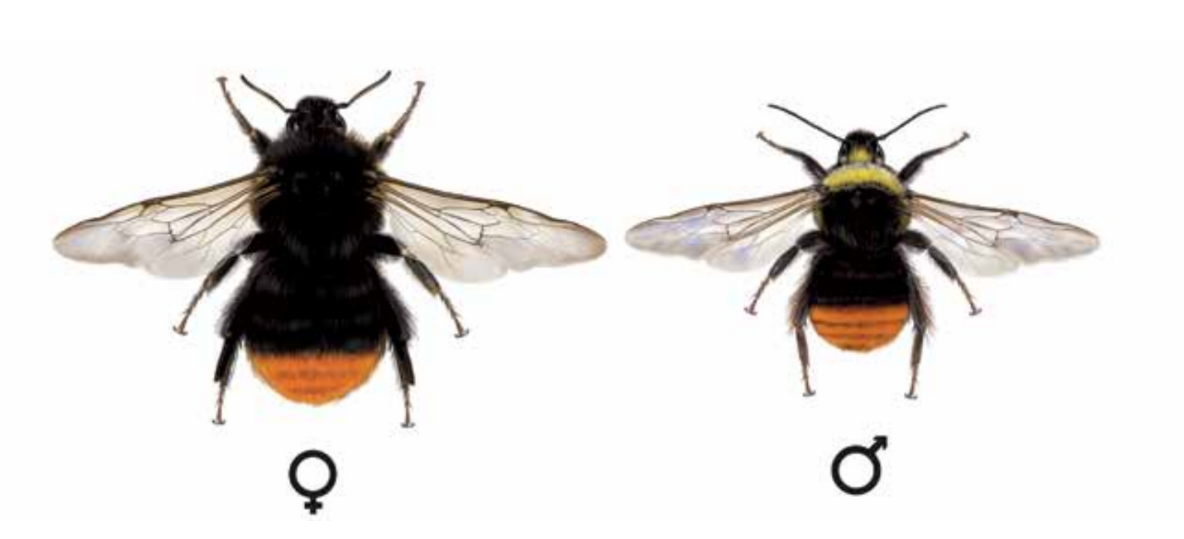
Rock bumblebee (Bombus lapidarius)
Source Pszczoły w mieście Trzmiele Wrocławia
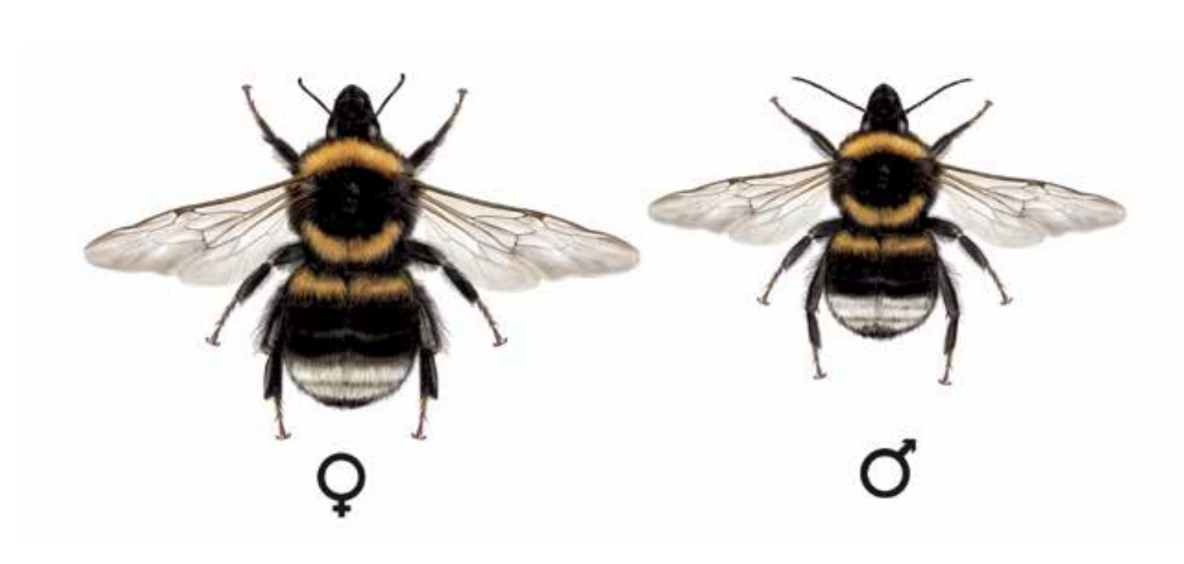
Garden bumblebee (Bombus hortorum)
Source Pszczoły w mieście Trzmiele Wrocławia
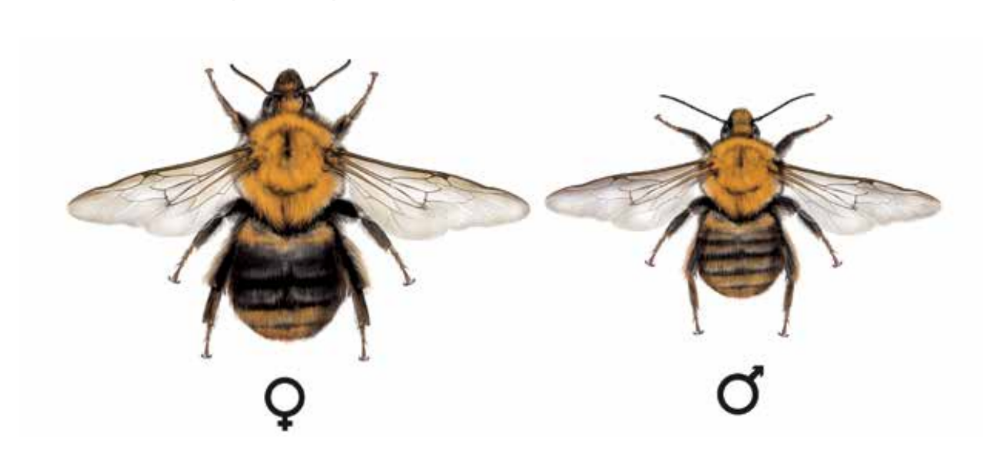
Field bumblebee (Bombus pascuorum)
Source Pszczoły w mięści Trzmiele Wrocławia
What happens when the mothers return and meet at the nesting site?
We have already written about this above and also in the description of the life cycle of bumblebees, see How it works in a bumblebee nest
Mothers of most bumblebee species return to their native nesting site after hibernation. If they meet there and find good conditions for nesting, there is enough space and bedding brought in by rodents/birds/humans, a duel of mothers will occur . During this, rivals may be injured or killed. The biologically most mature one will probably win , which may not always be the largest, it is also a matter of luck and a faster sting. She will establish a new nest there and raise the next generation of offspring.
So it's a form of natural selection of the fittest individuals, as nature does in other cases. Nature has it really well thought out, even if it's sometimes cruel from our perspective.
In the wild, the returns of mothers are not as dramatic. Their nest from the previous year has been destroyed and in most cases the nesting site will not be ready for settlement. The mothers will then disperse more around the area and there will be less conflict.
However, a different situation occurs in the case of a hive. It is prepared by a female keeper and if it is in the same place, fights will occur - there is something to fight for.
Some species do not seem to fight for a place . For example, if a queen of the hypnotic bumblebee (Bombus hypnorum) finds an already occupied nesting site, she does not fight for it. This is quite strange, because the same species can also chase birds out of a cavity that it likes. We have this observation from an experienced breeder, Luďek Šulda, whom we trust and are happy to quote here.
In the following photo you can see how it can turn out..
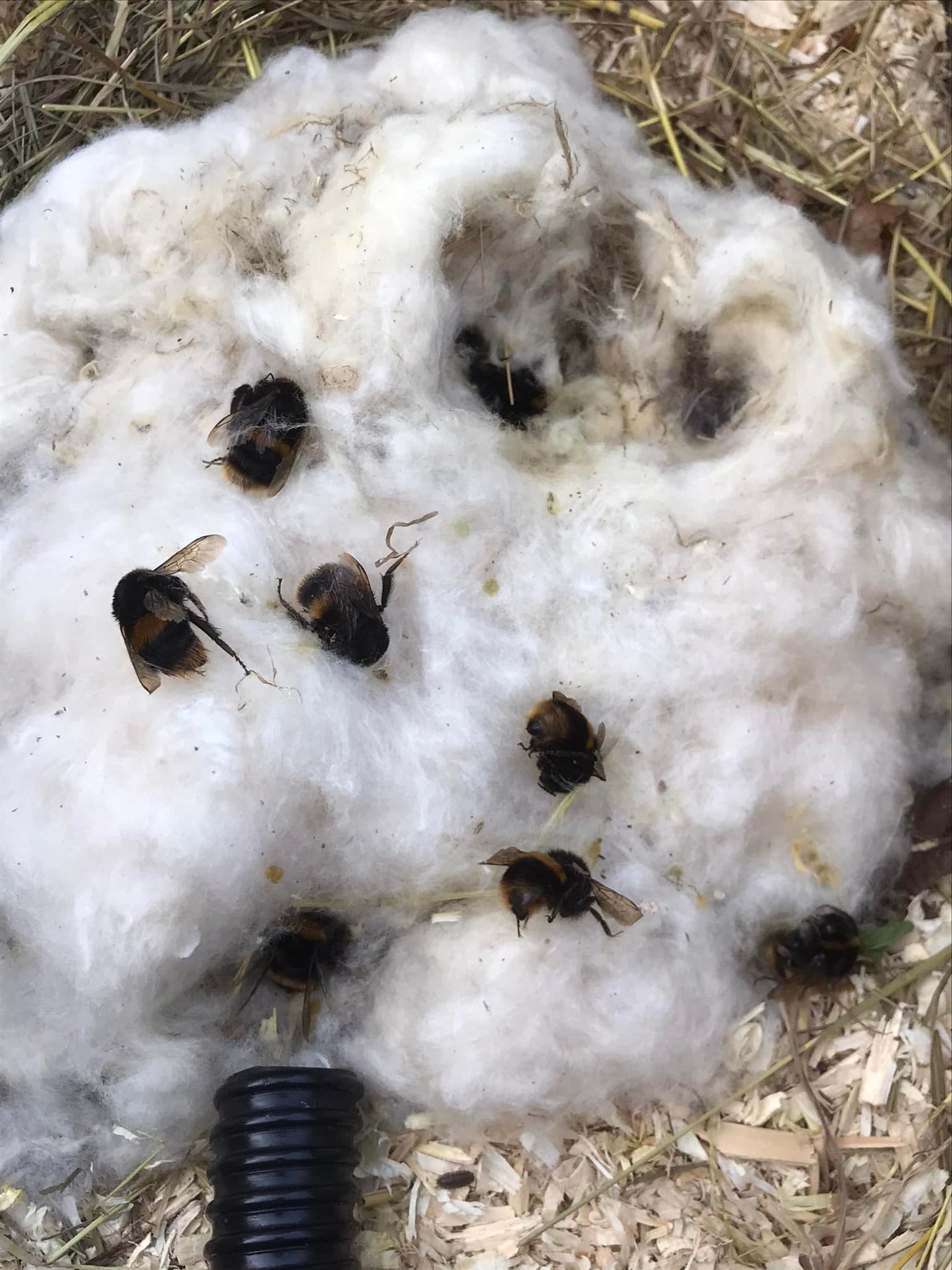
Result of the returns of mothers – ground bumblebees – mothers
Photo:, KP Henry 2022, UK
As a result, for bumblebees and its surroundings, several dead bumblebee queens of the same or a different species and only one queen with a nest. This situation has been observed by long-time bumblebee breeder Jaromír Čížek and others.
There are also situations where mothers of early species nest , such as the meadow bumblebee (Bombus pratorum), and then they are deprived of their nest and life by more aggressive mothers of late species , such as the rock bumblebee (Bombus lapidarius) or the ground bumblebee (Bombus terrestris).
two mothers nest in a nest and tolerate each other for a while. But this is only a temporary situation. Sooner or later, they will meet and the inevitable fight for the nest will occur.
Sometimes, mothers fight over a nesting site and both die , leaving the nesting site for another mother to use later.
Yes, it's harsh, but it's worked for millions of years. Nature allows the survival of strong healthy individuals , successful species, and prevents overpopulation leading to overexploitation of food resources.
What about the hives we offer to bumblebees?
Just like in nature, who were born there return to a hive (bumblebee colony) created and prepared by man
Since in nature unusable for . In such cases, bumblebees must look for another nesting site where they will find the right conditions.
However, the breeders clean the hive and prepare it again for the new season. The mothers who return there find suitable conditions for building a nest. Therefore, they are willing to fight for it - they have a reason and they will do it.
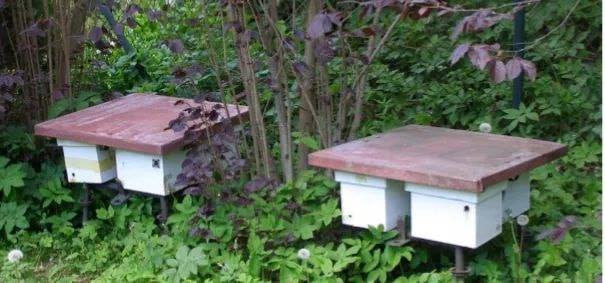
Hives concentrated in one place are a problem when queens return
Source Internet
The author of this video from Prague (who did not wish to be named) observed a duel between mother bumblebees (Bombus terrestris).
He saw one of the "returnees" climb into the hive and pull out the already nested mother - injured and dying. So a fight took place inside the hive.
As you can see, the winner of the fight then flies away. Often she returns to the nest just to look and only moves in after a few days.
How can a bumblebee breeder prevent their nesting site from clashing?
If the hive has an open flap, there is nothing to prevent the mother from returning. From our own observations, we know that mothers can lift the flap when returning to their natal hive , as they did last season, they have learned to do so.
If you replace the hive or change its color, but the entrance to the nest remains in the same place, the bumblebees will recognize it . Nevertheless, they will show interest and will try to settle in the hive even under new conditions. The location of the nest and its surroundings is a reliable guide for them and the color of the hive is not important for them . Even if the color change confuses them, it will only be a matter of time before they discover the entrance to the hive.
A possible solution to avoid mutual clashes and subsequent conflict may be to change the location of the hive - choosing a different location .
variants and procedures for you that you can use - see the following text.
What happens when you let fear take over and do nothing?
The queens will return to the hive and if they meet there, a fight will occur . Usually only one will win. If she is not injured, she will build a nest there and raise a new generation of bumblebees.
During fights, there can be large losses of queens , which the breeder can prevent . In the extreme case, a situation could arise that out of 100 queens born here, only one will survive. Therefore, there will be no reproduction of bumblebees, but simple reproduction.
We believe that, given the overall decline of bumblebees in nature, supporting their reproduction in hives makes sense.
If you try to prevent unnecessary clashes between mothers, you will give more mothers, including the weaker ones, a chance to establish a nest . You will certainly prevent unnecessary losses of strong mothers , who would otherwise fight to the end and could kill or mortally injure each other. If they are given the chance to find a place to nest elsewhere, that is certainly the right thing to do.
There is a different philosophy that opposes this approach. You can let things run their course and rely on the strongest queen to win . The others will perish. The weaker ones will certainly perish, but so will those that could succeed in nature . From the point of view of natural selection, this is probably correct. However, it is necessary to realize that by preparing the hive you are creating such a situation and are therefore part of natural selection. So you have to accept this fact and the context of such a decision.
If the beekeeper had a common species of bumblebee (Bombus terrestris) in the hive, the decision is easier. When it comes to rarer species, the approach should be carefully considered.
Which approach is the right one? We don't have hard data to make a decision. So we'll leave it up to you which path you choose .
In the following text we describe possible solution scenarios. They require time, patience and work from the breeder, but they are functional.
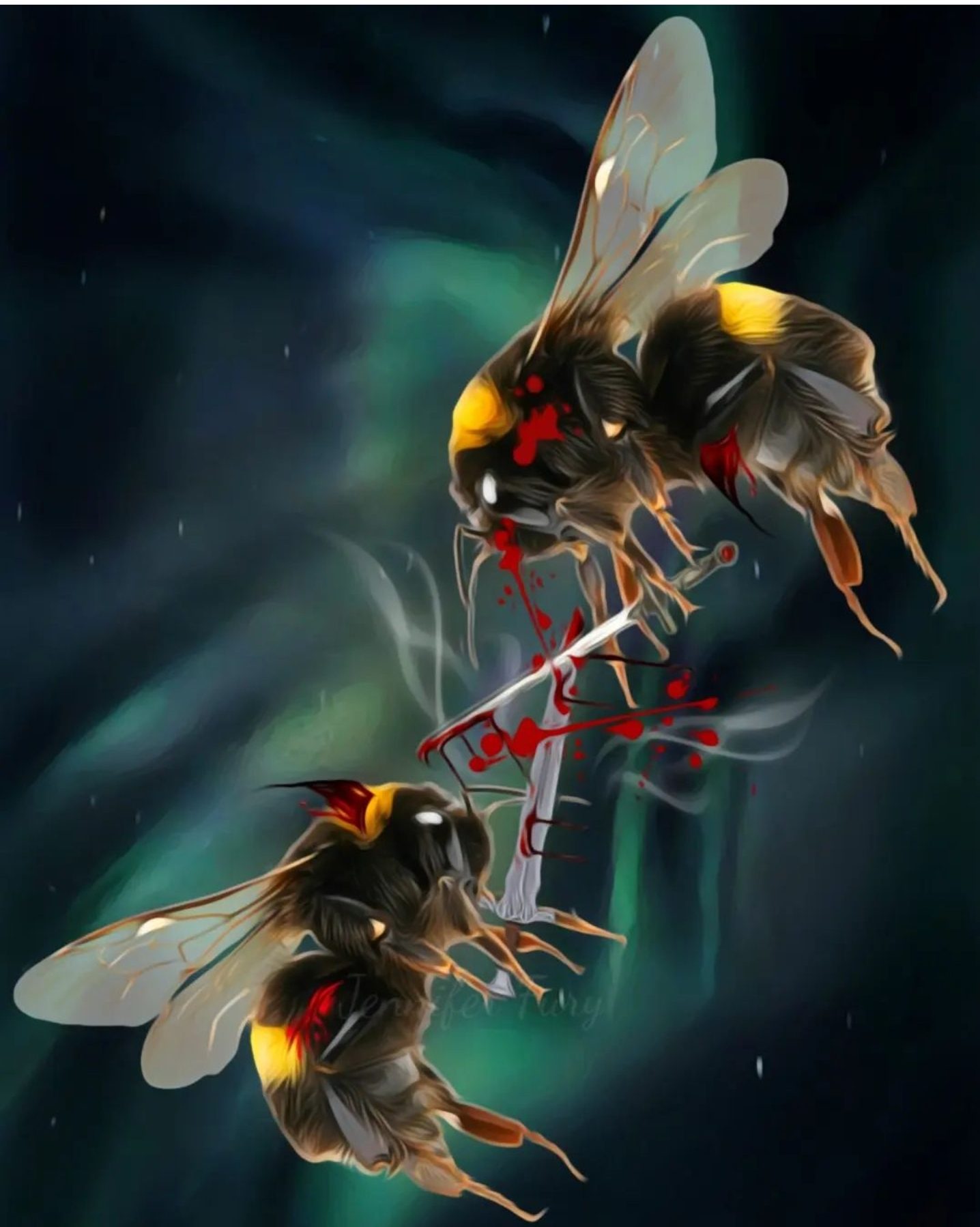
Mothers' duels
Source: Jennifer Fury
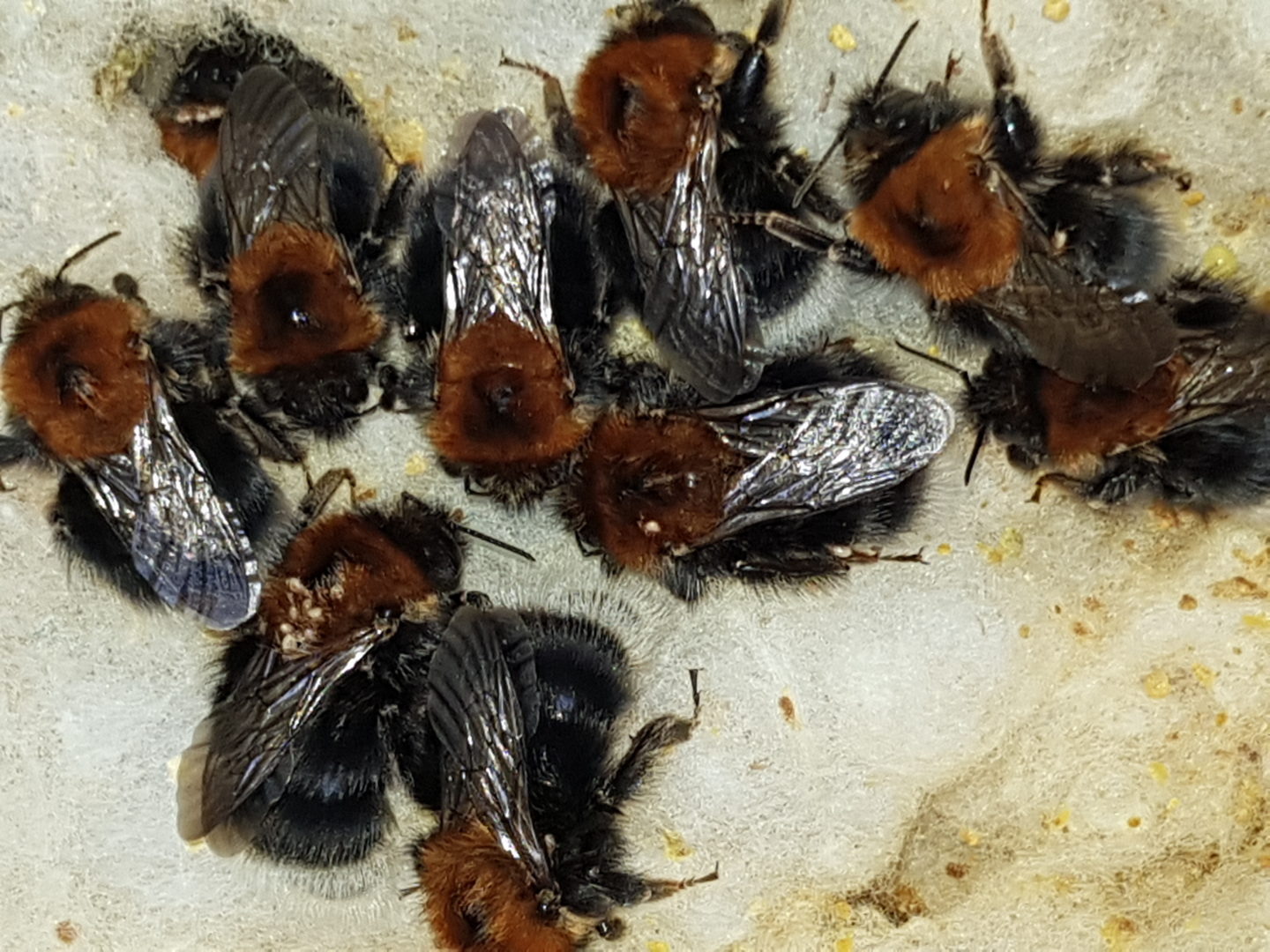
Mother bumblebees (Bombus hypnorum)
Solution options
In the following section, we present individual solutions to the situation when the queen mothers born in the hive last year return to the beekeeper in the spring.
Sometimes you read that it is enough to turn the hives in the next season, meaning to change the direction of the axis of the flight hole . Such a solution cannot be completely recommended, it is not reliable .
After hibernation, the mother will return to the original place where she was born. She will search there, it is only a matter of time and chance when she will find an opening to the hive on the other side or in the nearby area.
You can try it yourself if you close the entrance hole for the bumblebees during the season. They will first look for an entrance to the hive on the garlic, then in its surroundings, and sometimes they will even try the hive next door.
Finding an entry hole on the other side of the hive will most likely occur, and it cannot be prevented other than by the methods described below.
Note: Queen bees do this in the spring, but workers do it throughout the season. That's why we recommend placing hives as far apart as possible.
So choose from our offer. A little work is worth it - there will be no unnecessary reduction of mothers .
Option 0 "No scare this season"
The safest thing is to leave the original location untouched and use it until next year.
Returning queen mothers will not find their original nesting site , will look for another nesting site, and will disperse into the wild .
But tell this to the breeder and he will beat you up on the spot with his whip. 😀
Advantages:
- No risk of mothers fighting over the scare.
Disadvantages:
- You won't have a scare this season.
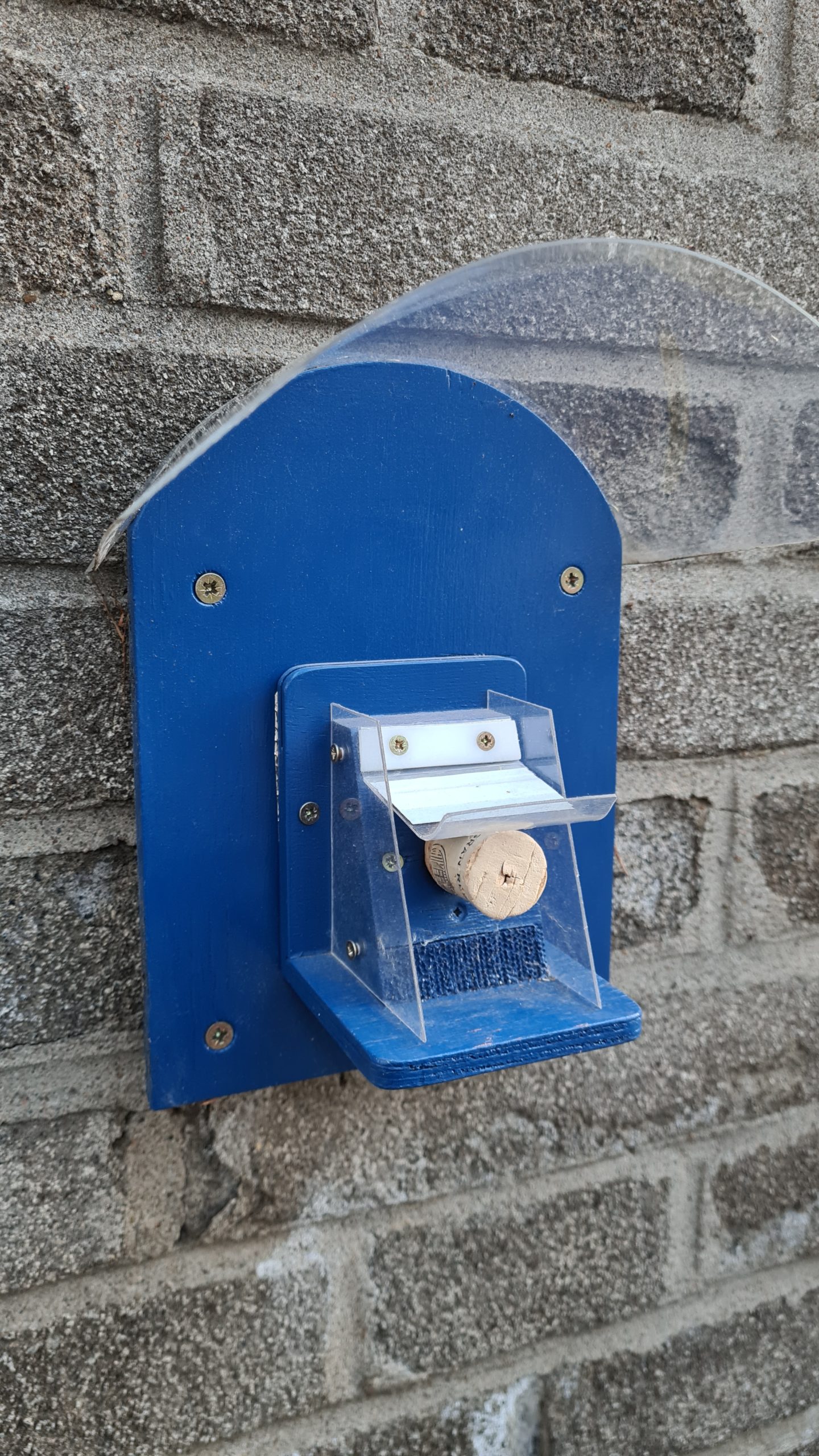
Closed inlet
Photo: O. Hercog 2021
Option 1 "No shock at the original location, or wait for a later species"
An equally safe solution is to not place any new shock in the original location and to place the original shock in a new location .
If the young queens return to their original location, gently trap them in a net using the known procedure, see How to place a queen bee in a hive.
the captured queen to another hive that is as far away from the original hive as possible, meaning in the immediate vicinity . If she gets scared there, she should have no reason to return.
I will look for the remaining queens disperse into the wild to look for another place. However, they may search for and try other hives in the nearby area .
You can also wait this season with a closed hive for later and rarer species .
Advantages:
- No risk of mothers fighting over the scare.
Disadvantages:
- It may happen that the settled mother will return to the original location several times and the procedure will need to be repeated.
Option 2 “Closed scare in the original place as an attraction”
Leave the hive in , for example with a cork. A lowered flap is not enough to close the hive - the queens from last year are used to this and can lift it.
Here you capture a queen and take her to another distant hive . Gradually, you can capture other queens and take them to other hives.
I will look for the remaining queens disperse into the wild to look for another place . However, they may search for and try other hives in the area.
Advantages:
- Small risk of mother fights for the hive (on the hive).
Disadvantages:
- It may happen that a settled mother will return to her original location several times.
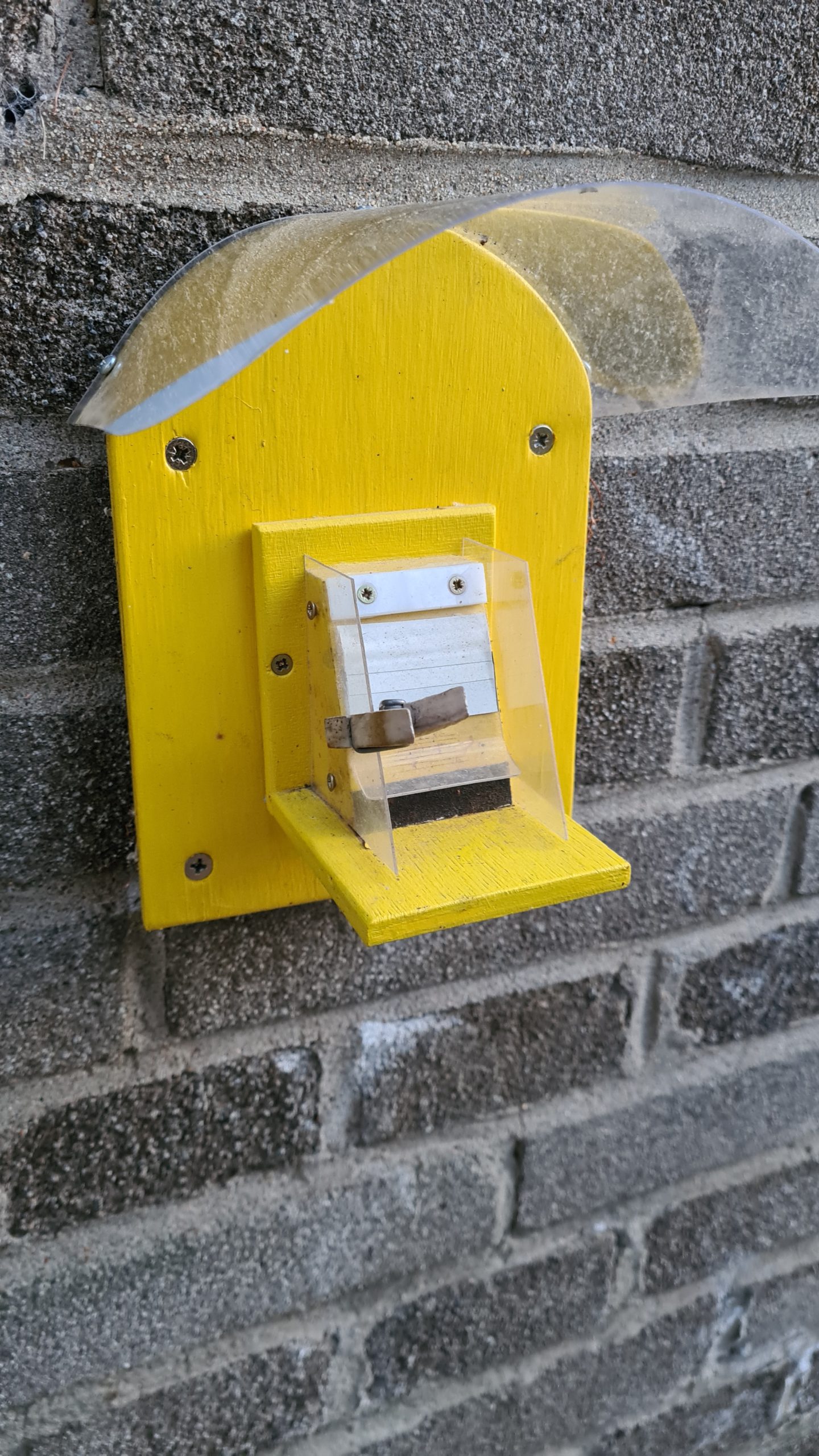
Closed inlet
Photo: O. Hercog 2021
Closed inlet
Photo: O. Hercog 2021
.
Option 3 "Occupy the shelter in its original location and move it elsewhere in time"
You leave the original hive in its original location with the entrance hole open . You wait for the queen to settle .
Then you immediately close the hive (entrance hole) and carefully transfer it to a new location - as far away from the original location as possible, meaning in your neighborhood/garden.
If you open the hive after it has calmed down (i.e. after a few minutes) and the queen bee makes an orientation flight , then she has accepted the new location and will return to this place. We wrote about the orientation flight How to settle the queen bee in the hive
Notice
- However, it is important to note that even in this case, the mother (if she finds it) can return to the old place. However, if she fails here (there is no longer any fear), she flies to the new place (where you relocated her) and usually settles there.
- Sometimes this procedure fails, so the only thing left to do is to try it repeatedly and monitor it.
- If this procedure does not suit you, use the previous options.
This procedure has been verified several times by experienced breeder Niky Stein.
The procedure works best if you move the hive to a new location as soon as possible after the mother settles in. Time is important so that the mother becomes fixated on the hive and not on its surroundings.
After the move, you need to make sure by observation that the queen is really returning to the hive at the new location. Here we recommend taking your time to observe, using a marker and being patient.
A mark in the intake opening will help, but you need to check it regularly. We wrote about the mark in I have or don't have a seat .
I will look for the remaining queens in their original location, but then they will disperse into the wild to look for another place. However, they may also search for and try other hives in the area.
Advantages:
- The mother will settle on her own without the need to be caught.
Disadvantages:
- If you do not move the hive to a new location in time, the queens may meet in the hive and a fight may occur.
- The mother may return to the original location after moving the hive, e.g. if the hive is not far enough from the original location, or if it is in direct sight and the mother can easily find such a location.
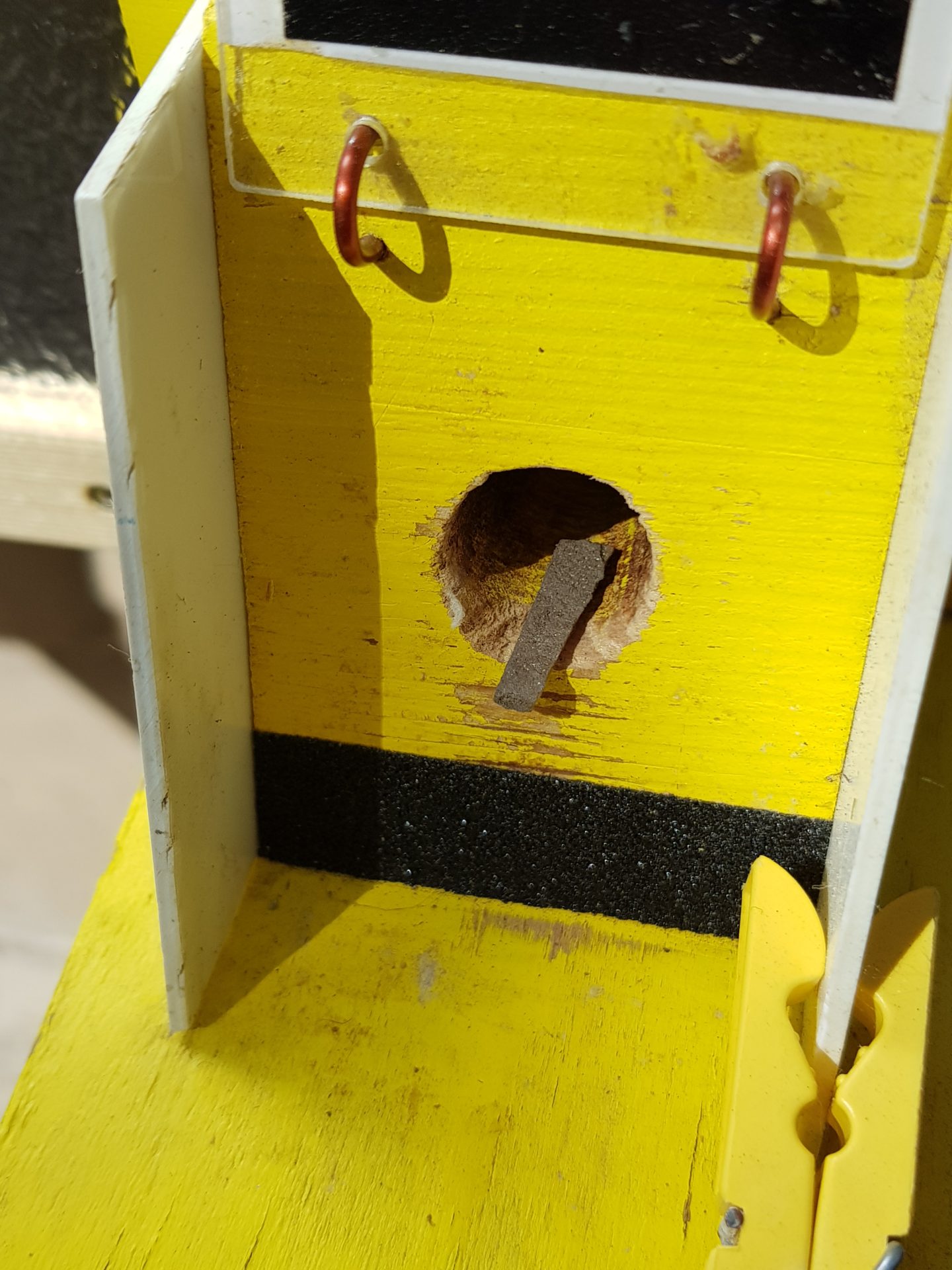
Mark in the entrance hole of the hive
Oblong stone = ideal mark
Photo O. Hercog
Option 4 – Control of the use of the protective flap
As we wrote above and elsewhere, timely use of protective flaps will reduce the risk of another queen bumblebee trying to enter the hive.
In 2020 and 2021, we tried another method. We lifted the protective flap on a bumblebee nest, which happened to be in a hive located in a garage, after the new queens were born. Our goal was to see how the queens would behave the following year when they returned.
If the queens cannot pass through the protective flap, there will be a greater chance that they will not get into the hive and will not fight for it.
In our observations, it seems that some mothers are discouraged by this. They try to get under the flap, but because they are not familiar with it, sometimes they give up and fly away. The method is not 100% reliable, but it can be used . If you have no other option, you can use it and count on it during the year.
You may object that parasites such as the parasitic wasp (Aphomia sociella) can then enter the hive. Yes, that is true, however, at the stage when the nest has produced queens, the wasp does not cause much damage and the nest is already alive. The tested nest was attacked, but the wasp did not find conditions for development there and only one cocoon was found in the hive during cleaning.
Option 5 – Mother capture
Theoretically, there is another method, but it is borderline against the nature conservation law. It consists of gently capturing the mother, placing her in a carrier and transporting her to a distance of at least 5 km.
You can read about this method somewhere, but it is better not to use .
In addition to manipulating the bumblebee and breaking the law, there are risks for which we do not recommend this solution:
- the mother may end up in a place where she does not find suitable conditions
- the mother gets to a place where her species does not occur and does not find partners to reproduce – see examples of rare bumblebee species that are tied to a specific location and would thus weaken them
- non-native species may be introduced to places where they do not belong, including protected landscape areas
- This may support the spread of hybrid bumblebees , which unfortunately already occur in our nature and which many breeders do not recognize.
Try to support and help the bumblebees. If you want to solve the problem of queen returns, you can use the simplest method – rotate the location of the hive . Just choose two or three places and use them cyclically, and the problem is solved.
Can I put a new one in the original place?
If you are happy with the original location, place the new hive there .
But do this only after the queens stop returning there = nest another species/individual there. Queens may return there for several days, sometimes even longer. It depends on the hibernation conditions (when they wake up) but also on the weather and their condition.
You need to be patient. If you don't have time and would rather go somewhere else, choose the previous options.
What if the queens keep coming back and the keeper no longer has hives or doesn't want to stock them?
Beekeepers usually solve this by buying another hive and are happy. They are happy because this multiplies the number of hives in their garden...
If you don't have a hive in the original location, the queens will gradually disperse and look elsewhere . This is the easiest and safest option.
Of course, bumblebee queens can find other hives in the area. There's not much you can do about that.
prevent this by:
- you will not have hives placed close to each other
- hives will not be near or on the ground, where most species forage
- use the protective flap in time, see the procedure The Art of the Flap
Conclusion
If you do all this, you will do a lot of work for nature and help it.
There will be no unnecessary losses of queens = you will support the reproduction of bumblebees .
You need to be patient and dedicate a lot of time to this worthwhile activity.
Now you probably understand why a successful beekeeper's hives in the garden multiply like bumblebee mothers after a successful season (sorry, like mushrooms after the rain) and why a successful beekeeper is nervous and hairless in the spring.
And maybe you already understand our favorite slogan " It all starts with buying a hive ".
Thank you all for your interest and choosing one of the proposed scenarios for dealing with the return of mothers.
We would like to thank in advance those who will add their knowledge to the scenarios listed here and thus help with the issue of queens returning to hives.