
Procedures for safely introducing a bumblebee into a hive
What you will learn here
- How to settle a bumblebee queen in a hive
- What are your options?
- What techniques to use
- What to watch out for
- What not to do under any circumstances
Last updated date: 74/3/2026

In a nutshell
- Respect nature: when occupying the hive, be extremely considerate and respect nature
- Spontaneous settlement: if the queen bumblebee mother finds a nest on her own, it is a natural process and a 100% respectful process
- The Queen Mother can be offered a scare: it requires maximum consideration – force, pressure and imprisonment are not fair and do not lead to the goal
- Persistence is harmful: do not try to settle the queen at all costs and do not settle queens who are not actively looking for a nesting site - you will not succeed.
- Those who are prepared are not surprised: practice all the steps and repeat them several times "dry"
- Last year's daughters return: a hive can also be occupied by having last year's daughters return if they successfully survived hibernation
- The Bumblebee Quick Rota helps : it is not necessary to be stubborn and try to occupy the hive at all costs. You too can become a savior of a nest in need and occupy your hive during the year together with us.
English abstract
- Respect nature: be as considerate as possible when casting your hive and respect nature
- Spontaneous settling: if the queen bumblebee finds a hive on her own, it is a natural process and 100% respectful
- The bumblebee queen can be offered a reprieve : it takes the utmost consideration – force, coercion and imprisonment are not fair or conducive to the goal
- Resistance is harmful: don't try to settle a queen at any cost, and don't settle queens who are not actively seeking a nesting site at all – you won't succeed
- Those who are prepared are not surprised: rehearse all the steps and repeat several times "dry"
- Last year's daughters return: the bee hive can also be occupied by returning last year's daughters, if they have successfully survived hibernation
- The Bumblebee Fast Squad helps : it is not necessary to be persistent and try to occupy the scares at any cost. You too can become a rescuer of a nest in need and occupy your nest in the course of the year together with us
Contents
How to offer a mother bee (bumblebee) to nest in – breeder options
A) How to attract a mother bumblebee to the hive (bumblebee)
How to get the mother to nest
What you must not forget
How do I know that the mother has nested?
What are the chances of success
B) How to actively offer a bee sting to the queen mother
When to actively offer the hive to the mother
What you will need
Catching the searching queen mother in a net
Moving the queen mother to the feeder
Moving the queen mother from the feeder to the hive
The queen is locked in the hive, exploring its interior and making decisions
Orientation flight of the queen
mother The queen has made an orientation flight, what next?
What if the queen has not left the hive?
What is the next step?
C) The queen mother who was born in the hive last season will return to it on her own
Introduction
We write about the possibilities of acquiring bumblebees on the page How to get bumblebees . We write there that we recommend setting up a hive (bumblebee colony) of bumblebees from nature . It is a way in which you can help nature and, if everything works out, you will multiply the bumblebees that live in your area.
We will describe the procedure for setting up a hive with a purchased nest in a separate chapter HERE (in preparation).
The basic condition for successfully settling the queen in the hive is that you have it ready and placed in its final location. After the bumblebees have settled in, we do not recommend manipulating the hive .
In particular, manipulating the hive while the queen is in the solitary phase threatens the successful breeding of bumblebees .
There are exceptions here, which we will describe separately and which we recommend only to experienced breeders.
Before you get started, we'll try to explain why our instructions can sometimes seem long and detailed ...
We are aware that the instructions will seem detailed to you. The process of settling the queen can actually be done in a few minutes.
However, it is sometimes a problem for a beginner – he lacks practice and is afraid. However, with our detailed instructions, nothing will surprise him and he and especially the queen bumblebee will be able to handle it without any problems.
That is why we have included in this guide some common mistakes made by beginners , which should help you solve any problems. So, I guess 🙂
How to offer a mother bee (bumblebee) to nest in – breeder options
Once the queen bumblebee mothers have grown stronger and signal that it is the right time to nest, they will start looking for a nesting site, a place to build their nest. You can tell that the mothers are looking for a nesting site by their search flight .
There are these basic options for populating a hive (bumblebee) with a mother from nature :
A) Attract a mother bumblebee to the hive (bumblebee) = leave it up to her and chance
B) Actively offer the hive to the mother = introduce her to the bumblebee colony and let her decide for herself
C) The mother-queen, who was born in the hive last season, will return to it on her own
In all these cases, the nesting site more attractive queen mother by using the entrance passage from last year's breeding. You can also use a clean part of last year's heat-retaining lining, which contained the bumblebee nest.
However, do not forget that the used corridor must be thoroughly cleaned (see Corridor in the hive) and the used lining must be sanitized (see Lining in the hive).
Please do not forget about the returns of the dams from last year's breeding. It is very important.
A) How to attract a mother bumblebee to the hive (bumblebee)
This solution to occupy a hive is the most natural and closest to nature . It doesn't always lead to the goal, but with a little luck you can succeed and our instructions will help you with that.
How to let the mother nest
The prerequisite for success is that you place the nest in a suitable location so that the mother can find it herself when she searches for a suitable nesting site.
We wrote about the placement of the hive in the garden.
the nest herself , it should be placed in the places where the mother searches (this can be determined by observing the frequent routes of search flights). Most often it is on the ground - see our videos.
Species that search for cavities in trees search at heights , sometimes even under the roof, such as the hypnotic bumblebee (Bombus hypnorum).
From the perspective of later successful breeding, we recommend placing it on a raised platform or a low stand . It is therefore a good compromise to choose a height of 20-30 cm above the ground.
Most species will not nest on a high stand because it will not be a natural place for them.
An exception may be, for example, the hypnotic bumblebee (Bombus hypnorum), which often occupies higher nesting sites, such as birdhouses.
Recommendation:
- If you prefer spontaneous settlement by the queen mother, then we recommend leaving the hive directly on the ground until settlement .
- Once the queen mother has occupied it, after a day or two, close the entrance hole with a plug at night, carefully lift it to a height in the same place (stand/pad)
- After calming the mother, open the entrance hole
- The mother will probably do a short orientation flight in the morning and accept the change in position.
- If the mother does not accept the change and continues to look for him on the ground, then it is necessary to capture the mother and introduce her into the hive with a feeder (see the procedure in the following text).
If you leave the baby on the ground , it is quite possible that another searching mother will discover it and try to occupy it . Then a fight will occur, often with fatal consequences for both mothers.
As we wrote earlier, the hive should be completely prepared and you should not approach the hive unnecessarily so as not to scare away the searching mothers .
What you must not forget
You must not forget that the hive ventilation must be closed and the flap open .
Also, remember that you must not disturb the mother - it is better to observe her from a distance (a few meters), do not move her or interfere with the process.
How do I know that the mother has nested?
If you don't have time to observe if the queen mother is interested in the hive, it is a good idea to place a marker .
If the marker is thrown away, the hive has been visited. If the marker is thrown away regularly , then most likely someone is returning to the hive regularly because they like it.
However, don't expect to meet your newly settled mother regularly, see the next text.
You can learn how to insert a marker into the entrance hole of a hive on the page Do I have or don't I have a beehive?
What is the chance of success?
Even if you do your best, the probability that the queen mother will discover the nesting site herself is not high . From nature's point of view, this is the most natural and gentle way of occupying the hive and we recommend trying it.
We have tested it and it works.
However, do not forget that if the nest is on the ground, another mother may be interested in it. The mothers will then fight for a place to live, which ends in the death of one or both mothers. Therefore, it is necessary to move the nest to a higher position in time .
B) How to actively offer a bee sting to the queen mother
If the mother does not find the hive you have prepared on her own, it is possible to gently catch her with a net and offer the hive to her = take her into the hive to inspect it.
This way you can offer her a hive that is placed where the mother is not looking. These can be hives on high stands, on the wall, on the balcony, etc.
It is important to remember that bumblebees are protected by law . You must avoid threatening the queen mother in any way, trying to force her to settle, or even harming her in any way .
The procedure described below is not complicated. If you practice it beforehand , you will eventually realize that it is easy and you can do it in a minute .
From experience and years of supporting beginners, we know that introducing a queen into a hive usually fails for those who do not prepare well , and especially for those who are stubborn and try to succeed at all costs . Practice, calmness and patience are the cornerstones of success.
Before you start, we recommend placing an emergency dose of wort in a feeder from a PET bottle cap . Press cotton wool into the cap and drip an aqueous solution of sucrose (white sugar) .
This is not a bribe, but an emergency dose of energy in case the queen is exhausted and has to look for a way out of the hive for a long time - see the next text.
When to actively offer a scare to the mother
Perhaps we should review from the previous chapter how and when mothers search for nesting sites. This will be useful for us to develop the right tactics, or for the time allotted for observing bumblebee mothers.
Only the queen bee, who is searching for a nesting site on her own .
If the mother is not looking for a nesting site, there is no point in introducing her to the hive – she will not accept the scare and you will only endanger her unnecessarily. She is SHE and she must decide on her own whether to settle in. Please respect that.
Do not offer the bumblebee queen a nest when the weather forecast promises daily cold to 0C, frost or prolonged rain/ snowfall .
The mother can handle morning frosts in the spring months. However, the condition is a good hive, thermally insulated and with a sufficient amount of quality lining. Likewise, enough food in nature during the day (she can fly even in low temperatures, if necessary).
However, the mother cannot keep the brood alive for several days without a supply of food . So if she lays eggs in warm weather, she will not have sufficient supplies of pollen and nectar and also if she will not be able to collect food outside the hive.
If she cannot do this, she may leave the nest , or herself die of exhaustion while warming the nest .
Expect the mother to lay eggs under normal conditions 3-5 days after settling and then stay in the nest. So keep an eye on the medium-term weather forecast .
Mothers actively search for nesting sites during the day in several waves – in the morning, and then later in the afternoon. They are especially interested in the early evening, when the wind calms down and they do not need as much energy for flight.
If it is cold or windy, they are not so active in searching. They are also not very active when they sense changes in the weather and when conditions (temperature and food availability) are not suitable for nesting.
Warning in case you try to settle the queen in the early evening – you need to take into account that the queen will only leave the hive after dusk, so she will stay in it at night.
a dose of sugar solution or honey-sugar dough on the surface of the lining . You can find suitable materials and feeders HERE
Notice
- If you want to be successful, try to capture and introduce the queen into the hive calmly, without stressing the queen, and as quickly as possible.
- If you stress the mother with rough and long capture and transfer, her desire to nest will quickly disappear.
- Transport the mother for a maximum of 10–15 minutes , you are unnecessarily stressing her
- Do not transport the mother from a distance :
a) you may accidentally capture a nested mother - her nest will disappear and she will become a vagrant (she will not establish a new nest
) b) you may weaken the population at the capture site - her offspring may not find suitable breeding partners = breeding would lose its meaning without the next generation. - For the reasons mentioned above, do not transport captured mothers by car.
- It is best to capture the queen near the hive, or within a 10-15 minute walk . This reduces the time the queen is stressed and from such a distance the queen can return to where you captured her (she will not find her nesting site from more than 3km away).
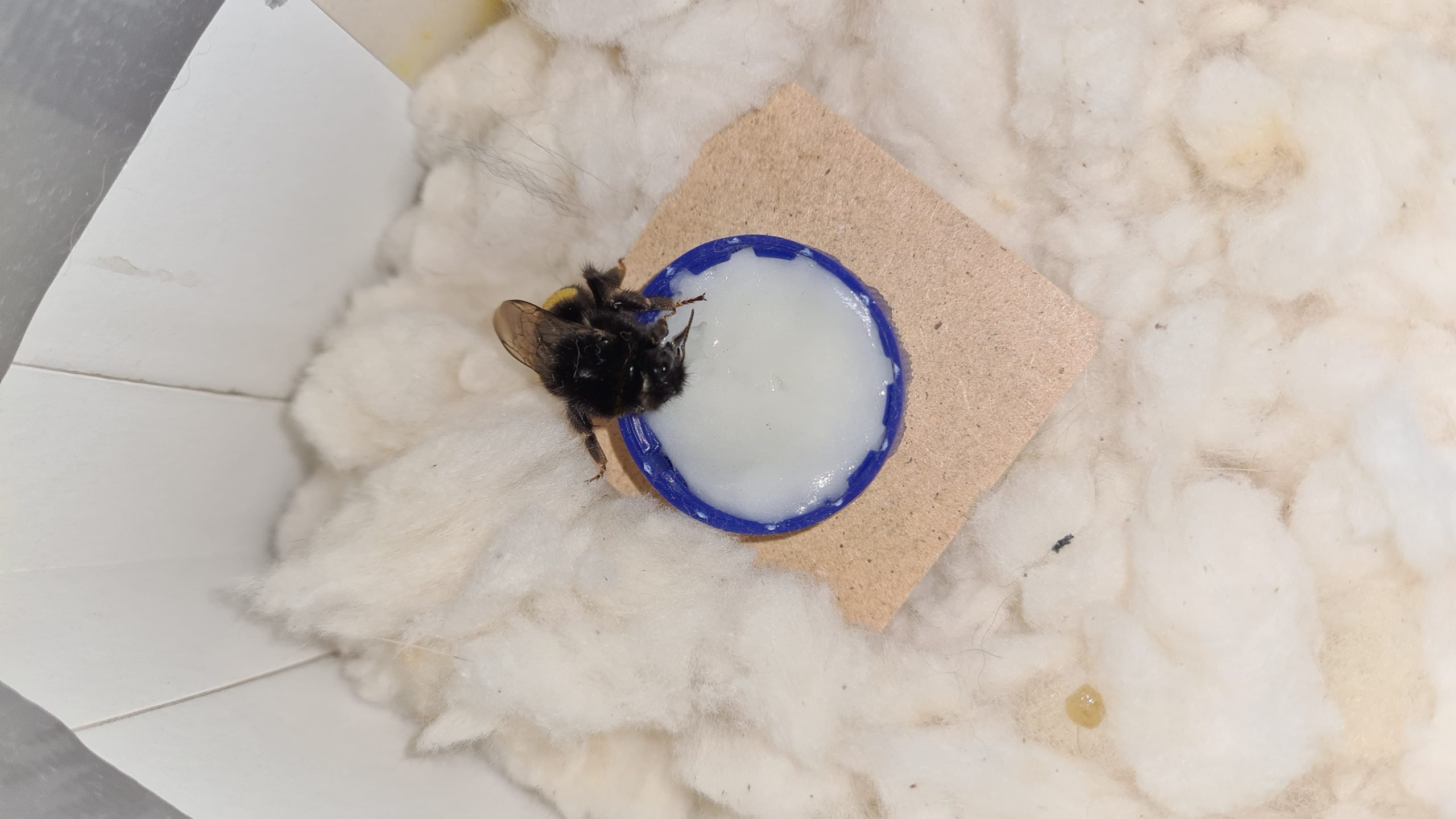
Feeder made from a PET bottle cap - honey and sugar dough - mother feeding
Photo: O. Hercog 2022
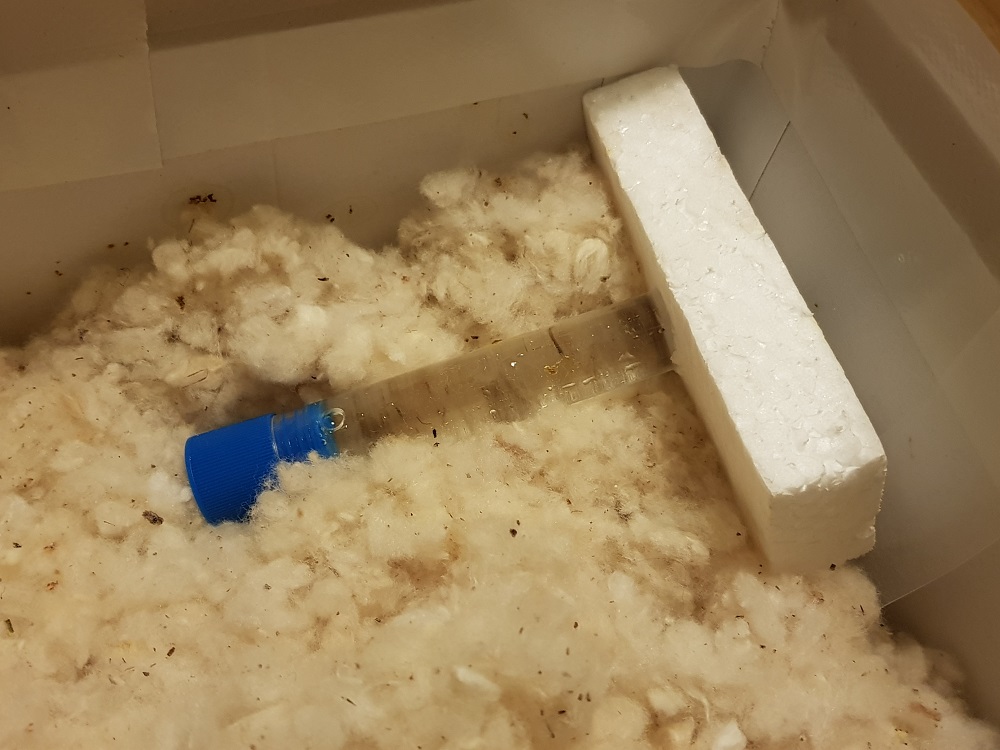
Tube feeder – inclined position
Photo: O. Hercog
What you will need
- Catching net(s)
- Loader – we recommend a slanted loader; Prepare the loader = pull the plunger out to the maximum
- Hive entrance/inlet plug
- A plug to close the inserter with the captured nut
- Inserter case = a cover that shields the inserter and keeps the captured mother calm
- Time, patience , strong nerves and optimism
- As a safety precaution to place a PET bottle cap with dissolved sugar before introducing the queen into the hive HERE.
Sugar paste, which is sold in beekeeping supplies (e.g. Apivital, Apifonda, etc.), can also be used.
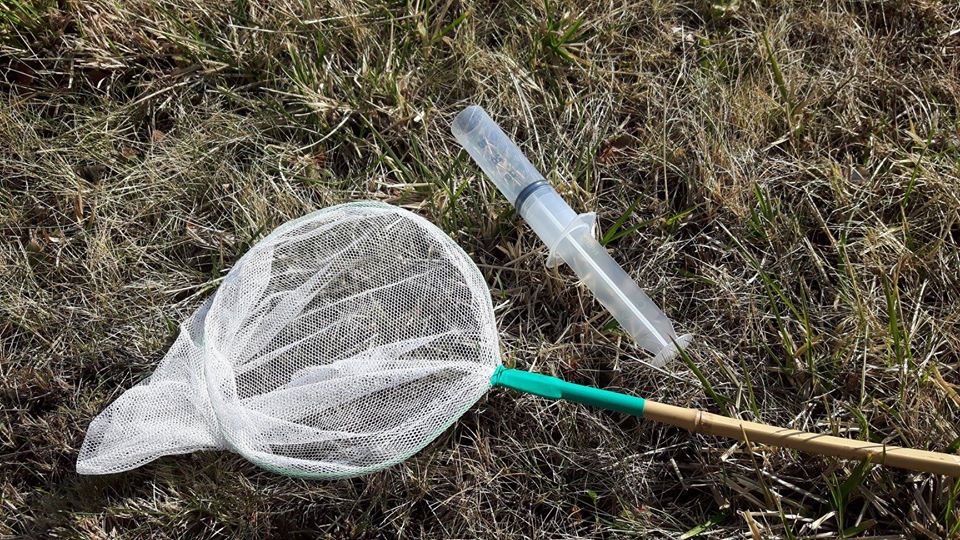
Trap set net and feeder
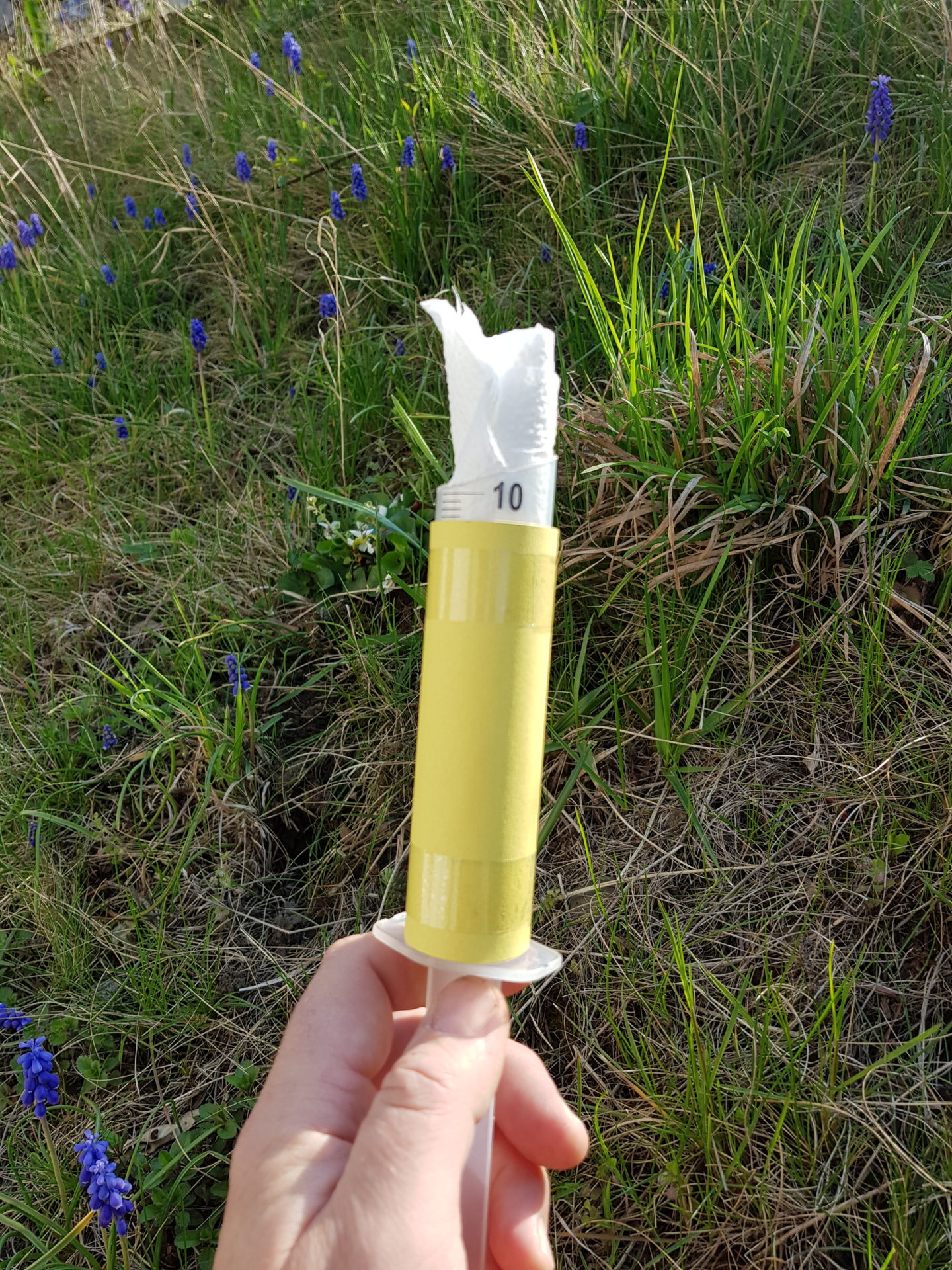
Loader with powder and paper stopper
Photo O. Hercog
Note
- The mother does not look for sugar in the nesting site, nor does she accept it as a bribe – the mother is looking for a place to live, not a buffet.
There are known cases when the mother went to the hive only to feed, but did not want to live there. - This is just an insurance policy in case she doesn't find her way out of the hive in time - she could starve to death.
An emergency dose of feeding is especially suitable when you settle the queen in the early evening and darkness may overtake her in the hive .
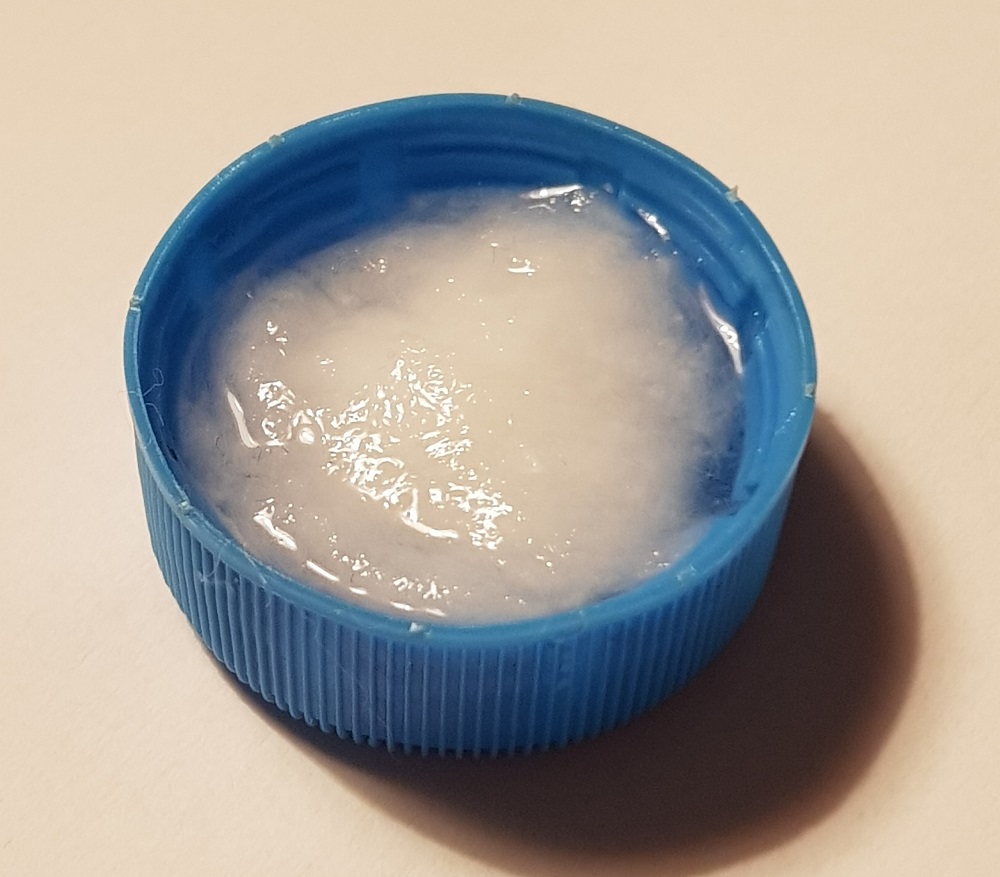
Feeder made from a PET bottle cap with a cotton insert
Common beginner mistakes:
- Unpreparedness
- Missing training
- Striving to succeed on the first try and persistence
Capturing a searching queen mother in a net
First, you need to find and gently capture the queen bumblebee with a net.
Procedure
- It is necessary to calmly observe the bumblebee queens and their foraging flight . If you find a place where they are foraging, it is best to stand there, wait and calmly observe.
- As soon as the searching mother approaches, lower her to the ground with the trap net – being careful not to hurt her.
- There is no point in chasing the mother because you will only scare her, stress her out and she will fly away. Likewise, try to catch her in flight or while she is grazing
- Depending on the situation, you can choose a net with a smaller/larger diameter (approx. 20 cm / 40 cm) . A smaller mesh diameter is suitable for tall grass and short distances.
- Once the mother finds herself in the net , she will instinctively try to escape by flying upwards.
- Hold the net down with one hand to prevent the mother from falling. Use your other hand (fingers) to lift the bottom of the net – the mother will try to escape upwards.
- Wait for the mother to emerge and use your other hand to close the net under the mother (grip the net with your fingers and palm)
- Ufff – the mother is in the net! 🙂
We highly recommend:
- don't breathe on the mother - it stresses her out
- Don't shake the boot unnecessarily - it stresses her out
Common beginner mistakes
- Capturing a mother who is not conducting a search flight, on flowers, or in flight
- Unnecessary fear of the sting or mandibles of a bumblebee
- Bumblebee hunting, instead of waiting
- Unnecessary stress for the beginner and therefore for the mother bumblebee
- Hasty movements
- Netting not properly pressed to the ground
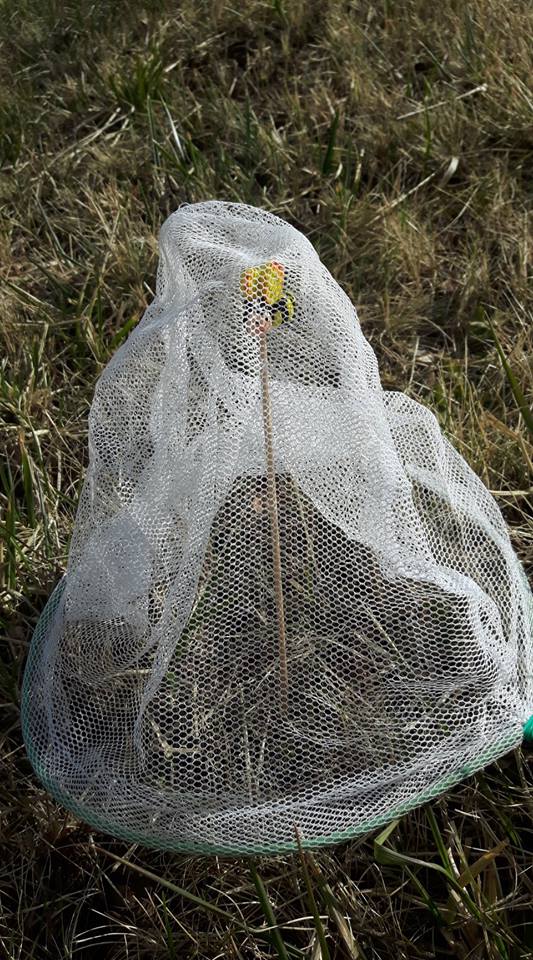
Mother caught in a net
, pin her to the ground with the trapping net
Photo O. Hercog
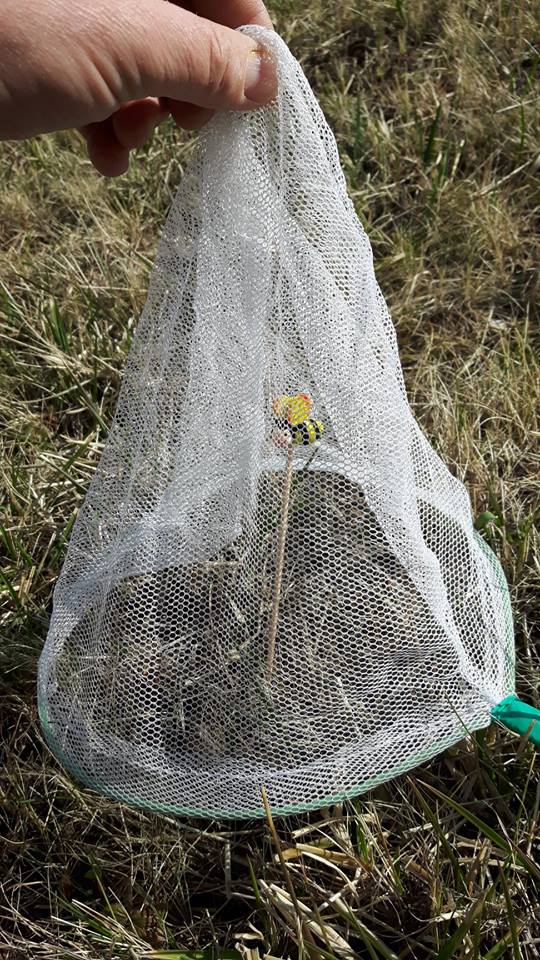
Mother caught in the net,
lift the bottom of the net - the mother will try to escape upwards
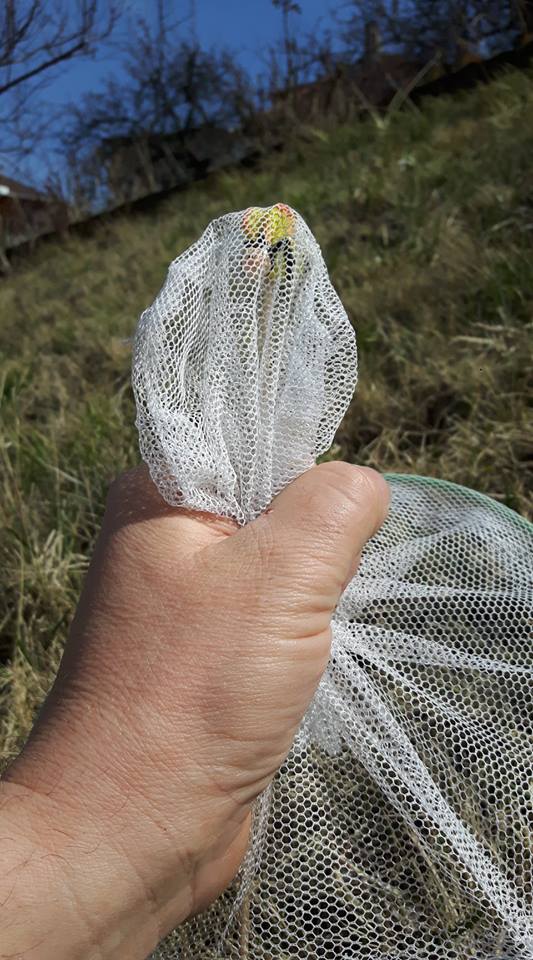
Mother caught in the net
Wait for the mother to emerge and use your other hand to close the net under the mother
Experienced breeders use several methods for capturing queens, which we will describe later. Here we will describe one of them, the so-called hole method .
You prepare a hole in the ground for your mother and wait for her there – with coffee in hand and sitting.
In the section for experienced breeders, Dr. Kučera will describe gentle trapping in "flash traps" ( in preparation )
Procedure
- a hole in the ground where the searching mother bumblebee moves
- The hole should be approximately 20–30 mm in diameter.
- It should be oriented diagonally into the ground, approximately 15-20 cm deep , simulating the entrance to a rodent burrow.
- It should be placed where the searching queens move and where you can easily reach with the trapping net.
- a thicker stake , a handle from a garden tool, or a gardening stake to create one.
- It should be visible and not covered by grass
- The searching mother will be attracted to such a hole in the ground and you will catch her more easily - you wait until she enters the hole in the ground and you knock her down with a trap net , into which she will return from the hole.
- This method will give you one great certainty – you will have a queen mother in the net who is demonstrably looking for a nesting site !
Warning and apology for repeating this over and over again
- If the mother is performing a search flight = looking for a nesting site. It is worth catching her and offering her a scare.
- If the queen mother is feeding on flowers or flying high , she is not looking for a nesting site, or it cannot be determined. There is certainly no point in offering her a scare – she would not accept it.
- If the mother has pollen threads on her back pair of legs, she already has her own nest and must not be disturbed . She would never accept an offered nest and if an accident occurred during capture, her abandoned offspring would perish.
Transferring the mother to the inserter
Once the queen is captured, she needs to be gently placed in a carrier, which will safely guide her into the hive.
Procedure
- The mother is caught in a net and closed by hand
- Grasp the loader with your other hand (the plunger should be pulled out to the maximum)
- Insert the inserter into the sieve from below – loosen your palm and fingers a little so that the mother does not fly away, but so that the inserter can be inserted there
- Carefully bring the inserter closer to the mother and reduce the space in the mesh until the mother falls into the inserter and sinks to the bottom.
- Hold the inserter in a vertical position . The smooth surfaces of the inserter walls prevent the mother from climbing out or flying out of it.
- If you are near the hive, leave the feeder covered with a net. Otherwise, close it with a prepared stopper or a roll of tissue.
- If you have a carrier bag to shade the mother in the carrier , this will reduce her stress.
- Move to the hive
Common beginner mistakes
- Long-lasting transfer of the mother from the net to the inserter
- Due to a mistake in the procedure, the bumblebee flies out of the net/loader
- Long and rough transport in a carrier – mother's stress
- Excessively long examination of the mother in the boot – maternal stress
- There is no bumblebee in the bootloader, but a patchouli
Mother caught in the net
Wait for the mother to emerge and use your other hand to close the net under the mother
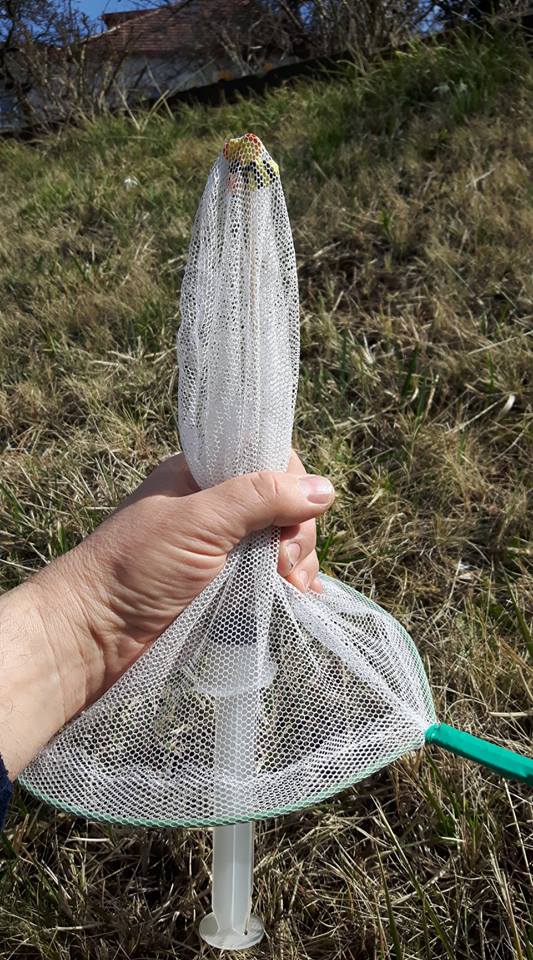
Queen caught in the net
Insert the feeder into the net from below
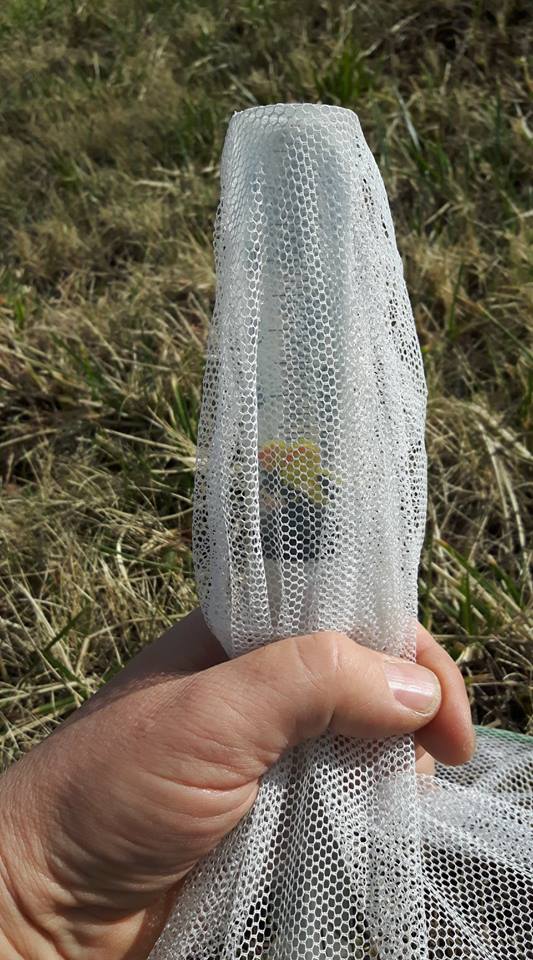
Mother caught in the inserter
Slide the inserter under the mother until it falls into it and sinks to the bottom
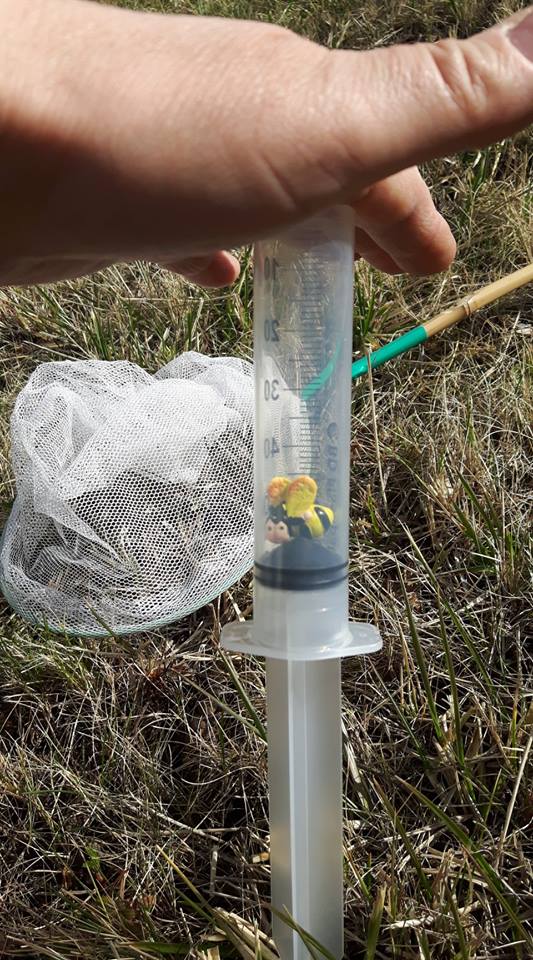
Queen trapped in the feeder
Close the feeder with a stopper or a roll of tissue
If you are close to the hive, simply cover the feeder with your hand or a net
Sometimes the mother gets caught in the sling and refuses to let go. There are several methods to solve this situation, such as the one shown in this video.
But you can just stand still, don't breathe on the mother (human breath stresses her) , don't shake the inserter and wait for her to let go . Sometimes it's enough to turn the inserter to a horizontal position , or slightly push the plunger upwards.
The mother is trying to escape upwards, so she lets go. You can also solve this by carefully pulling the net .
Moving the queen from the loader to the hive
the queen bee into the hive from the feeder through the entry hole . If everything goes well and the queen enters the hive , she will walk along the corridor to the interior of the hive. She marks her path with pheromones and makes buzzing sounds. explore the interior and lining of the hive .
It is essential that it is in the dark and undisturbed. It will create a path that it will then take to the outside of the hive, and if it receives a startle, it will be marked by its scent.
Notice
- If the mother does not want to enter the entrance hole and everything is taking a long time, it is better to let her out.
Either she is stressed, or she is not looking for a nesting site and will not accept the shock - you must not force her into the hive and there is no point in doing so.
Procedure
- Make sure the roof is closed and the ventilation cover is closed.
- Prepare inlet plug
- If you used a bootloader shield, remove it.
- In a vertical position, bring the loader closer to the inlet hole and remove its cap.
- Flip it to a horizontal position and press it against the air inlet.
- Be careful not to squeeze the mother . If this is a danger, it is better to let her fly.
- The mother is buzzing loudly and is agitated, try not to prolong this conversation unnecessarily.
- The mother will seek an escape from the feeder and enter the inlet.
- If she doesn't want to, try inserting the piston and bringing her closer to the inlet hole - but don't press on her - the piston doesn't push her into the inlet hole, it just reduces the space in which she moves until she can fit into the inlet hole on her own - it's the only place she can escape
- Once the mother enters the entry hole and does not immediately return to the inserter, carefully close the entry hole with a plug.
- Sometimes the mother will turn around and try to escape. In this case , wait until she enters the passage before closing the entrance hole.
- Check that the inlet seal is secure, that no light can pass through it into the hive, and that the ventilation is closed.
Note
- The queen needs to be led into the hive through the entrance hole . This will help her find her way back when she wants to leave the hive, and possibly return to it and move in.
- There is also the option of introducing the queen into the hive through the roof. However, there is a risk that the queen will not find her way out of the hive. We do not recommend this option for beginners, or we will describe it as a specific procedure for populating a hive with a long corridor HERE (in preparation)
- You can also watch an interesting video , but we do not recommend the procedure for beginners.
Common beginner mistakes
- Long-lasting transfer of the queen from the loader to the hive
- Use of an inappropriate small diameter introducer see HERE
- Due to a mistake in the procedure, the bumblebee flies out of the loader
- The inserter is not pressed properly against the flap, risk of pinching the mother's leg (antenna)
- A slanted inserter in which the mother slides
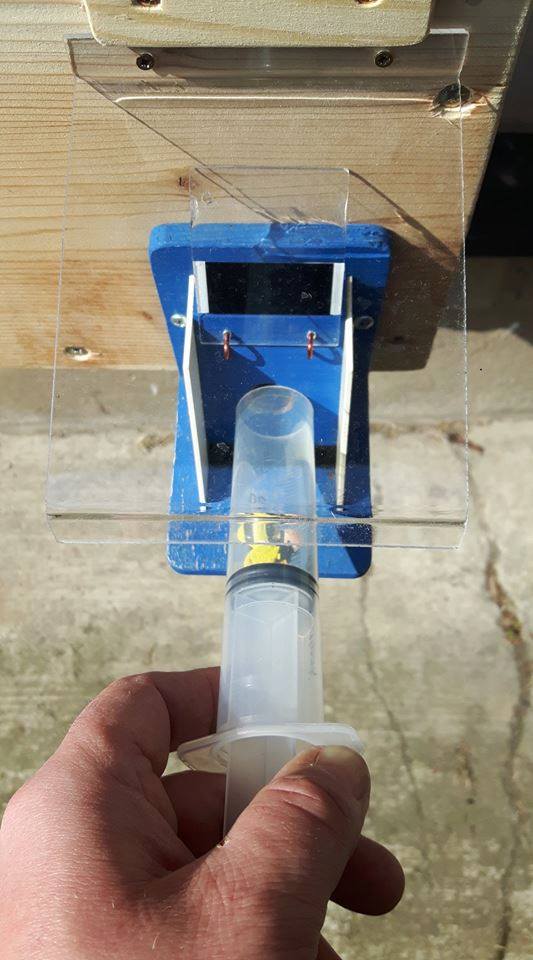
Introducing the queen into the hive
Tilt it to a horizontal position and press it against the entry hole
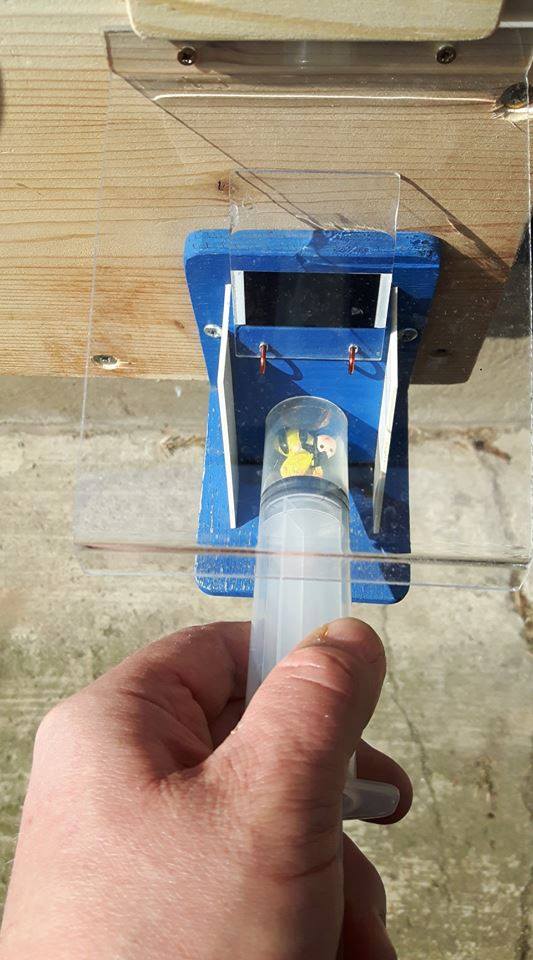
Introducing the queen into the hive
If she doesn't want to, try carefully inserting the plunger and bringing her closer to the entry hole - but don't press on her
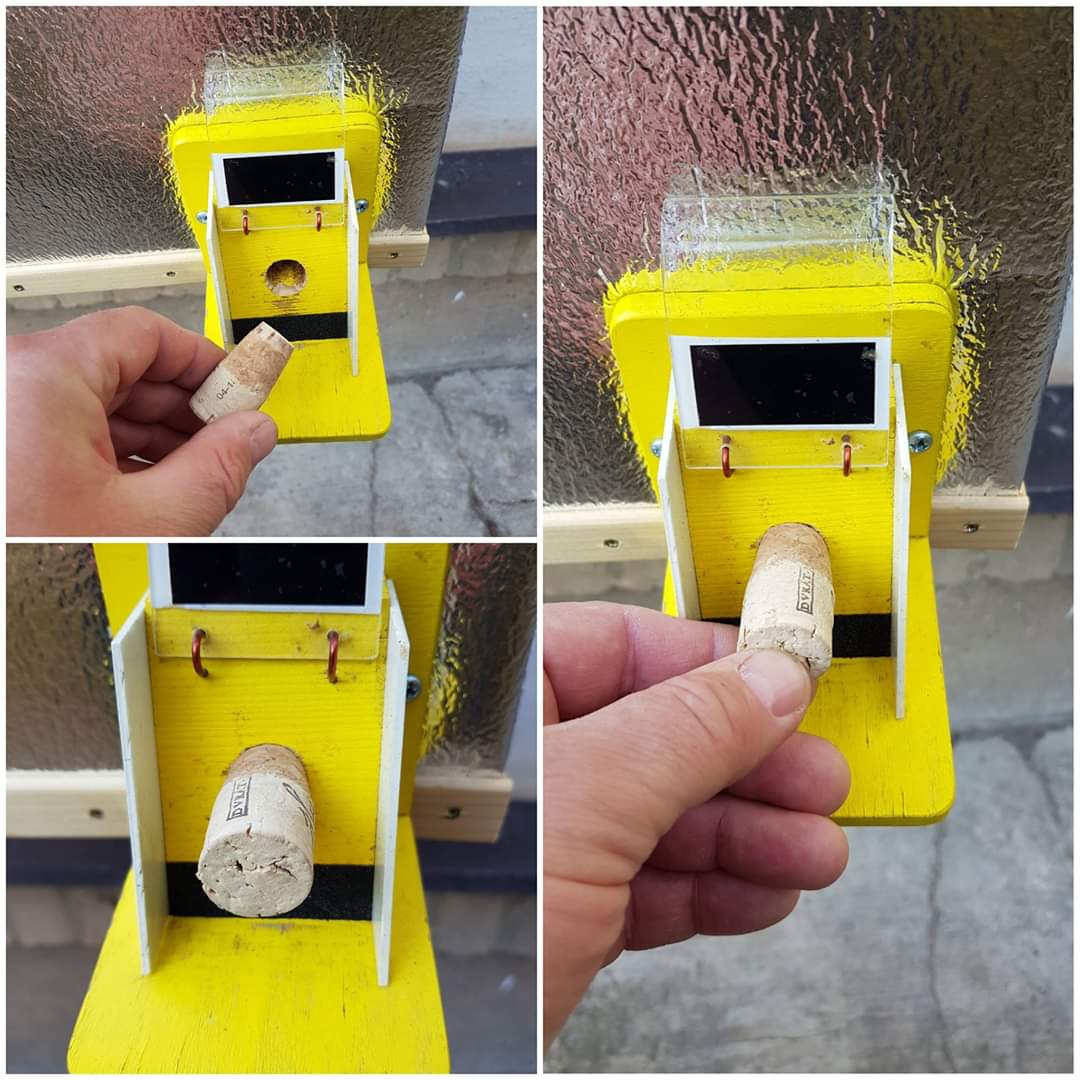
Once the queen enters the entry hole and does not immediately return to the feeder, carefully close the entry hole with a plug. Closing
the hive with a ground cork plug
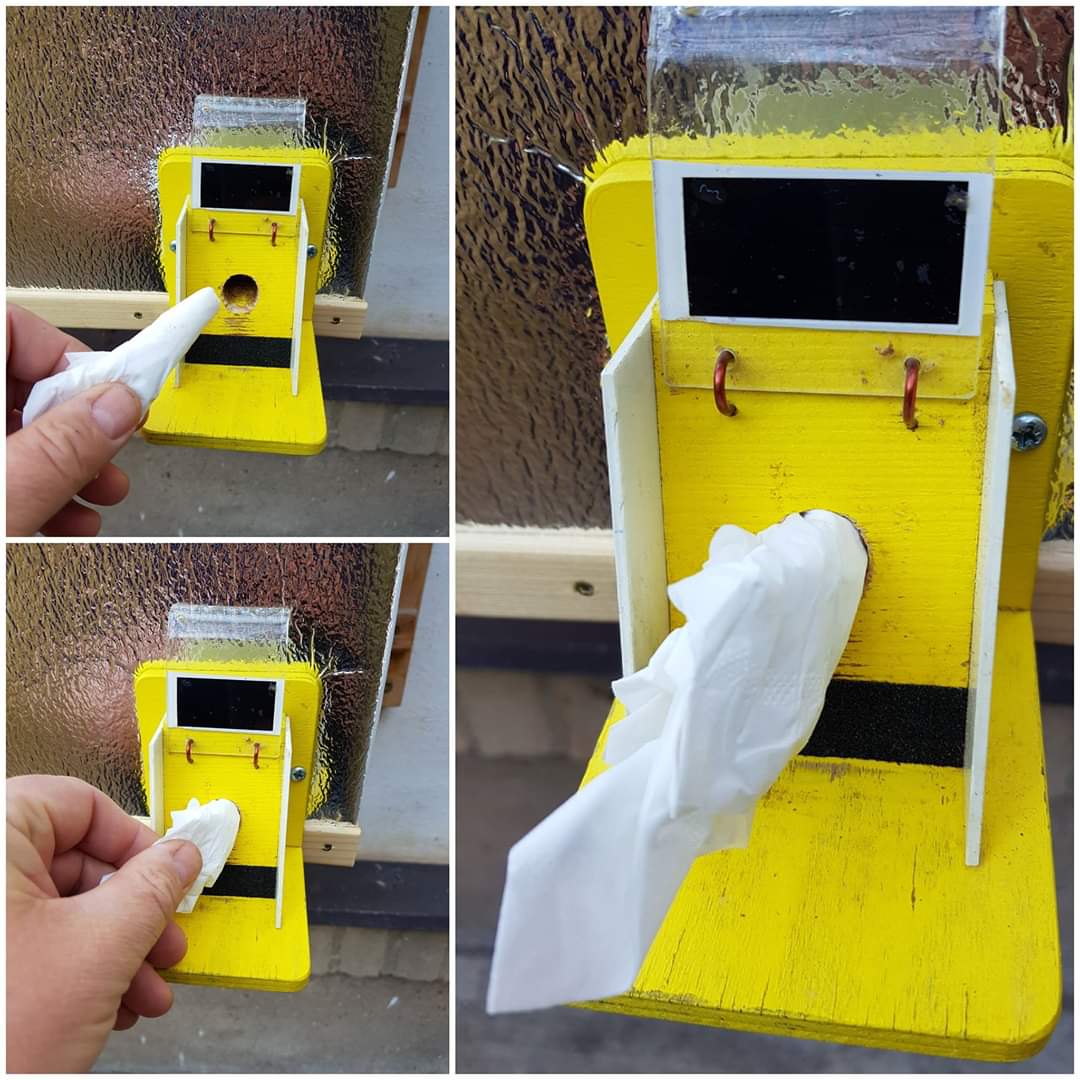
Once the queen enters the entry hole and does not immediately return to the feeder, carefully close the entry hole
with a plug. Closing the hive with a roll of tissue
Video instructions for introducing the queen mother into the hive. As you can see, the introduction went as planned – quickly, smoothly and most importantly, without stress for the mother .
It was a mother of a meadow bumblebee (Bombus pratorum)
This mother did not want to go into the hive, so the introduction attempt was terminated and the mother was released.
The mother is locked in the hive, exploring its interior and making a decision
This phase is crucial and is completely in the hands (wings) of the mother.
If you have done everything according to our recommendations and the mother is really looking for a nesting site, there is a high chance that she will settle down. But there is nothing you can do – just wait .
Procedure
- Leave the mother locked in the hive
- Do not touch the hive in any way, do not disturb it and step away from the hive
- The purpose of closing the mother is to make her walk through the entrance hall and begin to investigate the scare.
- It is essential that when entering the hive, the queen bee cannot see the light either in the entrance hole or in the hive .
- You can, for example, listen and make sure that the mother is in the hive - as soon as she walks through the corridor , she makes "buzzing sounds" - sometimes it is clearly audible.
- Leave the air inlet closed only for the necessary time.
- If the mother immediately continues down the corridor to the hive, closing it for 1 minute is enough
- The inlet should be closed for a maximum of 5 minutes. There is no point in extending the time, it will not help the settling.
- Sometimes it happened that after a longer confinement, the mother "froze" in the hive or in the corridor - this was when she did not want to nest and the keeper still tried to offer her a hive.
- Sometimes the mother wanted to nest, she quickly inspected the nest, but she could not leave it to inspect it and do an orientation flight - a longer confinement unnecessarily stressed her and she did not accept the nest.
- Keep the vent closed and the flap open (fully raised flap)
- Immediately move away to a safe distance of approximately 5 m or more, to a place from where you can observe
- The result of the observation is extremely important – it will tell you whether the mother wants to accept the nest or not.
- If the mother climbs out of the entrance hole and flies away immediately - she will definitely not return.
- Likewise, the mother is unlikely to return if she only circles briefly above the hive (2-3 circles) and then disappears = look for another mother with a search flight
- If the mother climbs out and does a so-called orientation dance, the fright has caught her attention and there is a good chance that she will settle down.
Recommendation
- that you wait for the result and her decision after introducing the queen into the hive
- It's worth waiting for this moment. It's worth the experience, and most importantly the result
- If for some reason you cannot wait for the result, use the marker in the flight slot HERE
Common beginner mistakes
- Poorly closed ventilation hole – mother sees light shining through and wants to leave through it
- Poorly closed inlet opening – ditto
- Opening the hive early/late
- Disturbance of the queen in the hive after her introduction
- Observation of orientation flight from a short distance – disturbing the queen when leaving the hive
- The breeder does not wait for the result and does not make sure that the mother has really left the nest = he risks dying there
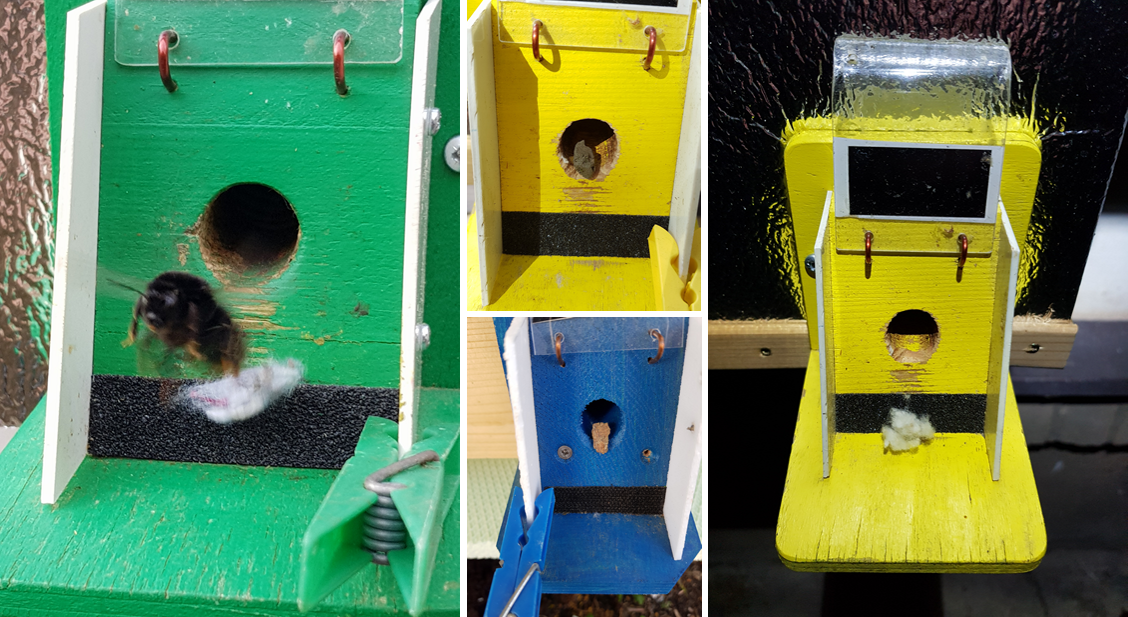
Markings in the entrance hole of the hive
Photo O. Hercog
.
If you place a bumblebee queen in the hive (bumblebee) in the early evening, she may be afraid that darkness will overtake her and she will not leave the hive in time. Therefore, it is a good idea to put a lid from a PET bottle with a sugar solution .
To prevent the queen from getting wet in such a feeder, it is a good idea to press a piece of cotton wool into the lid and drip the solution there. This is not a bribe, but an emergency dose .
If the queen does not want to stay in the hive, even if there is a sweet solution there. It will only help her to safely pass the time until the morning, when she will leave the hive on her own, or when you let her out through the roof.
.
Mother's orientation flight
The mother's orientation flight is a special flight in which the mother remembers the appearance of the hive and its location . She also orients herself in the surroundings to find her way back.
Interesting fact
- You can observe the orientation flight when the mother has chosen a nesting site, when new workers or new mothers leave the nest for the first time - they also have to remember the nest in order to find it
- Orientation flights are performed by mothers and workers after the entrance hole has been closed for a long time and they have not been able to leave the hive
- Mothers and workers will also make an orientation flight when they discover during a trip that the surroundings of the hive have changed or that they have moved with the hive
- Males do not return to the hive, so they do not make an orientation flight
We describe the orientation flight as follows:
- A bumblebee climbs out of the entrance hole
- Sometimes he walks over it and looks at it
- After a while it takes off, turns towards the flight hole
- Standing in the air, looking at the airlock
- It swings in the air in front of the hive, circles around the hive, gradually rises
- It makes wider circles, flies higher and keeps looking at the hive and its surroundings
- It circles higher and higher and then flies away..
- Please cardia watch your blood pressure 🙂
Mother did an orientation flight, what next?
If the mother has performed an orientation flight, there is a chance that she will return. Now you have to wait and see how it turns out - there is nothing more you can do.
Sometimes it happens that the mother is so fascinated by the scare that she returns within an hour and immediately settles in .
Sometimes, however, the mother does not want to nest yet and will return to the hive later, perhaps after 1-3 days .
If she doesn't return within this time , there's no point in waiting - look for another mother with a search flight.
Procedure
- When the queen has landed and you can't wait any longer, place a marker in the entry hole to let you know she has returned (a correctly placed marker will be thrown out when the queen passes through the entry hole).
- But do it quickly and move away from the hive immediately – if the mother returns, she will be scared and probably won't come back again.
- If you can, wait at a safe distance of at least 10 m or more from the hive and watch the hive.
- If you see that the queen has returned, do not disturb her – continue to leave the hive with the flap raised and the ventilation hole closed.
- The mother carefully approaches the hive, lands on the garlic and after a while enters the hive.
- its further movement by looking (you won't last long), or even better, by using the marker in the entry hole.
- Here, most cardiologists call it "fast"..
Notice
- The mother's trips from the hive will be very irregular - don't be surprised. The mother will gradually work on the nest chamber, carry supplies, build a wax cell and lay eggs, etc. see HERE (we are preparing)
- Don't disturb her and give her time - any disturbance or opening of the hive at this stage may mean she will leave the hive and never return.
- Once the mother is settled in, it will be time to teach her to go through the protective flap – we will explain later
- If the queen does not return immediately after the orientation flight, it is better to wait about 3 days before introducing another queen into the hive.
- If you try to place another queen immediately in the nest and the previous one returns in the meantime, the queens may meet in the nest and kill each other in a fight for the nest.
Common beginner mistakes
- The breeder does not wait for the mother to return for at least 3 days
- The keeper does not understand that the mother will not fly out regularly and wants to introduce a new mother into the hive, or he opens the hive and disturbs the mother
- Beginner does not place the marker correctly in the entry hole and the mother goes around it / the wind knocks it down
What if the mother didn't leave the house?
Sometimes it may happen that you do not see the queen leave the hive , even though you are waiting for her. Or the marker in the entrance hole is not thrown out (be careful - the queen sometimes bypasses this).
Sometimes the mother cannot find her way and remains trapped inside.
Sometimes the queen bee will “ freeze” – she will remain sitting on the lining, stiff and motionless. There can be several reasons for this and they are not directly related to temperature .
Most often it is a queen mother who has recently woken up from hibernation and is just looking around the nesting site. After being introduced to the hive, she returns to a state of hibernation. Her hormonal processes are not yet fully activated and she reacts to darkness and sometimes cold in this way. A mature mother is active in a cold hive.
This effect is sometimes supported by a large temperature difference between the outside environment and the cold hive - it is warm outside and the hive is significantly cold after the night. However, if the hive is not completely frozen, its temperature does not have a significant effect on the queen's freezing. Therefore, keepers sometimes open previously unoccupied hives on a warm day and let them warm up a little in the warm air.
The stiff mother sits on the lining, or is hidden in the lining , but appears sluggish – stiff.
A very common reason is light shining into the hive through the ventilation hole . The mother sits near it and does not look for a way out through the corridor.
If you leave the mother locked in the hive for a long time and she doesn't leave on her own, she may die there .
Therefore, we recommend putting a little sugar solution/dough on the surface of the lining - it is a safeguard in this case and food until you free it from the hive (see above).
Warning: Do not place another queen in the hive (bumblebee) until you are sure that the previous queen is not in the hive, perhaps stuck on/in the lining. This could lead to unnecessary fighting.
Procedure
- Monitor the startle ( observation/mark ) – the mother should leave it on her own within one hour at most
- If the queen does not leave the hive, we recommend opening the roof . If the queen is sitting on the lining, leave the roof open and she will fly away on her own. There is no point in holding her – she will not nest in the hive
If the queen is stuck in the lining , you cannot introduce more queens into the hive. So check the lining to see if it is hiding in the dark – if it is stuck, she will make a weak buzzing sound. - The mother can sometimes hide in the entrance hall - so blow into her from the side of the air inlet - if she is sitting there, she will probably respond.
- If a frozen mother does not fly away, we recommend giving her a little sugar solution and releasing her back into the wild.
- If you can't see the mother, leave the nest open for a while - the mother will climb out of it herself. The nest will at least warm up to ambient temperature.
Common beginner mistakes
- The keeper does not open the hive even if he did not see the mother fly away and risks the mother getting stuck in the hive
- The keeper introduces another queen into the hive prematurely
Interesting fact:
Some beekeepers do not cover the entrance tube in the hive. According to them, this will reduce the risk of the queen becoming stuck in the hive after introduction. I have tried it, but in our opinion it did not have any significant effect.
However, this method is also possible. However, it means that after the queen has settled in and the first generation of workers is born, you open the hive and cover this place with a lining . However, do it in such a way that a cavity remains there. Otherwise, the bumblebees would defecate there and spread dirt throughout the nest.
The following video shows the mother gradually coming out of her stupor. It took her about 10 minutes before she seemed to fly away.
If the queen "freezes" in the hive , she will sit on the lining, but she can also be hidden in it. If she stays there, she can die. She can also die when the keeper introduces another queen into the hive and the queens compete for the nest.
Therefore, it is necessary to open the nest that the queen has not demonstrably left and free the queen – from the surface of the lining, from the lining or from the entrance tube . Don't forget to adjust the lining again.
Your mother will call you while you search the lining, but you can see she has enough worries and won't attack you.
Warning: do not interfere with the nest of an already settled queen , you will destroy the base of the nest and the queen will most likely fly away. We recommend this procedure only for rescuing queens "stuck" in the hive during replanting.
What is the next step?
If you have succeeded and the queen has settled in, enjoy the success. Be sure not to interfere with the hive , watch the movement from a distance and monitor the queen's movement as much as possible using a marker . Instructions can be found on the page I have or have not settled in.
The queen is sensitive to disturbance at this stage and may leave the hive in fear . Be patient, your time for safe observation of bumblebees is approaching.
Once you are sure he is coming back regularly for 7-10 days, start training him to latch on . You can find the procedure on the Art of the Latches
If the mother does not return the entire settling procedure must . Be patient, sometimes settling is successful on the first try, sometimes up to 50. With each attempt you gain the necessary practice and confidence. Everything will go better and faster = the mother's stress will be reduced and the chances of success will increase.
If you are still having trouble with the nesting process, check the entire process of preparing the hive, the conditions for capturing the queen and introducing her from the beginning. In most similar cases that we, as beginners, have dealt with, a seemingly minor but ultimately decisive mistake has occurred.
You also need to accept the fact that you will not succeed in settling the mother . Then there is still a chance that the Bumblebee Rapid Rota will help you settle in, see the Bumblebee Rapid Rota .
C) The queen mother who was born in the hive last season will return to it on her own
This part is extremely important for breeders who were successful in the previous season and had young queens born in their hive .
If the young queens successfully overwinter, they will look for the place where they were born and try to settle there. If the breeder places the hive in the same place and the queens return, they will fight for the hive and in the best case, the strongest one will remain.
The breeder should prepare for such a situation and, if possible, avoid unnecessary losses of queen bees.
A description of the solution can be found in the separate chapter Queen returns to the hive.