Hive inspection and season evaluation
Final check after the end of the colony's life
What you will find here
- we will explain how to perform a hive inspection after the end of the season
- We will teach you to read in the nest
- we will teach you to find shortcomings that you can eliminate by next season
Why do it?
- Revealing weak points in the hive.
- Evaluation of the success of the season – the condition and size of the colony, estimation of the number of mothers born.
- Control of parasite infestation and evaluation of the effectiveness of individual protective measures.
- Insights from the life of bumblebees without interfering with colony development
Don't forget to thoroughly clean the hive , you can find the procedure HERE
The inspection is a bit of detective work, where you gradually disassemble the nest, monitor its condition, and document it.
Advice - recommendation:
It is advantageous to use a camera and take pictures of the entire process step by step as if it were a crime scene. It is also worth having a ruler, tape measure, etc. with the photos. If you want to discuss something from the nest with others (e.g. finding a parasite, a strange cocoon, a dead strange bumblebee), the attached photos along with the scale will be very helpful, because otherwise, thanks to zoom and focus from different angles, the photos can distort the size. The photos will also allow you to return to the matter even after a gap of years and you can observe how the bumblebees in a given hive are doing in different periods and whether the place is suitable for them or whether it is better to choose a different location. (Even a hive placed according to the recommendations can be, for example, in a cooler or wetter part of the garden, etc.)
Start of inspection – external condition
- It's a good idea to start by taking a photo of the hive in its original location (you'll appreciate it years later :).
- We check the external condition of the hive to see if it is not damaged, for example by mice, or if it has suffered from increased humidity.
- We check whether the external components of the hive, such as the flap, long external corridors, traps and so on, have fulfilled their intended purpose, we mainly look for risks of clogging with waste, clay, vegetation and also whether a water level has formed somewhere. It may also be condensate, which we may not detect during normal hive inspections during the life of the colony.
- We monitor and document the traps we use to catch insects. Whether harmless species or even bumblebees were caught, and whether the traps were damaged or clogged.
- Only after these first steps will we move the hive outside, where we have enough space to disassemble and clean the nest. Since the nest is often moldy and rich in parasites, we recommend that the inspection be done in nice weather, somewhere out of the wind and really outdoors.
Upper part of the nest
- Those who have done regular inspections have well-researched it. For others, however, it is a surface where bumblebees rest, ventilate and defecate. The strength of the colony can be estimated according to the degree of contamination. We evaluate the degree of processing of the lining and ventilation channels.
- We always check the condition of the roof and edges from below to see if there are any parasites, leaks or parasites chewing through the seals.
- Air flow can also be estimated based on the level of humidity and settled dust - i.e. a leak that may not be visible.
- Parasites are often found near the roof and on the top of the lining or in the inner part of the ventilation, trying/tried to get out through this. – We again evaluate the effectiveness of the protection in the ventilation and other elements. We also look for their traces, such as the remains of pupae, larvae and droppings.
Below is an example of three possible findings and their interpretation: (photos in the text from Karel Kučera's inspections)

Checking the upper part.
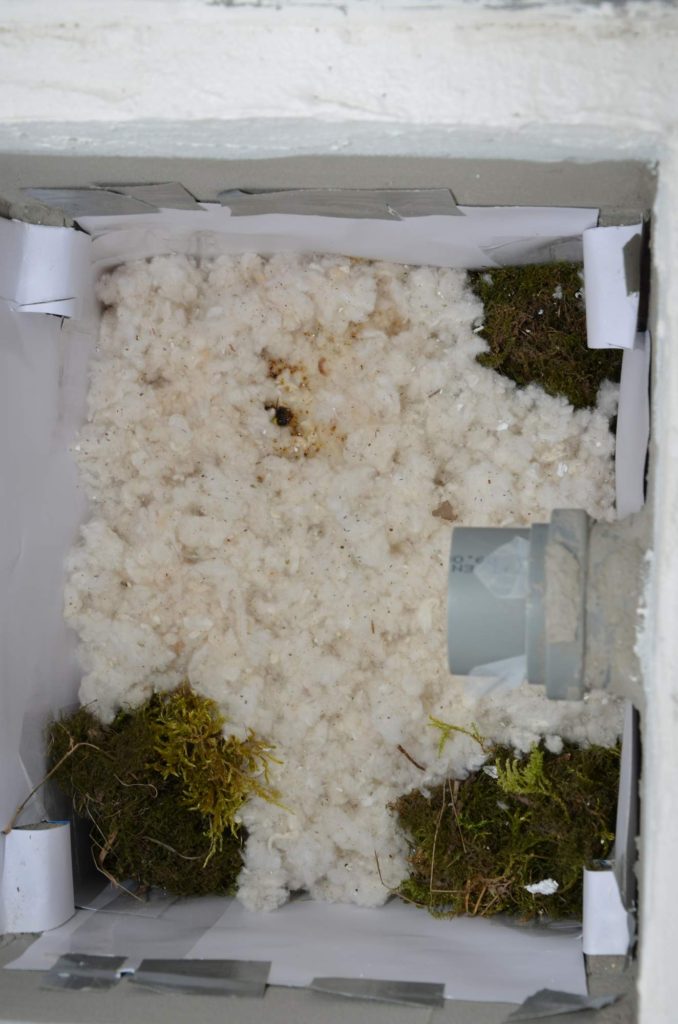
Picture as in spring before settling. Minimal pollution, only one hatch visible. No parasites, however, in this state of preservation a weak nest can be expected.
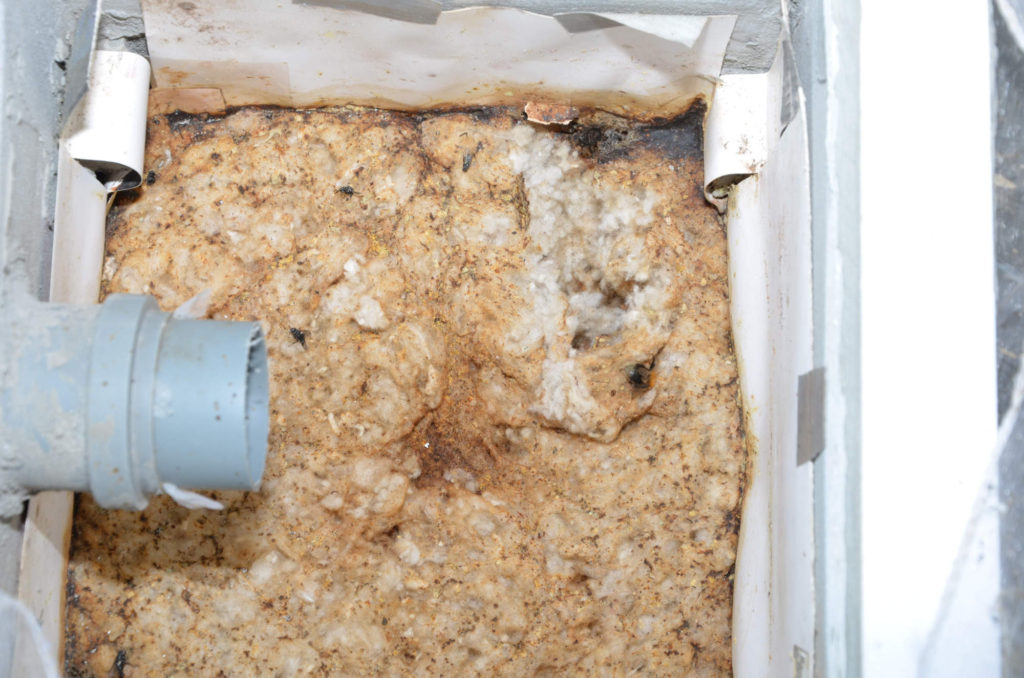
Upper part of the lining – optimal condition.
Dirt only in the corners, paper without mold, lining processed by bumblebees without mold, only the upper layer is dead, only adult flies are parasites
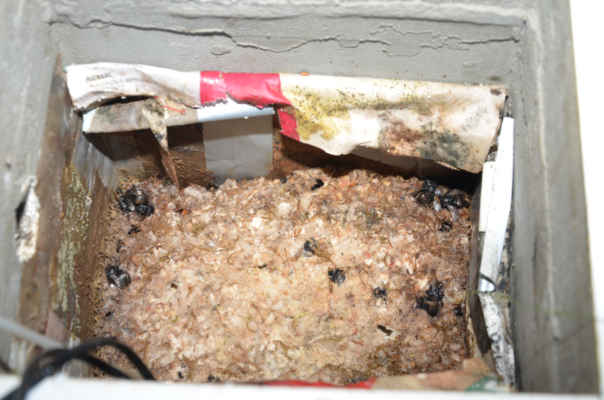
Example of a top view of the lining of an earthen hive. Clear signs of excessive humidity, the paper walls are wet, moldy, the lining is falling apart. The lining is moldy, wet and dead. Without parasites, but with a relatively large number of corpses already on the surface. Here was the problem…
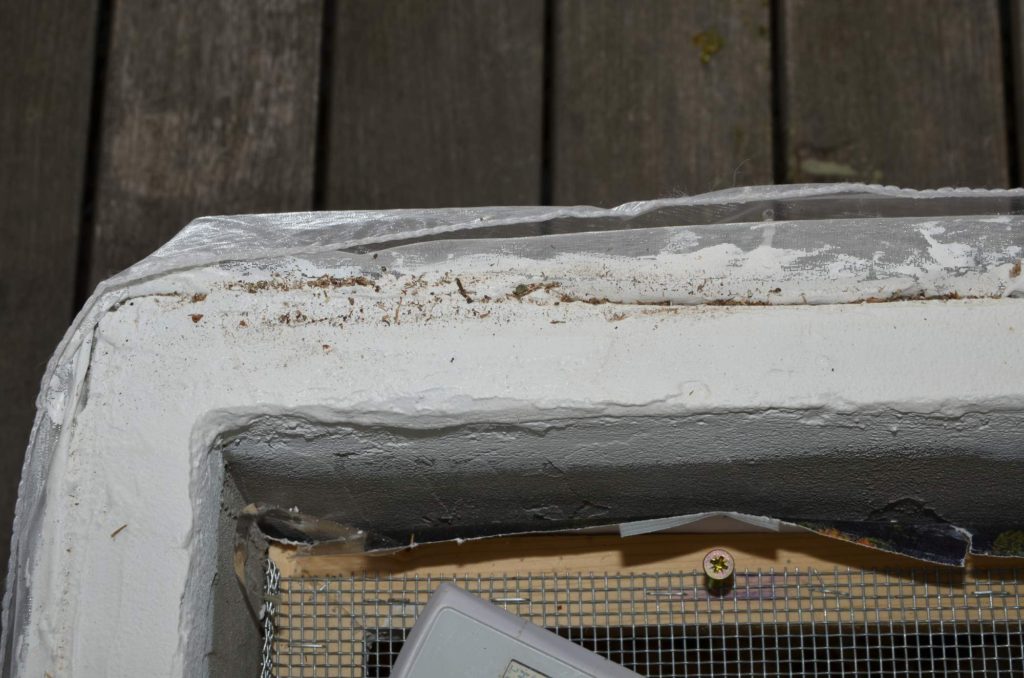
Detective work checking the edges of the hive at the roof area. We see dust buildup in one spot, there was a leak in the hive roof seal and it was a possible risk spot for parasites to enter. The result of the checks was to adjust the edge and roof seal before the next season.
Nest area and bottom
Similar to inspections, we disassemble the lining and look for
- parasites
- possible uninvited visits from other bumblebees (workers, spring queen battles)
- we evaluate the bumblebee corpses present, whether they are tangled in the lining, whether they have signs of infestation, the total number of dead workers, males and queens
- we will assess the condition of the lining – mold, humidity and degree of sagging
- It is also good to note how the nest was placed throughout the hive
We proceed in the same way in the case of the bottom under the nest, where we often find larvae or pupae of parasites.
The obtained data can be used to evaluate the quality of the lining used, the suitability of the bedding and the choice of material combinations (moss and cotton, animal fur, etc.)

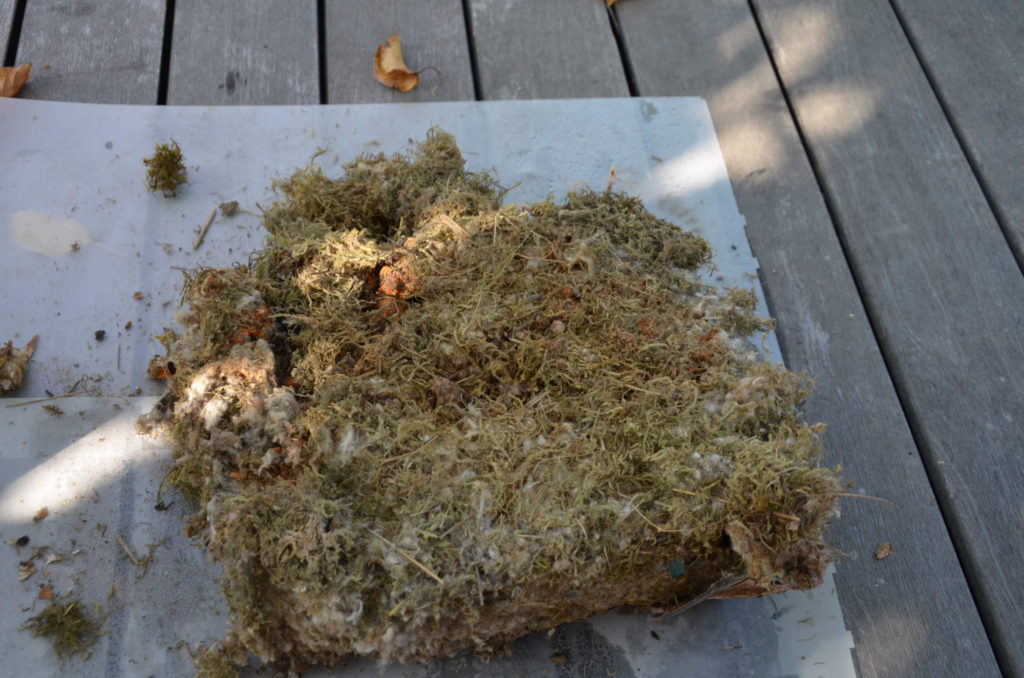
Moss from the bottom of the lining.
We can see that it is free of parasites such as the ectoparasitic worm, but damp with signs of mold.
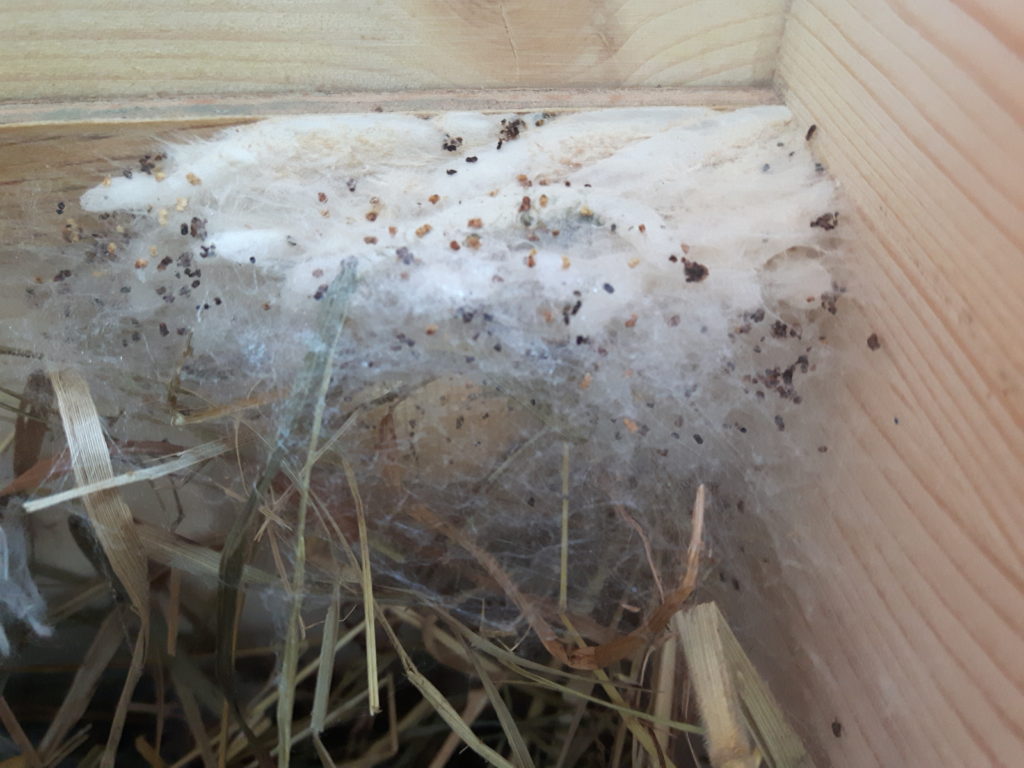
Aphomia sociella – nest infested with Aphomia sociella
Photo O. Hercog (2016)
Checking your own nest
After removing the surrounding lining, we evaluate the size of the nest, its shape. We carefully remove the ceiling in the species that make it. We inspect it for the presence of parasites.
We will have a view of the entire nest. The condition can also be assessed by smell – whether it smells more like mold or honey. We will not forget to check the bottom of the nest under the cocoons and the bottom of the cocoons. We gradually disassemble the cocoons and sort them by size.
- The noticeably large cocoons were mostly maternal – meaning new queens developed from them
- the small cells were worker cocoons and honey cups
- we note the presence of honey and whether it is present at all
- we look for parasites present or the degree of destruction of the bumblebee's work
- we will assess the level of mold
- We will put the cocoons that have not opened separately
- We will count and sort the dead bumblebees in the nest into workers, queens and males
- we count the large open queen cocoons, by subtracting the dead queens in the nest we can get an idea of how many queens the nest produced and therefore the overall breeding success
- We examine the closed cocoons very carefully, counting them. It is also advantageous to dissect them. We often find dead, immature bumblebees in them, but we can also discover parasitic infestations.

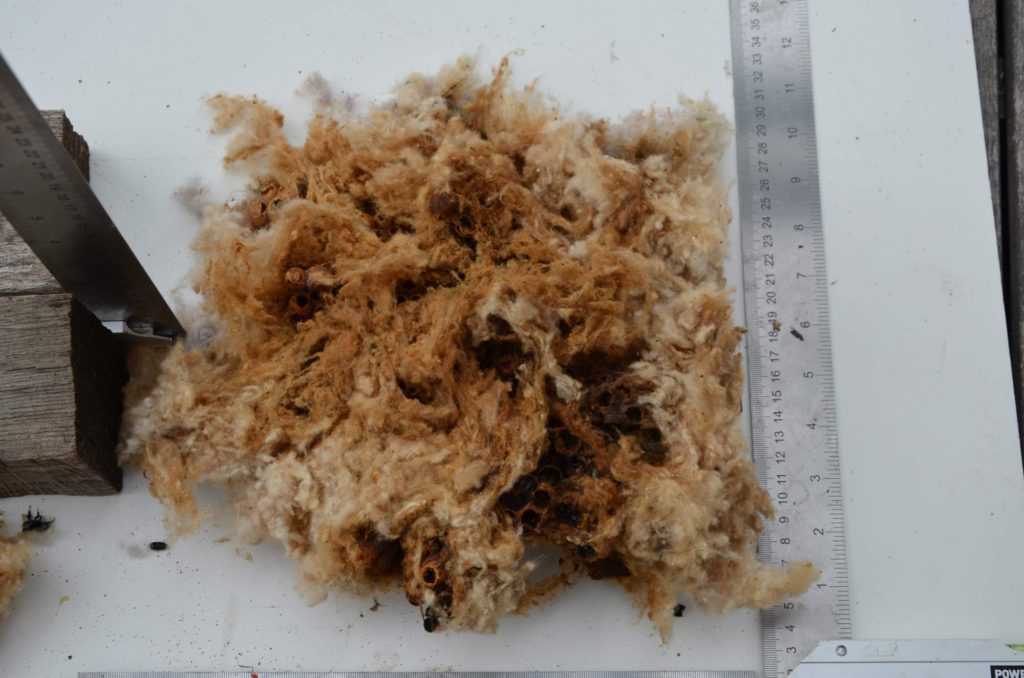
A sample of a nest of its size. It can be seen that it is not moldy, the ceiling has no signs of parasite infestation, the surrounding lining is clean. At the bottom left, a finding of pupae, most notably Brachycoma devia
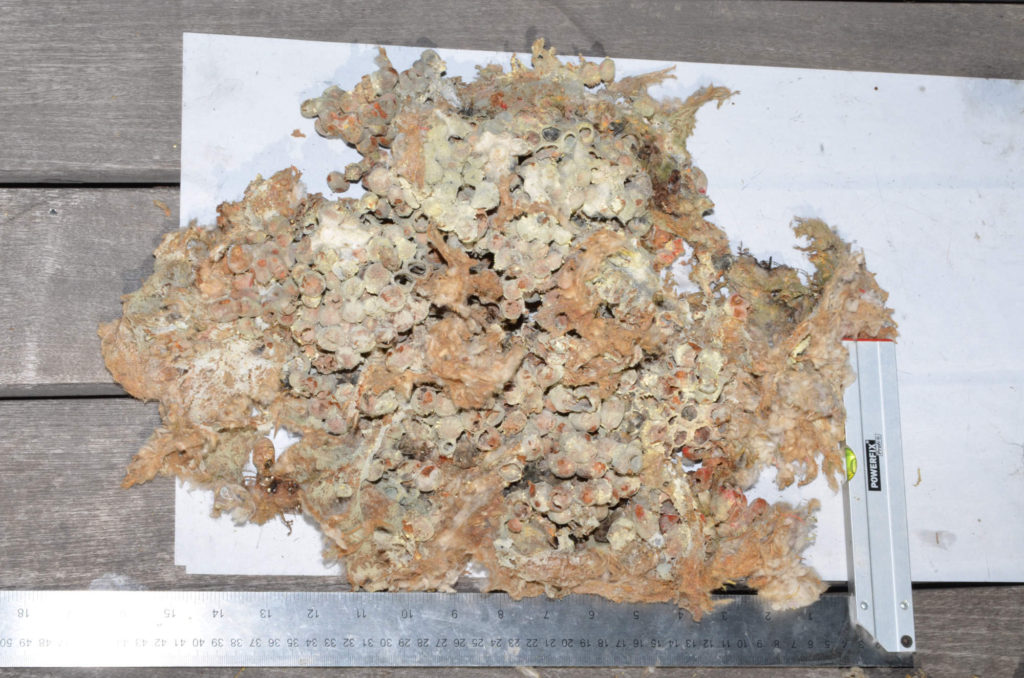
Inspection of a ground bumblebee nest from a ground hive.
Mold is visible throughout the nest and surrounding lining. Breeding in such a hive will have to be modified or it cannot be recommended for further settlement.
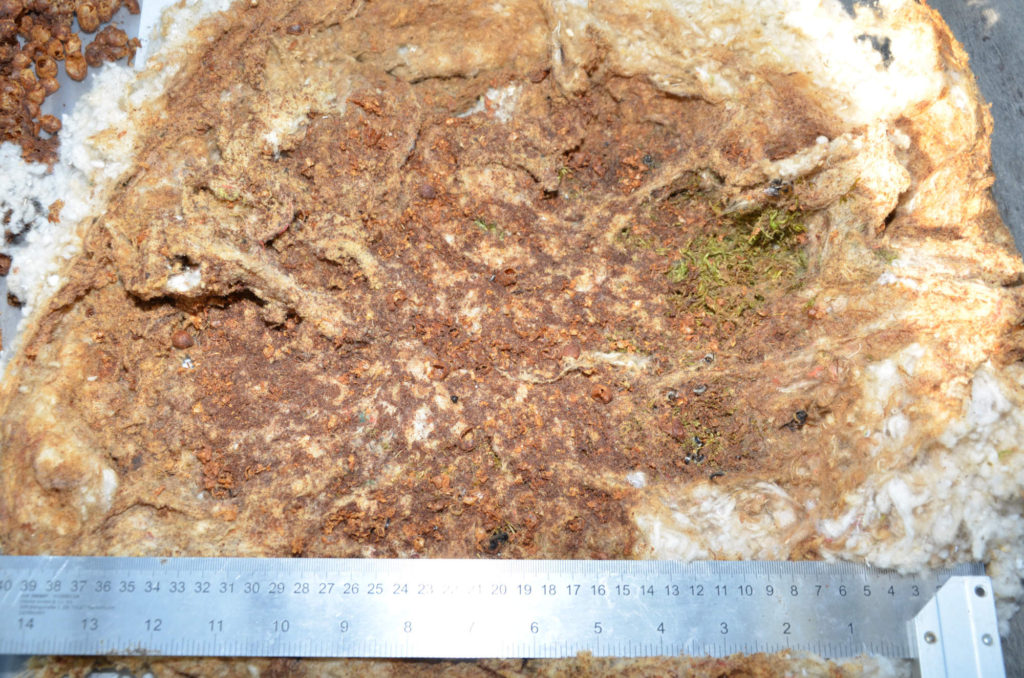
Checking the substrate under the cocoons, only mites and antherophagus nigricornis are parasites, ideal condition with no signs of mold
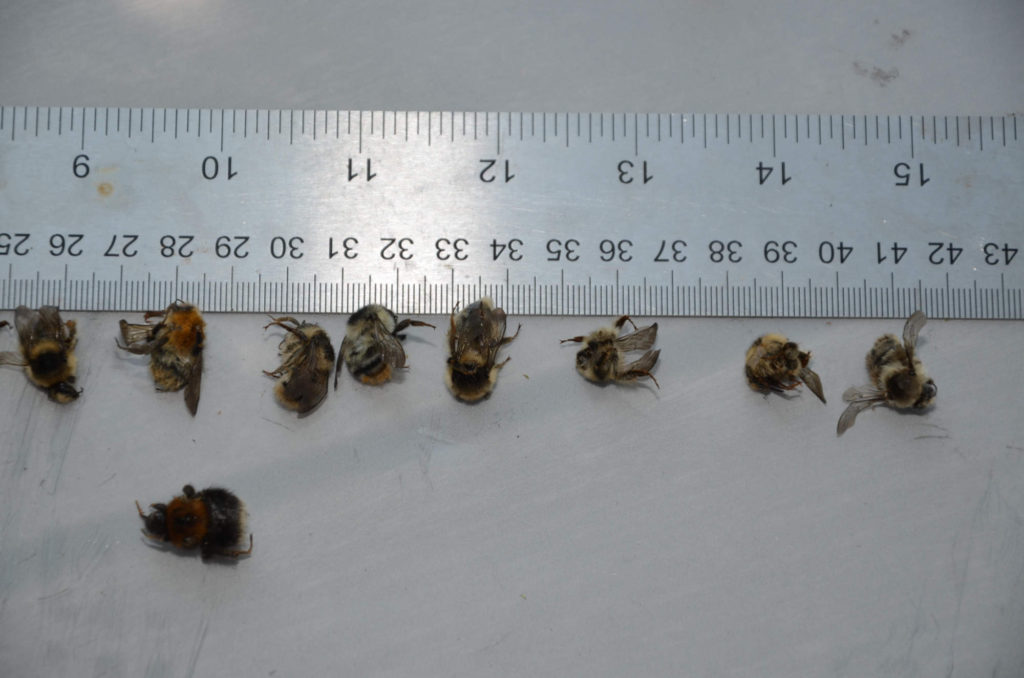
Inspection of corpses from a wood bumblebee nest.
The inspection revealed a normal condition, corpses without signs of virus or infestation. In the foreground, however, a dead mother of a hornet bumblebee without wings and part of its legs – it can be assumed that there was a duel in the hive between the wood bumblebee workers and the hornet intruder, who lost his mistake.
[
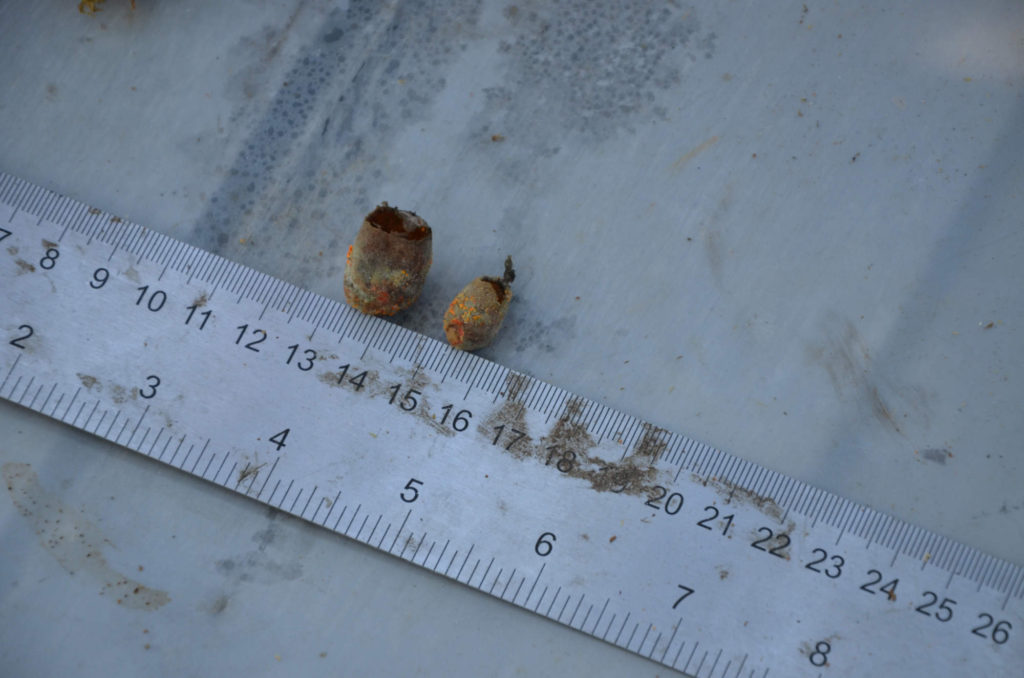
An example of the difference between a small and a large cocoon. In both, the bumblebees have completed their development, the cocoons are open and, apart from the mold, there are no signs of parasite infestation. In the case of the mold, it is necessary to assess the time between the inspection and the end of the nest – whether it was created later or already during the life of the colony.
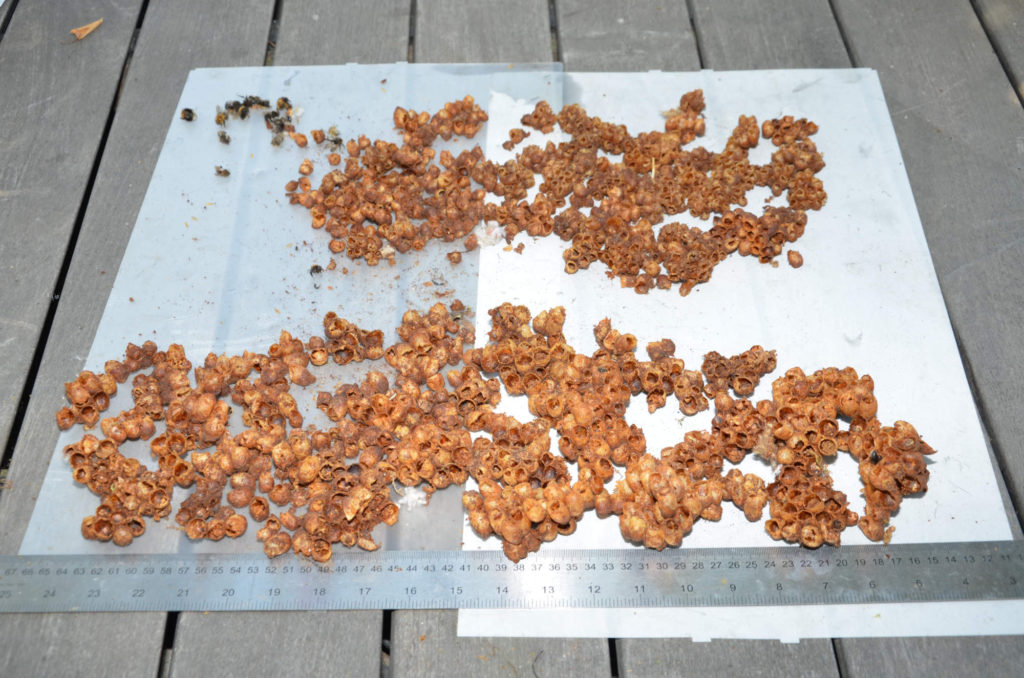
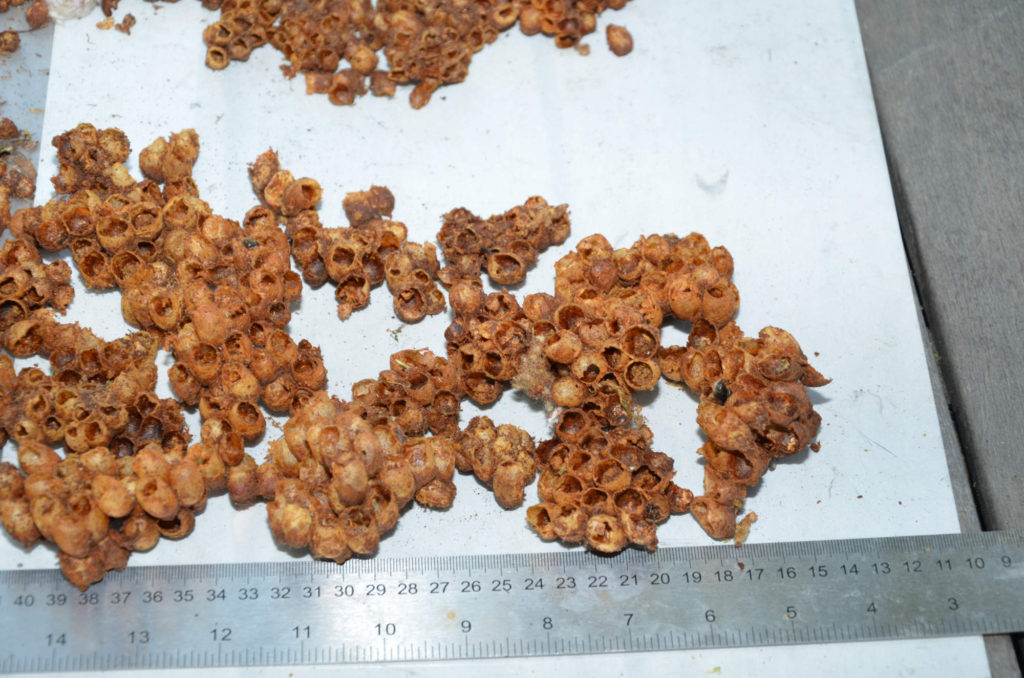
Sorting cocoons.
Above are small worker cocoons and honey cups, below are open queen cocoons. In the upper left corner, corpses in the nest. An example of a beautiful, strong and healthy nest. No mold, parasites, a huge number of queen cocoons. The number of corpses is minimal.
A detailed inspection shows no parasites, and finding some dead bumblebees as they leave their cocoons is common.
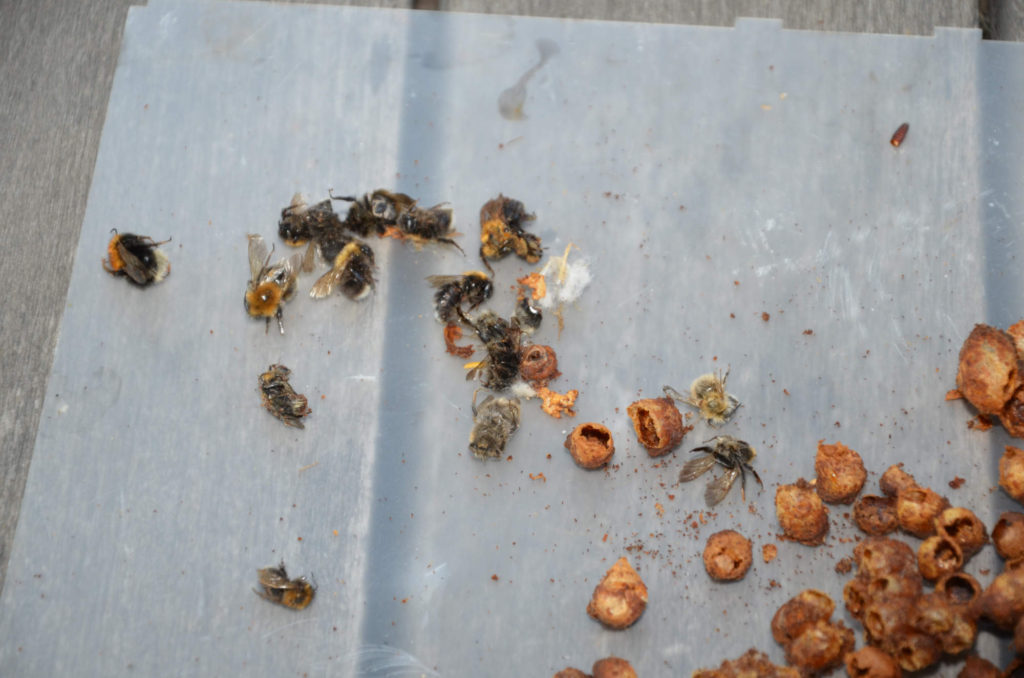
It is common to find dead bumblebees in the nest.
Finding body parts with the head severed is normal after the tipping point.
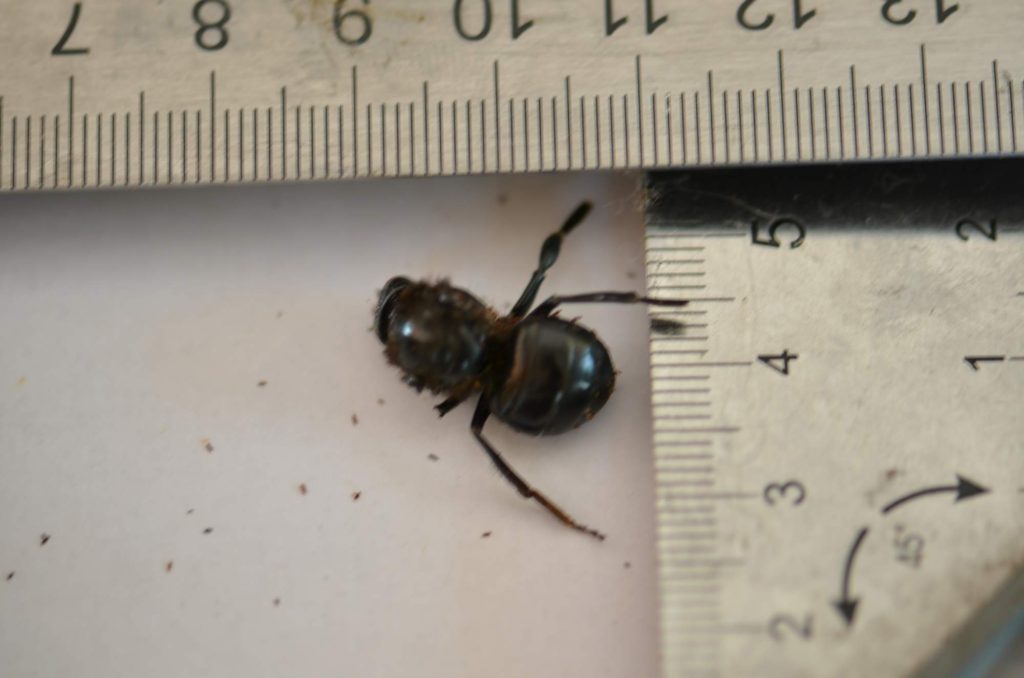
A surprising find in a rock bumblebee nest. That's what detective work reveals.
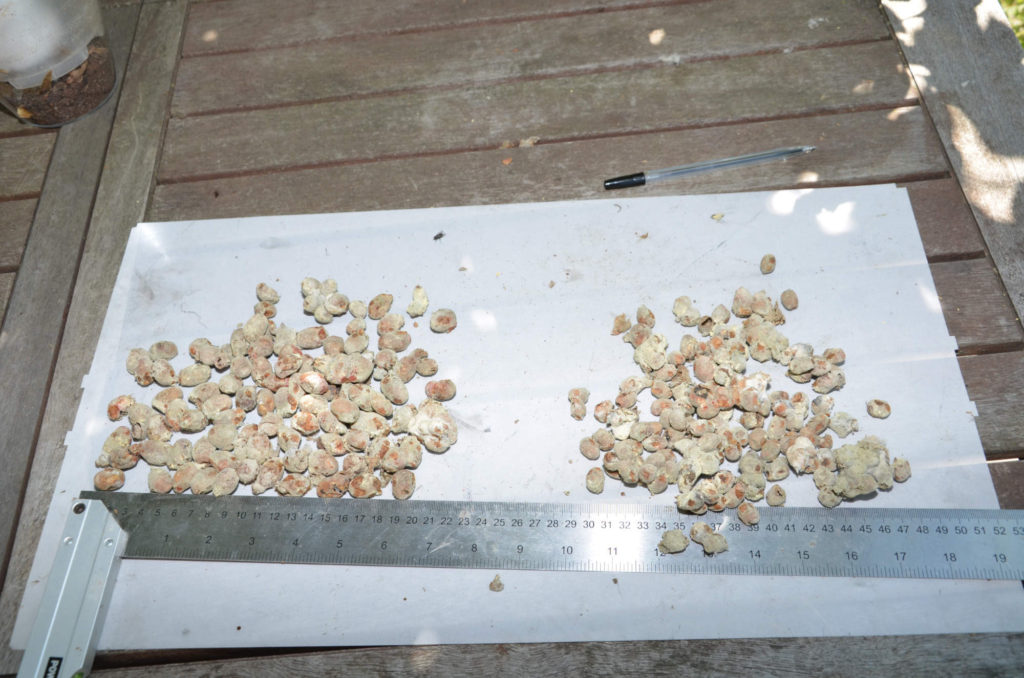
Example of sorting cocoons.
On the right, closed small cocoons, on the left, closed large cocoons. There are already a lot of them, all of them moldy. This indicates a problem in the nest at the end of the colony's life. Possible causes: excessive humidity, poor ventilation.
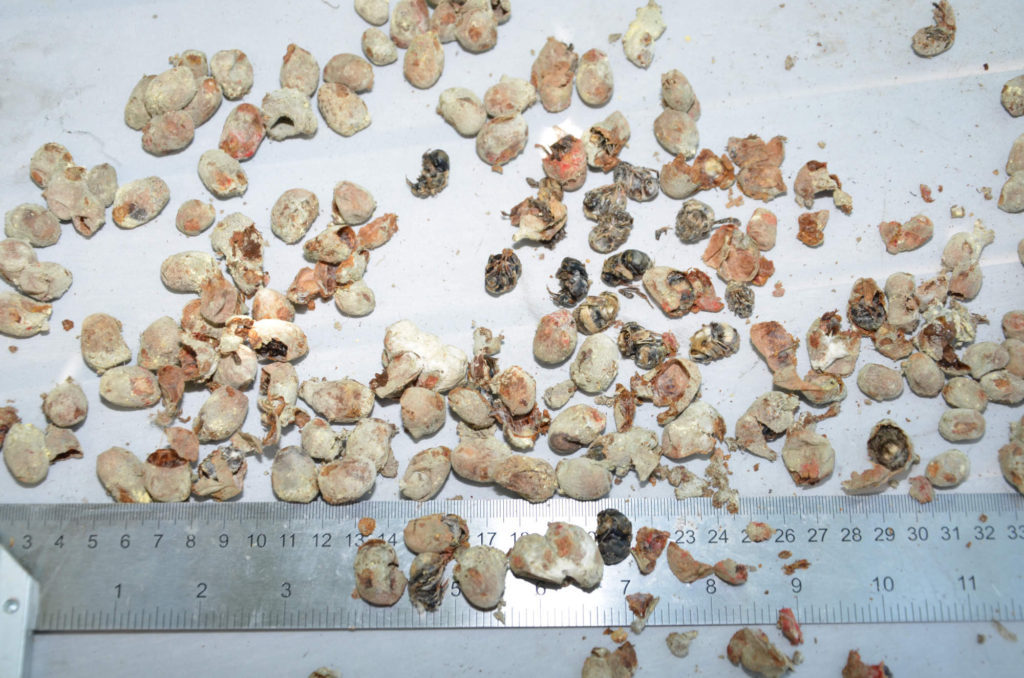
Detective work – dissecting large closed cocoons. We find only dead bumblebees with incomplete development and mold everywhere. This indicates that the nest did not die prematurely due to a parasite infestation, but rather due to poor ventilation or a decrease in food. There was no full honey cup in the nest.
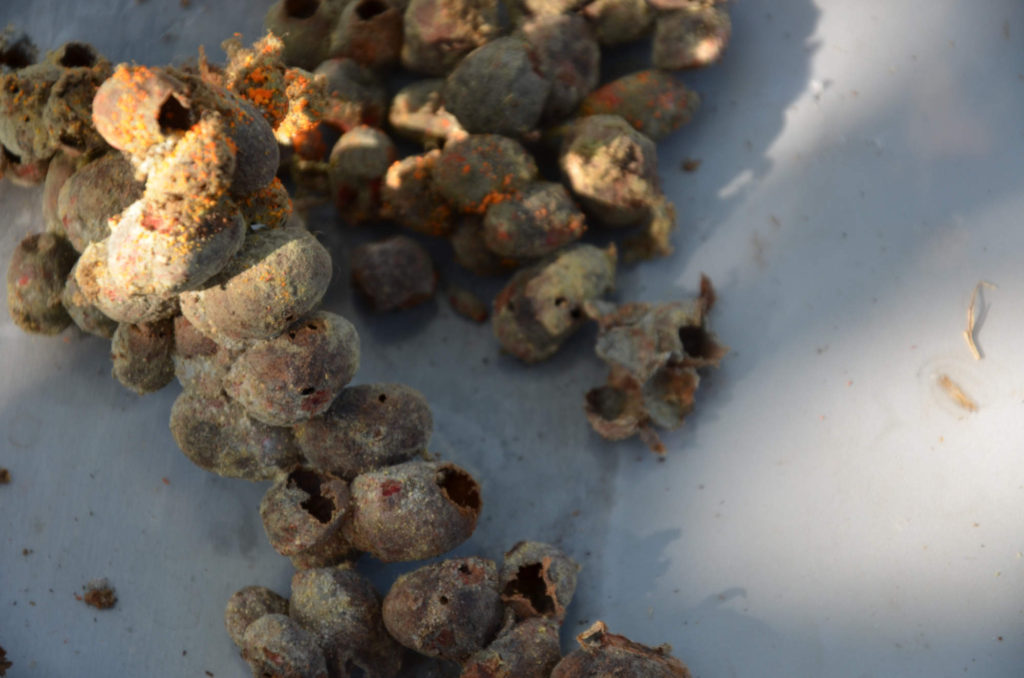
Closed queen cocoons with holes from parasite infestation. Later inspection therefore cocoons with mold findings, when it is impossible to determine whether the infestation occurred during the life of the colony or only after a period of time.
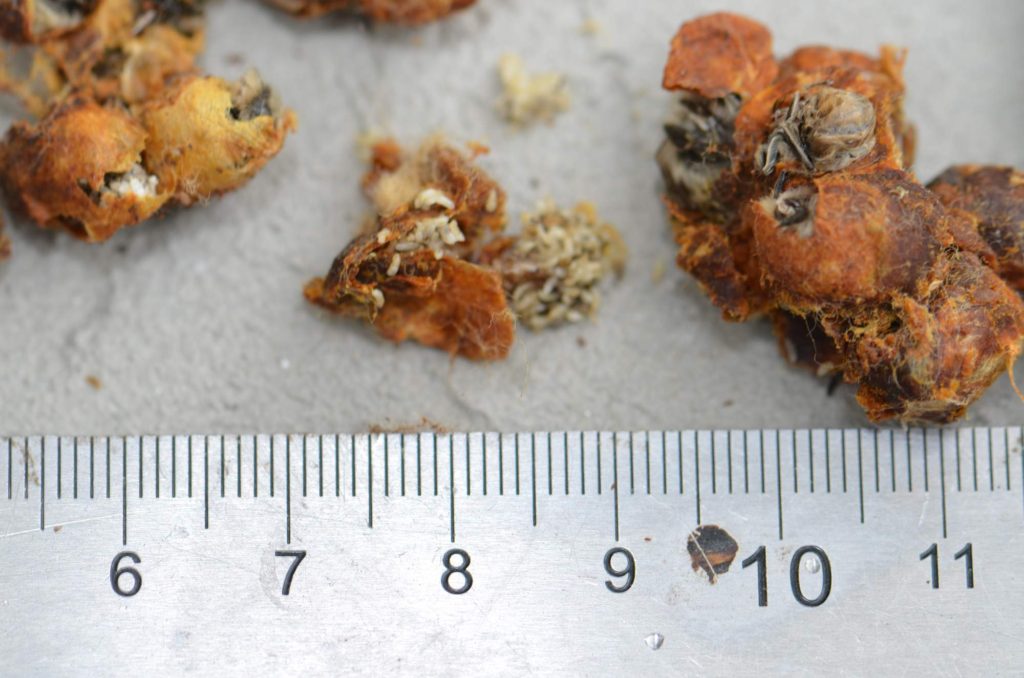
Sample of the autopsy of closed cocoons No. rolního.
On the left, only a dead immature individual in the cocoon (a common finding) but in the middle, a sign of Melittobia acasta infestation of the cocoon. A bumblebee larva eaten by thousands of small larvae. There were only two cocoons, so the infestation was at the very end of the colony's life, no adults were caught in the hive. Therefore, the parasite did not spread and the hive completed its development, perhaps with an earlier end. Further detective work found a hole in the 53S hive as a possible entrance gate.
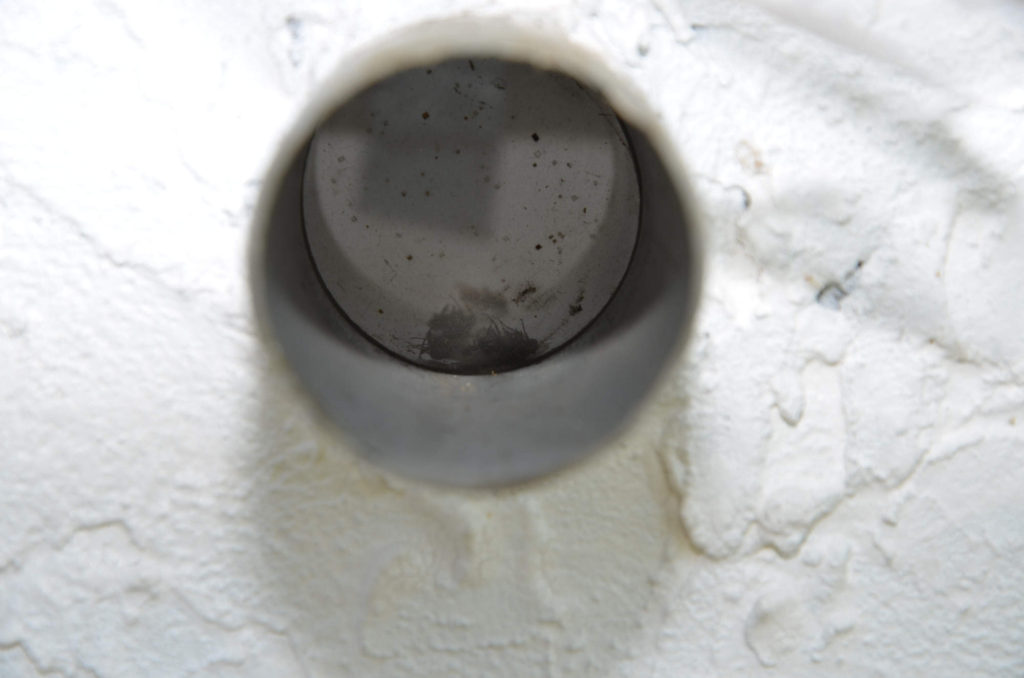
Checking walls, corridors and openings
- we check the paper wall covering, evaluate its function, integrity, degree of mold, durability of the joints made, we look for parasites on both sides
- We will assess the humidity of the walls, the degree of contamination, look for possible leaks, cracks, etc.
- we are looking for possible parasites again
- We assess the degree of bumblebee contamination of the openings, and assess whether the function of the openings (ventilation, traps) was or was not limited during operation
- At the end, it is worth emptying the inside of the hive onto paper/plastic sheeting, and evaluating the captured parasites and their stages
- We don't forget about the flap, we look for leaks, parasites, we assess the condition from both sides, loss of lice, findings of corpses, larvae
- We pay attention to the degree of clogging and its permeability in the corridor. We evaluate the contents of the corridor separately – parasites, other workers/mothers from neighboring nests

Ventilation check. Intact Uhelon 53S, minimum dust and mold, flies trapped inside the nest
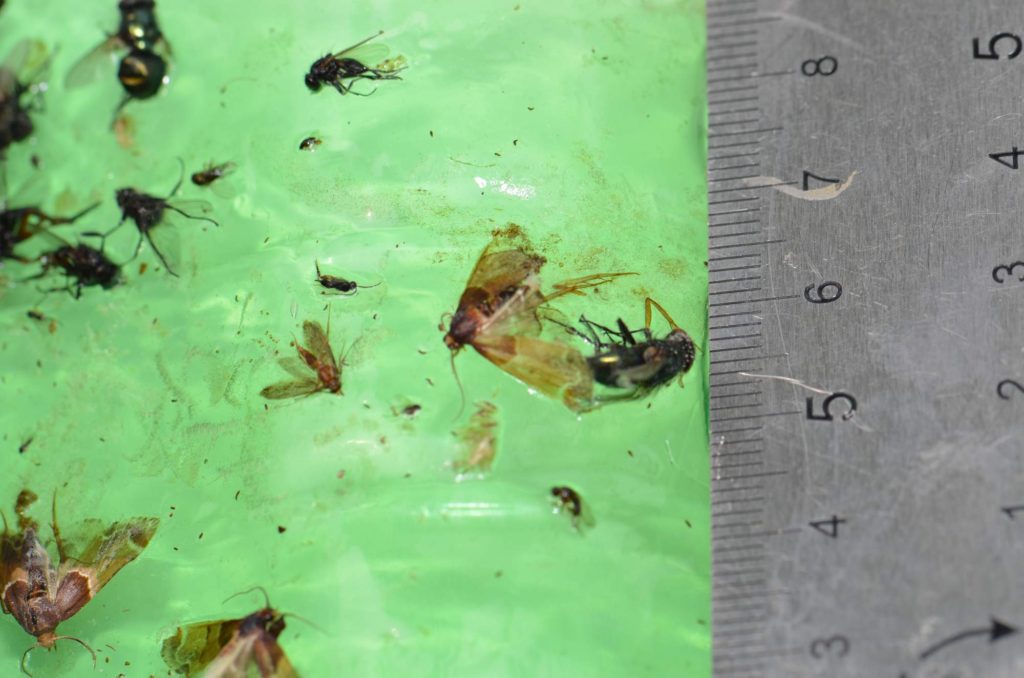
Catching on sticky traps. Flies and moths.
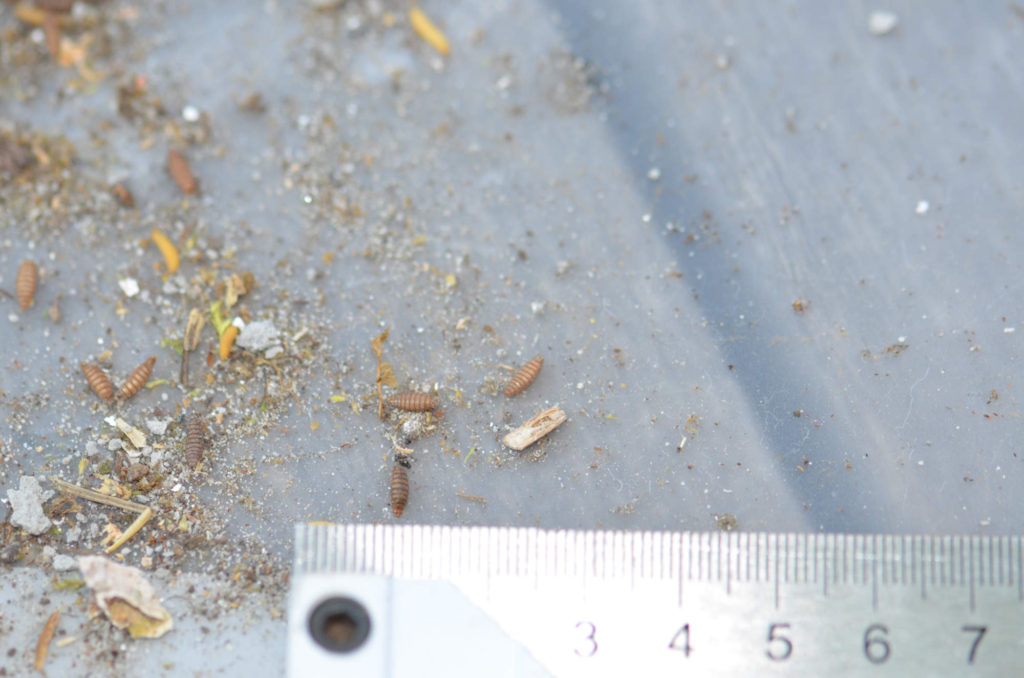
It is also worth checking the discharge from the hive, as Antherophagus nigricornis pupae were captured here.
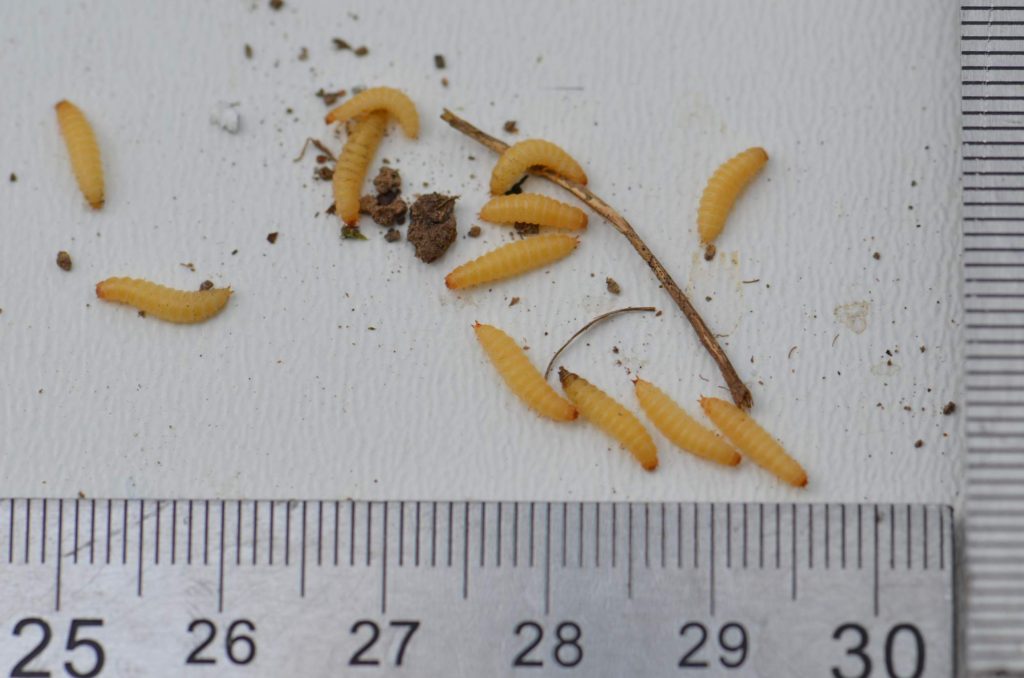
A common parasite when checking the hive after the season.
If you don't know the species, a photo like this with scale and sufficient sharpness will help us identify the parasite - in this case, it is the larvae of Antherophagus nigricornis.
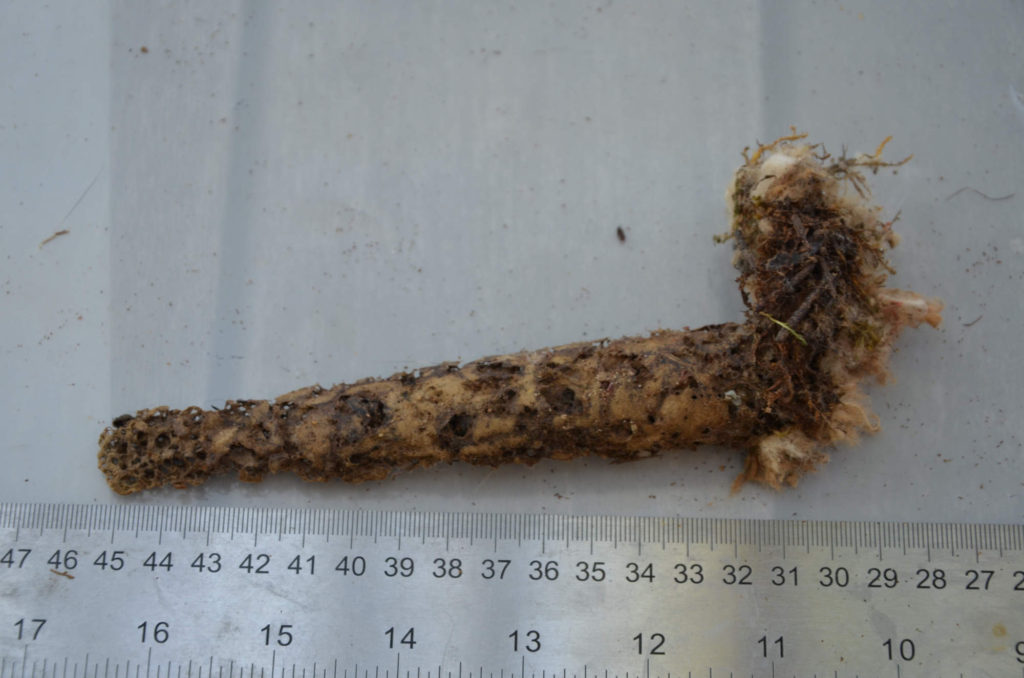
Feces and waste in the corridor. Upon inspection, we see that it was dry, which is good, its size did not cause blockage of the corridor, and from the infestation, only signs of consumption of the feces by fly larvae.
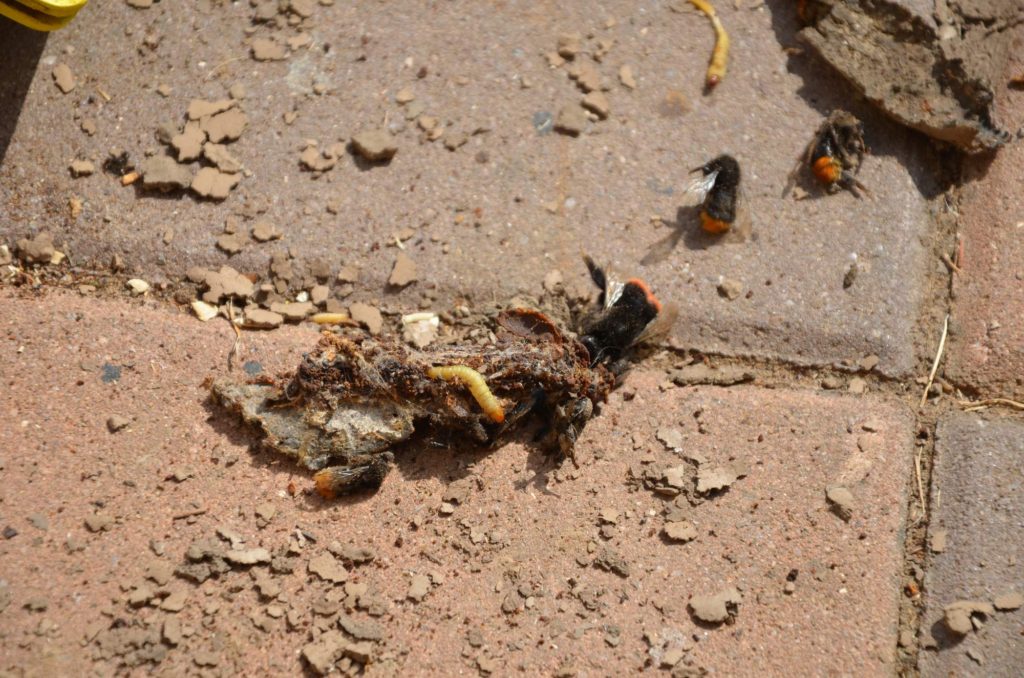
Found during inspection of the waste of the corridor right behind the flap.
Dead workers of the rock moth and three L. aphomia sociella feeding in the waste. Only one caterpillar was found in the nest near the entrance. This only indicates that eggs were laid at the flap without the adult butterfly penetrating the hive. So the hive's closure was well secured, the protective elements fulfilled their purpose.
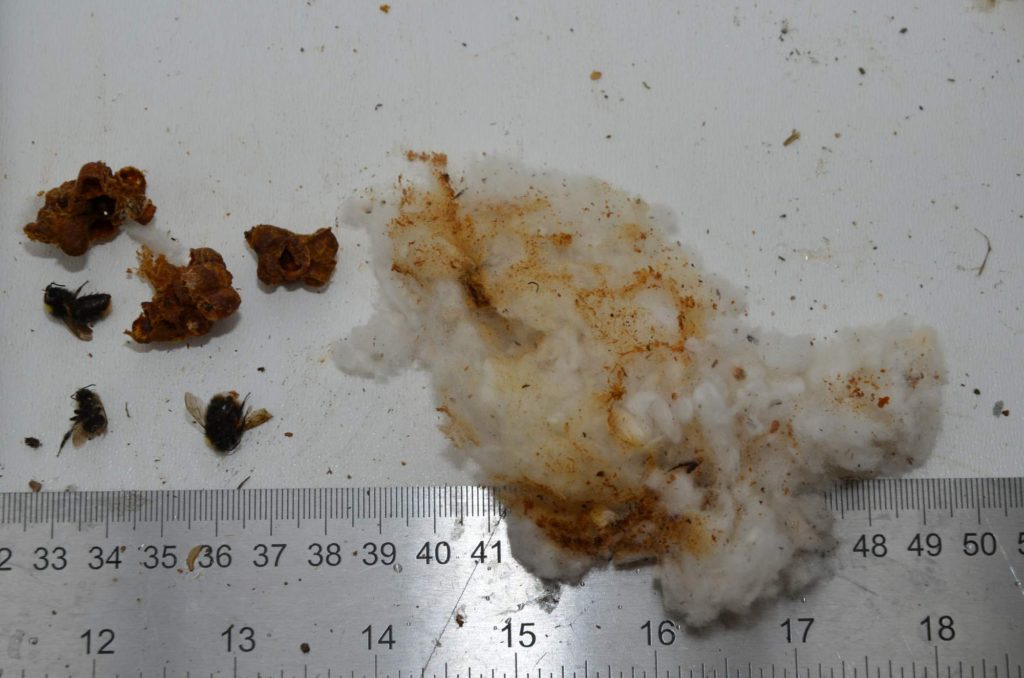
Conclusions and possible interpretations of the results
- When making an overall assessment, it is always necessary to take into account the time factor between the end of the colony's life and the inspection. The later, the more mold there is in the nest, the parasites consume dead bumblebees, cocoons and cocoons with larvae.
- The overall condition of the nest, the amount of mold and dead workers, can be used to determine the quality of ventilation.
- A detailed inspection also gives us an idea of the conditions in the nest, whether the hive was too small.
- A larger number of alien bumblebees may indicate inappropriately placed hives close together.
- By evaluating the lining and interior wall cladding, we gain knowledge for the choice of materials for the coming years. This also applies to the adhesive tapes used, insulation, moisture removal, etc
- Findings of a large number of closed cocoons, a large number of dead bumblebees - all this can indicate a possible problem at the end of the colony's life. The causes can be both unsuitable conditions inside the nest, infestation by parasites, and most often a lack of food. It is the overall assessment and, for example, the finding of a normal degree of infestation of the nest by parasites with a large number of dead workers, a large number (1/3) of unopened cocoons and the absence of honey or pollen that may indicate the end of the colony due to lack of food.
- The status of the colony, comparison with other hives or keepers, will allow the keeper to provide their own feedback and discover possible errors.
- On the corpses, you can find signs of fights, post-mortem elimination of commensals or nest parasites, but also signs of possible more serious diseases - e.g. viral infections. Similarly, the finding of melittobia acasta larvae is a sign and a guide to the extent of subsequent overall sanitation of the hive. In the case of a viral attack, for example, old lining should not be used. Surfaces that are in contact with bumblebees should be replaced or treated with virucidal preparations. This intervention is ideal to be carried out immediately after the end of the colony's life, as it will not spread further and then the active chemical components in the hive will evaporate by spring, or their concentration will be reduced to a safe value for bumblebees.
- Common parasites in the hive are flies and their larvae or pupae, larvae or pupae of Antherophagus nigricormis, and spider mites. All of these do not represent a major problem or a sign of a bad hive.
- In the case of finding larvae or adults of the parasitic wasp (Aphomia Sociella), we also evaluate the location of the finding and their number. This also allows us to estimate the level of effectiveness of the traps, the consistency in using and cleaning the flap, the quality of the ventilation performed, its protection and the protection of the roof of the hive. We also receive feedback on the effectiveness of the checks carried out. The finding of a dozen larvae is more of a sign that the wasp did not get into the hive, but landed somewhere nearby, for example at the flap, and the larvae were then able to penetrate inside. However, the finding of dozens of larvae already indicates that the parasite penetrated directly into the hive. Then it is necessary to search for a possible cause.
- Findings of 20-50 large, open queen cocoons indicate an average nest, but even that is a success, as we rarely reach these numbers in nature. Larger numbers indicate a healthy and strong nest. There is no reason to be sad if there are fewer or no queen cocoons. There can be a number of reasons, and a large part of them are not the fault of the breeder or the breeding. However, it is precisely the checks and this detective work that will help us distinguish between a nest that simply failed and a nest where there was some problem that can be eliminated, and that is the goal. Not to repeat mistakes or rest on our laurels just by looking at the lively swarming in the hive..
- If you are not sure about the evaluation of the nest, upload the photos to one of the repositories and we will be happy to help you. Over time, the breeder will gain both systematicity and a detective eye :).

The result of the inspection of the extinct nest of the second generation meadow bumblebee.
We see the mother, two workers. A few cocoons with laying, a full honey cup. The cocoons and the lining are free of mold. Poisoning would be possible, further inspection is needed to rule out parasite infestation, but this is more likely to be a stoppage of reproduction in the second generation mother or a different cause, but one that the breeder cannot influence. This is also valuable information.
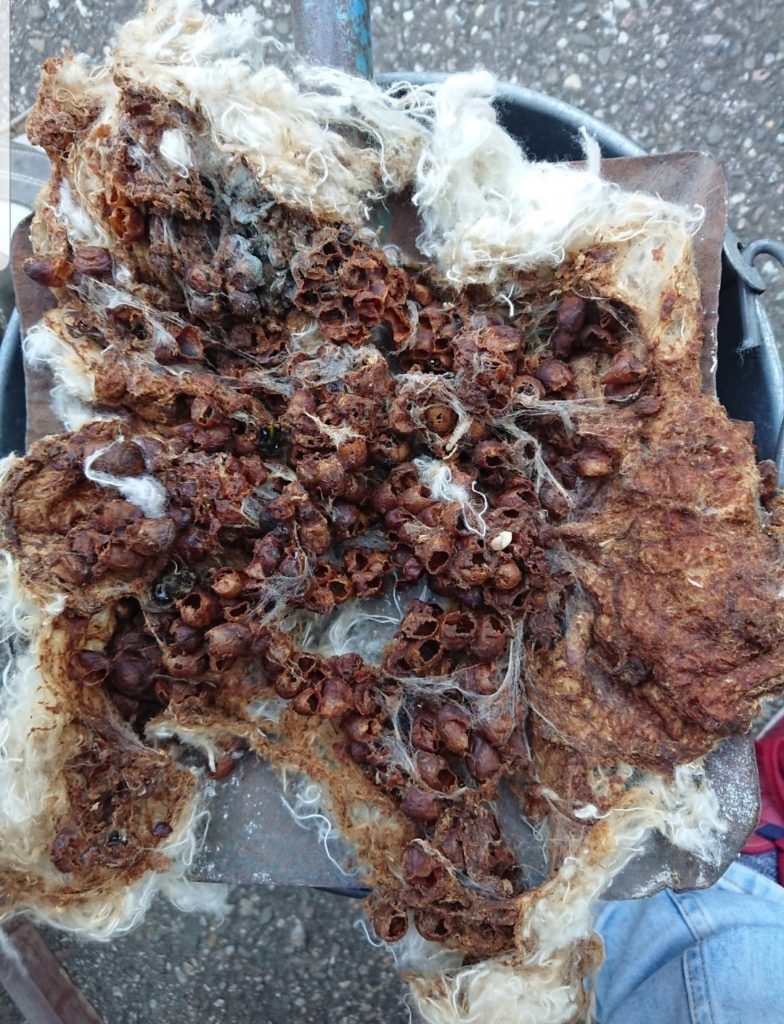
Aphomia sociella - nest infested with Aphomia
Photo P. Menšík (2019) Our comment: If it weren't for this, it would be a beautiful nest with minimal mold. Even so, open large cocoons are visible, which indicates breeding success. The nest ended its life prematurely only due to the aphomia infestation, which is a fairly common condition in natural nests. The living bumblebees left it prematurely. The result of the investigation - consider the possible cause of the aphomia penetration, thorough elimination and cleaning of the hive. It is best to burn the nest with the lining to prevent the aphomia from multiplying.
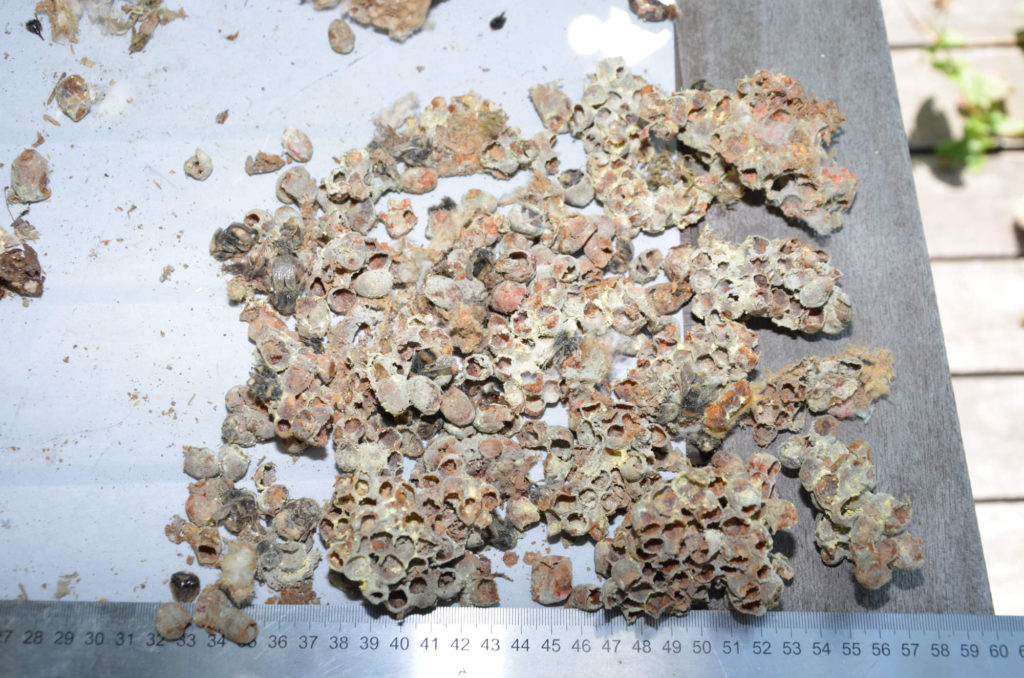
At first glance, the black-footed ferret's nest looked huge, but the degree of mold is also enormous
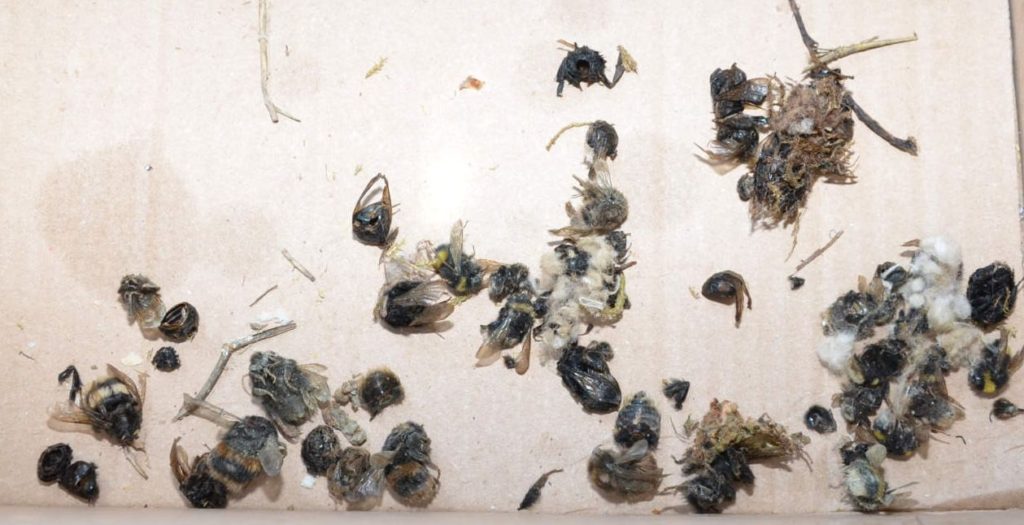
there was also a large find of dead individuals at the site
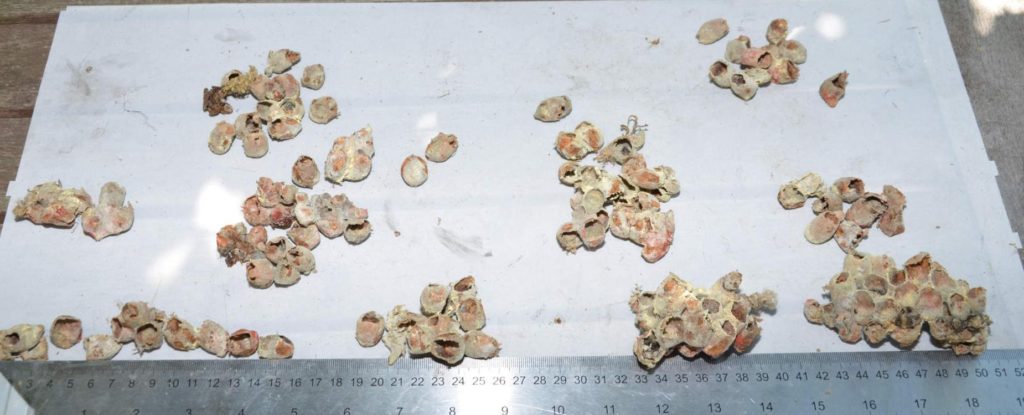
after sorting finally an overview of large open mother cocoons
You have already encountered this nest, at first glance a huge nest. However, the number of closed cocoons was about 1/3 of the total number, the large spread of mold is noticeable everywhere, many dead individuals, no honey reserves and minimal parasitic infection. A free, unclogged corridor. It was a ground hive, where the bumblebees apparently stopped thriving when fully developed. The cause is most likely both the unsatisfactory parameters of the hive and the lack of food - however, when compared with other nests in the same location, the unsatisfactory parameters of the hive will dominate. This hive (it was a test project of a polystyrene hive embedded in the ground) did not prove successful and will not be used for further bumblebee breeding. Next year it will be left for possible returnees. However, it will not settle in it any longer and if it remains vacant, it will be closed. These are also valuable results. Don't repeat mistakes and don't prepare a trap for bumblebees instead of safety, no matter how well-intentioned.
