

Basic advice and recommendations Bumblebees PLUS
A beehive or hive for bumblebees is not just a nice-looking wooden box with a tunnel. It is a complex device that must not lack a protective flap at the entrance, good ventilation and other details that will decide whether the beekeeper will be successful or, on the contrary, will prepare the bumblebee family for certain destruction at the first serious load on the hive.
We will not state here what specific bumblebee hive you should buy, there are many manufacturers and everyone claims that their hive is the best. Unfortunately, both those boxes and high-quality hives are for sale. The mentioned flap is the first clue to quality. In order for a novice beekeeper to better understand such a qualitatively diverse offer, we state the key things to focus on and where the pitfalls of the products are hidden.
The time and care spent choosing a hive for bumblebees will pay off – it will significantly affect the chances of a successful season.
Tip one: Focus on the key parameters of the hive rather than the design and accompanying advertising. The essential parameters of hives are listed below.
Second advice: Expressed in a popular proverb: "A lazy mouth, a naked misfortune."
If the product lacks a description in the points we have listed, do not be afraid to ask the manufacturer / seller about them. If the seller does not know , is vague, or is not willing to answer questions, you are buying a pig in a poke and the result will usually surprise you unpleasantly. It may bother you, but it can directly threaten the lives of bumblebees... It is difficult to complain about a product that lacks this or that if you have not specifically asked in advance. For the sake of complaints, we recommend that you always resolve the clarification of the hive in writing.
Some general advice for shopping:
Ask for specific and clear answers, don't be lulled by sentences like:
"It's verified, you don't have to worry about that." - Really? On how large a sample? Where is it documented? Are the results really true?
"In our opinion, in the opinion of Mr. xy, it is/is not necessary." Do you know Mr. xy and trust him, is it really his opinion, or did someone just borrow it, edit it. Isn't it better to check directly with the stated author whether this is really the case?
Many people have had/tried this before you and were satisfied.
Maybe yes, maybe not. Do you know a company that would tell you the opposite when you are interested in buying, even if it were true? It is better to use FB / the internet and ask breeders directly, for example in the breeding community Čmeláci PLUS - Discussion forum .
Very soft, very dense, very strong, etc.
Subjective impression, but how much. How much is it really in units? What do you imagine by that, others something completely different and again the company probably won't tell you that its materials are the cheapest in the first place... .
You will try and see.
Okay, but then what are the conditions for withdrawing from the contract ? Who will pay for the return shipping of the returned goods?
Established manufacturers versus DIYers
Higher quality products should be supplied by manufacturers who produce them in larger series
. This is not always the case. That is why we try to advise manufacturers free of charge so that their products are of high quality and meet the requirements for breeding. On the Internet you can also find a number of small manufacturers and DIYers (hand made portals such as FLER.CZ, but also others such as bazos.cz, etc.). But here you will find a number of things "for a pittance", which are made by those who do not understand at all what a bumblebee hive should look like. In addition, there is another trap hidden here - the manufacturer can delete negative reactions and keep only those that suit him. So there is no need to worry about customer reactions here as a good guide. Moreover, most of those who buy a poor quality product here will not hear back. If they do, you may not find their reaction there...
Warranty period
Before buying, I would always be interested in what is covered by the warranty and how long the warranty period is . I would request the warranty conditions in writing. The hive is always exposed to excessive humidity, whether internal or external. As a buyer, I would definitely be interested in the warranty conditions for the strength of the joints, wall gluing, mold. Are there any production limits on accuracy from which a complaint can be made.
Price
Price is important for everyone, but it
is not the most important parameter . Follow the motto " I am not rich enough to buy cheap things ". So there is no point in buying a hive for 500 CZK that you will then throw away. We are not criticizing manufacturers, but the fact is that serial production and development cost something. On our market today, there are quality hives priced at over 1,500 CZK (without flap). Whether we like it or not, most hives below this price cannot be considered quality products. However, a price over 1,500 CZK is not automatically a sign of good quality - see other recommendations.
Manufacturers and products
There are many products on the market. Some are close to the condition described below and can be easily adjusted to the correct condition (e.g. by adding a seal between the roof and the body of the hive). Others are almost there and after one year of operation, the bumblebees, their parasites and natural influences will show you whether everything is as it should be.
However, there are also products on the market that only pretend to be a beehive for bumblebees and have only the name and possibly advertising in common with a real hive...
There is also a fundamental difference whether the hives are made by a breeder or just a skilled carpenter who has no practical personal experience. That is why you should pay attention to the key features of the hives and also evaluate your options, whether you are able to remake or supplement the missing features with the product you buy.
Keep in mind that it is you and your demands on the manufacturer that create pressure to stop selling junk and sell really good hives . Until you buy, our customer, our master, pays and it's your money. It's a shame to throw it away for a non-functional product that you'll burn after the season at most...
water further improve and respond to the good, what worked for you and what can be recommended in the future. You can use both the menu: write to us, contacts or our FB
Absolutely essential parameters of the right hive for bumblebees
Bumblebee hive size:
- bumblebees need sufficient space for their nest (depends on the species)
- A sufficient size of the hive also provides space for a sufficient amount of heat-retaining lining (it thermally insulates the nest in both cold and heat and also has an effect on humidity regulation)

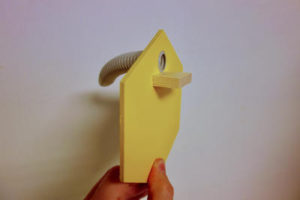
An example of the front wall of a completely unsuitable hive:
thin walls and an overall very small size of the hive
(source: internet, one of the hive manufacturers)
Recommendation:
- The optimal internal dimensions are a cube with a side of around 25 cm or a cuboid as similar as possible (e.g. 25-30 cm (w) x 25-30 cm (d) x 20-30 cm (h) ).
- the internal volume should not be less than 12.5l – a larger volume is better than a smaller one
- the shape of the cube is optimal (a nest in the shape of an imaginary sphere will optimally fill it)
- If it is going to be a cuboid , the height should definitely not be disproportionately the smallest side and the cuboid should be as close to a cube as possible for reasons of ventilation, humidity and temperature fluctuations when the hive is opened.
- In smaller hives there is a risk of overheating, as the colony grows the bumblebees will throw out the lining, there is a risk of greater development of mold. A small space is generally much more susceptible to temperature fluctuations. For this reason, we do not recommend such hives.
Construction of a bumblebee hive:
- the structure should be sturdy because it must withstand weather conditions and increased humidity
Recommendation:
- It is advisable to use laminated wood – high-quality blockboard/plywood, waterproof plywood,
or concrete plywood (can be purchased as “anti-slip plywood” with a dark surface).
Note: waterproof plywood is relatively heavy, it is excellent for the roof of the hive. - wall thickness should be at least 25 – 30 mm or more
- If the hives have internal air insulation, then 18mm is sufficient. However, the individual layers of the walls must be insulated from the surroundings so that no fresh air can enter the gap between the walls
- you can also layer the material, see thermal insulation below
- The hive is exposed to high internal and external humidity, as well as the strongly acidic environment of the bumblebee nest – it must be made of high-quality material
- Chipboard, OSB boards, Pertinax, materials full of chemicals are not suitable solid wood is not suitable either (wood twists, cracks), all-plastic hives are not suitable either
- The material should be as resistant as possible to woodpecker attacks, or withstand such attacks for some time
Tightness of the structure and seals between hive parts
- It is very important that the structure is well sealed and no drafts parasites enter
Recommendation:
- There must be no gaps in the hive body , everything must be well sealed. Caulking is permissible, but it should not solve gross leaks.
- The hive should be glued with waterproof glue and fastened with stronger screws.
- the roof and ventilation openings must also be sealed or must allow for additional sealing (soft rubber/foam or other durable sealing);
- The seal itself will not stop some parasites, they can penetrate it if the seal is not wide and the nest smell passes through it. Therefore, it is recommended to seal in several places (external and internal) and remove the nest smell from critical places - see ventilation.
- Some hives have a construction without a seal. Thanks to the double contact surface and the inserted acrylic plate, the seal is achieved by the construction
- There must be no gaps in the joints or seals (even 1mm is a risk)
Protective flap at the entrance to the hive
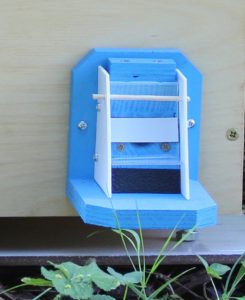
- The nest must have a protective flap , without such a flap, the nest will almost certainly be attacked and destroyed.
- If the flap is not part of the hive, it is necessary to verify whether the flap can be attached to the hive in a way that it fulfills its function.

A flap protecting the entrance to a bumblebee hive (source: internet)
- For a hive without a flap, the future beekeeper should purchase a flap straight away , and therefore, when calculating the price of the hive, it is necessary to take into account the fact that the hive does not contain a flap as an integral part.
(For more details about the flap and why it can be repaired, see the relevant section)
If someone offers you a bumblebee trap without a flap, beware – something is wrong!
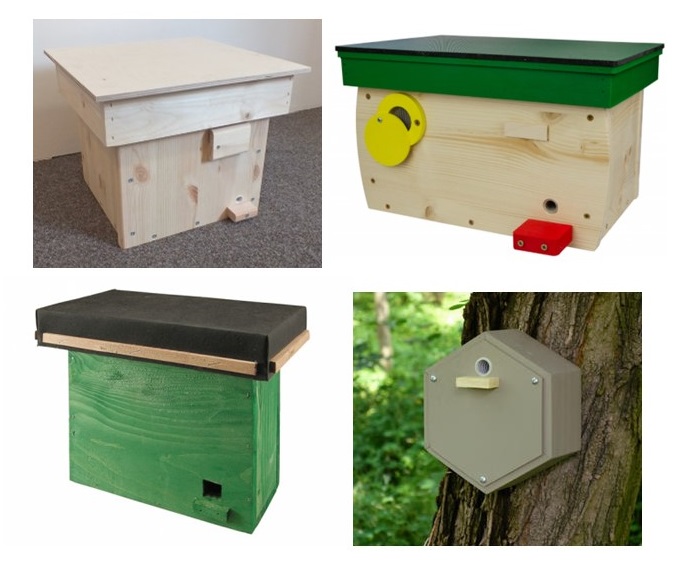
Examples of unsuitable hives without a protective flap
Source: eShopy sellers
Keep in mind that structurally unsuitable hives will be difficult to repair. In a hive without a flap, the bumblebee population will be destroyed before new queens and males can be born - breeding will be unsuccessful for the bumblebees.
Important parameters of the right hive for bumblebees
The shape of the hive body (corpus)
- The shape is very important, as is the construction of the body. When settling the hive, the queen builds her nest in the imaginary center with the best thermal properties, which she can instinctively recognize.
Note: if the hive is also lined with polystyrene on the bottom, the queen often builds her nest near the bottom. - The design and shape of the hive must also respect the requirements for easy access and intervention in the hive
Recommendation:
- if the shock is big enough, the shape doesn't matter that much
- the advantage is the shape of a cube, which is the best for production and maintenance
- The size (volume) of the interior space also matters, the optimal size is approximately 15 liters; anything under 12 liters is already unsuitable for strong nests of larger species of bumblebees (ground bumblebee, rock bumblebee, etc.)
- unsatisfactory
- The body needs to be accessed from above after opening the roof
- Access from the side walls/front/back is not recommended – it is not possible to intervene in the nest and even a routine inspection will show that bumblebees will fly out of the hive and the lining/nest will fall out
- do not create/buy hives connected by walls – this is not an advantage, but a number of disadvantages (manipulation of the hive, proximity of entry holes, etc.); at the cost of saving one wall, you will create unnecessary complications. Double hives connected by a wall are a clear misunderstanding of the principles of bumblebee care
Heat insulation
- a very important element, because temperature fluctuations, insufficient/high temperature threaten the nest inhabitants
Recommendation:
- We recommend lining the inside of the hive with additional thermal insulation (for example, polystyrene), the nest will not be as susceptible to temperature fluctuations
- You can also add insulation from the outside; there it is susceptible to damage and weather conditions, but this can also be solved, for example by adding a covering layer
- If the hive has double walls and an air gap is created between them for air to flow, then this is the best that can be found/made, but here too the emphasis is on the quality of the workmanship and the design solution
Entrance hall
- most bumblebee species need an entrance corridor (simulates the corridor to a rodent nest)
- for these species, the corridor is essential at the beginning of nest development, then it can be removed

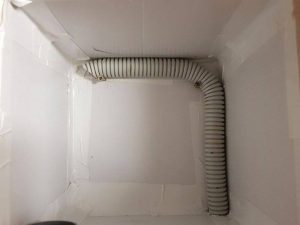
Example of the correct placement of the inner corridor in the hive
Recommendation:
- The corridor is most often made of a tube made of various materials, more details in the chapter on the hive corridor
- the pipe diameter, i.e. the inner diameter, should be 25mm, it should not be smaller
- The corridor should be bent at a right angle and end in a corner of the hive, where the bumblebees can easily find its end
- There are hives on the market with a corridor diameter of less than 18mm, but they tend to clog when the nest is in operation. With such a corridor, the hive must be able to safely remove the corridor even during full operation.
- If the hive has an unsuitable corridor or does not have one, then focus on the design of the entire hive. That is, whether it will be possible to add a suitable corridor to the hive.
(The issue of the hive corridor is described in the Hive Equipment menu HERE )
Ventilation
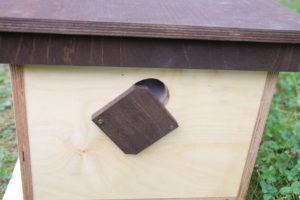
- The shelter must be airtight, but at the same time also ventilate safely
Demonstration of proper hive ventilation – sufficient opening size, protective nets inside, cover for cold springs and queen placement
- Even small parasites cannot pass through the ventilation system, this will be ensured by the mesh system
- Ventilation brings air into the nest and removes moisture from it
- A hive without ventilation will overheat, become damp and moldy during the season
- the ventilation hole must not be placed above the inlet hole / flap, it must be as far away as possible - the smell of the nest attracts parasites and it is not good to lure them into the hive
Recommendation:
- The ventilation should be large enough (at least a circle/square with an inner diameter or side length of 40-50mm), the ventilation should be placed as high as possible in the hive
- The hive should have ventilation, which is equipped with a fine cover grid on the inside that is resistant to being bitten by bumblebees (be careful of thin plastic meshes that bumblebees can bite through) (e.g. fine aluminum mesh with a mesh size of around 1mm is suitable)
- The grid will not allow stronger parasites to penetrate the nest, nor will it allow bumblebees to pass through
- we also recommend a mesh made of Uhelon 53S ; this will also prevent the passage of parasitic wasps Melittobia acasta; be careful – the fine mesh must be protected with aluminum mesh so that bumblebees do not chew through it – so these meshes should not touch each other closely
- ventilation should have the possibility of complete closure (settlement period and cold spring)
(The issue of hive ventilation is described in the Hive Equipment section HERE )
Protective elements
- protective elements prevent bumblebee parasites from entering the nest – the flap is an absolute minimum
- The hive should have a solution to protect the nest against parasites – these elements can be purchased/made
We recommend:
- Proper sealing and protective grilles in ventilation are also protective elements
- There are traps for parasites in the ventilation. The hive does not have to have them, but the construction should be prepared in such a way that they can be easily added if the owner is interested.
(The issue of protective elements and flaps in particular is described in detail, for example HERE , but also in other parts describing the work of the breeder)
Roof
- The roof protects the hive from rain but also from temperature fluctuations
- they must also prevent the penetration of parasites and predators of bumblebees
Recommendation:
- The roof should have an overlap so that rainwater does not run down onto the body and into the hive
- The roof of the hive should be made of a well-built, sufficiently heavy, rigid, perfectly fitting and waterproof wooden board and structure. Waterproof plywood or a material covered with an impermeable layer, for example a linoleum-like material, is very good.
- Roofs with sheet metal are unsuitable due to overheating.
- It should be heavy or we should weigh it down so that the wind does not blow it away. It should hold so that, for example, it does not open or leak due to carelessness.
- The roof should have a gasket to seal the space between the body and the roof.
- the roof should have a thermal insulation board that can be removed in hot weather (the roof can be cooled and then the thermal insulation would limit the cooling)
(You can find a description of the roof HERE )
The interior of the hive
- You will use the hive for several seasons, so the surface should withstand use and should allow for cleaningabout the season (bumblebee activity causes pollution, there is high humidity in the hive)

Example of an unsuitable hive without ventilation, with an internal partition replacing the corridor – the bottom of the corridor will be very difficult to clean. Moreover, there is very little internal space for the nest.
(source: internet) - The hive should be able to be opened easily and safely during operation, e.g. by removing the roof
- The interior space should be designed so that the keeper is able to inspect the nest, which is one of the basic elements of bumblebee keeper care.
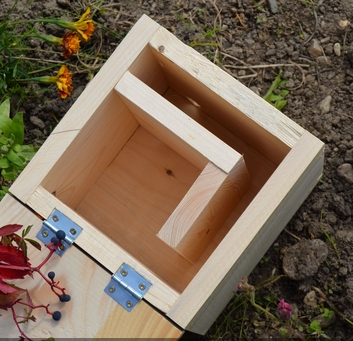
(You will learn how to perform nest inspections in due time in the relevant chapter)
Recommendation:
- The hive should not have any other internal chamber/antenna accessible to bumblebees; bumblebees consider such a space as “outside” and defecate there, which can then become a source of infection for the nest
- The interior walls can be painted with eco-friendly paint, but it is better to leave the walls untreated. The smooth finish of the walls makes cleaning easier.
- All indoor spaces accessible to bumblebees must also be accessible to the owner so that he can perform post-season maintenance and cleaning.
(A description of how to prepare the hive before the season can be found HERE )
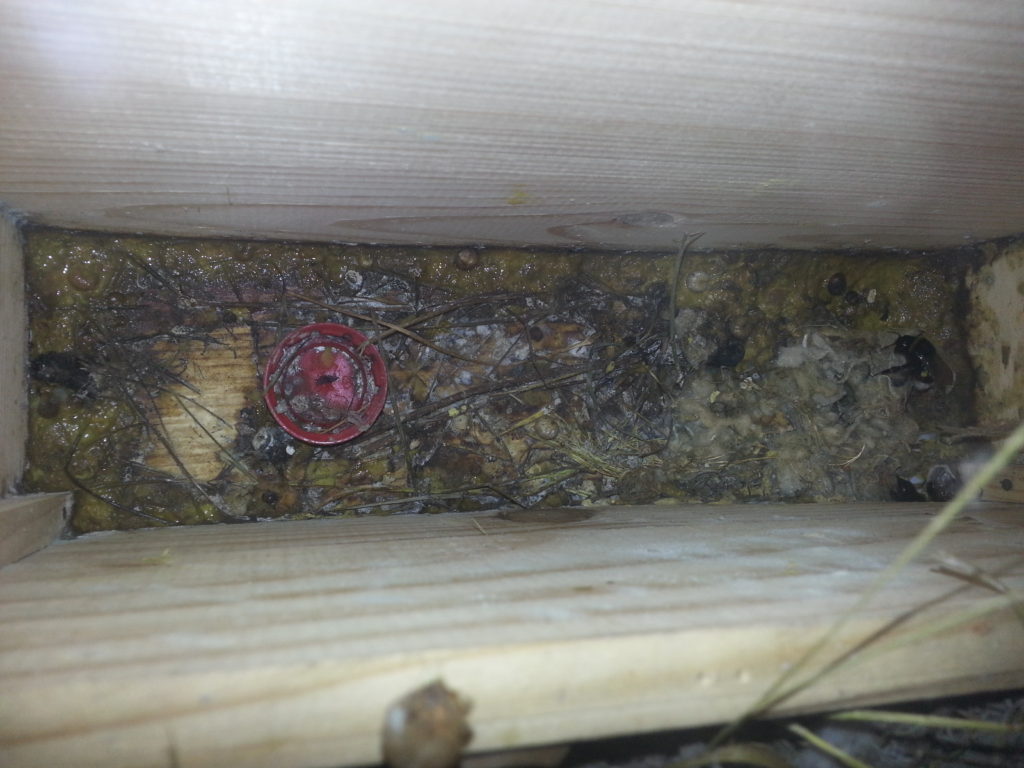
Inappropriate solution – hive with an antechamber. You can see the amount of waste, which is a source of disease and a hiding place for parasites
Hive paint
- The coating protects the hive from weather conditions
Recommendation:
- no need to paint if you don't mind the patina
- If the hive is painted/varnished, it should be environmentally friendly paints or paints used by beekeepers, the paint should not be fresh at the time of installation
- It is advisable to paint the roof with a waterproof paint (or provide it with another waterproof layer), for example teak oil
- If you paint, use proven paints and coatings used by beekeepers and always in advance before the start of the season
- Treat areas exposed to weather and rainwater with a suitable coating – typically wooden parts of the protective flap after the end of the season
Attaching the hive
- Manufacturers usually do not consider the attachment of the hive, some hives have legs made of screws
- The attachment ensures that the hive is placed in the desired location so that it is securely attached and can withstand wind gusts, etc.
Recommendation:
- The attachment must be secure and rigid
- The hive must not vibrate or oscillate
- the attachment must prevent ants from crossing
- It is advisable to use a mount that allows the hive to be easily removed and taken to a closed space for intervention
- If the hive does not have a fixed attachment, it should be structurally prepared for this, for example with a reinforced bottom or rear wall. (It is difficult to attach stable legs up to 20 mm...)
(An example of where and how to place a beehive in the garden can be found HERE )

Jakub Černý – Bumblebee business, or helping nature
Source: Ekolist.cz