
Behavior of the bumblebee queen in the first days after settling in the hive
What you will learn here
- What does a queen bumblebee do in the nest she found?
- What the mother builds and how she lays her eggs
- How the mother feeds her larvae
- How can we tell if the mother is home?
Last updated: 7/4/2021
Contents
What happens in a bumblebee nest after it is settled by the mother
How long will it take for the mother to return if she likes the nest
When does the mother start building the nest
What does the mother actually do in the nest
does egg laying
How do bumblebees feed the larvae
How long do the larvae feed when the first worker appears in the nest
What does the end of the solitary phase mean for the nest
Why does the mother fly irregularly
How to find out if the mother is in the nest
What to do if the keeper does not see the mother
Conclusion
The text is based on an article, photos and videos by J. Čížek published on Facebook HERE
What happens in a bumblebee nest after it is settled by a mother
After a thorough search of the terrain, the bumblebee queen finally found a suitable nesting site and settled in. It could be an abandoned nest of a small mammal or bird, or a nesting site prepared by a beekeeper – a bumblebee.
First, the queen mother runs briskly around the space inside the nest, flapping her wings, blindly exploring the space she has found. During this behavior, she marks the space with her scent using a tracking pheromone. She also marks the exit corridor and then flies away.
A very important sign that the bird likes the place and wants to return to it is its orientation flight . This flight is how it learns to return. Therefore, it is important to be able to recognize orientation flights well.
The queen mother (female) usually begins such a flight by turning her head towards the garlic. Then she takes off and stops for some time in the air in front of the garlic. Later she flies in small circles, always facing the garlic. These circles become larger and gradually turn into multi-directional flying over the space above the nesting site.
Sometimes , in the case of thorough marking of the garlic with bumblebee pheromones, the queen does not perform the first part of the orientation flight . In such a case, the olfactory sensation can replace her visual orientation near the garlic.
If the queen flies only a few circles when leaving and immediately flies away, it is not an orientation flight and therefore does not intend to return.
How long will it take for the mother to return if she likes the nesting site?
The time it takes for a queen to return to a suitable nesting site for the first time depends on her level of biological maturity for nesting .
It can be 20 minutes or even several days. In addition to its maturity (readiness of the nest), it depends on the weather . If the mother likes the nesting site, but then it gets very cold , she will return only after it warms up , even after more than 7 days.
Breeders sometimes make the mistake of not believing in the queen's return after a long absence from the nest and moving in a new queen . However, after some time, the original queen returns and there is a risk of unwanted conflict between the two.
When does the mother start building the nest?
she will start building the nest almost immediately after discovering the nesting site . It can take minutes, hours or even days.
Sometimes the mother just explores the nest but does not start nesting – her ovaries are not developed and she needs to finish feeding and let the eggs mature. She does not need to settle down and then just wait. Everything in the life of bumblebees has its own order and meaning, there is no time for waste.
Sometimes the mother knows the cold weather is coming and doesn't nest right away , even though she has made a nice orientation flight. But she likes the place and sometimes she returns to it to make sure it is still "free" and that she can move in there.
Example 1
From our own observations (end of March 2020), we know that a mother bumblebee (B. terrestris) was introduced to the hive, after 25 minutes she made an orientation flight, after 10 minutes she returned to the hive, and after another 5 minutes she began to bring nectar and ivy leaf juice to the hive to strengthen the walls of the chamber.
Example 2
After settling, the mother bumblebee (B. ruderatus) performed a non-greasy-non-salty orientation flight and flew away. After a week of cold days with temperatures near zero (March 2020), she emerged on her own and began building a nest.
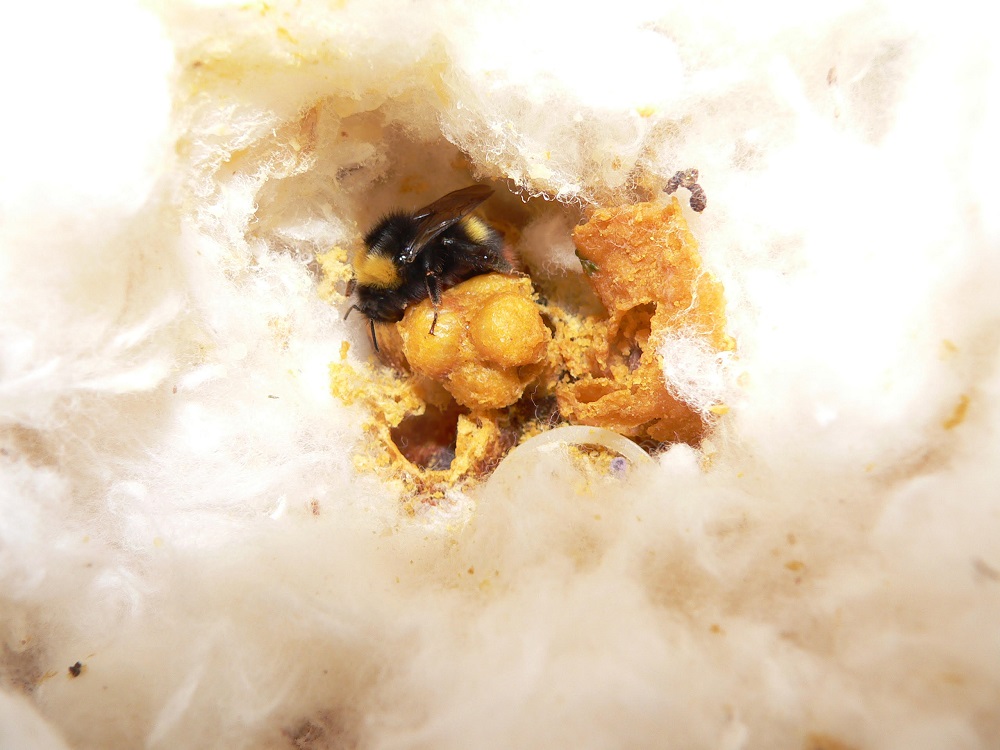
Mother Bumblebee (Bombus pratorum in the nest
Photo J. Čížek (4/2020)
What does the mother actually do in the nest?
After marking with her pheromones, the queen creates a small spherical nest chamber in a cotton-like filling. its walls with nectar or plant sap . Then she begins to bring pollen grains to the bottom of the chamber. She then moistens them with nectar and glues them together with her mandibles into a flat structure.
The resulting area is covered with a layer of wax . The queen excretes the wax between the cells of her abdomen and wipes it with her legs. She also brings pollen and shapes it into a pollen cake .
The mother can complete the construction of this part of the nest within 3-5 days, but under good conditions even within 2 days .
It then creates a capsule , into which it lays its eggs and closes the egg-laying process.
Sometime around this time, the mother will start spending the night in the nest permanently – she must take care of the brood and keep it warm .
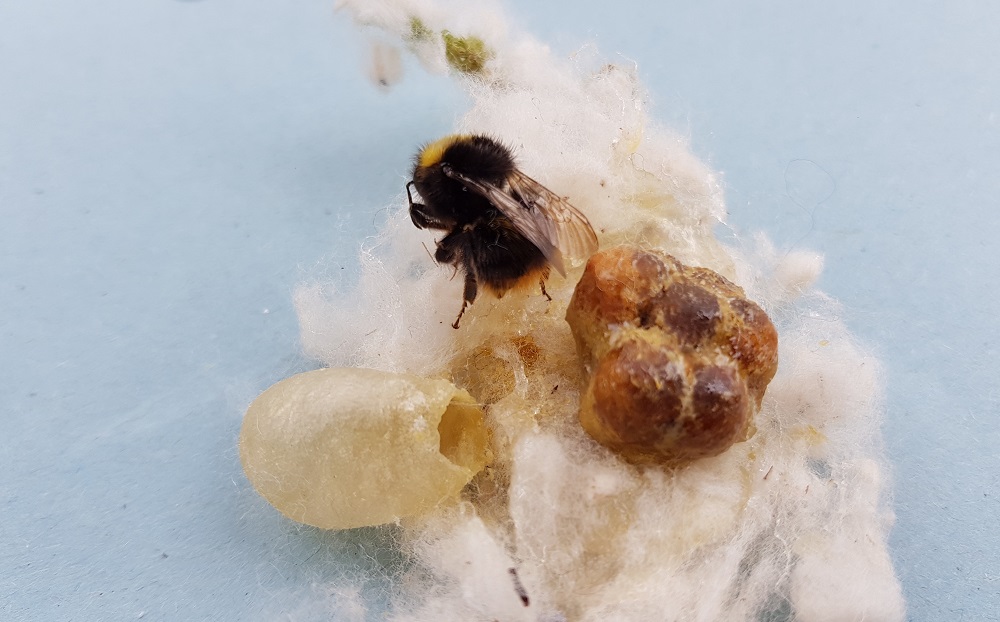
A mother meadow bumblebee (Bombus_pratorum) with a wax nectar cup and the first cocoons.
On the left, a nectar cup, on the right, a cluster of cases with larvae.
The mother probably died after another bumblebee attacked her nest.
Photo by O. Hercog (12/2/2019)
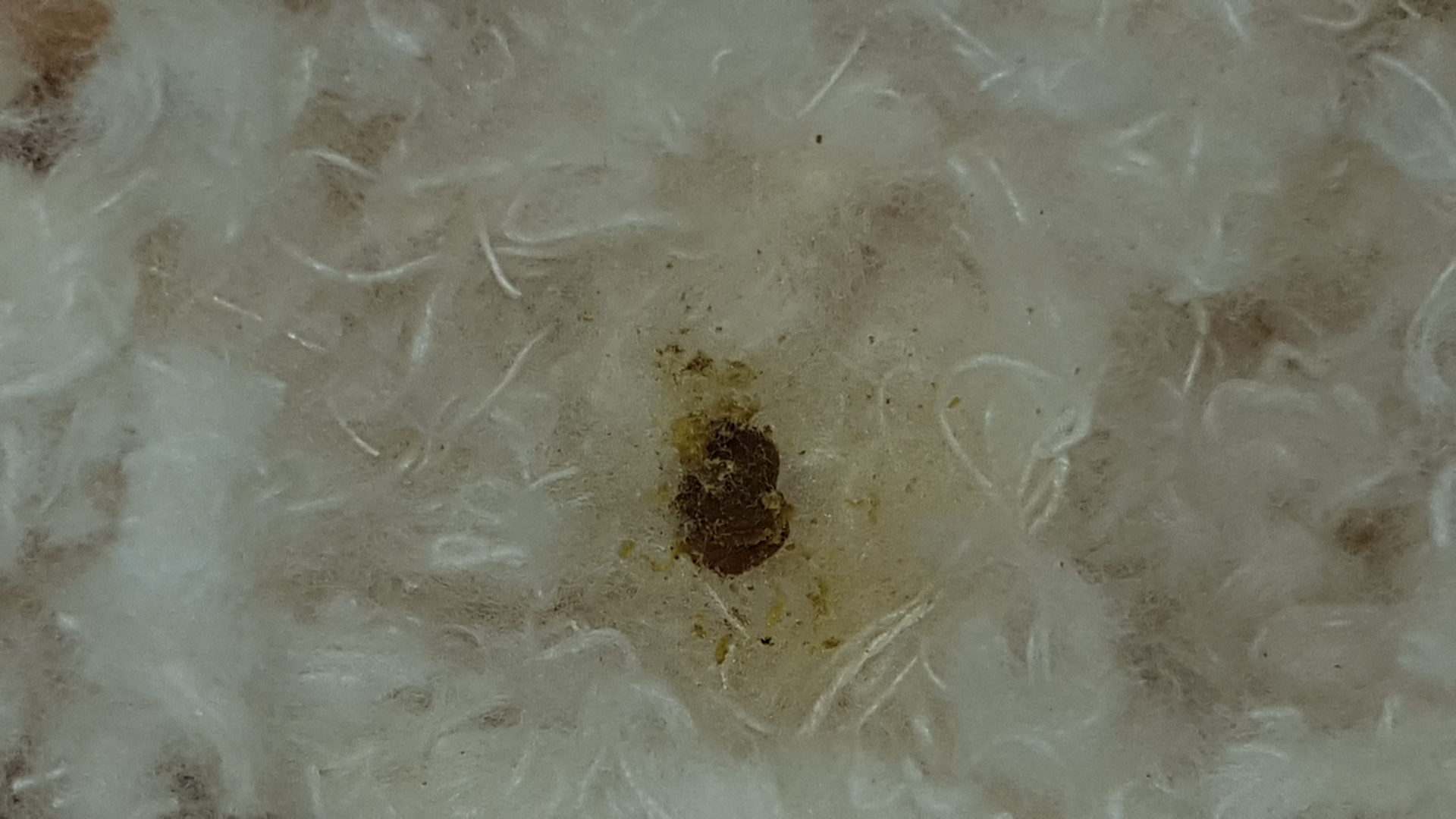
Wax pad and laying in abandoned nest of a bumblebee (Bombus terrestris)
Photo O. Hercog (3/2020)
How is egg laying going?
The number of eggs varies depending on the type of bumblebee and the amount of food. According to the observations of J. Čížek, it can be determined in the range of 4 -20 eggs .
The time from nest establishment to laying can vary. The queen can lay on the day of establishment (if the nest is ready), but also as late as the 4th day after nest establishment.
Usually in advance, but sometimes during the incubation of the eggs, the queen creates a nectar container from wax . In times of excess food, she creates even more containers. Sometimes, however, she begins the nest building by preparing food containers. In this way, she instinctively prepares herself for possible weather fluctuations. The food supply allows her to spend more time in the nest. That is why the mother flies so often at the beginning and then it is difficult for her to see .
The mother often uses her body heat to warm the eggs in the pouch and maintain them in the optimal conditions necessary for the successful development of the fetus.
The mother can change the energy from nectar into heat by vibrating her flight muscles and transfer it to the embryo hidden in a waxy pouch with her bare belly.
She has a kind of clutch between her wings and her flight muscles. She "flies" in a way on idle. Thanks to this, she can heat the embryo and the small nest chamber up to 30°C . But this has its limits, see HERE
The chamber is just big enough for the mother to fit in, along with the fetus. The mother has to save energy, so her chamber is very tight – everything is subordinated to the purpose – to successfully raise the fetus even on cold days .
After 3-5 days larvae hatch from the eggs . The mother-queen herself brings food and feeds the larvae.
How bumblebees feed their larvae
Two types of feeding of bumblebee larvae are known
1) feeding by placing pollen grains in holes under the larval case, called pollen pockets . The larvae take their food from under them and can therefore be fed even when the mother is out of the nest.
2) feeding through holes in the wax shell covering the larvae. The queen creates a hole in the middle of the curled larva covered with a layer of wax. She secretes a small amount of food into it and closes the hole immediately at first. However, in adult larvae that have separated into separate wax shells, she leaves the hole unclosed for the entire period of larval growth.
According to these two types, bumblebee species can be divided into two groups:
1) Pocketmakers , which do not store pollen in empty cocoons, but in wax cases.
An example of such a bumblebee is the field bumblebee (Bombus pascuorum)
2) Pollen storers feed the larvae through holes in the wax cover. They store pollen in empty cocoons of already hatched bumblebees. They pack the pollen into them, similar to bees, and arrange it so that it does not dry out.
An example of such a bumblebee is the ground bumblebee (Bombus terrestris)
However, as is usually the case in nature, under certain circumstances bumblebees do not respect the human-defined division and use more or less both types of feeding .
Note:
- It is quite difficult to provide pollen for pocketmakers. The larvae take it from their pockets and if the worker/mother finds it elsewhere, they cannot take it back to their pockets – at best they consume it themselves
- In the pollenstorers group, pollen can be given to bumblebees, for example, in the cap of a PET bottle. If it is located near other reservoirs, the queen/workers can use it to feed the larvae. Otherwise, they consume it themselves.
A view into a bumblebee nest – in the middle a large larva with a feeding hole, to the left a pollen reservoir
. Honey stored in the empty cocoons can be seen.
The nest was photographed in its final stage, a male was born from the larva.
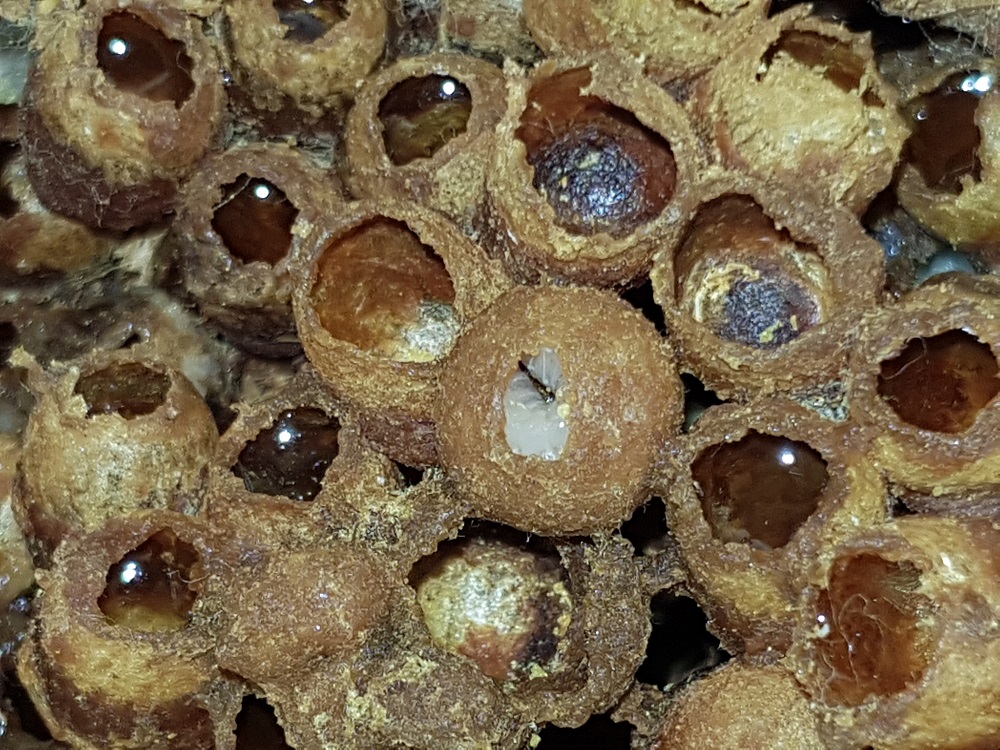
Nest of a bumblebee (Bombus terrestris)
Photo O. Hercog (2019)
How long do the larvae feed and when do the first workers appear in the nest?
The time from hatching of the larvae from the eggs to their pupation depends on the temperature in the nest and the amount of food provided , as well as the strength of the mother and other conditions. It is usually around 8 days .
The hatching of the workers after their pupation ends the solitary phase of the mother-queen and the development of the bumblebee nest.
Its length, which varies between species, can be determined to range from 18 days to 1 month.
What signs for the nest the end of the solitary phase
The end of the solitary phase is the time when the mother does not leave the nesting site . Food is found and brought to the nest by the workers , who also help the mother from the beginning. The mother now stays permanently in the nest, lays more eggs and takes care of the brood - feeds and warms it.
Another reason why the mother does not leave the nest is to reduce the risk of the nest losing the mother during the migration . If you look into the nest at a later stage (see the care of a bumblebee nest described below), you will see that in most cases the mother will hide under the nest, instead of attacking you. This is her defensive reflex and thus also the defense of the fate of the nest.
Unlike bees, which can raise a new queen mother under certain circumstances, a bumblebee nest has only one mother and cannot replace her .
If a bumblebee nest loses its mother, the workers can lay unfertilized eggs and raise males from them. However, new workers and mothers are born only from fertilized eggs, and only the mother has them. The nest will therefore not achieve its goal and will disappear without the birth of new mothers capable of founding nests in the next season.
The queen bee sometimes flies out of the nest , but these are only exceptional cases. For example, we have recorded a situation where the first generation of workers was weak or small and could not provide enough food for the nest.
The same case occurred in a situation where there was a reduction / death of workers / infestation of the nest by parasites associated with a lack of workers , or a significant cooling and thus an insufficient supply of food to the nest. The mother accepted the risk and flew out several times with the workers, but it was always a big crisis that this happened.
Under normal circumstances, the queen mother only leaves the solitary phase once, when she leaves to merge with nature at the end of her life
A view into the nest of a field bumblebee (Bommus pascuorum). With a little work, you can find a pocket on the side of the wax case in the upper left corner – the field bumblebee is a representative of the pocket makers group
Why does the mother fly irregularly?
She really has a " full house" . She has to build a wax structure, warm the brood, feed the larvae, close and open the wax case with the larvae for feeding. In addition, she has to fly out for nectar and pollen and so on and so on.
This is done throughout the solitary phase - until the birth of the first workers.
During this entire period, the mother flies very irregularly . She does not linger - she works first on building the nest. She only flies out when she needs nectar for building or as food for herself - as well as pollen.
Initially, the bee only needs a little pollen to create a surface (pad) under the wax capsule and to build up a reserve (pollen bun). It feeds itself with pollen – it needs proteins to mature its eggs in it.
If the mother has brood and food supplies in the hive , she will fly out only minimally - she doesn't need to and doesn't have the time.
If we gave the mother all the food (nectar and pollen) in the nest, she would not fly at all. It is necessary to realize that the meaning of life is not to fly around flowers, but to establish a new generation of mothers and males - this is their goal in life. That is why bumblebees can be bred in a laboratory in a plastic box without ever seeing a real flower and the sun.
The intervals between flights vary and this often bothers novice breeders. They have so much wanted to see the mother flying and suddenly they basically can't see her. They usually have trouble accepting that it's up to the mother and that she will fly according to her "timetable" .
What really bothers users is that one day the mother flies "a lot" and then "behaves strangely and flies little ". It is unnecessary self-torture and a human perspective. It is necessary to accept that the mother does not respect the breeder's interests, but her own needs and those of her future family .
Very often, the fears of the beekeepers lead to interference with the nest and its subsequent damage and destruction . They also try to stimulate, feed and persuade the mother in the hive in every possible way "to have cocoons".
Very often, this does not last and they introduce another mother into the nest without being 150% sure that the original mother is irretrievably lost - they do not give her a chance and time to prove that everything is fine. This is all wrong.
Every year, in a similar situation and after a cold snap, we encounter cases where an impatient breeder opens the hive and looks for a nesting chamber " to see the mother ". If something hurts , then this is such an action.
The mother is very sensitive in the solitary phase. Very often she leaves the nest and becomes a so-called wanderer. . She does not have to leave it only because of disturbance. Digging up the nest leads to the destruction of the structure . The fragile cup with nectar spills out, the ceiling of the chamber tears and any laying in the wax case breaks.
How to tell if the mother is in the nest
Observation
The keeper can observe the hive and follow the movement on the hive , this is the best method, but unrealistic. It is also possible that the keeper does not see - she slips past him and does not even notice it. Or she sees a figure near the hive and does not return to it and waits in the distance
Mark in the inlet hole
A practical solution is to use a marker in the inlet hole, see HERE
Even a marker is not a perfect solution. A beginner often places the marker incorrectly and the mother avoids it (but this can happen even to an experienced breeder).
Therefore, we recommend placing the marker repeatedly to reduce the risk that the mother will miss it and not come out.
The mother in the hive responds to a gentle tap
If the mother is present (preferably at night) and is nesting, her presence in the nest can be detected by gently tapping the hive wall. The mother will make a distinctive threatening buzzing sound – defending the nest against a suspected intruder.
This method has limitations :
- A mother who has nothing to defend yet (has not laid any eggs) will not respond
- A mother who is cold will speak almost inaudibly
- the mother of some smaller species (for example, the mother of the field bumblebee) practically never calls
Electronic sensors
recently started to be used. They monitor passages and bumblebees in the corridor and count them.
We'll see how well such devices will perform. It depends on how well they handle the conditions in the hive (heat, humidity) and whether the bumblebees don't clog them with debris in the corridor.
Camera traps
There are a number of camera traps that react to movement at the entrance opening and take a poor quality but still documentary image. Such traps are often designed with climatic conditions in mind . However, quality traps are relatively expensive.
Cellular phone
As an alternative to a camera trap, you can also use an older mobile phone and a suitable application. However, the disadvantage is such a device is less resistant to climatic conditions .
What to do if the breeder doesn't see the mother
This is one of the most difficult moments of our work – explaining to the breeder that everything is fine and that the queen mother is simply flying as she needs to and that she is passing by.
He can wait for them and monitor the mother's movement according to the mark, asking it repeatedly and differently.
The breeder must understand and, most importantly , accept that:
- The mother cannot and will not fly regularly
- worrying about your mother.
- There is nothing to do but wait and use one of the methods to gently make sure that the mother is present from time to time.
- He must not look into the nest unnecessarily - he would unnecessarily scare the mother and, in extreme cases, drive her away.
- He must not dig through the lining , look for the nest chamber, or the wax structure of the work - he would damage everything and drive the mother away.
- It is not worth introducing a new queen into the hive if she has not been seen for the first few days, or if she is "strange because she does not fly much" - the queens would meet and one/both would die in a fight.
Experiences from our consultancy
- Experience from our clinic tells us that most of the time everything is fine and unfortunately the problem is only with the impatient breeder who simply wants to see the mother fly.
- Such an impatient breeder often disturbs the mother unnecessarily, peeks into the nest, wonders what is wrong with "his" mother, and tries to resuscitate her in every possible way.
- Sometimes the nest is dug up and irreparably destroyed.
- Sometimes he puts food in the hive for the mother and wonders why she is feeding at home.
- Sometimes the breeder leaves the mother food and she just flies there for the buffet, and doesn't want to settle down there.
- If you buy a bumblebee nest, for example from "Český čmelák", you will not see the mother at all and the bumblebees will fly out when they run out of the food they received on their journey.
If you really need to verify that the queen is in the hive, you can tell by gently tapping and listening through the vent.
For filming purposes, we removed the roof and filmed in red light so that the queen bumblebee's response could be heard.
The nest is covered with a protective net, its description is HERE
Conclusion
- You already know that mothers have a lot of work to do in the nest and only fly out when they have to.
- Mothers won't fly as you wish and you'll only see them occasionally
- If you want to meet your mother, adapt to her and observe her from a reasonable distance - give her your time.
- Don't disturb the mother by unnecessarily tapping on the alarm - it's stressful for her
- Under no circumstances should you interfere with the mother's lining or even her labor
- Give your mother your trust and time when you have her settled in with you.
- If the mother does not appear after 7-10 days , carefully inspect the nest, make sure it is empty, and only then try to populate it.
- Don't be stubborn and accept the possibility that even though you've really tried, your scare will be empty.
- There is no shame in having an empty nest , the shame is in having an nest occupied at all costs, even for the unnecessary loss of the life of a mother who you did not believe really lived with you and you moved a new mother in with her.
- If you keep your nerves in check, the Queen Mother will reward you royally – with beautiful workers and then generations of her followers and handsome grooms.