
How to prevent colony destruction due to heat or cold
What you will learn here
- Is it possible to prevent a situation where a hive occupied by bees freezes in the spring?
- Can this be solved with just good thermal insulation?
- Is it appropriate to heat a bumblebee hive and how to do it?
Last updated: 11/2/2022
Thermal insulation of beehives for bumblebees – an introduction to the issue
In the spring months , the temperature often fluctuates greatly and sometimes it gets very cold for a long time and, unfortunately, very cold .
The breeder has several options for how to respond to this:
- She leaves the nest in the hive to fate and nature
– bumblebee mothers can sometimes endure such a situation, but often they abandon the nest
– sometimes they become exhausted and die while warming the brood - He leaves the nest outside , but provides the mother with wort (honey-sugar dough or sugar solution)
– the mother has a source of energy and a better chance of handling the situation - He closes the nest at night and takes it to the temperature max 15C see
– but transfer is not an optimal solution
– in addition to shocks and disturbances, moisture also condenses on the walls of the hive (temperature differences)These options are described in more detail HERE
- It ensures passive heating of the hive
- but it must be a heating that does not endanger the hive = it does not overheat it, does not dry it out and does not cause sudden temperature changes
- but simple heaters without regulation are often not entirely satisfactory - It will provide hive heating with temperature control
– this solution should regulate the heating output within a specified range, with an accuracy of degrees °C.
In all cases the condition for success that the insulation is of high quality , well insulated and has sufficient thermal inertia to dampen temperature changes.
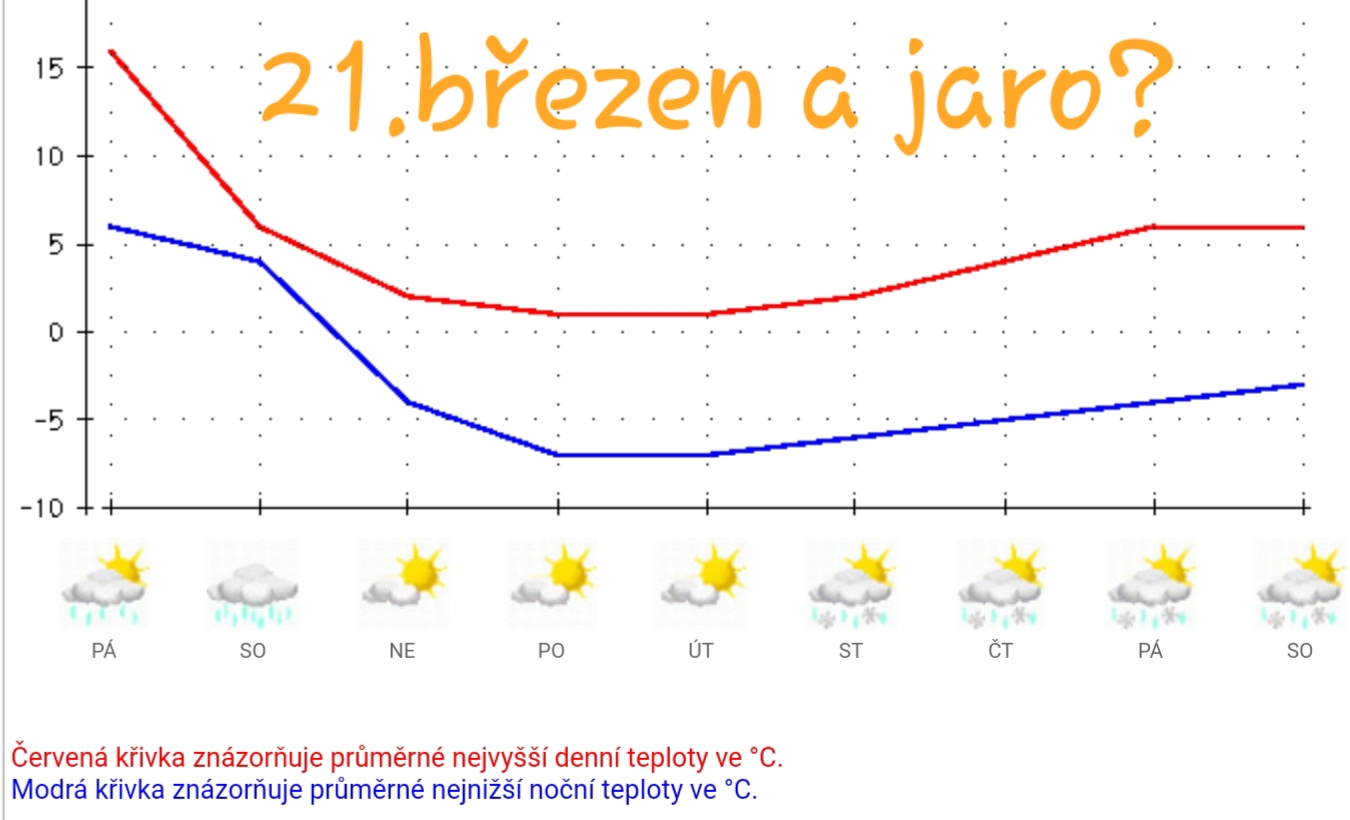
Extreme temperature drops in spring
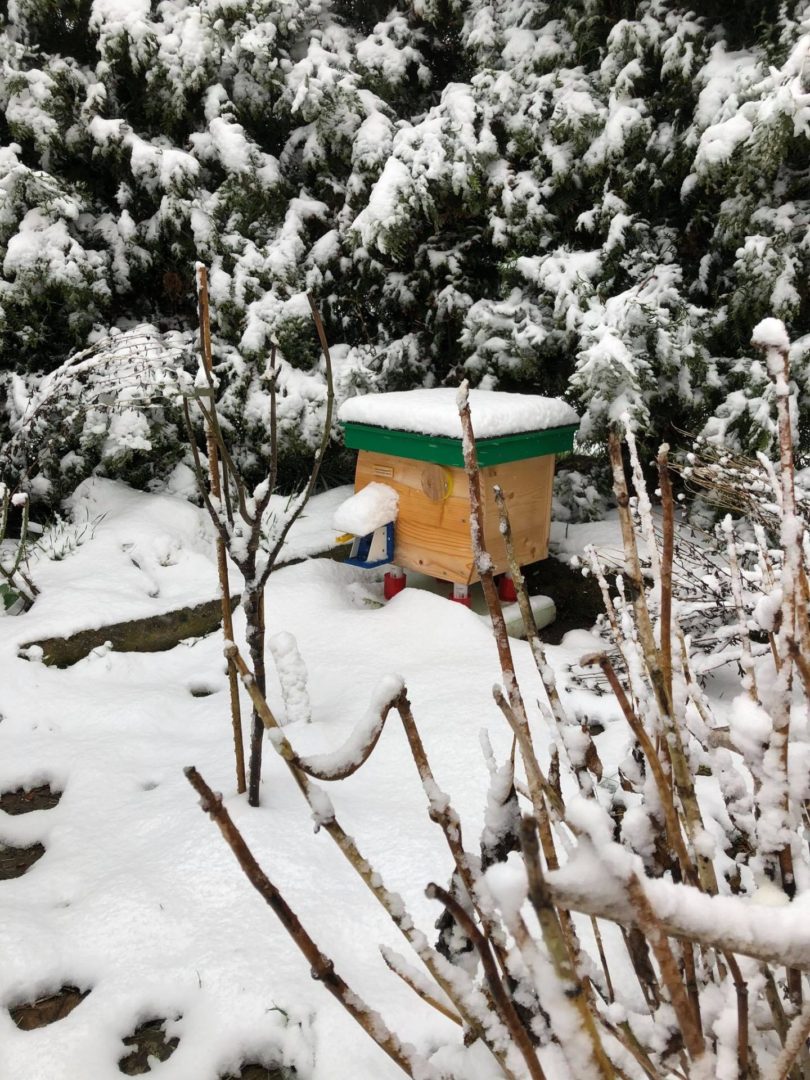
A sleigh ride in a snowy garden
Photo: PG Gröbl (21/3/2020)
Why and how does the temperature in a hive change depending on the temperature of the surrounding air?
Our measurements
As evidence of the behavior of different hives, we present the internal temperature curves in different hives . We will describe the graph and measurements, here only a demonstration of the influence of external temperature on hives and differences in the change of internal temperatures .
You can see for yourself how the internal temperature changes over time , even with a static external temperature. The less the temperature in the hive fluctuates, the better . Therefore, it is necessary to pay attention to the thermal insulation of the hive , rather than heating, which in practice is used only a few days a year.
Graph 1 shows how the temperature in the hives increases depending on the ambient temperature.
Description:
- Top – outdoor temperature
- Then gradually hives with different quality of thermal insulation
- The lowest curve ( gray ) represents the startle with modifications , which we further describe HERE.
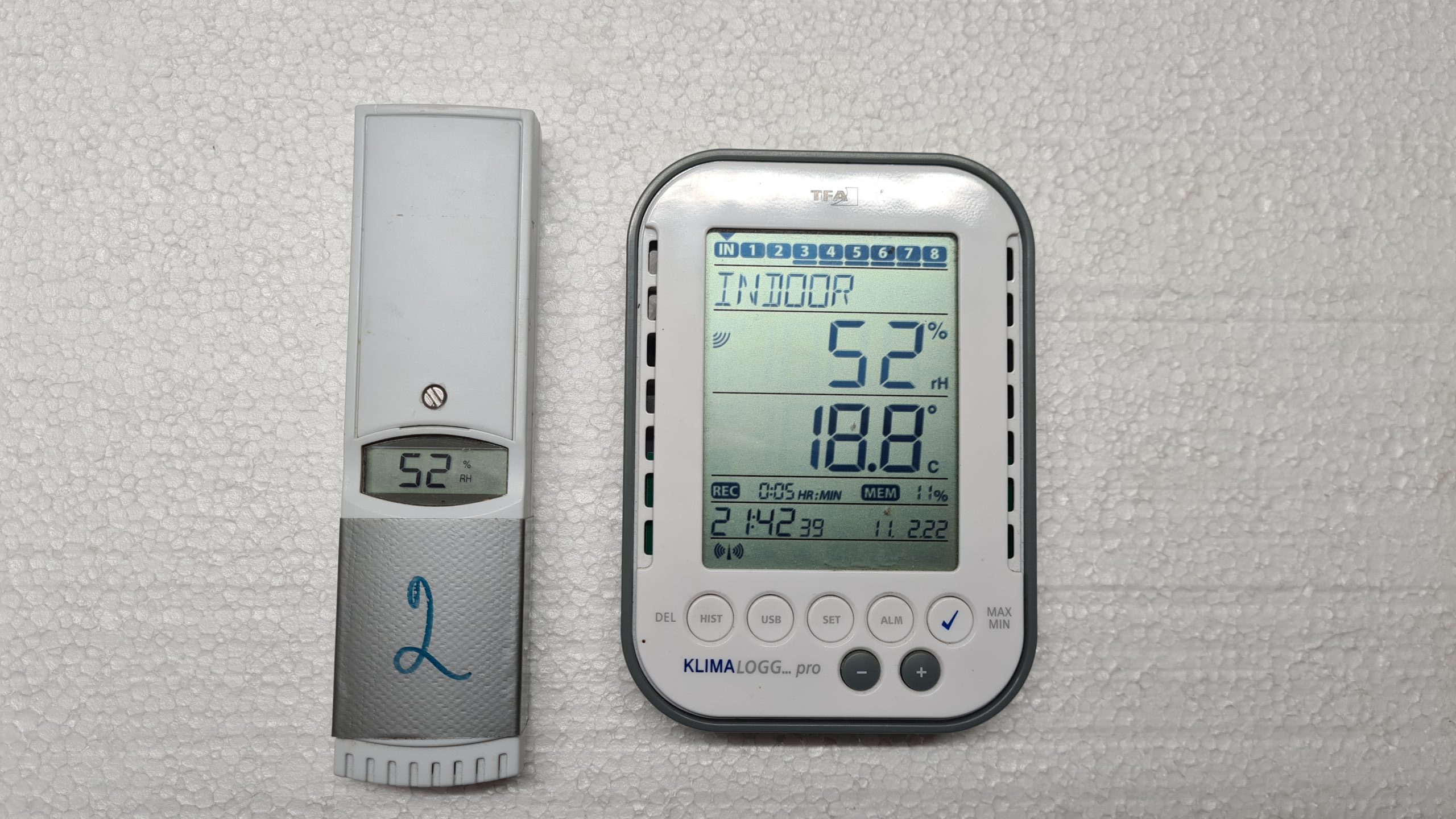
Temperature measurement kit
Photo: O. Hercog 2021
Graph 1 shows how the temperature in the hives increases depending on the ambient temperature.
Description and evaluation of results:
- Top – outdoor temperature
- Then gradually hives with different quality of thermal insulation
- You can clearly see how big the differences are between the individual designs
- the temperature changes fastest in a small hive (green curve)
- slower in a larger hive
- The temperature changes almost as quickly in a commercially available hive and in a hive with 20mm polystyrene internal insulation
- the slowest changes are represented by the gray curve and light blue – this is a shed with 30mm polystyrene external insulation and 25mm wooden walls inside the insulation – its description is HERE
It is complicated to ensure stable temperature conditions in a passive hive , unless you want to turn it into a "engine room full of technology", so it seems optimal to place it indoors - see the description of hive placement .
This solution, where the hive is placed in a relatively stable environment of a garage/basement, etc., is unfortunately not available to everyone.

Graph 1 – Change in temperature in hives depending on external temperature – temperature increase
Measured by: O. Hercog 2021
Graph 2 demonstrates the process of cooling the hive depending on the external temperature
Description and evaluation of results
- Little Ulek did not participate in this measurement
- It is similar to Chart 1, only in reverse order.
- Hives without thermal insulation cool down very quickly.
- Even a large, uninsulated bird equalized its internal temperature to its surroundings.
- A well-insulated shed cools down the slowest – its description is HERE
Physics simply is and will always work.

Graph 2 – Change in temperature in hives depending on external temperature – temperature drop
Measured by O. Hercog 2021
Heating in the hive for bumblebees
Bumblebees PLUS recommend
- We are making efforts to improve the design of passive hives and their thermal insulation.
This is also worthwhile in times of high temperatures and sudden changes, when a good solution dampens fluctuations and allows the hive to maintain suitable conditions for as long as possible. - Provide the mother with food (nectar and possibly pollen) on cold days, but do not disturb her unnecessarily by interfering with the nest
- Don't freeze the hive unless you have a good solution
. Spring temperature drops can be solved in other ways. For example, by transporting the hive after dark , where frost is expected, to a place where the hive will not freeze , but will not overheat. The temperature in such a place should not exceed 10-15°C. - There is no point in heating the hive heavily when it is cold outside and the bumblebees cannot fly and gather food, these are not natural conditions.
It is more natural for the queens to wait in a state of reduced activity for the temperature to rise . Queens of bumblebees in a good hive with a sufficient amount of good lining can overcome short-term drops in temperature even without heating. - If you want to heat the hive, do it in a way that the hive does not freeze and if possible use a heater with a regulator.
Other links:
about the issue of thermal insulation and our measurements HERE.
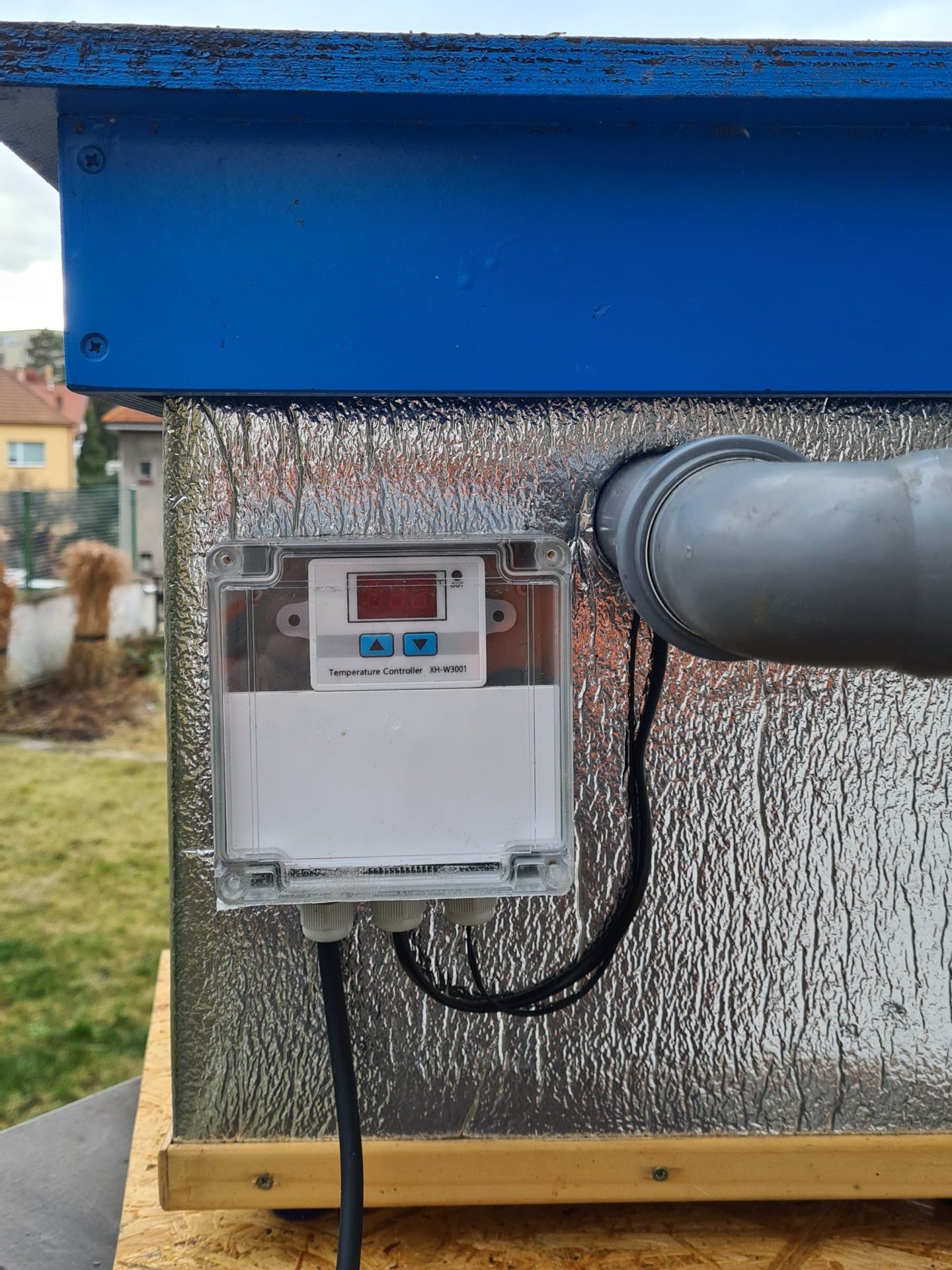
Regulator in a box on the wall of the hive
Photo: O. Hercog 2021
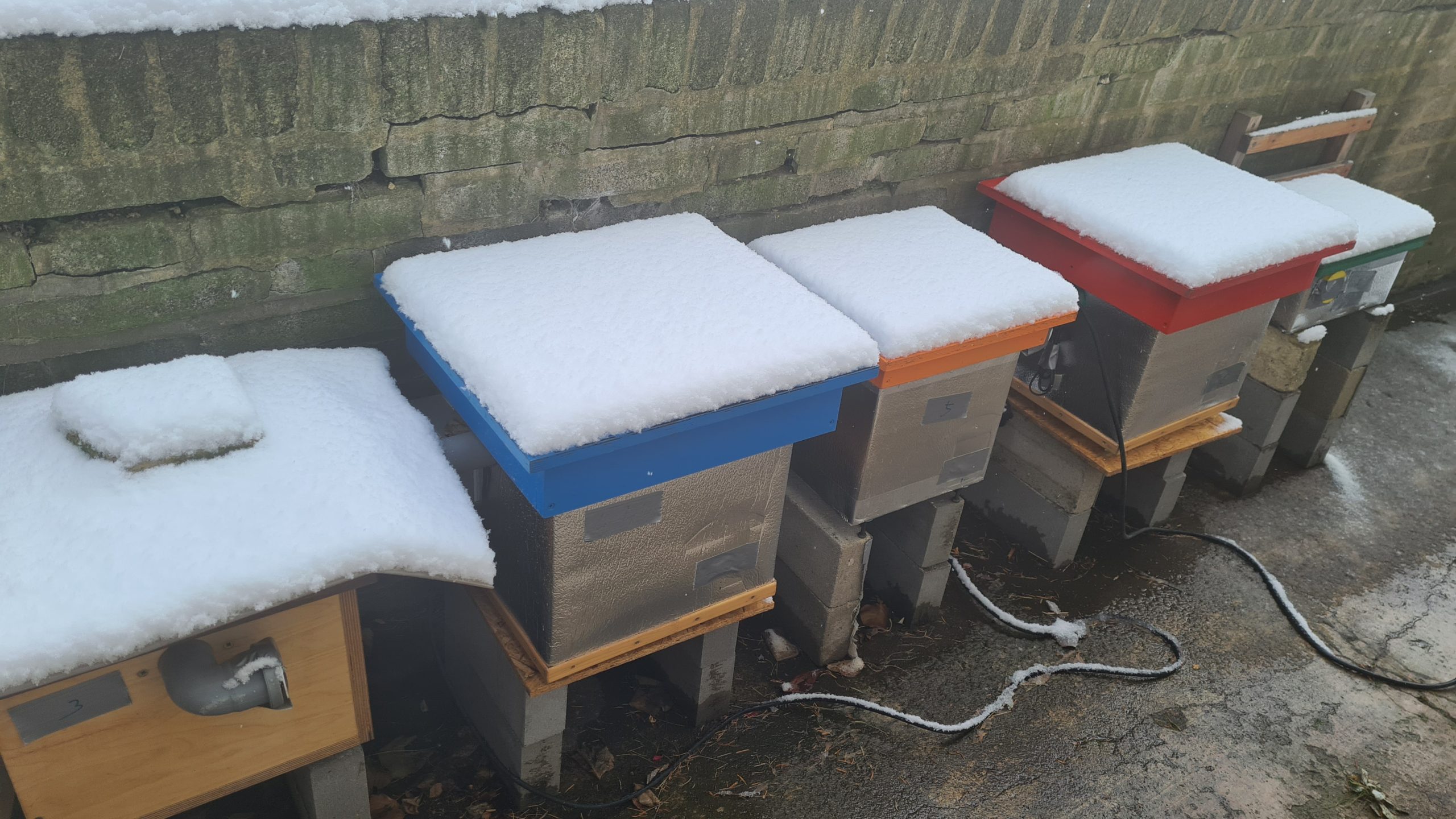
Measuring temperatures in hives
Photo: O. Hercog 2021
Conclusion
As always, we have suggested several solutions and explained their pros and cons.
Choose a solution that suits you both in terms of difficulty and your approach to bumblebee breeding.
If you share your experiences with us, we will be happy to use them and offer them to others.