
How things are in nature and in the hive between bumblebees and wasps
What you will learn here
- What are patchouli?
- How to recognize them
- What is their life cycle?
- How they damage a bumblebee nest
- How to defend against them
- Why patchouli have their place in nature
Last updated: 9/5/2021
CONTENTS
What are bumblebees?
What do bumblebees look like?
Types of bumblebees and which bumblebee species do they most often parasitize?
What is the life cycle of bumblebees?
How do bumblebees affect a bumblebee nest?
How to recognize a bumblebee nest infestation
How to defend yourself preventively?
How to intervene when a nest is attacked?
What happens if you don't intervene
? Is a bumblebee a pest?
Conclusion
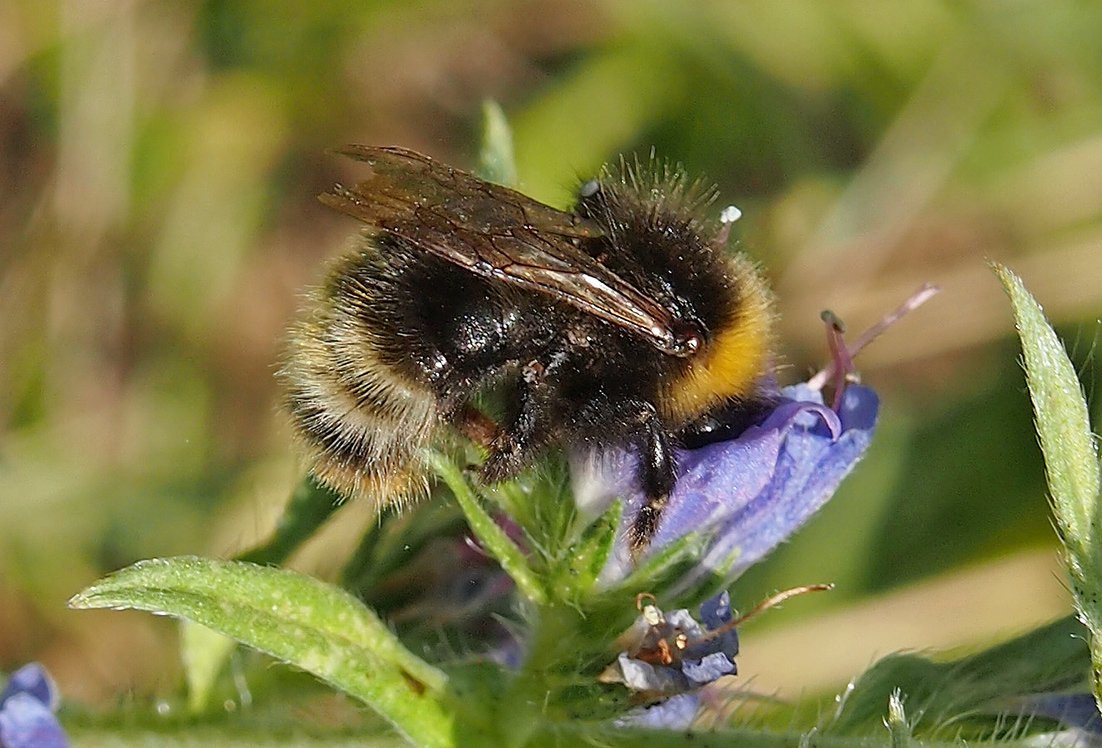
Woodlouse (Psithyrus sylvestris)
Photo: H. Kříženecká
What are patchouli?
To prepare the text, parts of the publication "Breeding and support of bumblebees in gardens and in the city" by A. Votavová and J. Čížek were also used, in the update of which we, as Čmeláci PLUS, participated.
We also used "Insect families and states" by J. Ždárek and the beautiful publication "Bumblebees" by Pavelek and Smetana.
Bumblebees are parasitic, close relatives of bumblebees that do not have a worker caste, only females and males . They are dependent on bumblebees for their survival, which they attack and parasitize.
The bumblebee (Bombus, formerly Psithyrus) is a genus of insects in the family Apidae. The very close relationship with the genus Bombus has sparked a debate in the scientific community, probably already closed, about whether to distinguish the two genera or unite them into one genus called Bombus and, within this genus, distinguish the subgenus Bombus and the subgenus Psithyrus. Currently, bumblebees do not have their own genus and are therefore included in the genus Bombus. (Source WiKi).
However, you will commonly encounter the use of the genus names Bombus and Psithyrus.
Bumblebees occur only as sexual individuals. They parasitize in bumblebee nests. The female lays eggs in them. She either kills the original female or subdues her . The larvae are cared for by workers of the host species until pupation. Only sexually mature individuals – males and females – hatch from the pupae. The worker caste does not occur in bumblebees .
In individual bumblebee species, there is usually a narrow specialization in parasitism in individual bumblebee species. For example, for the Czech bumblebee, the host is the wood bumblebee, etc.
Female bumblebees do not collect pollen and therefore do not have pollen cups on their feet. Although they can feed their larvae, they prefer to leave the care of them to the host workers . Therefore, their tactic is to find a bumblebee nest and enslave it so that it helps them provide food for their offspring. They cannot carry pollen or nectar to the nest and do not have glands for wax production and cell construction . However, they are effective as slavers .
That's why they need worker bumblebees to provide all of this for them - without bumblebee nests, bumblebees are unable to reproduce.
After the bumblebee weevil, bumblebees (especially in some locations) are the biggest (often hidden) problem in outdoor bumblebee breeding .
However, bumblebees also have their place in nature . For some abundant bumblebee species, they serve as their natural reducing agent . This is the case, for example, for the abundant ground bumblebee (Bombus terrestris) and the parasitic virgin bumblebee (Bombus vestalis).
Although bumblebees do not collect pollen and nectar, they pollinate plants while feeding . They are therefore pollinators , like bumblebees, although they are probably not as efficient.
There are fewer wasps than bumblebees. That is why it is necessary to protect and, if you encounter them, respect their way of life .
What do the patchouli look like?
Bumblebees resemble bumblebees in their coloration and body structure , often the same species of bumblebees on which they parasitize .
Their coloration and body structure make them relatively difficult for a layperson to distinguish from bumblebees. Therefore, it takes time and careful observation of several characteristics .
They differ from bumblebees in their darker coloration .
In males, you can recognize the different morphology of the copulatory organs – but put it into practice…
Queen mothers of bumblebees differ from queens of bumblebees in their more robust body structure .
Female honeybees do not collect pollen and therefore do not have pollen cups on their legs .
Robust females can be identified with certainty by the different anatomy of the hind leg tibiae. Unlike bumblebees, which are convex, smooth, shiny and lined on the sides with long stiff bristles, those of patchouli are convex and covered with hairs over the entire surface (coughing about depilation..)
They have darker wings compared to the transparent wings of bumblebees and often have bald patches of shiny black "armor" on the upper side of their backs and possibly on their chests .
This armor is also stronger than that of a bumblebee, so they have a better chance of winning in a fight with it.
The fur on the chest of a patchouli is never gray, brown, or orange, but always black, sometimes with transverse yellow stripes .
Overall, the hair on the wasp is thinner than that of the bumblebee.
The head of queen mother moths is never longer than it is wide.
Spiders have a strong, saber-shaped stinger .
The entire tip of the stinger-bearing butt is often black and hairless – the last segment of the butt is almost hairless .
Another difference is that they have stronger mandibles than bumblebees .
They also lack wax glands – the waxy nest construction is provided for them by bumblebee workers.
Sometimes, woodpeckers can be distinguished in flight, when they make a distinctive gurgling sound.
for beekeepers to know, for example, that if they cannot introduce a large queen into the hive in the later stages of spring, it may be a female . If they succeed, such a queen will not make an orientation flight after leaving the hive and will fly away without interest. However, introducing a female female does not mean anything and is not a fundamental mistake - see below.
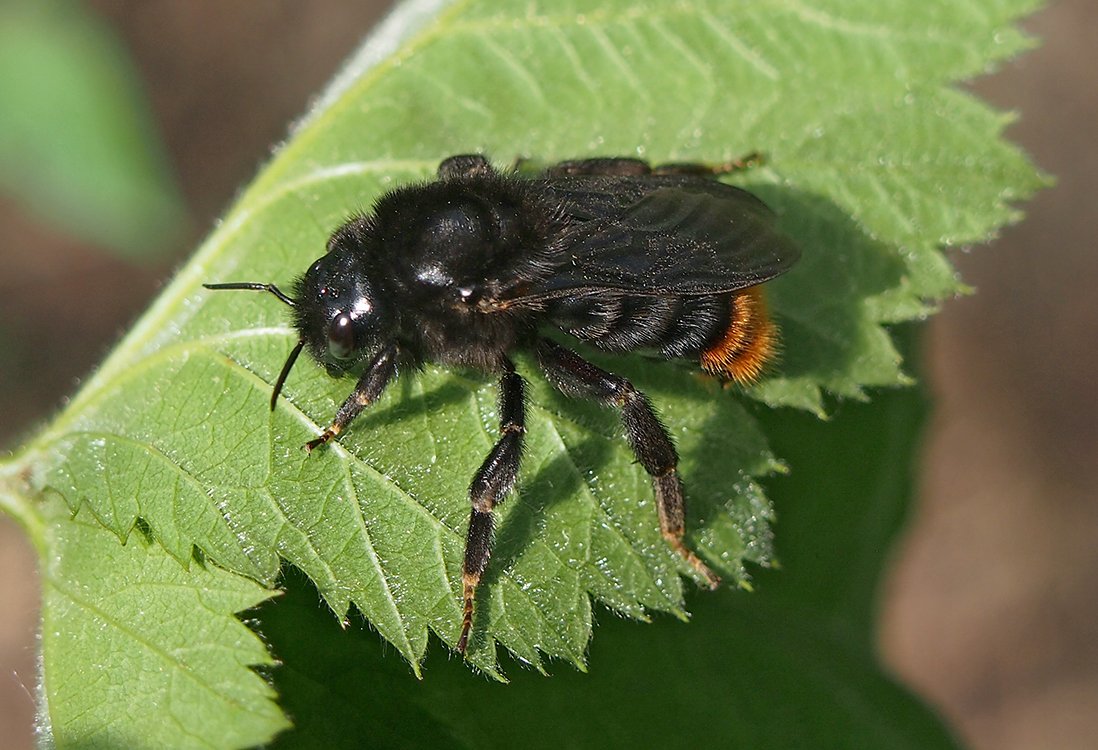
Female scaly-tailed siskin (Psithyrus rupestris)
Photo H. Kříženecká
Types of bumblebees and which bumblebee species they most commonly parasitize
- In our nature you can find several species of patchouli, often very endangered.
Here we list the most common species of bumblebees and the species of bumblebee that most often parasitizes them :
- Ground bumblebee (Bombus terrestris) x Virgin's patch (Psithyrus vestalis)
- Rock bumblebee (Bombus Lapidarius) x Stone bumblebee (Psithyrus rupestris)
- Wood bumblebee (Bombus lucorum) x Bohemian bumblebee (Psithyrus bohemicus)
- Field bumblebee (Bombus pascuorum) x Field bumblebee (Psithyrus campestris)
- Meadow bumblebee (Bombus pratorum) x Wood bumblebee (Psithyrus sylvestris)
- Hypnotic bumblebee (Bombus hypnorum) x Norwegian bumblebee (Psithyrus norvegicus)
- Garden bumblebee (Bombus hortorum) x Hairy bumblebee (Psithyrus barbutellus)
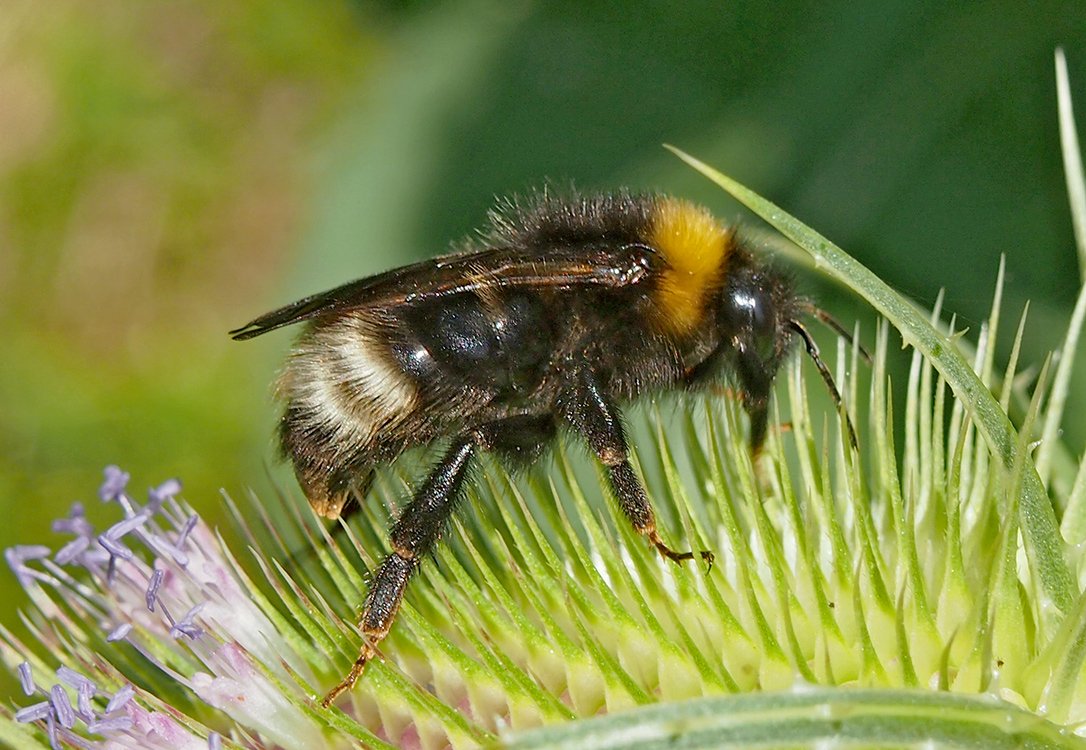
Bohemian Woodpecker (Psithyrus bohemicus) female
Photo: H. Kříženecká
To give you an idea, we have prepared an example of a comparison of the basic species of bumblebees and the wasps that parasitize them.
You can see for yourself that identifying a wasp is not entirely easy, and if you are not sure about distinguishing the species of bumblebees, it will confuse you.
Source Blooms for Bees (UK)
Take a look at the basic species of bumblebees and wasps in the Czech Republic , where you will also find a detailed comparison of bumblebee species and the wasps that parasitize them (IN PREPARATION).
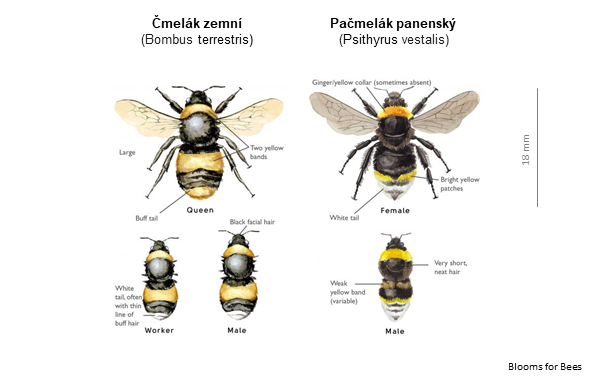
Bumblebee x Common Bumblebee
Source: Blooms for Bees
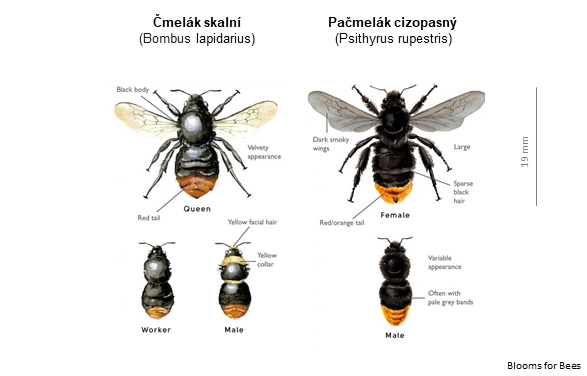
Rock bumblebee x Parasitic bumblebee
Source: Blooms for Bees
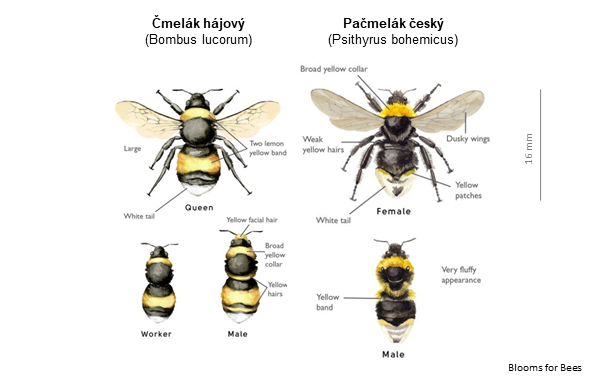
Bumblebee x Czech Bumblebee
Source: Blooms for Bees
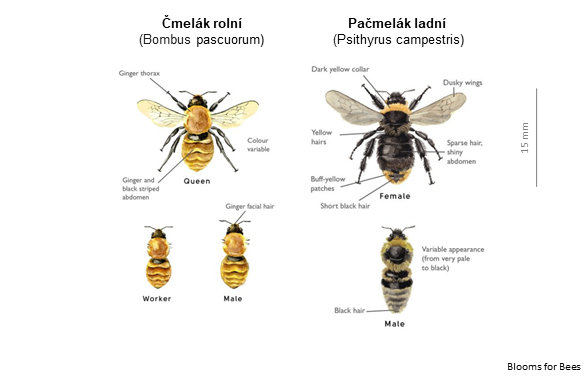
Bumblebee x Common Bumblebee
Source: Blooms for Bees
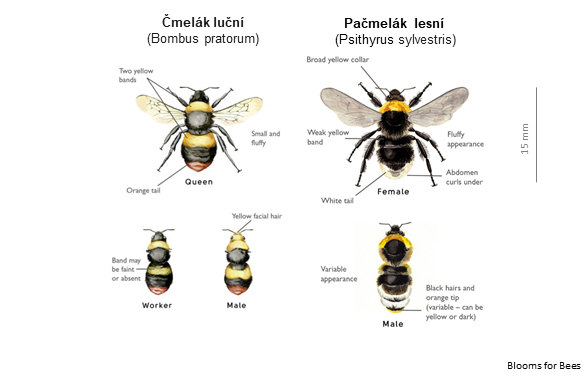
Meadow Bumblebee x Wood Bumblebee
Source: Blooms for Bees
What is the life cycle of a patchouli?
Bumblebee mothers emerge from the ground later than bumblebee mothers, so they often hibernate deeper than the mothers of the target bumblebee species, so that spring awakens them later.
When the mother bumblebees wake up, they leave the hibernaculum, fortify themselves with nectar and pollen, just like the mother bumblebees. They then set out, persistently searching for existing bumblebee nests with workers .
It has been proven that the scent of the nest and the traces of workers in the area are their guide. The scent is also a guide to finding the species they are looking for (see the relationship between the species of bumblebee and the species of bumblebee).
But often they don't find such a place right away, only a settled mother bumblebee in the solitary phase (without workers). They leave such a mother alone - they want a nest with workers, with one or two generations.
Interesting fact
- Apparently, however, mother bumblebees are able to remember the place they found and return to it later – just as mother bumblebees choose between multiple nesting sites.
- Mother bumblebees must therefore wait until they find a nest with workers that they need as their slaves. However, the bumblebee nest must not be too strong, so that there are no strong workers and a large number of workers that they would no longer be able to overpower. Therefore, mother bumblebees constantly search for bumblebee nests by smell and wait for the right moment to attack.
If the mother patchouli finds the nest in the right condition, she will attack . If the path is clear, she will try to penetrate the nest.
Workers from several generations of bumblebees have a chance to win over the mother bumblebee in the corridor to the hive, where they can outnumber the larger mother bumblebee.
If the corridor has a small diameter (inner diameter) of less than 18 mm, only one worker will be able to resist the mother bumblebee. If the diameter is large, the mother bumblebee can bypass the workers. That is why we recommend a corridor width of 18 - 25 mm.
In a developed nest, it sometimes happens that strong workers kill or drive out the bumblebee, often costing several of them their lives.
Therefore, the bumblebee mother primarily seeks nests with one generation of workers , i.e. about 10 workers. These nests are also an easy target in bumblebee breeding in hives . Very often, beginners feel sorry for the small workers from the first generation and leave the hatch open for them . This is an opportunity for the bumblebee mothers .
If a mother patchouli breaks into the nest, all is usually lost.
The mother wasp first kills the largest workers that she cannot control. They are combative and are the first to resist her. She also kills these workers because they would lay drone (male) eggs in the future.
The next target is the mother . A fight ensues, and the physically better equipped mother of the pačmelák usually wins.
The mother patchouli leaves only the weaker workers alive, like slaves . She manages to control them with her pheromones and other chemicals. She applies these to them by roughly pressing them to the ground and rubbing herself against their backs and sides (mauling).
Jaromír Čížek describes how the mother wasp also uses chemicals . After eliminating resistance, she sprays the remaining workers with her pheromone, and they then treat her as if she were their mother – the queen.
Now the nest is taken over and the slave girls work for the mother patchouli .
Subsequently, the mother bumblebee consumes the eggs of the mother bumblebee, and possibly also the workers, and begins to lay her own eggs in the bumblebees' wax cells.
Interesting fact
- Bumblebees only eat eggs and not bumblebee larvae and pupae, which is why in addition to female and male bumblebees, queens and male bumblebees are sometimes born in an infested nest (in the case of late infestation) in smaller numbers.
- In some species, the coexistence of a bumblebee and a wood bumblebee has been observed – see, for example, the meadow bumblebee (Bombus pratorum) and the wood bumblebee (Psithyrus sylvestris)
With the help of existing bumblebee workers, including food delivery, the mother bumblebee queen establishes her own brood – a brood of female and male bumblebees, which, earlier than is the case with bumblebee families, leave the hive.
The newly born male and female bumblebees then fly out of the nest, where they find partners, mate, and then hibernate – similar to bumblebees.
In the spring, everything starts over, just like with bumblebees.
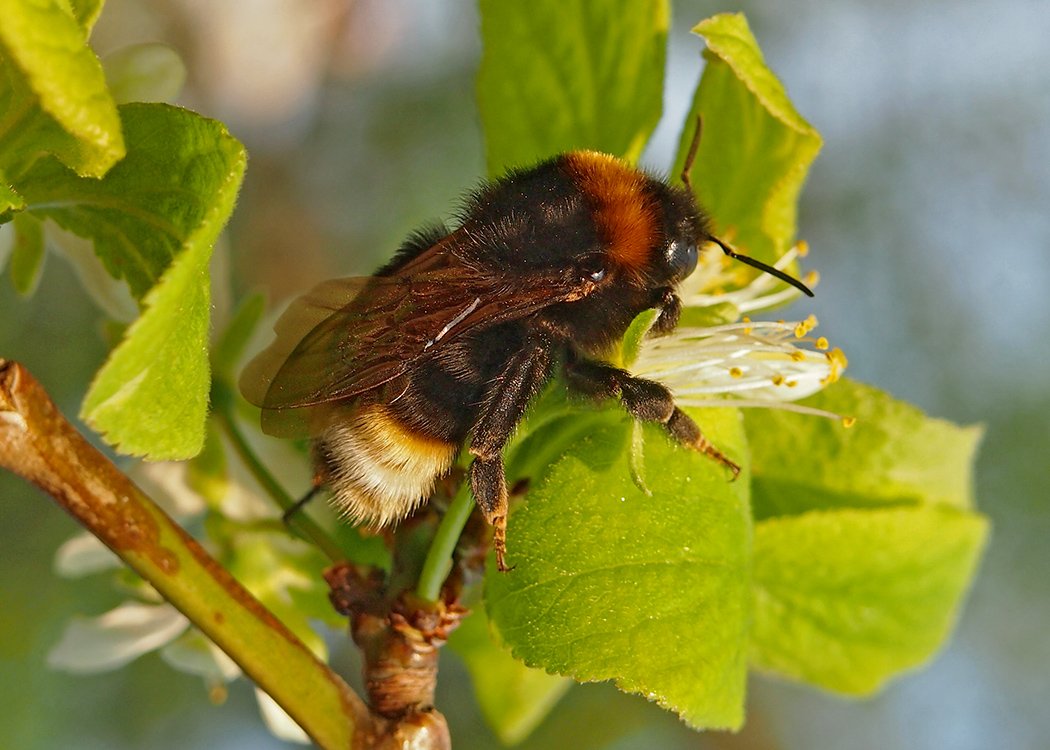
Female virgin's patch (Psithyrus vestalis)
Photo:. Kříženecká
How do patchouli affect a bumblebee nest?
Once a mother bumblebee invades a bumblebee nest, she has only one goal in mind – her own offspring .
The last bumblebees (workers and, exceptionally, mothers and males) are born from the remaining larvae in the nest. However, the mother bumblebee is dead, so the next generation of workers and sexual individuals is not born.
The nest therefore does not develop as well as it could and its energy and work is used for the benefit of the parasitic mother.
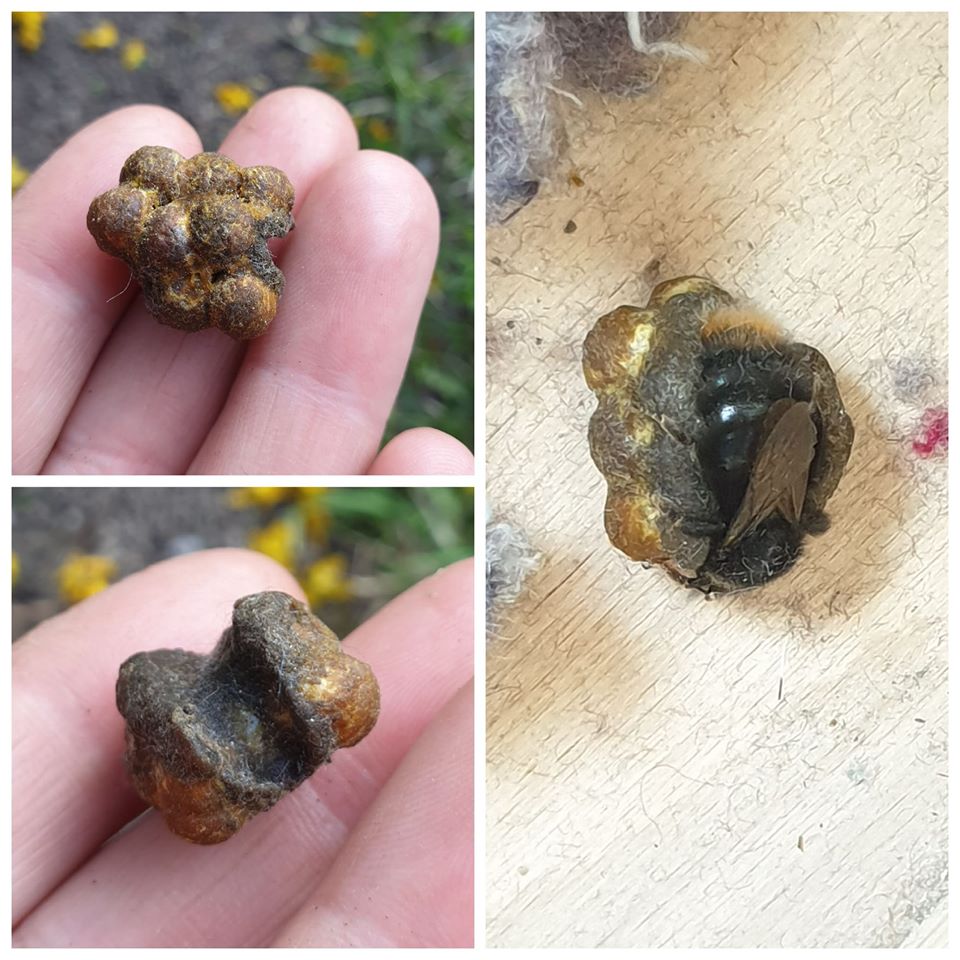
Parasitic wasp on cocoons of meadow bumblebee ( Psithyrus rupestris)
Photo: Ála Ungerová
How to recognize a patchouli nest infestation
very difficult to recognize a nest infestation . If you do not watch the emerging adults – sexual individuals – and do not notice their difference, you may not even notice it.
Sometimes the beekeeper himself introduces a “mother of a slightly different bumblebee” into the hive in the spring . The bumblebee is large and defensive. It could be the mother of the bumblebee. Even if this happens, nothing terrible happens – the mother of the bumblebee will not stay in the hive (see the life cycle of the bumblebee).
However, if a mother patchouli finds a nest and takes over it, the nest often ends up weakened by workers in the first or second generation at most and stops developing . New workers are not born, and the nest dies prematurely.
The number of workers is therefore a certain guide, as is the early observation of sexual individuals that are different in color and appearance than those belonging to the given species.
In the best case scenario, after the bumblebees leave the nest, the workers may lay individual male bumblebee eggs, but even this may not be a reliable indicator of infestation.
Often, an ordinary beekeeper does not even notice a beehive attack by bees and does not realize what happened and that he may have contributed to it by not protecting the nest with a protective flap .
How to prevent prevention
hive protection measures appears to be a form of prevention, see HERE .
Early and consistent use of a protective flap . This may (but may not) deter the mother patchouli.
Early use of the flap is essential . Novice breeders often leave the flap open too long, thus blocking the way for the mother raccoon.
We recorded a case where a mother wasp was so impudent that she and the workers broke through the flap , but repairing the flap reduces the risk of the wasps breaking into the bumblebee nest .
Notice
- Do not populate hives without a protective flap installed
( If a mother bumblebee discovers the hive, she can investigate it, leaving the mother bumblebee alone for now, but returning later). - Teach the mother to go through the flap as soon as she is settled in and returns to the hive steadily. If the mother bumblebee discovers the hive, she can explore it, leaving the mother bumblebee alone for now, but returning later.
- Once the worker bee is born, she will take care of the flap.
- If you hesitate and leave the flap open "because the worker bee is struggling with the flap", you risk a wasp visiting such a nest and breaking into it.
For small species of bumblebees, it is possible to narrow the entrance hole . However, we do not recommend this solution to beginner beekeepers at all and therefore we do not describe it here.
The ventilation opening must be equipped with a bite-resistant mesh.
Inspections can detect the presence of a bumblebee, but they cannot intervene and remove it - it is already too late, because the bumblebee mother is dead and cannot be replaced .
Other defensive barriers of the hive are good sealing of the roof and the entire body . But the bee eater follows the scent of the nest and the trail of the workers. It usually cannot pass through a small opening, so it is interested in the entrance opening.
Bumblebees visit certain species of bumblebees . If they encounter a species other than their "favorite", they usually do not try to occupy it. In such a case, the mother bumblebee flies away in disappointment.
Lenka Wettermanová recorded a case in 2019 when a mother Bohemian honeybee (Psithyrus bohemicus) lifted the protective flap and entered the nest.
This can happen because the mother honeybee is robust. Properly implementing the protective flap and leveling the hive significantly reduces the risk, but may not prevent the honeybee from entering the hive 100%.
Learn more about the protective flap HERE
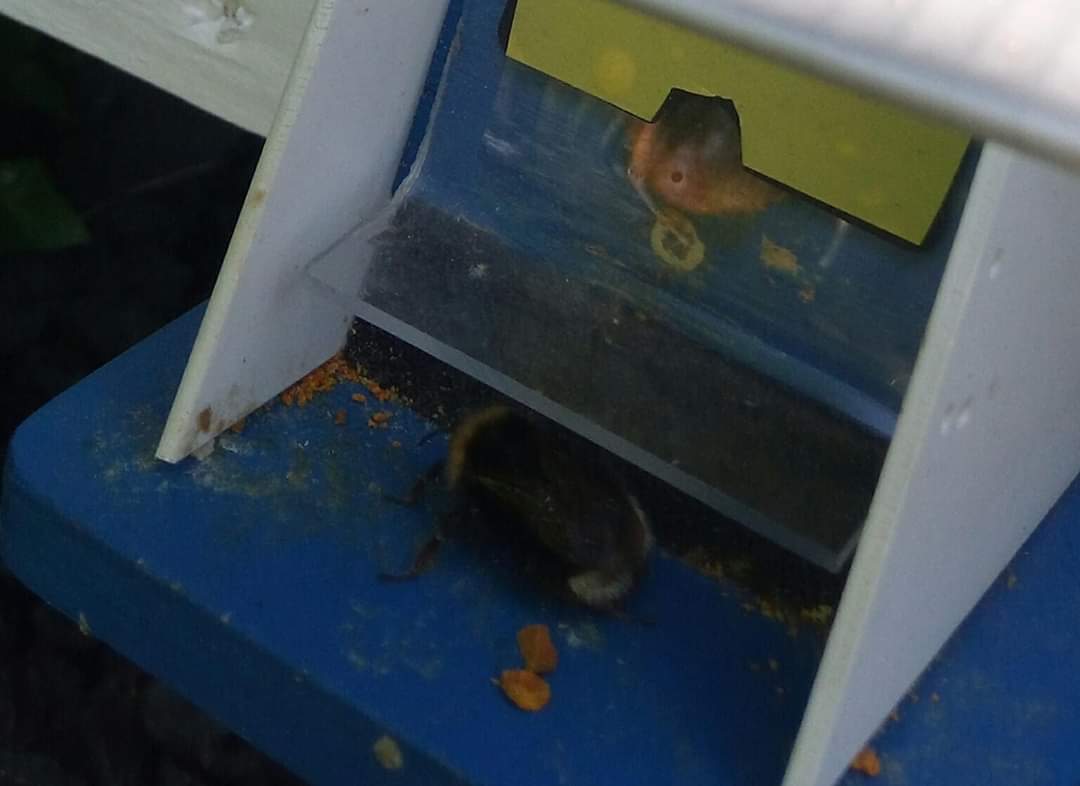
Bohemian Patchouli (Psithyrus bohemicus)
Photo L. Wettermannová (2019)
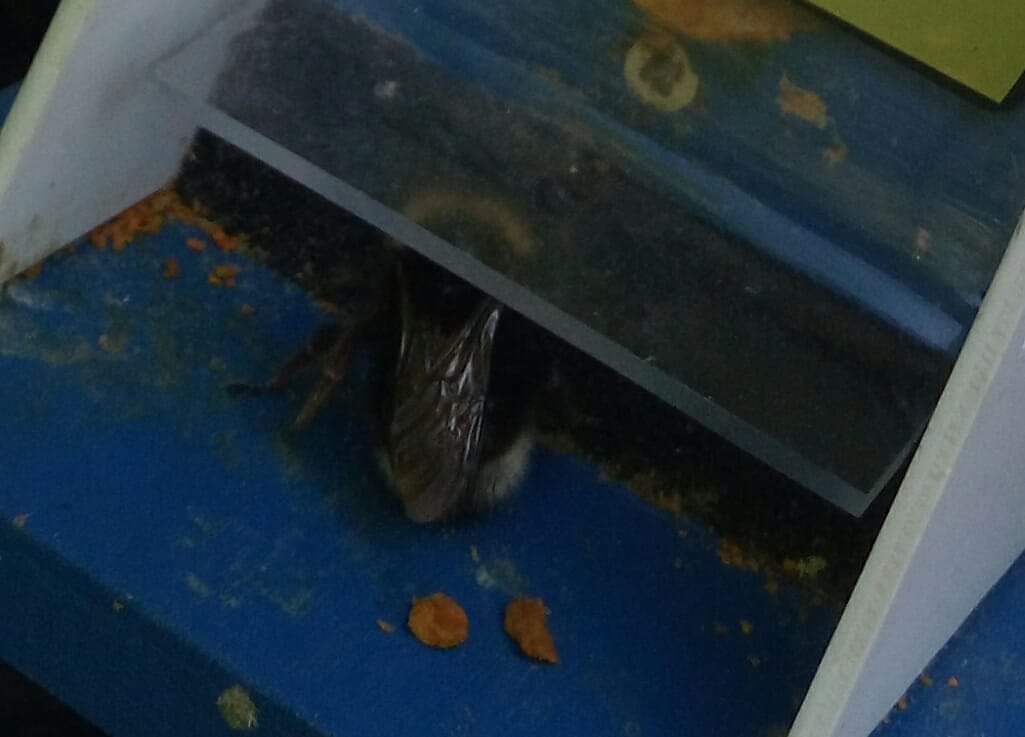
Bohemian Patchouli (Psithyrus bohemicus)
Photo L. Wettermannová (2019)
How to intervene when a nest is attacked
Intervention at the moment of attack is no longer possible - however, we do not recommend destroying the nest (we will explain in the following text).
What happens if you don't intervene?
As we wrote above, once the nest is attacked, intervention is no longer possible - it's too late.
After a hive is attacked by a mother bumblebee, the mother queen bumblebee is killed. The generation of sexual bumblebees, her offspring, is usually completely lost, at best.
It often happens that the beekeeper does not recognize the attack of the hive by wasps. Even if this happens, it is necessary to admit that the wasp is also a protected creature, its occurrence is smaller than that of bumblebees, and therefore we recommend letting things take their course
The bumblebee is also a beautiful relative of the bumblebee and pollinates the flowers of plants when it visits them. Therefore, it also deserves our attention - let it live and accept the state of things. If you are lucky, the nest will already contain larvae and pupae of adult bumblebees, and sometimes even mothers and males.
Is the patchouli really a pest?
This is a very difficult question. From a human perspective, yes. But in reality, its life is more complicated than that of a bumblebee and is therefore more endangered . Bumblebees are supposed to reduce the excessive number of bumblebees in nature, and if the number of bumblebees decreases, there will also be fewer bumblebees.
Even scientists are not in agreement on whether the mother of an infested nest will always be killed by the ants. Not all species of ants restrict the development of their host species, sometimes coexist with them and to some extent tolerate each other .
If you see a bumblebee feeding on flowers, you will know that it certainly has its importance in pollinating them . Its mother also takes touching care of her offspring and if it were not for the murder of the host mother, we probably would not be angry with her. After all, they are so similar to bumblebees. Sometime during the course of evolution millions of years ago, each lineage chose a different direction and you cannot be angry with them for that. But when you fly in and move, you probably will not notice that it is not a bumblebee...
Bumblebees also have their place in nature . In some abundant bumblebee species, they serve as their natural reducing agent . This is the case, for example, in the abundant ground bumblebee (Bombus terrestris) and the parasitic virgin bumblebee (Bombus vestalis).
Patchouli are also a good indicator of the health of their host species. If they are present somewhere, their host species is thriving there. Otherwise, patchouli would not thrive in that location either.
Although bumblebees do not collect pollen and nectar, they pollinate plants while feeding . They are therefore pollinators , like bumblebees, although they are probably not as efficient.
There are fewer wasps than bumblebees. That is why it is necessary to protect and, if you encounter them, respect their way of life .
So let the patchouli live even if it scares you!
Conclusion
- Try to prevent a patchouli attack by closing the protective flap promptly and consistently.
- Do not leave the protective flap open even when the little workers are "struggling" with it - at that time the wasps attack.
- Don't kill bumblebees and let them live - they are close relatives of bumblebees and an integral part of our nature
- If you are interested in bumblebee and wasp species in the Czech Republic , check out the species catalog HERE
Check out the beautiful photos of pačmelák by Hanka Kříženecká on the website www.blanokridlivpraze.cz
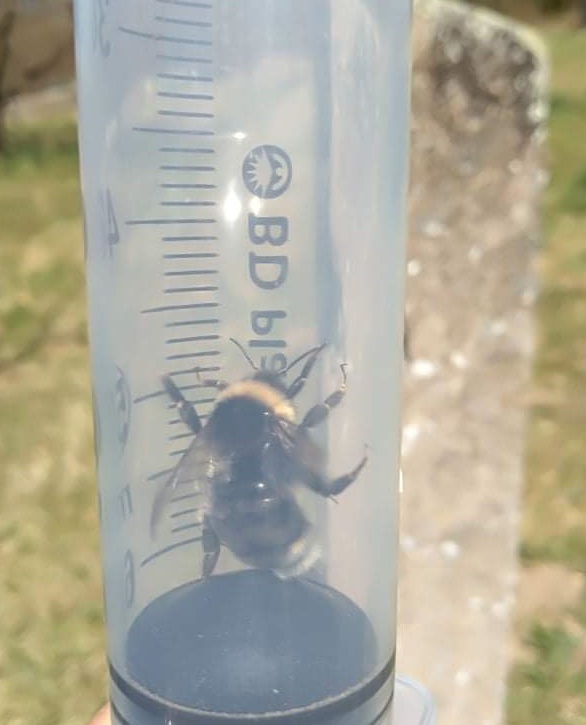
Bumblebee or bumblebee?
"Blue" and Martina already know..
Photo: M. Bradová