Protective flap
What you will learn here
- What is the purpose of the protective flap?
- What does such a flap look like?
- How to care for the flap
Last updated date: 7/2/2024
In a nutshell
- Protection against parasites: the protective flap protects the bumblebee nest from its parasites and enemies
- Install the flap on time : for the flap to perform its function, it must be installed and folded on time
- It is better to buy a protective flap: making a protective flap is not easy, we recommend buying a functional flap from an established manufacturer - you will save time, worry and money
- The stickers on the protective flap have a purpose : they help the bumblebees press the flap in the right place and lift the flap.
- Rising stripe: a roughened strip for the flap helps bumblebees lift the flap
- The damper flap must move freely: if the flap gets stuck when moving, the damper is not functional
- Bumblebees can handle the flap: it is usually the breeder who thinks the flap is getting in the way of the bumblebees
- The flap does not bother the bumblebees: the flap protects the bumblebees, the real trouble is the parasites that can destroy the nest
- Only a closed flap protects the nest: if the flap is not closed, it does not protect the nest
- Set the hive horizontally: For the flap to work properly, the base of the hive must be horizontal.
- Check the flap regularly: if the flap is dirty with wax and pollen, it is not functional.
- The flap can be adjusted: if the bumblebees are losing pollen on the flap, carefully adjust the edge of the inlet hole with fine sandpaper.
- Treat the damper after the season: the damper is exposed to the weather, so treat it after the season. Maintenance and a protective canopy will extend the life of the damper
English Abstract
- Protection from parasites: the protective flap protects the bumblebee nest from their parasites and enemies
- Install the flap in time: for the flap to perform its function, it must be installed and folded in time
- Buy a protective flap : it is not easy to make a protective flap, we recommend buying a working flap from an established manufacturer – you will save yourself time, trouble and costs
- The stickers on the flap have a purpose: they help bumblebees to push the flap in the right place and lift the flap
- Climbing bar: the roughened bar behind the flap helps bumblebees to lift the flap
- The flap of the flapper must move freely: if the flapper catches when moving, the flapper is not functional
- Bumblebees can handle the flap: it's usually the keeper who seems to be bothered by the flap
- The flap doesn't bother the bumblebees: the flap protects the bumblebees, the real trouble is the parasites can destroy the nest
- Only a closed flap protects the nest: if the flap is not closed, it does not protect the nest
- Position the beehive horizontally : For the flap to work properly, the base of the hive must be horizontal
- Check the flap regularly: if the flap is contaminated with wax and pollen, it is not functional
- The flap can be adjusted: if bumblebees lose pollen on the flap, carefully adjust the edge of the inlet opening with a fine emery board
- Treat the flap after the season: the flap is exposed to the weather, so treat it after the season. Maintenance and a protective canopy will prolong the life of the flap
Contents
Introduction
The meaning of a protective flap
The principle of operation of a protective flap
Technical design of a protective flap – the most important components
Description of the key features of a protective flap and its use
Buying a protective flap – what to focus on when choosing a flap
Comparison and recommendations for modifying protective flaps
Flap stickers
Roughening the entry surface of the flap body Flap
roof and sides
Other recommendations
Storage
How bumblebees use the flap
Conclusion
Introduction
A protective flap is an absolutely essential part of every hive. Just as a hive must have a roof, it must also have a protective flap.
From our experience, we know how often its importance is underestimated , which is why we have described it in detail in the section for novice breeders to convince them and help them have a successful first season.
Although we describe the protective flap and many of its details on our website, we highly recommend that novice beekeepers buy one . Making your own flap is not as easy as it might seem and in the end you will not save money , but rather spend a lot of time making and tuning it . Moreover, any mistake in making a flap leads to problems that will endanger your bumblebee breeding and may lead to a premature end to the season .
Even the authors of this website do not make knee flaps, and we make a lot of things for bumblebees ourselves 🙂
The fact that some manufacturers ignore the importance of the protective flap proves the low quality of their products and the overall attitude towards the interest in the result of breeding, or breeding as such. If a manufacturer sells a sty without a flap, this is the first signal that something is wrong (see How to choose the right sty ).
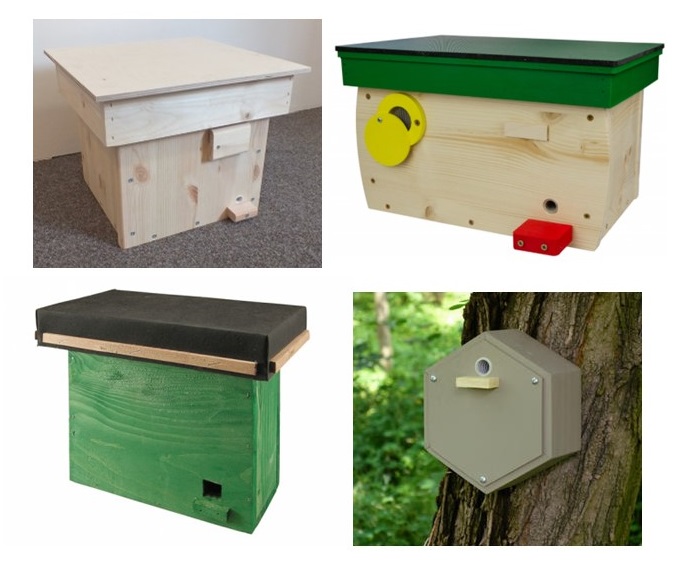
Examples of unsuitable hives without a protective flap
Source: eShopy sellers
Sellers very often sell hives without protective flaps .
It is true that some recommend a flap at least somewhere in a long text describing the hive. However, if the purchase is made online on the eShop, such a recommendation is very easy to overlook and a novice beekeeper runs into a problem. In this case, it would be enough to take a photo of the hive with a flap, put it in the eShop and deliver the hive with a flap as standard.
However, in general, if a seller offers you a hive without a protective flap, they know nothing about bumblebee breeding.
If someone already has the flap, they can remove it from the order upon express request (i.e. with one "click" in the eShop). Or instead of the text " Free filling ", you could also write " Protective flap required ".
We have been telling hive manufacturers this little thing, which would be very helpful, for several years, some have already understood, others have not. Then we deal with their clients' infested bumblebee nests and they cry on the phone that no one warned them about it.
Maybe one day the manufacturer will understand this too, it would be a small thing and a real help to bumblebees .
Any slightly more skilled carpenter can make and sell a nice box with a hole and a gooseneck, and with minimal costs. The protective flap, on the other hand, is the most technically and cost-intensive part of the hive - it requires precise and high-quality material processing. That is why we pay great attention to its correct design.
It often happens that a beekeeper buys a protective flap, but for some reason does not use it , or puts it on the hive too late . Often, novice beekeepers feel sorry for their bumblebees, that they "troubled" with the flap and leave it open for them . Sometimes, novice beekeepers decide to save a few hundred crowns and not buy the flap at all . We have come across many cases where the seller did not warn the customer about the necessity of its use and calmly sold him the hive without it (see above).
All these breeders/sellers expose the bumblebee nest to a risk equivalent to certainty . A hive without a protective flap will sooner or later be invaded by parasites, the nest will be weakened and will usually die prematurely - no further generations of sexual individuals (queens and drones) will be born in it.
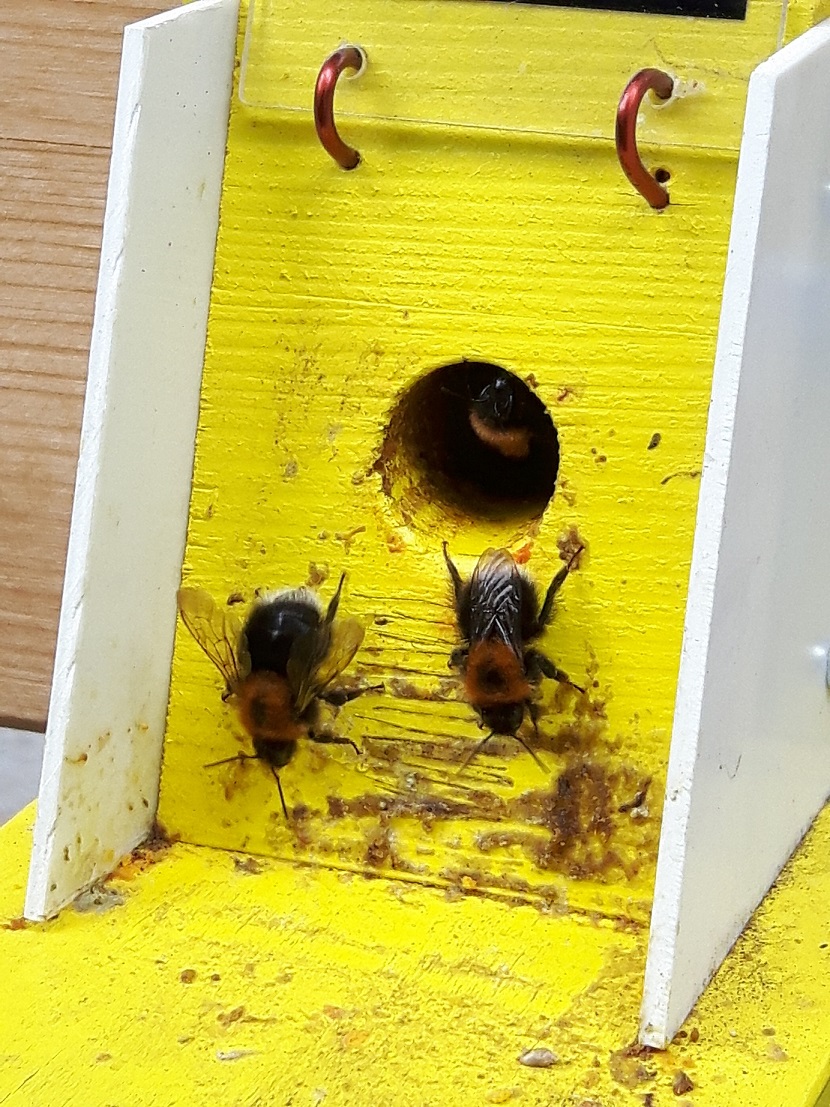
The open flap of the protective flap as an open path for parasites
Photo O.Hercog
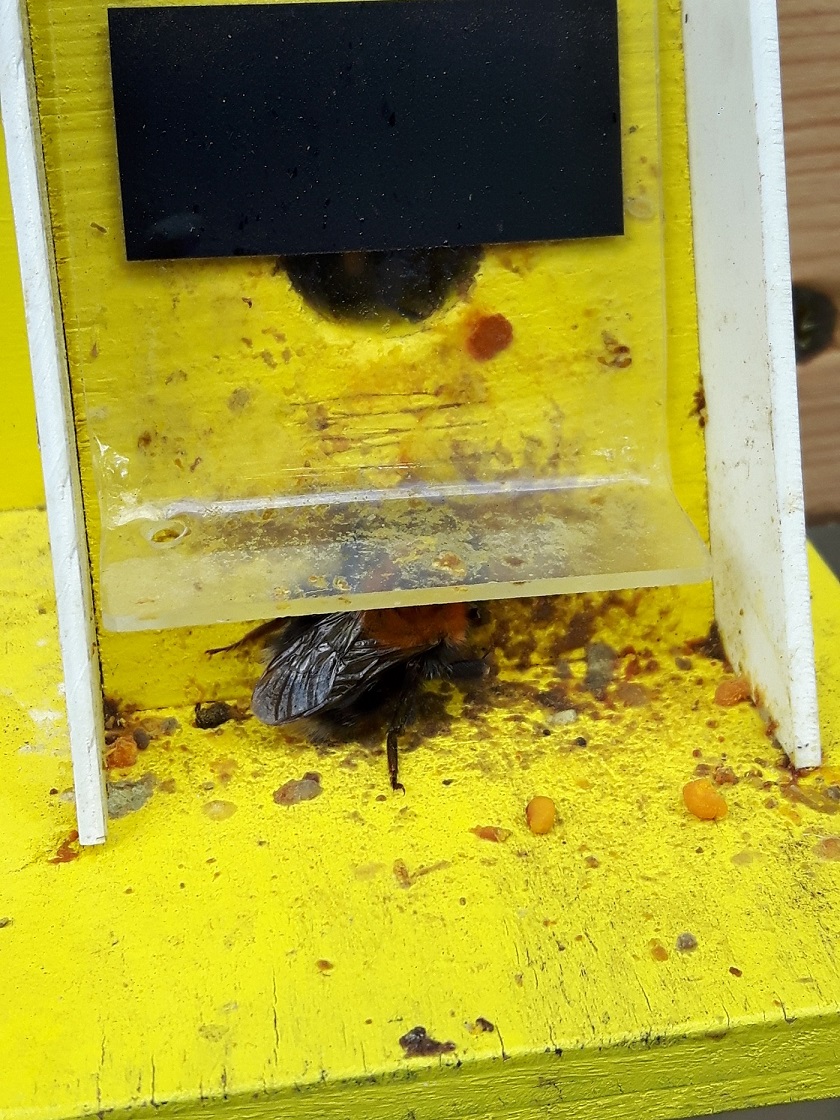
Protective flap clogged with pollen threads and wax
Photo O.Hercog
Also remember that the protective flap must be fitted to the hive as soon as you install it and must be used from the start . The flap also protects the queen bee in the solitary phase against intruders and other queens who would like to occupy her hive!
Training bumblebees is especially important for the mother-queen. She must learn to use the hatch after nesting. This is because when she flies out, she does not yet have a fully developed nest. Without training, there is a risk that she may abandon it or, while searching for a way to overcome the hatch without training, she will be on the prowl for an unnecessarily long time and fall victim to enemies (birds). All other bumblebees, guided by the scent of the nest, can already cope with the hatch. Making it easier for bumblebees to work with the hatch means opening the door to parasites and reducing efficiency.
You can learn how to teach bumblebees to use the flap, how to control it and how to maintain it during the season in the chapters on breeding under the title The Season Begins. The page dedicated to using the flap is HERE .
You must not forget that you must regularly check the functionality of the flap. The flap can sometimes get stuck, bumblebees also often lose pollen threads on the flap or wax parts of it. If the flap does not close, the path to the hive will be free for parasites. We will also provide you with procedures for checking the flap later.
You can read more about the protective flap, the history of its development, more complex modifications, etc. in the chapter for advanced breeders. We are still working on the chapter there and will announce the final version in due course.
Our recommendations and texts here are the consensus opinion of our breeding team, not the opinion of one person. That is why the final version of the article takes longer because the working version is first discussed by a panel. .-)
We recommend again:
1. Get a proven model of protective flap and resist the temptation to make your own flap. It is better not to start manufacturing or making more complex modifications. There is a lot to expect in the first season and especially in the event of a problem, you need to know that you have a good foundation = a reliable trap and a proven flap. Without this, it is very difficult for an inexperienced breeder to find the cause of a possible problem in breeding.
2. Use the flap from the beginning, check it and protect the bumblebee nest in the hive
The meaning of the protective flap
Every hive must have an entrance for bumblebees, but this is also a critical point for parasites to enter the hive. The protective flap is the only really functional part of the hive that has a chance of stopping the parasite at this point.
It must be admitted that even a hive equipped with a flap is not 100% safe. Parasites have more opportunities to penetrate the hive. However, a protective flap significantly reduces the risk of parasites penetrating a hive with bumblebees.
Part of the penetrations are the fault of the beekeeper. If the flap is to work , the flap must always be closed, the flap must seal against the wooden body and the functionality of the flap must be checked regularly .
Sometimes a parasite still manages to overcome the flap, but the probability of a successful attack is much lower and therefore the chance of the bumblebee colony surviving is greater than in hives without a flap.
Why does this happen? Parasites orient themselves primarily by the smell of the nest or by following the returning workers, and here it is necessary to realize the fundamental difference compared to natural nests. A man-made nest is a closed above-ground space from which the smell is released only through leaks and penetrations. This creates a clear and distinct trail , which can be smelled far and wide.
In natural nests, the situation is different. Some bumblebee species have nests underground, where the ground acts as both an absorber (absorbs the smell) and a diffuser (disperses the smell). In addition, in ground nests, the workers adjust the entrance as needed, which is not possible in a hive, at most they can close the entrance to the hive with a lining. Some species have natural above-ground nests, but even there the dispersion of the smell into the surroundings is greater than in the case of hives. The parasite also finds these natural nests, but usually later than in the case of a hive, so there is a greater chance of bringing out sexual individuals than in the case of a hive. Studies also show that most natural nests are destroyed by parasites.
Some breeders/sellers are promoting their strategy of offering bumblebees a hive and leaving everything to nature – but we do not agree with this approach. The hive can thus become nothing more than a feeder and a breeding ground for parasites.
If we offer bumblebees a hive, we have a responsibility for them and must take care of them – see the above-described issue of finding a hive by the smell of the nest . If we do not do this, the nest will be attacked, weakened and probably destroyed before a sufficient number of new queens and males have time to develop. Those who want to leave it to nature should arrange a garden for the bumblebees, but it is better not to buy a hive as an artificial structure – then they will really help the bumblebees and not harm them. Sellers of beehives without flaps are not happy with this approach of ours. Their goal is mostly just to sell as many hives as possible and they are not interested in the rest. But we are not here for their business, but for the bumblebees. Everyone uses the flap, including breeders who are able to perform detailed inspections of the nest and treat it in case of infestation by parasites.
Added traps, auxiliary protection methods (e.g. attempts to cover the smell of the hive with aromatic plants) are all just additional options that increase the overall protection of the hive, but they cannot be considered an equivalent replacement for the flap.
Side benefit of the protective flap:
- prevents drafts in the hive,
- limits the penetration of light into the hive in cases where the hive does not have a corridor,
- allows you to close the hideout if you perform an action on it or in its vicinity.

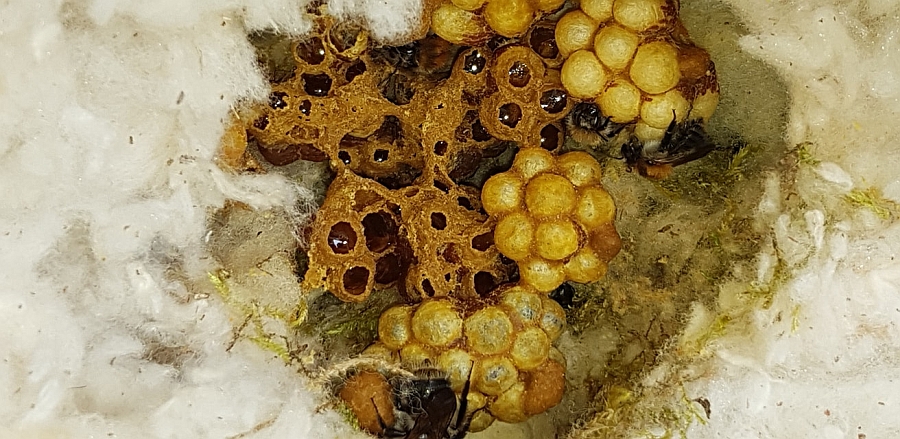
A view into the nest, where the flap is consistently used.
photo O. Hercog
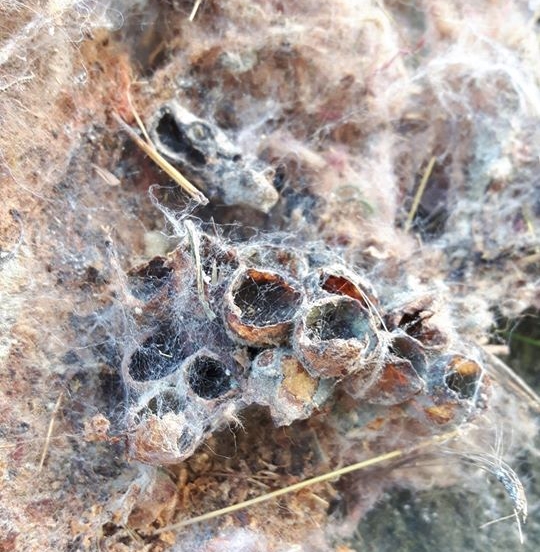
And here it was left to nature without a hitch. The nest was eaten and covered in Aphomia sociella caterpillars
Operating principle of the protective flap
A protective flap is actually a light flap or trapdoor that covers the entrance to the hive (the entrance hole). The flap prevents bumblebee parasites from getting into the nest and harming the bumblebees there.
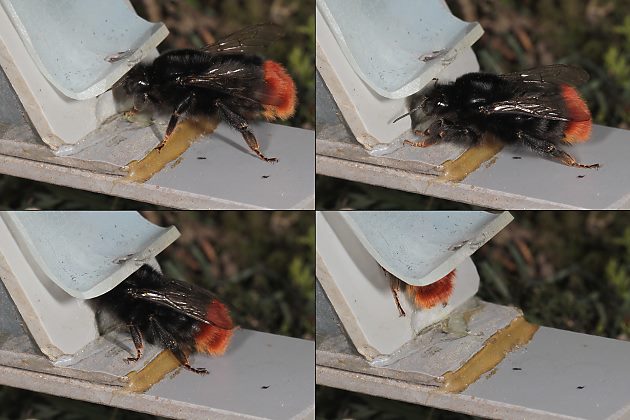
Bumblebees quickly get used to having to lift the flap and slip under it, and they also have to get to their home. After a while, they can safely walk along the pheromone-scented path to and from the hive.
The parasite does not have the strength to lift the flap properly (e.g. the dreaded bumblebee warbler or parasitic flies). Or it does have the strength to do so (wasps, wasps), but it does not have the "nerves" to do so - it needs to learn and wait, it simply did not expect such an obstacle. It does not know how to do it with a flap, so it "cannot" do it and will fly away without it, looking elsewhere. Yes, the wasp sometimes lifts the flap, but at least it discourages some of them from attacking the nest.

Protective flap – entering rock bumblebee (Bombus lapidarius)
Photo http://www.wildbienen.de
In this video you can see how bumblebees pass through the flap . For the purposes of creating the video, we used transparent flap sides and here the side was dismantled.
Technical design of the damper – the most important components
For better orientation in the following texts, it is better to first describe such a flap:
A valve refers to the entire mechanism, which has integral parts:
- Flap (door) a movable part that covers the entrance to the flap passage.
- The body of the flap – it is a wooden beveled square with an inlet hole and a passage to the hive.
- Entry part of the body – this is the front part of the flap body, which the bumblebees use to climb to the entry hole and where they lift the flap from below. It has a free part and a part covered by the flap. Its dimensions and design are important because it is also a place through which a parasite can enter the hive.
- Valve hinge – mechanism that ensures valve movement
- Base – the bottom plate to which the damper body is attached, protects the body from moisture
- Česno – the overhanging area of the base where bumblebees land and take off
- Sidewalls (in other literature sidewalls ) – body covers and flaps on the side against wind, parasites and rain
- Back plate – depending on the design, it is the connection point to the hive
- Canopy – protects the valve body and prevents water from flowing under the valve (not in the photo)
- Trap – a solution for catching parasites attacking the nest in the hive (not in the photo)
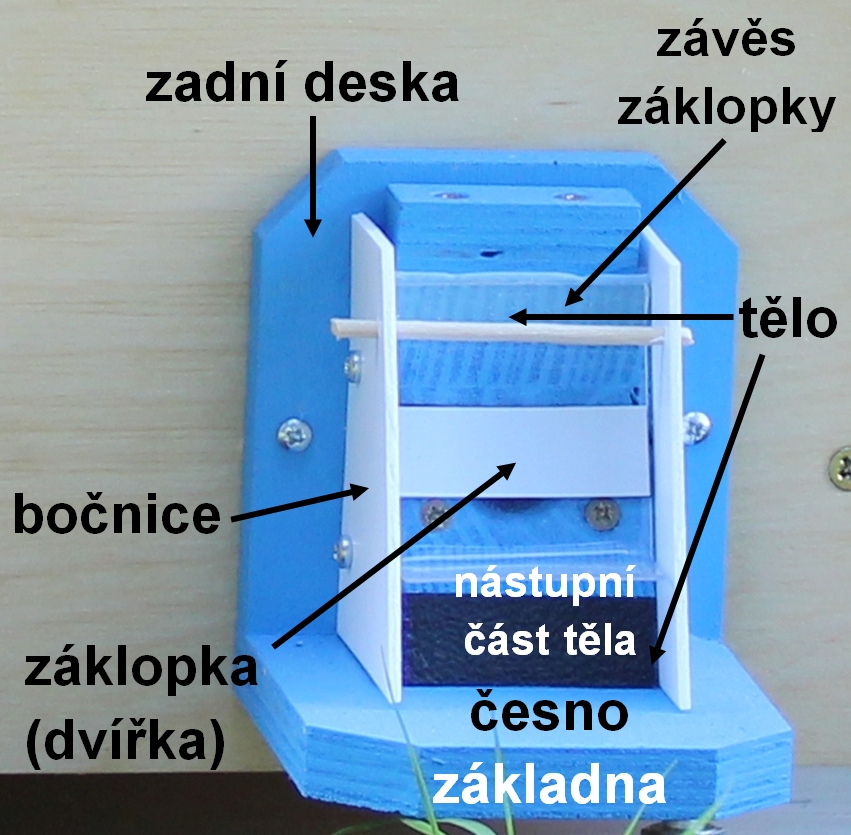
Description of the flap parts
photo J. Černý
Description of the key features of the protective flap and its use
For a damper to fulfill its purpose, it must:
- Be made of quality materials and withstand weather conditions for several seasons.
The flap should be robust and painted with water-resistant ecological paints - The flap should have the ability to regulate the flap stroke .
You need this solution to "train" bumblebees to lift the flap.
The regulation does not necessarily have to be on the flap, but we consider it the optimal solution. - The inlet opening (passage through the damper body) should have a diameter (clearance) of no more than 16 mm.
Do not adjust the diameter of the inlet opening in the damper. The damper also functions as an aperture and should not let larger individuals, such as mice, pass through.
Our proposals for modifying the entrance corridor (inlet pipe) only address the corridor that is connected to the damper. - The entrance hole should have slightly rounded edges and a smooth surface (coating).
Thanks to this measure and less roughness, bumblebees lose fewer pollen grains here. - The landing surface of the body of the flap should be roughened so that the bumblebees can climb on it better and lift the flap with their backs.
According to our recommendation, manufacturers provide this surface with Velcro or notches. The surface should also be blackened. However, it is best to use black anti-slip tape , which, in addition to the roughened surface, guides the bumblebees to land on the underside of the garlic (see further text). - The flap must fully rest on its base.
The flap must not protrude, otherwise parasites will use this gap to lift or crawl under. Bumblebees pollute the flap. A pollen grain can get stuck there, they often build up wax deposits on it, or they displace part of the lining – all of which results in the flap not closing properly.
The flap needs to be checked and cleaned, preferably every evening after dark. - The door must lift freely and close freely . The door must not jam, rub or jam.
The flap must be checked. - The trap must be heavy enough to prevent the parasites from lifting it easily.
Note: Sometimes there are various instructions on the Internet on how to reduce the weight of the trap to make it easier for the workers to pass through. A light trap is not a problem, but it also does not provide any protection. - covered on the outside stickers = shaded with black tape/paint so that it covers the upper 2/3 of the entrance hole when the flap is closed (lowered onto the flap body).
The light into the hive then shines through only on the lower side of the entrance hole (view into the flap from the side of the hive).
This is important for bumblebees climbing out of the hive – at that moment they are looking for a way out for light. The solution forces them to push into the lower third of the hole, where they open the flap with the least effort. - The flap is covered on the outside stickers = shaded with white tape/paint .
This is important for bumblebees returning to the hive – at that moment they are looking for the dark area of the entry hole. If you cover this black tape/paint with white tape/paint , the arriving bumblebee will navigate to the dark area of the landing surface of the flap body (on the anti-slip tape). It will land here and start pushing and lifting the flap.
So it is two tapes glued over each other. Please see the photos “Adjusting the flap. Covering the black tape with white tape”, which will illustrate the description for you. - The space that bumblebees have to overcome by crawling under the door must be at least 10 mm long for the flap to fulfill its protective role.
- The flap must be closed at all times.
Examples of the most common mistakes “out of sympathy”:
1. The flap is used only at night.
2. The flap is left ajar due to small workers or loss of cocoons.
3. The flap is not used at all. - The protective flap should be protected by a roof against rainwater.
Buying a damper - what to focus on when selecting a damper
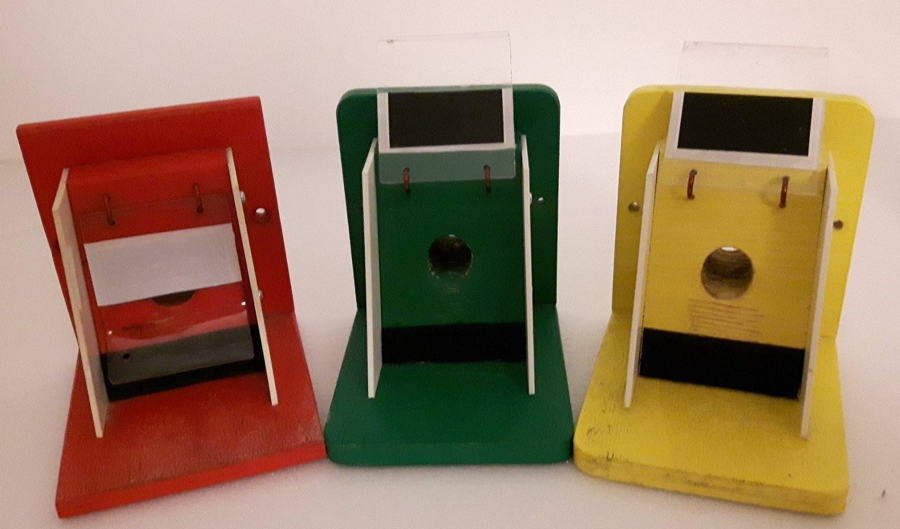
There are several products on the market, with different designs. We have tested the following three and can comment on them.
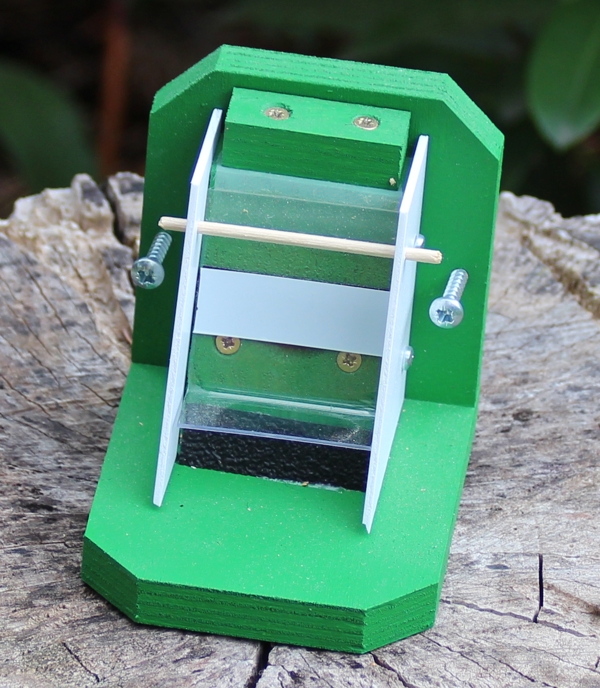
Currently, the most advanced product is Product (A) shown in the picture. It is robust, weather resistant and, thanks to the hinge (Uhelon) designed by our group, has a smooth operation without the risk of jamming. The hinge also eliminates parasites that try to penetrate the inlet opening from the top. The polycarbonate flap cover is firmly attached to the flap body with screws.
Product (B) , as an alternative from which Product (B) emerged. The model is very widespread. It is by no means a bad product, just outdated in some respects. However, it can be easily modified.
However, recently we have noticed a problem with the durability of this product, especially if it has been wetted by rainwater.
The polycarbonate canopy, which is interestingly inserted into the body of the flap, is a good idea. However, if water flows here, the flap collapses. The canopy often falls off in the wind and then rains on the flap. Older models had a separate canopy, which was more advantageous from this point of view.
Product (C) This is a new model of side flap inspired by the German model. The model also includes a side trap for catching parasites. It uses the same hinge as Product (A).
The polycarbonate flap cover is firmly attached to the flap body with screws.
Note: The effectiveness of this trap has not yet been fully verified. However, the function of the flap is unaffected by the side trap, so it can also be classified as a top product.
We do not list specific manufacturers due to our Code, but you can find them on the Internet.
The described types of protective flaps are shown in the figures:
Some manufacturers use Uhelon hinges on their flaps. This is a solution from Čmeláci PLUS, which they provided to them for free. See HERE

Product (A) Recommended model based on a competitive damper. Incorporates the latest recommendations and findings.
Photo: manufacturer's website
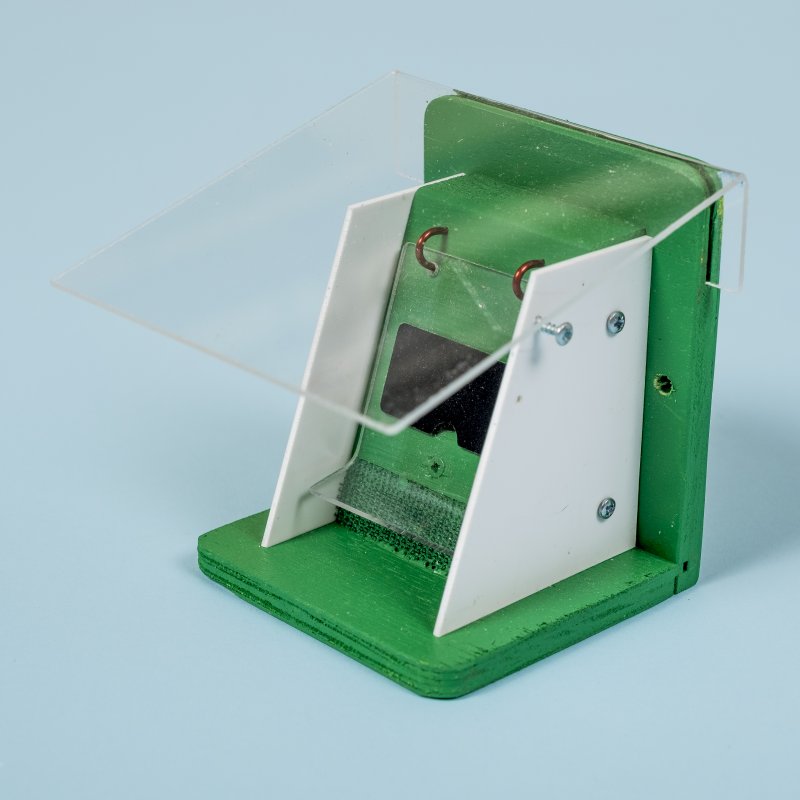
Product (B) . Older, but fully functional and much expanded model. We recommend a few modifications.
Photo taken from the seller's website
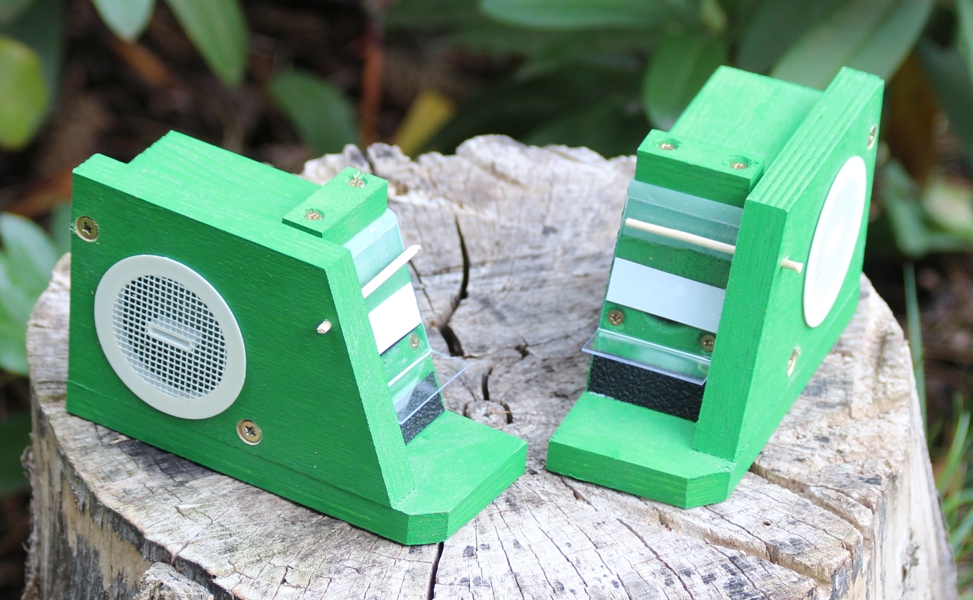
Product (C) New in the development of flaps. A flap with side mounting on the hive, supplemented with a trap for parasites lurking near the flap. The effectiveness of the trap in the testing stage.
Photo: seller's website
Comparison and recommendations for adjusting protective flaps
Valve stickers
All types of protective flaps listed here meet the requirement to cover the upper 2/3 of the inlet creature and have a black tape applied to shade the inlet opening on the flap, see Description of key features of the protective flap and its use .
Repetition: A bumblebee returning home to the hive looks for a dark spot that reminds it of the entrance to a dark corridor. The outer black sticker (with an undifferentiated lower landing area) directs it to the flap. It cannot climb through here and, moreover, if it sits on the flap, it makes it difficult for the bumblebees to climb out, as it weighs down the flap.
That is why it is really important that the sticker has two layers – the bottom black and the outer one in white or the same color as the entire flap, so that the sticker does not confuse the arriving bumblebees.
Solution:
- If the flap is provided with a black sticker, do not remove it . Cover it with white tape or paint it so that the underlying black sticker is completely covered.
Be careful to leave the viewing window at the bottom free . Apply the paint or sticker to the existing one and always only to the outside of the flap so that the flap fits well. - If you decide to use stickers, electrician's insulating tape sold in hobby stores or electrical stores is ideal.
- If you decide to use paint , water-based acrylic paints used in modeling are suitable.
Layers should be applied gradually, only after the previous one has dried. - If the valve does not have any stickers, please visit the section for advanced breeders, where it will be described in detail how to apply the stickers correctly (we are preparing).

Adjusting the flap. Covering the black tape with white tape. Leaving only the lower window.
photo O. Hercog
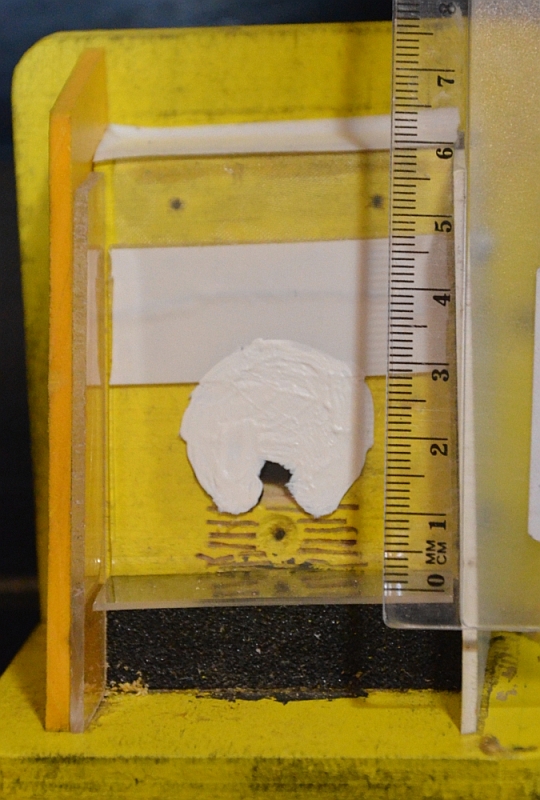
Final painting of the flap and checking the correct width of the body's entry surface.
The dark target under the white mark is the unpainted area, = a view into the inlet opening. Photo by K.Kučera
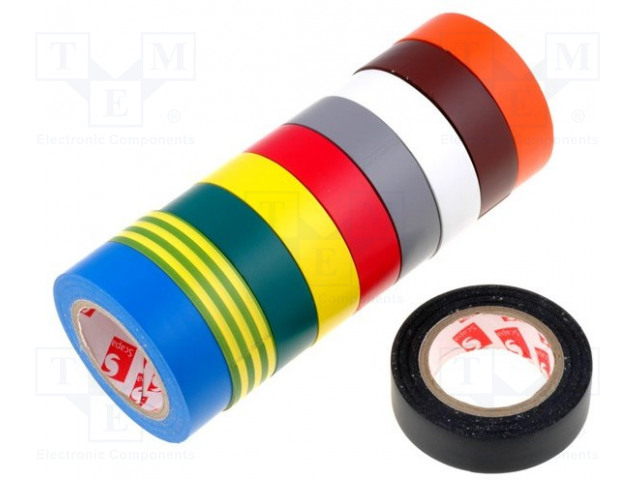
electrical insulating tape
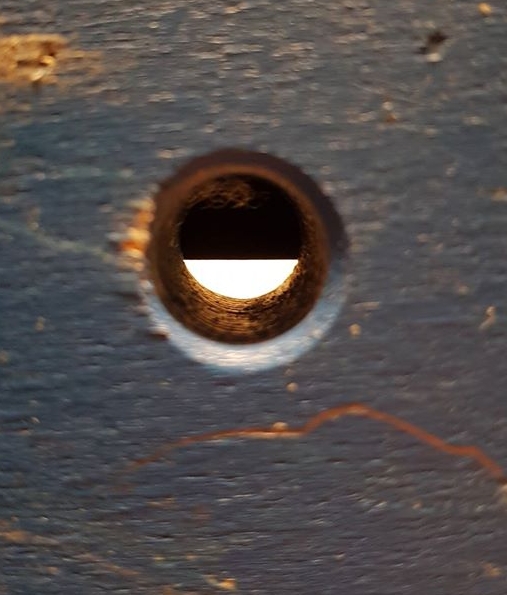
This is what a bumblebee should see when it climbs out of the hive through the flap.
Translucent only in the lower third of the corridor.
photo O. Hercog
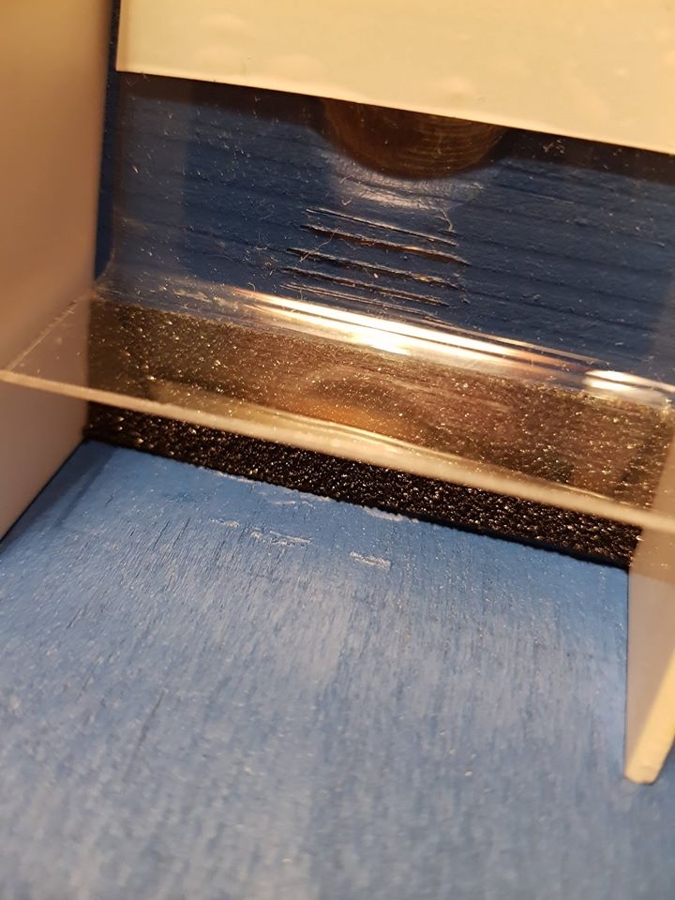
Roughening of the flap body entry surface
After landing on the garlic, the bumblebees push their heads and backs against the valve and climb up to the entry hole under the valve. They lift the valve and gradually slip under it until they get inside. It is advisable to roughen this climbing surface so that they can climb better and lift the valve more easily.
The roughening of the landing area is done only between the garlic and the bend of the flap. At the same time, this area should have a dark finish, especially the part under the opening into the flap, as this helps the bumblebees to orient themselves correctly to land on the flap.
If everything is resolved well, then:
- The worker bees with pollen threads waste no time searching for the right entrance,
- Hair loss is reduced,
- The possibility of waxing and the veil getting stuck in the contact area between the body and the valve is reduced.
Note: pollen grain loss always occurs, but this can be reduced
The part of the flap body covered by the flap (the surface on which the flap rests) is a very important part of the hive because this surface forms a barrier to penetration for the parasite.
Solution:
- should not reduce it, for example by excessively enlarging the inlet opening.
- If you have a valve with a damaged valve, contact the manufacturer, or see the solution in the section for advanced breeders (coming soon).
Products (A) and (C) meet these requirements. In the case of Product (B) a Velcro is used, where we have recorded several cases where a worker bee's leg got stuck in the Velcro. However, the Velcro works and if it is painted over, it is not dangerous for bumblebees,
Solution:
- We recommend using black anti-slip tape for the edges of the stairs. Tesa ANTI-SLIP tape ( self-adhesive anti-slip tape for stairs from the hobby market) has proven to be the best.
In terms of its roughness, it is a material similar to sandpaper. However, unlike sandpaper, the tape is adapted to moisture and abrasion. - We do not recommend sandpaper because it loses its strength in moisture, crumbles and peels off.
- Replace the Velcro strip with a stair anti-slip strip. Use the same dimensions and placement as the original strip.
- If the flap does not contain any tape, add it as recommended products have.
- Note: the tape must not extend into the bend of the flap or even into the part covered by the flap!
The bumblebee must be able to stick its head under the rounded part of the flap and the tape/velcro – this means a gap of about 5 mm. In the bend of the flap, it would be harder for bumblebees to lift the flap and if the tape is also under the flap, the flap would not fit properly. - If you do not want to change the Velcro strip, we recommend painting it black at the entrance hole. This creates a mark where the bumblebees should go when they fly through.
The mark should not interfere with the garlic, as it is better to leave it clear for cleaning the flap.
Advantages:
- The black area directs the bumblebees to the correct flap entry point
- The rough, only grainy surface makes it easier to get on the flap body, but at the same time does not lead to the loss of hairs
- easy cleaning of the belt
- unlike Velcro, there is no risk of the bumblebee getting stuck on the Velcro hooks
Alternative solution:
- If you do not have anti-slip tape (recommended) or self-adhesive Velcro tape (the part with the eyes), you can make shallow horizontal climbing cuts in the entry area with the tip of a knife,
- However, the notches should not extend below the flap so as not to reduce its protective function,
- We recommend painting this area black (dark color), to help guide incoming bumblebees.
.

Correct design of the anti-slip strip and scratches. The strip ends under the flap. The flap fully fits the body. The scratches are shallow.
Photo O. Hercog
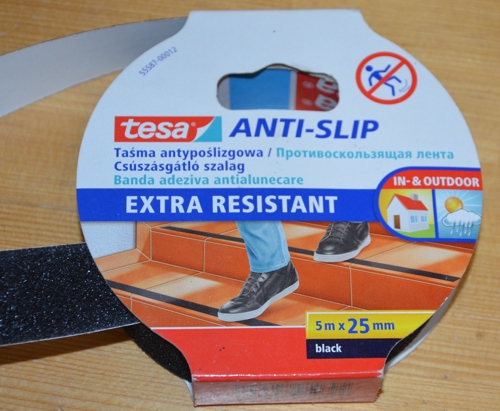
Recommended material for replacing the Velcro on the entry surface on the flap body
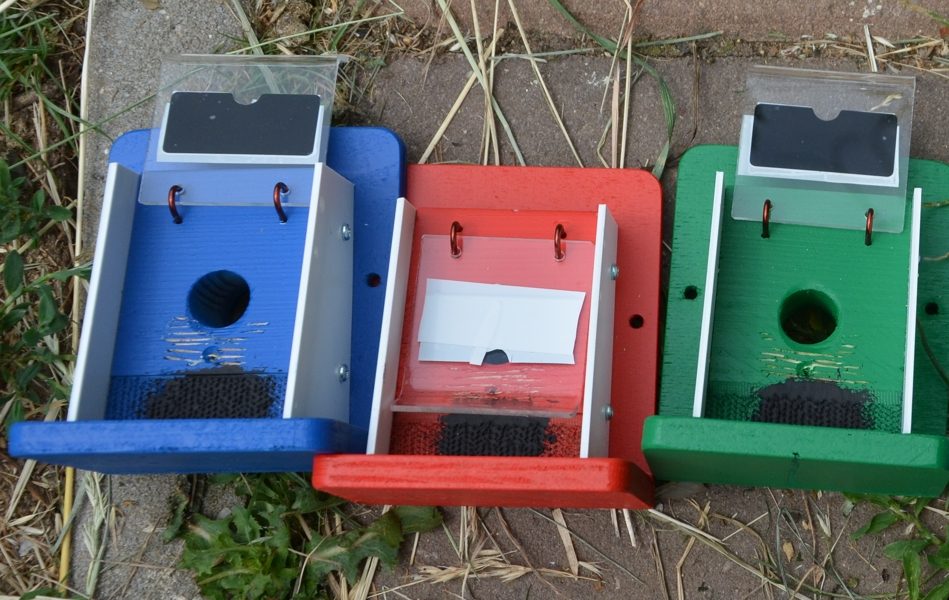
Repair of the color of the flap using white electrical tape.
Color repair of the Velcro fastener with a dark landing mark.
Photo by K. Kučera
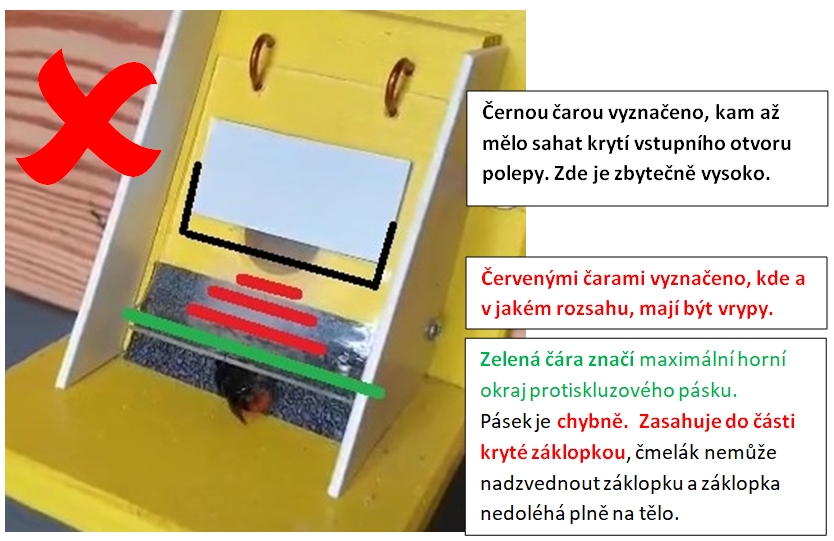
Unsuccessful adjustment of the flap. Errors described in the picture.
Photo: K. Kučera and A. Ungerová
Other recommendations
The geometry (dimensions and angles of the flap) is important for the correct function of the flap. Therefore, we recommend that breeders purchase a flap that has been tested in practice and we deliberately do not publish instructions for its manufacture.
The products we listed have these properties, but we still have a few recommendations for easy adjustments/checks.
- Product (B) model has one screw with a conical head . The screw is intended for lowering the flap during training of the queen mother. The manufacturer placed it there and did not want to take advice that the screw placed in this way would bother the queen mother and, in the worst case, injure her with the sharp edge of the screw head. It is not like putting a fence post in front of the front door of the house ... "-)
Solution:
- remove the screw, putty the place after it and paint it
- instead of a screw, there are other methods for regulating the flap that do not damage the flap with additional holes, see Controlling the flap and How to teach the queen mother to use the flap (we are preparing)
- if you insist on learning with screws, then the screws should be higher and only on the sides, not under the entrance hole, see photos. For details, see the advanced section. - If you are using an old, already used damper, check before the season whether the damper body has been damaged and the contact surface has been lost.
Solution:
– it is a good idea to temporarily remove one side panel and inspect it from the side.
– if the damper is deformed, complain about it or repair it so that the damper fits properly. - If you use the damper for several seasons, the wire hangers can cause wear on the damper.
Solution:
– replace the damper (plastic part) with a new one. - If you have dirty flap surfaces and roughening tapes, clean the flap and fit new tapes.
- If you don't have to, don't repaint the flap with new paint - the smell of the flap after bumblebees is an attractant for other bumblebees.

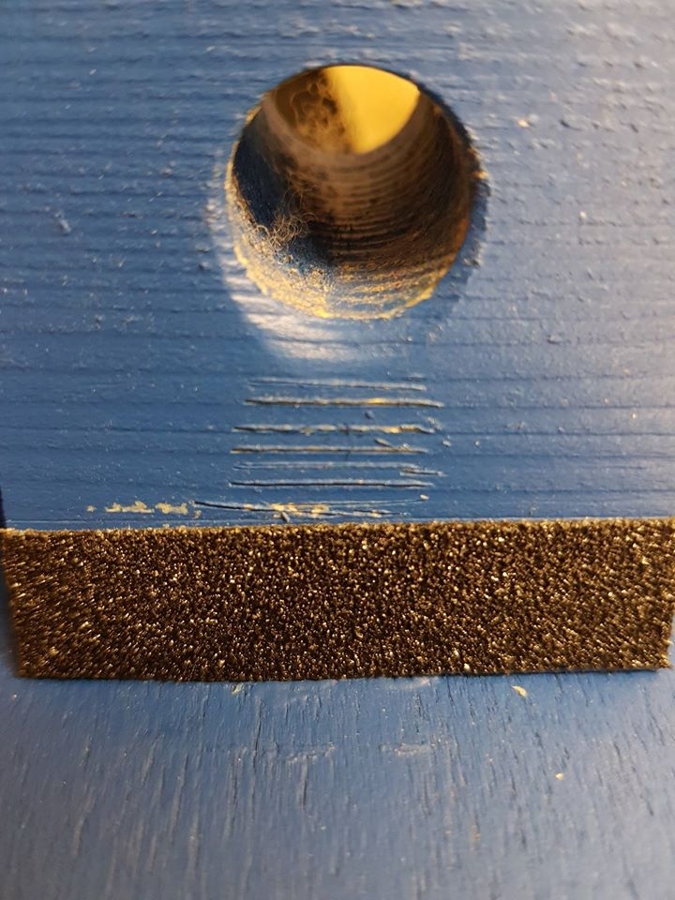
This is what the entry surface of the flap body should look like.
Shallow, non-contacting grooves and a Tesa anti-slip strip.
photo O. Hercog
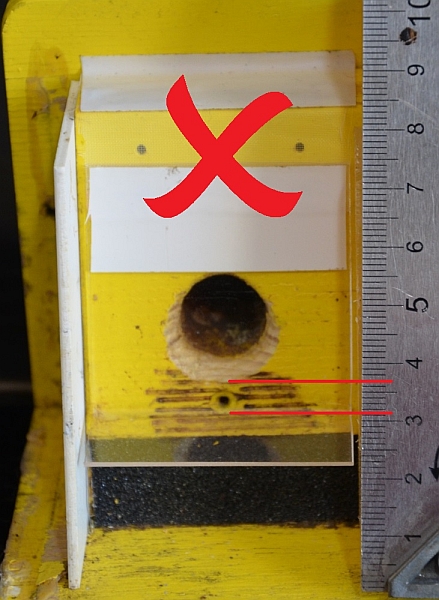
Poorly executed flap modification. Grinding the groove reduced the protective surface of the entry part of the body, covered by the flap.
photo: K. Kučera
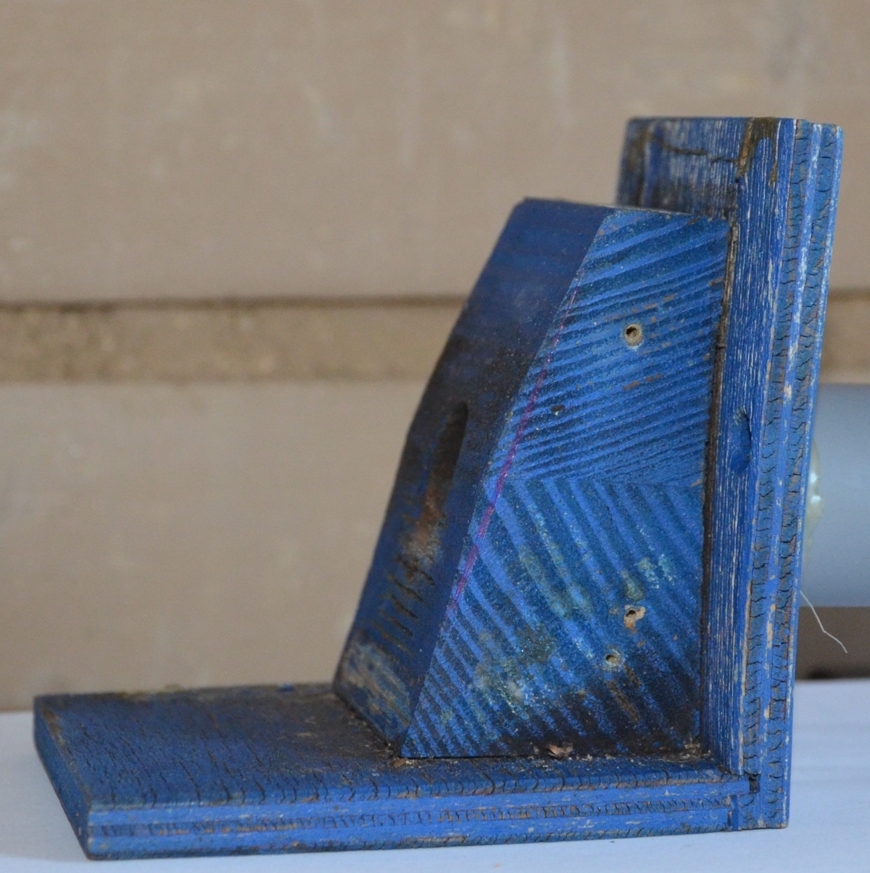
An example of why we recommend removing the side panel and inspecting the body on older valves. Body collapse due to water leaking onto the valve.
Photo: K. Kučera
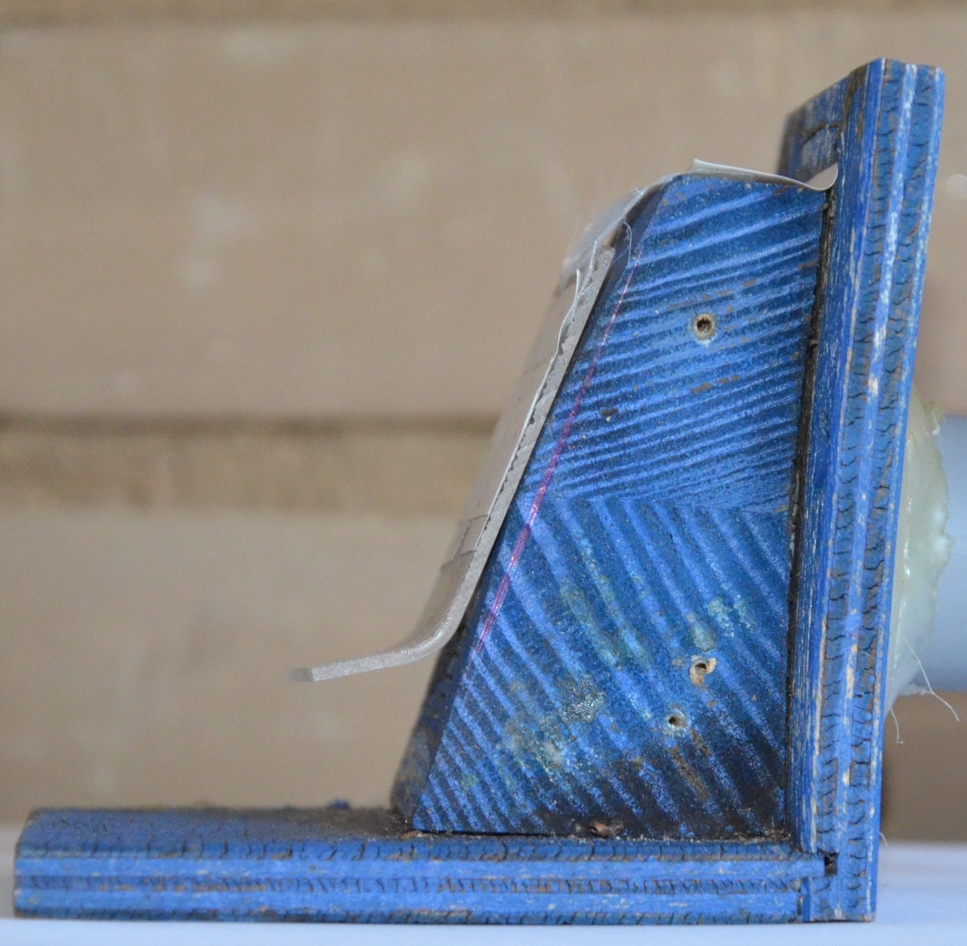
After removing the sidewall, it is noticeable that the flap is almost not touching the sidewall. The flap is not functional. Damage caused by moisture.
Photo: K. Kučera
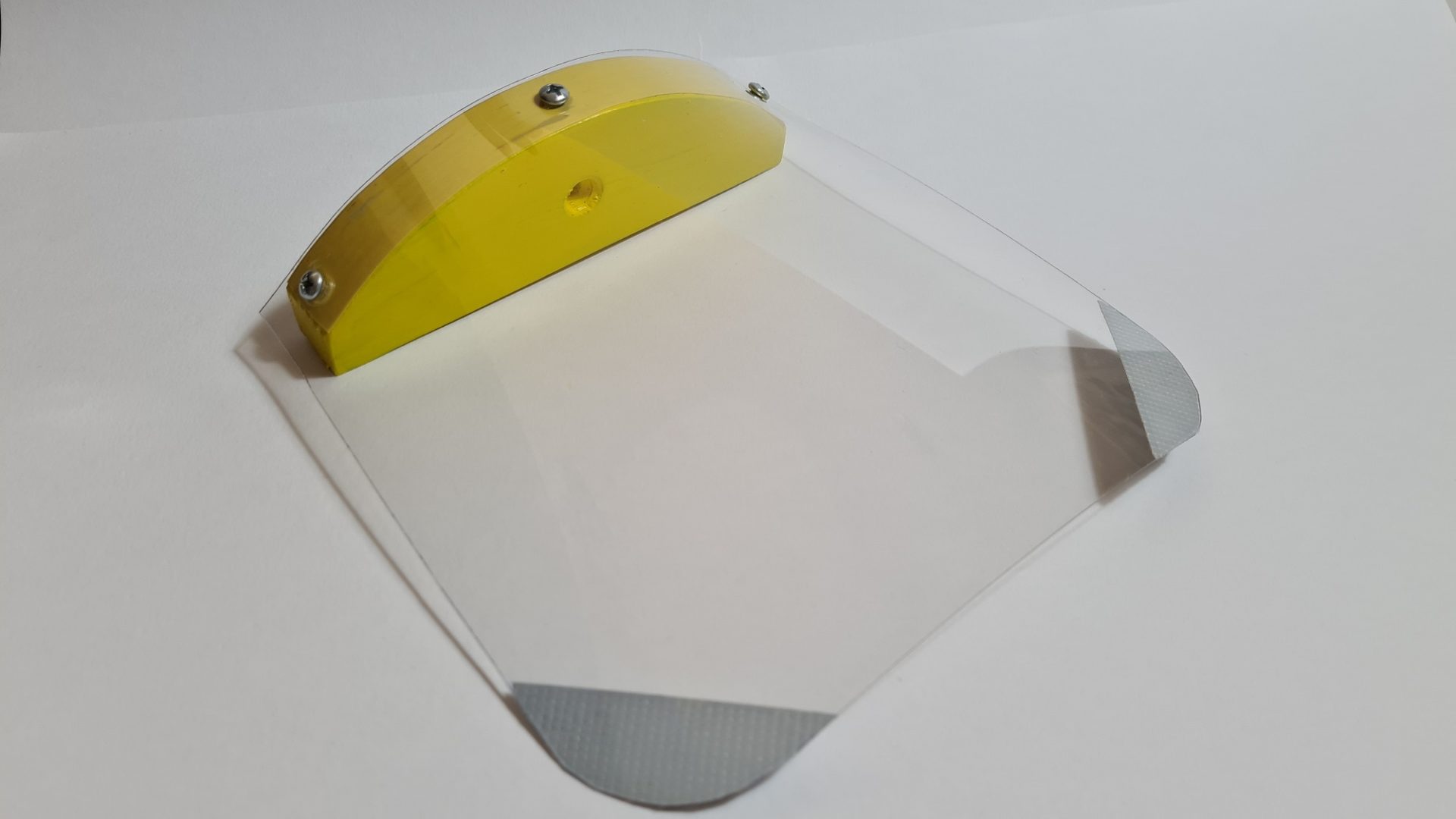
Roof and side panels of the flap
Like the side panels, the flap cover is also very important - it prevents water from flowing onto the flap .
If gets wet at the flap location, the flap adheres firmly to the base by capillary forces and bumblebees will not lift it.
The canopy, as well as the sidewalls , prevents the wind from lifting the flap .
The polycarbonate (plexiglass) canopy is supplied separately for commercial products, or in one package together with a protective flap.
1. Flap with separate canopy
The canopy is mounted on a ledge above the flap. This solution was used in older models of Product (B).
When installing the canopy, the canopy should be positioned so that it covers the flap, but at the same time so that the flap can be lifted (preferably to a completely vertical position).
2. Damper with a roof attached with screws to the damper body
If you have a sturdy damper body, such as Product (A), a thin polycarbonate canopy can be screwed onto the damper body. The canopy is thin and flexible, it bends on its own and the water drips off the roof.
3. Flaps with a canopy inserted into a cutout in the flap body.
The new model of Product (B) does not have a very well-designed canopy. Although the intention was good (the canopy can be easily removed and inserted into the cutout in the back wall), the design could not be sufficiently tested in practice. Otherwise, the manufacturer would have to figure out that water is leaking into the back plate at the point where the groove is . It sticks there and cracks the back plate. As a result, not only does the canopy either not hold or cannot be mounted. There is also a risk of damage to the back plate, which then may not fit exactly on the hive, and this is a big problem - parasites can enter the hive through leaks between the hive and the back plate. In addition, there is a general deformation of the flap and a reduction in its service life .
Solution:
- The roof joint must be protected from leaking water, .
- We recommend covering this area with high-quality waterproof textile tape so that water cannot flow along the inserted roof into the back plate. So stick the tape as the outer corner of the roof on the hive.
You can easily make an elegant canopy that will protect the flap very well. You can find the instructions HERE

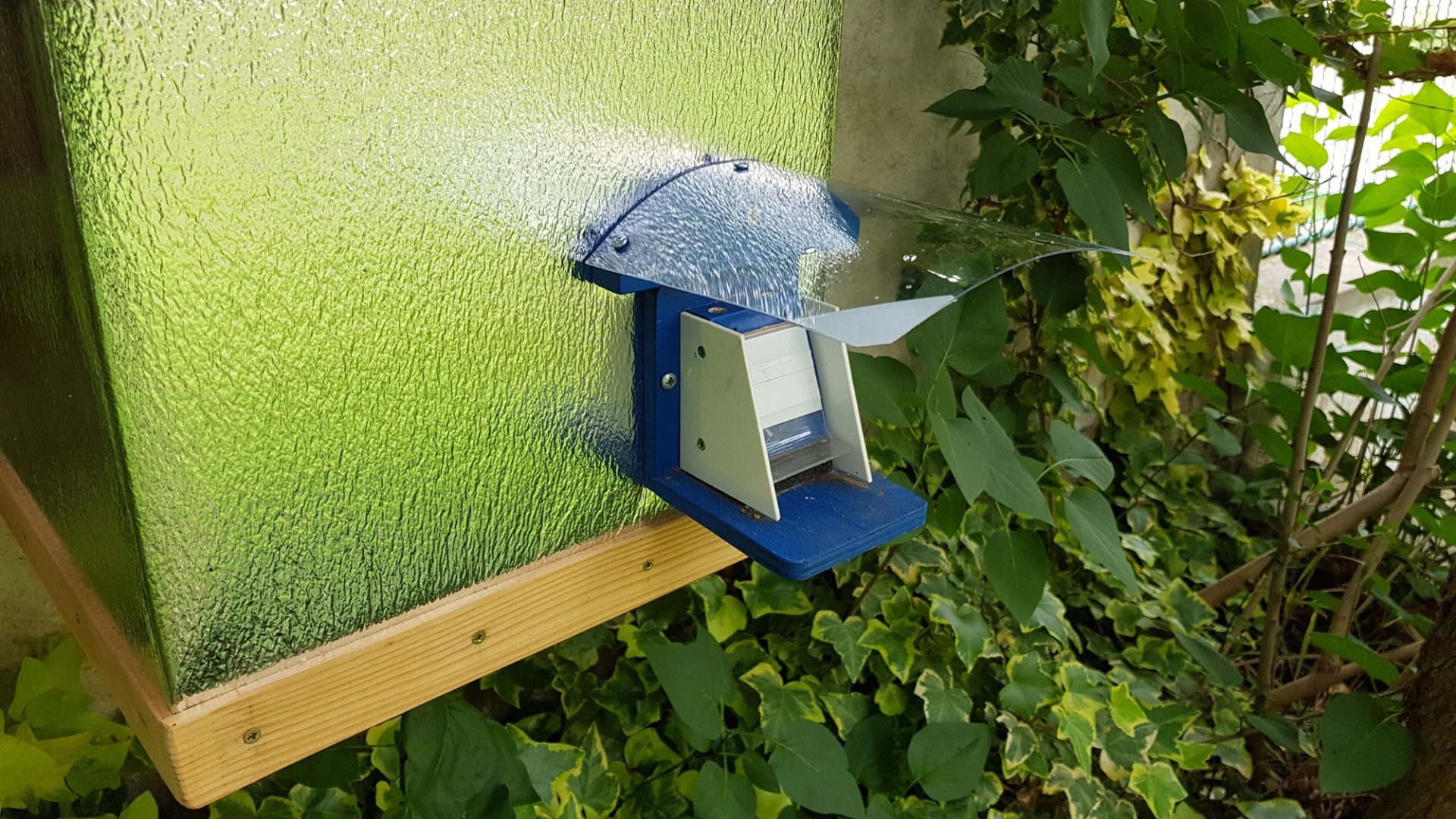
Bumblebees PLUS - Canopy mounted on a holder
Photo O. Hercog 6/2020
Bumblebees PLUS – A shelter over a drop
Photo O, Hercog 6/2020
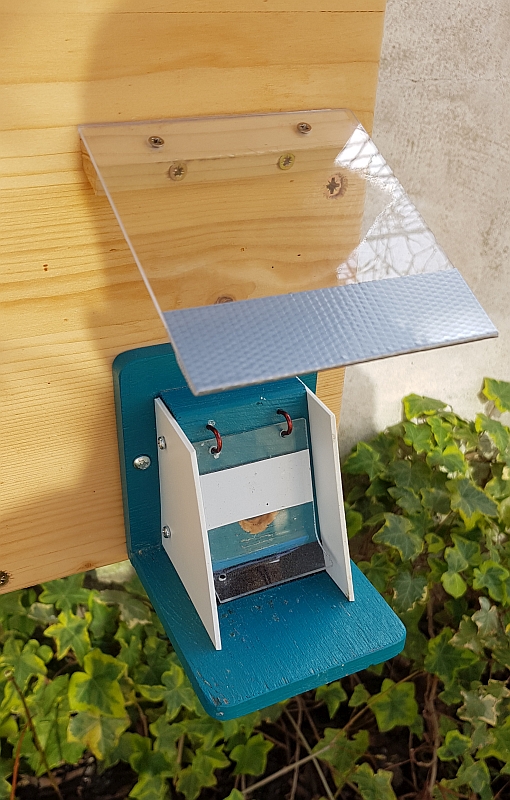
Correct placement of the canopy protecting the flap. The tape edge improves the visibility of the canopy and also shades the grass.
Photo O. Hercog
Back wall sagging due to water seeping into the roof notch. One season of use.
Photo: K. Kučera
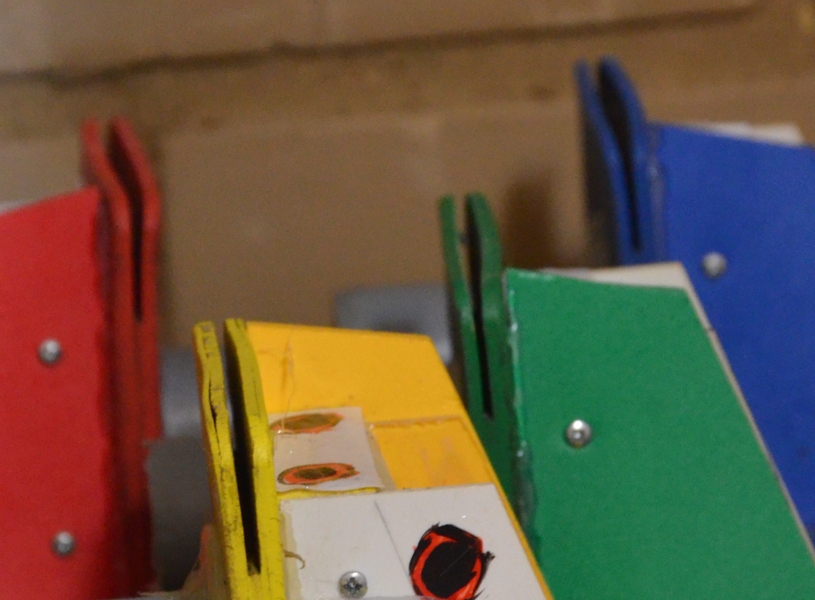
Side view of damage to the notch for the canopy. Flaps Product (B) after one season.
photo K. Kučera
Storage of protective flaps
We recommend storing the flap in a dry place during the off-season.
How bumblebees use the protective flap in the hive
Don't worry about bothering the bumblebees with the flap. They will handle it and you should leave it to them.
The only bumblebee that needs to be helped at the beginning (taught) , i.e. accustomed to using the flap, is the queen bee , and this should be done soon after settling in.
The sooner you get the queen mother used to the flap, the sooner she will be protected , for example from another queen who would like to settle in the hive and drive away/kill the original resident.
The mother needs some time to get used to the flap.
You can find the procedure for teaching her to use the flap HERE
Conclusion
- The protective flap is an essential part of a bumblebee hive , so we have been using it from the very beginning.
- To start breeding, we recommend one of the three commercial flaps listed here.
- The most important part of the flap is the landing area of the body covered by the flap and the flap itself.
- The above parts must be kept clean and checked to ensure that the valve fully fits the body.
- We never leave the valve open or ajar.
- For the type where the hanging mechanism is solved using rings, check whether the flap does not get stuck .
- The canopy must be above the valve to prevent water from flowing between the valve and its body.
