



- Bumblebee farming is not always helpful to bumblebees; there are easier and much more beneficial ways to help them.
- Bumblebee farming is a beautiful but time-consuming hobby – think carefully before you start it.
- It will cost you time, money, and nerves – bumblebee keeping has its joys, but it can also lead to setbacks.
- Don't attempt to breed bumblebees without a tolerant family/partner.
- Acquiring a bumblebee nest is just the beginning; the keeper needs a whole range of equipment.
- Most beekeepers don't stop at one hive, but gradually acquire more hives.
- Care is essential, as the beekeeper must take care of the bumblebee colony in the hive throughout the entire season – from spring to late summer.
- The breeder must be patient and able to overcome fear and shyness in order to work with the nest.
- Without good grout, it's not possible; cheap commercial products are often a waste of money.
- Making your own hive is often more expensive than buying a quality one. The „trial and error“ method usually leads to the loss of the brood.
- Beehive rearing requires patience and humility, the ability to learn from failure, and the willingness to start again.
- If none of that puts you off, why not join us?
- If you are hesitant, it is better to undertake other help for bumblebees, for example, creating a diverse garden with nectar-rich plants, where bumblebees and other insects will find enough food throughout the season.
Please have a look at this page to find out more
Let’s take a moment to think about it first.
Bee husbandry is not always beneficial to bumblebees; there are easier and much more helpful ways to do this.
Before you decide on keeping bumblebees, you need to realise that it will cost you a lot of time, money and hassle, and you have to take responsibility as well.
If everything goes well, it’s wonderful. We at the Čmeláci PLUS association and the breeders call this passion for bumblebees „bombophilia“(according to bumblebee = bombus).
It is also important to realise that, even if you do everything right, nature is more powerful and your bumblebee breeding efforts may not succeed. Many novice breeders often fail in their first season and then needlessly give up on bumblebee breeding – and on bumblebees themselves.
Please bear in mind that buying a beehive isn’t the end of the story – on the contrary, that’s just the start.
For those who are not entirely sure they want to go through with all this, we recommend supporting bumblebees in other ways, as described in the relevant chapter. That, too, is a form of help, and is often far more significant and beneficial to bumblebees.
The Čmeláci PLUS group does not sell bumblebees or bumblebee-keeping equipment. We are independent, long-standing keepers and share our practical experience with you in the hope of helping. With all modesty and a sense of responsibility for our work, we can say – who else can advise you better than those who are passionate about bumblebees and have devoted themselves to breeding and caring for them for many years? Many sellers of bumblebee hives dislike us for our approach, as it does not support their goal – to sell and forget. Our goals, however, are different.
The most fundamental, elementary consideration when deciding whether or not to go into breeding.
Bumblebee farming It doesn’t just mean buying a bird scarer and not worrying about it any more. Yes, you can simply purchase a hive, position it correctly and leave it entirely up to nature to see if it becomes inhabited. However, if it does become inhabited, you must be able to look after the hive, and it is then your responsibility to do so.
Why? Because it was you who made the hive and offered it for them to inhabit. The queen bumblebee chose it, not because she appreciated your efforts, but because she considers it a safe place to raise new queens and males. The hive is intentionally designed to resemble natural conditions as much as possible, and in this regard, we are actually deceiving her. Without looking after the beehive and the bumblebee colony, it just won't work.. Without this, parasites will appear and destroy the entire bumblebee family in the nest before it can raise new sexual individuals necessary for the survival of the population the following year. Therefore If you’re not prepared to look after the bumblebees, don’t buy a hive. You would only benefit manufacturers or sellers, not bumblebees or nature, but rather the opposite. Such a “breeder“ not only thwarts the queen from choosing another, and perhaps better, location, but also becomes a multiplier of bumblebee parasites, which subsequently harm natural nests in the vicinity. And surely you don't want that...
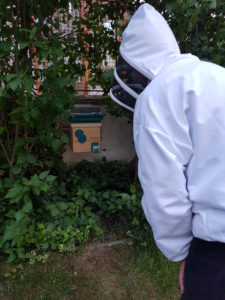
The inspection of the developed nest can commence
Photo: Ondřej Hercog
So it can't be done without care, but what does that entail?
- The breeder spends lots of time pre-season preparation, care for bumblebees and observing them Basic care doesn't take much time, but regularity is necessary – ideally every day, but at least At least once every 2-3 days.
- Have a chat with your family, if they go for it with you. Without a tolerant family, you will find yourself in awkward situations. A bumblebee nest is like an unwanted pet.
- If you plan to place a scare online, where you are once a month, You'd best not get a shock there.We will bring you a range of ideas on how to help bumblebees at your cottage, but the help does not lie in the hive.
- It requires patience. A bumblebee is a wild animal, it is neither a toy nor a pet. It will not obey you and will not fly as you whistle. Often you need to sit by the nest and observe and wait – only then will you find out if the queen has settled down or if the nest is functioning as it should.
- You need a bit of courage and determination. A developed nest is not just a joy, it's also a concern, and so at this time it's time to check the nest. Yes, it's necessary. There are various options, the secrets of which we will introduce you to. But you must not be afraid of bumblebees. The thought of a nest frightens whom?, when the hive opens (even with protective equipment) and dozens of worker bees „go“ towards him, he should look for other forms of help than direct breeding. It's not as demanding as beekeeping, but it's not as easy as the sellers claim either...
- Calculate with financial costs. Go for it, but only if you're willing to invest approximately £80 to £90 upfront for a quality bumblebee nest (i.e. with a flap and good insulation), and budget another £15 to £20 for basic protective gear (veil, gloves).
- There's no point spending money on low-quality products. It is necessary to purchase a truly high-quality scarecrow with protective features. (protective flap, good ventilation, quality sealing, etc.), ideally with references from beekeepers that bumblebees in such a hive
- You will need as well as luck for the queen mother to settle down. You can buy bumblebees, but then it's necessary Find a dealer with a licence and documentationthat he is selling to you natural bumblebee nest from the Czech Republic.
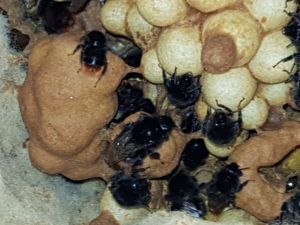
View of the bare nest on inspection day
- It requires self-reflection, determination, and a positive attitude. You're probably thinking, what nonsense is this... Well, it's not. Sometimes, even when you do everything right, investing resources, time, and care, the breeding still doesn't turn out well. It's enough for someone in the vicinity to carry out massive chemical treatment of plants, which poisons your bumblebees. Often, even an experienced breeder cannot answer why the nest failed and why the entire season was unsuccessful. One shouldn't be unhappy about it, but you also have to evaluate the possible causes, and if you yourself did something wrong – for example, neglected the care we recommended – then it is essential to learn from your mistakes for next time and try again (and better) next year.
Only if you are willing to fulfil all the points mentioned will bumblebee breeding make sense for you and for them. In that case, welcome to our breeders and a proper breeder starts no other way than with theoretical and subsequently practical preparation. For this, there will be a whole section here, under the heading "preparatory phase". More will be added gradually.
If you're thinking probably not...
Don't be sad, Looking after bumblebees isn't the main thing you can do for them.. It's just the icing on the cake, but the real and true help lies in your approach to insects. in your surroundings or in your garden, no matter how small. For you, but of course also for breeders, there will be a whole section on how to help not only bumblebees, but also other animals, and ultimately yourselves and your children. Even the best breeder has no chance of saving bumblebees if there are no favourable conditions for them in their surroundings. The whole help must start with this, and you will see, perhaps eventually, when you get to know bumblebees better, breeding will happen too 🙂
How to help bumblebees other than by breeding them
Beekeeping doesn't always have to be a help to bumblebees, especially if you won't have time for it. If you're hesitant, it's better to focus on other ways to help bumblebees, such as creating a diverse garden with nectar-rich plants where bumblebees and other insects will find plenty of food throughout the season.
On our pages, you will find lots of inspiration, for example HERE. There, as well as elsewhere on our website, you can choose from a range of support options. You can also find us on Facebook. Instagram a YouTube – every one is good and every one counts – thank you!
We will address individual topics on our pages and provide the necessary details.
We wish you every success.
CM+
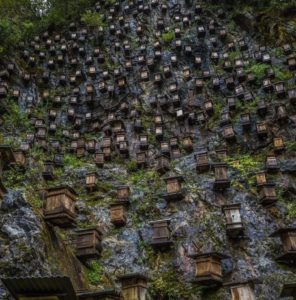
Beehives
Photo: Internet