



- Only a high-quality bumblebee nesting box will ensure that bumblebees thrive in it and complete their entire life cycle, meaning they will produce new queens and males, see HERE
- Producing your own hive/bumblebee box is often more expensive than buying a quality one. The „trial and error“ method usually leads to the loss of the nest and resignation from further breeding attempts.
- Looking at the accompanying text, you'll find that building a bumblebee nest isn't rocket science, but if you go into it without experience and equipment, making a bumblebee nest will take you a lot of time and the final costs will be higher than purchasing a quality nest from a trusted manufacturer.
- It's not worth spending money on low-quality products with suspiciously low prices. It's necessary to get a truly high-quality bumblebee house with protective features from a manufacturer with references from bumblebee breeders.
- The price of a good eagle today on the Czech market ranges from 2,500 – 3,000 CZK.
- We generally don't recommend bee hotels on DIY forums; many are offered by people who have never kept or successfully bred bumblebees in them.
- The hopper should be robust, with an internal volume of 12.5L or more.
- The ulcer's construction must be robust, made from high-quality and durable material, with wall thickness of at least 25-30mm.
- The seal must be tight, and the material used must not deform due to moisture.
- We do not recommend beehives with polystyrene roofs
- The housing must be fitted with an inlet opening with a protective flap against the ingress of parasites.
- The shelter must be equipped with closable ventilation with protection against pest entry.
- Interested in warranty period and terms
- The insulation must have good thermal properties – thin boards or polystyrene are not suitable
- Do not buy a chimney cowl without protective features such as a flap, or protection against parasites.
- The mount/stand should be variable, allowing you to choose a suitable placement location.
- The manufacturer should provide you with instructions or a link to resources on bumblebee rearing, as well as references from beekeepers stating that their hives are suitable for rearing. You can also obtain these by asking, for example. HERE
- If you can't decide which bee house to choose, ask bumblebee breeders, for example on our daughter website. Bumblebees PLUS – Discussion Forum
- On our website, you'll also find examples of products to avoid. You'll find them HERE
Essential tips and recommendations for Bumblebees PLUS
A bumblebee hive (bumblebee house) isn't just a nice-looking wooden box with a tunnel. It's a complex device that must have a protective flap at the entrance, good ventilation, and other details that will determine whether the keeper will be successful or, conversely, doom the bumblebee family at the first serious stress on the hive.
We will not specify which particular bumblebee hive you should buy here, as there are many manufacturers and each claims that their hive is the best. Unfortunately, both the shoddy boxes and quality hives are available for purchase. The mentioned flap is the first indicator of quality. To help novice keepers navigate such a qualitatively diverse range, we outline the key aspects to focus on and where the hidden pitfalls of products lie.
The time and care dedicated to choosing a bumblebee nest (bumblebee house) will pay off – it will significantly influence the chances of a successful season.
Tip 1: Focus on key hive parameters rather than on design and accompanying advertising. The essential parameters of the hives are listed below.
Second council: An idle tongue is an open door to misfortune.„
If the product is missing description in the points we list, do not hesitate to ask the manufacturer/seller. If The seller doesn't know, mist, noHe is unwilling to answer questions, you are buying a pig in a poke, and the result will usually surprise you unpleasantly. You might not like it, but it can directly endanger the bumblebees' lives... It's then difficult to make a claim on a product that is missing something or another, when you haven't specifically asked beforehand. Due to complaints, we recommend always resolving the specification of the hive in writing.
A few general shopping tips: Ask for specific and clear answers; do not be lulled by sentences such as:
“It's verified, so you don't need to worry.” – Really? From what sample size? Where is that documented? Are the results truly reliable?
“In our opinion, Mr. XY's opinion is that this is/is not necessary.” Do you know Mr XY and do you trust him? Is it really his opinion, or did someone just borrow it and tweak it? Isn't it better to check directly with the stated author to see if that's actually the case?
Many people have had this/tried this before you and were satisfied
Perhaps yes, perhaps no. Do you know a company that would claim the opposite when you're interested in buying, even if it were true? It's better to use FB / the net and to ask breeders directly perhaps within the breeding community Bumblebees PLUS – Discussion Forum.
Very soft, very dense, very firm etc…
Subjective impression, but to what extent. How much is "very" really in units. What do you imagine by it, someone else will imagine something completely different, and again, the company probably won't claim that its materials are first and foremost the cheapest... .
You'll try and see.
Alright, so what are Cancellation termsWho will pay for the return postage of the goods?
Manufacturer introductions versus DIYers
Higher quality products should be supplied manufacturers who produce them in larger series. This isn't always the case. That's why we try to advise manufacturers free of charge so that their products are of high quality and meet the demands of breeding.
On the internet you can also find a number of small-scale manufacturers and DIY enthusiasts (handmade portals like FLER.CZ, but also others like bazos.cz etc.). Here, however, you will find a number of things „for a song“ made by those who have no idea what a bumblebee house (bumblebee nest) should look like. Here, another trap is hidden – The manufacturer can delete negative feedbacki And only keep those who suit him there. Customers' reactions here therefore may not be a good guide. Furthermore, most of those who buy a low-quality product here will no longer respond. If they do respond, you may not find their reaction there…
Warranty period
Before making any purchase, I would want to know what is covered by the warranty and How long is the warranty period. I would request the warranty conditions in writing. The shed is always exposed to excessive moisture, whether internal or external. As a buyer, I would definitely be interested in the warranty conditions regarding the strength of the joints, the bonding of the walls, and mould. Whether there are any manufacturing tolerances for accuracy beyond which the shed can be claimed.
Dinner
The price is important for everyone, however that is not the most important parameter. Follow the motto „I'm not so rich that I can afford cheap things.„Therefore, there's no point in buying a shock absorber for 500 CZK that you'll then throw away. We're not recording manufacturers, but the fact is that mass production and development cost something.
On our market today, quality hives cost over £1,500 (without a valve). Whether we like it or not, most hives below this price cannot be considered quality products. However, a price above £1,500 doesn't automatically guarantee good quality – see other recommendations.
Manufacturers and products
There are enough products on the market. Some are close to the state described below and can be easily modified into the correct state (e.g. adding a seal between the roof and the hive body). Others are almost there, and after one year of operation, the bumblebees, their parasites, and natural influences will show you themselves whether everything is as it should be.
However, there are also products on the market that merely pose as bumblebee nests and only share the name, or possibly the advertising, with a genuine hive.
It is also quite fundamental the difference whether beehives are made by a beekeeper or just a skilled carpenter, which, however, has no practical personal experience. This is precisely why you should pay attention to the key features of hives and also assess your options as to whether you yourself can possibly modify or supplement the purchased product if anything is missing.
Please remember that just You and your demands on the manufacturer are creating pressure So that shoddy goods stop being sold and excellent beehives were on sale. Until you buy, our customer is our master, and it's your money. It's a shame to waste it on a faulty product that you'll burn at the end of the season at best...
vody further improve and respond to what works well and can be recommended further. You can use the menu: write to us, contacts or our FB
Absolutely essential parameters for the correct bumblebee nest
Bumblebee nest size
- Bumblebees need adequate space for their nest (depending on the species)
- A sufficiently large pouch also provides space for a sufficient amount of heat-retaining lining (it insulates the nest in the cold and heat, and also influences humidity regulation).

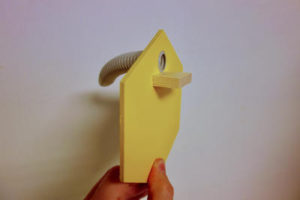
Example of a front wall of a completely unsuitable hive:
thin walls and a generally very small hive size
(Source: Internet, one of the beehive manufacturers)
Recommendation
- optimal Internal dimension It's a cube around 25cm which cube is most similar to it (i.e. 25-30cm (w) x 25-30cm (h) x 20-30cm (d)).
- internal volume would so should not be less than 12.5l – a larger volume is better than a smaller one
- form Cube is optimal (a sphere-shaped nest fills it optimally)
- if it's going to be cuboid, the height should definitely not be disproportionately the smallest side, and the cuboid should be as close to a cube as possible, for reasons of ventilation and fluctuations in humidity and temperature when opening the hive.
- Smaller hives risk overheating, and as the colony grows, bumblebees will discard the lining, increasing the risk of mould development. Overall, a small space is much more susceptible to temperature fluctuations due to the weather. For this reason, we do not recommend such hives.
Construction of a bumblebee nest:
- The construction should be robust, as it must withstand the weather and increased humidity.
Recommendation
- As a material it is suitable use laminated wood – high-quality plywood/plywood, waterproof plywood,
or concrete plywood (can be bought as „non-slip plywood“ with a dark surface)
Note: water-repellent plywood is quite heavy, it is excellent for the roof of a beehive - wall thickness should 25–30 Mmm and more
- If it is about hives with internal air insulation, then 18mm is also sufficient. However, the individual wall layers must be insulated from the surroundings so that a flow of fresh air cannot access the gap between the walls.
- You can also layer the material, see thermal insulation further.
- úit is exposed to high internal and external humidity, as well as the strongly acidic environment of a bumblebee nest – It must be made of quality material
- Doesn't fit chipboard, OSB boards, pertinax, materials full of chemicals, It doesn't even fit mass (wood warps, cracks), even all-plastic hives are not suitable
- The material should, if possible, also be resistant to attacks by daty birds, or withstand this attack for a period of time
The airtightness of the construction and the seals between the hive parts
- very important that the construction is finalised sealed a do hnízda dragged and didn't get there parasites
Recommendation
- in the hive's corpus There must be no gaps, everything must seal well. Caulking is permissible but should not address rough leaks.
- The wall should be drag with waterproof glue and fastened with stronger screws
- the roof and ventilation openings must also Seal or must allow for the seal to be supplemented (soft rubber/foam or other durable seal);
- the seal itself does not stop some parasites; they can gnaw through it if the seal is not wide enough and the smell of manure passes through it. Therefore, it is recommended seals in multiple places (external and internal) and removal of nest odour from critical areas – see ventilation.
- some corners have a seal-free design. Thanks to a double sealing surface and an inserted acrylic plate seal achieved by construction
- In the joints, in the sealing, there must be no gaps (1 mm is a risk)
Entrance reducer
- Fright must have protective flap, without such blinds run out s with a certainty level of probability for attacking the nest and destroying it.
- If the flap is not part of the hive, it must be verified whether the flap can be attached to the hive in such a way that it fulfils its function.

Clap protecting the entrance to a bumblebee nest (source internet)
- A future beekeeper should, in a hive without a landing board, buy a straight flap and therefore the price calculation for the hive must also take into account that the hive does not include the flap as an integral part of it.
(Details on the flap and why to repair it, and why not at all, in the relevant section)
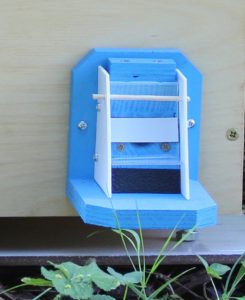
If someone is offering you a bumblebee box without a flap, be wary – something is amiss!
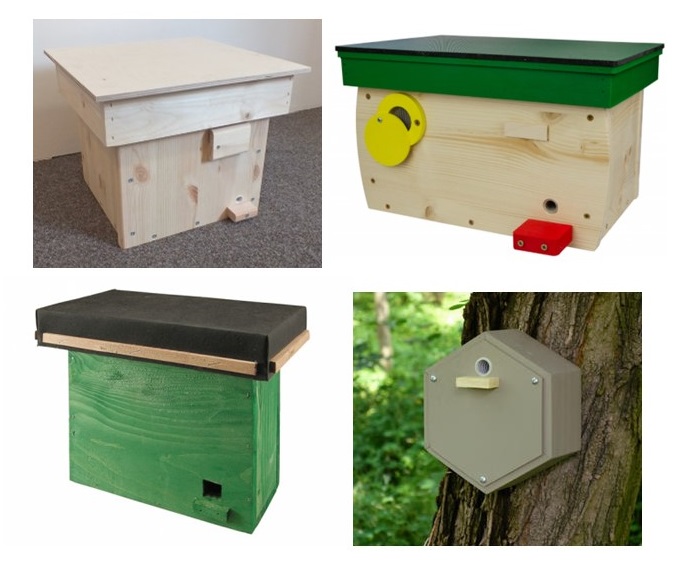
Examples of inappropriate wells without protective covers
eShop Sellers Source
Please bear in mind that hives that are structurally unsound will be difficult to repair. In a hive without a flap, the bumblebee population will be destroyed before new queens and new males can be born – so breeding will be unsuccessful for the bumblebees. .
Important parameters for a proper bumblebee nest
Ulcer body shape
- nThe shape is also very important, as is the construction of the body. When settling into the hive, the queen will instinctively create a nest in the imaginary centre with the best thermal properties, which she can instinctively recognise.
Note: if the nest is lined with polystyrene on the bottom as well, the mother often builds her nest close to the bottom. - The construction and shape of the hive must also respect the requirements for easy access and intervention in the hive.
Recommendation
- If the fright is big enough, the shape doesn't matter as much.
- An advantage is the approximate cube shape, which is best for manufacturing and maintenance.
- The size (volume) of the internal space is also a deciding factor, with approximately 15 litres being optimal; volumes below 12 litres are already unsuitable for strong colonies of larger bumblebee species (e.g., buff-tailed bumblebee, red-tailed bumblebee).
- Unsatisfactory
- Access to the body is required from above after lifting the roof.
- Access from the sides/front/rear is not recommended – intervention within the nest is not possible and even a typical inspection would result in the bumblebees flying out and the bedding/nest falling out of the hive.
- Don't create/buy hives joined together wall-to-wall – it's not an advantage, but a series of disadvantages (hive manipulation, proximity of entrances, etc.); at the cost of saving one wall, you create unnecessary complications. Double hives joined together are a pronounced misunderstanding of the principles of bee care.
Thermal insulation
- a very important element, as temperature fluctuations, insufficient/high temperature endanger the inhabitants of the nest
Recommendation
- We recommend lining the inside of the hive with additional thermal insulation (e.g. polystyrene), the nest will not be so susceptible to temperature fluctuations
- The insulation can also be added from the outside; it is susceptible to damage and weathering from there, but this can also be solved, for example, by adding a covering layer.
- If a beehive has double walls and an air gap is created between them for air to flow, then it is the best that can be obtained/produced, but the emphasis here is also on the quality of workmanship and construction solutions.
Vstairwell
- Most bumblebee species require an entrance tunnel (simulating a tunnel into a rodent's nest).
- For these types, the corridor is essential at the beginning of nest development, then it can be removed

Sample of correct placement of the inner hive entrance.
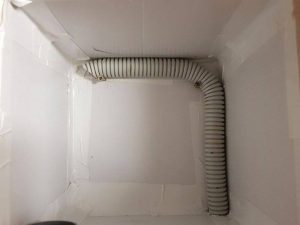
Recommendation
- The duct is most often formed by a pipe made of various materials, in more detail in the chapter on the ulcer duct.
- pipe brightness i.e. The inner diameter should be 25mm, it should not be smaller
- The corridor should be bent at a right angle and end in the corner of the hive, where the bumblebees can easily find its end.
- On the market, there are hives with a passage diameter less than 18mm, but these become clogged during nest operation. With such a passage, the hive must be able to safely remove the passage even during full operation.
- If the hive has an unsuitable entrance or none at all, then focus on the construction of the entire hive. That is, whether it will be possible to add a suitable entrance to the hive.
The issue with the ulcer's lining is described in the Ulcer Equipment menu. HERE)
Ventilation
- The seal must be tight but also ventilate safely.
Example of correct hive ventilation – sufficient opening size, protective netting inside, cap for cool springs and queen settling
- The ventilation must not allow even small parasites to pass through, which will be ensured by a mesh system.
- ventilation brings air into the nest and removes dampness
- Without ventilation, it will overheat, get damp, and will mould over the season
- The ventilation opening must not be placed above the inlet opening/shutter, it must be as far away as possible – the smell of the nest attracts parasites and it is not good to attract them into the hive.
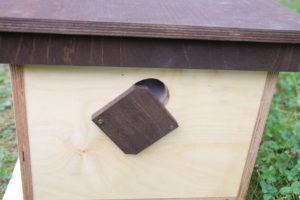
Recommendation
- ventilation should be large enough (at least a circle/square with an inner diameter or side length of 40-50mm), ventilation should be placed as high as possible in the hive
- The roof should have ventilation, which is fitted inside with a fine cover grille chew-proof (be careful with thin plastic meshes, which bumblebees are capable of chewing through) (for example, fine aluminium mesh with a mesh size of around 1mm is suitable)
- The grate will not allow stronger parasites to penetrate the nest, nor will it allow bumblebees to pass through.
- furthermore we also recommend a net from Uhelonu 53S; tand will prevent the passage of the parasitic wasp Melittobia acasta; caution – the fine mesh must be protected by an aluminium mesh so that the bumblebees cannot chew through it – meaning these meshes should not touch tightly
- ventilation should have full closure option (sedimentation period and cool spring)
The ventilation of the hive is described in the section Hive Equipment. HERE)
Protective elements
- Protective elements prevent the penetration of parasitic bumblebees into the nest – the clasp is among the irreducible minimum
- The nest should have a solution for protecting against parasites – these elements can be purchased / made.
We recommend:
- Correct sealing and protective grilles in ventilation are also protective elements
- There are capture traps for parasites in ventilation. The hive may not have them, but it should be designed so that they can be easily added if the owner wishes.
The issue of protective elements and flaps in particular is then described in detail, for example HERE, but also in other parts describing the work of a breeder)
Roof
- The roof protects the hive from rain but also from temperature fluctuations
- They must also prevent the ingress of parasites and predators of bumblebees.
Recommendation
- The roof should have an overhang so that rainwater doesn't run down the body and into the hive.
- The roof of the hive should be formed by a well-secured, sufficiently heavy, rigid, perfectly fitting and waterproof wooden board and construction. Waterproof plywood, or material covered with an impermeable layer, such as a linoleum-like material, is very good.
- Roofs with sheet metal are unsuitable due to overheating.
- Should it be heavy or should we weigh it down so the wind doesn't carry it away. It should be secure so that it doesn't open or become leaky due to carelessness, for example.
- Roof should have a seal, to seal the space between the body and the roof
- The roof should have a thermal insulation board that can be removed in hot weather (the roof can be cooled, and then the insulation would limit the cooling).
(You can find the description of the roof HERE)
The interior of the beehive
- You will use it for several seasons, so the surface should withstand operation and should allow for cleaning.Regarding the season (bumblebee activity leads to soiling, there is high humidity in the hive)

Sample inappropriate ulcer without ventilation, with an internal partition replacing the corridor – the bottom of the corridor will be very difficult to clean. Furthermore, a very small internal space for the nest.
(internet source) - It should be possible to open it easily and safely during operation, e.g. by removing the roof
- The interior space should be designed so that the beekeeper is able to inspect the nest, which is one of the fundamental elements of bumblebee keeping.
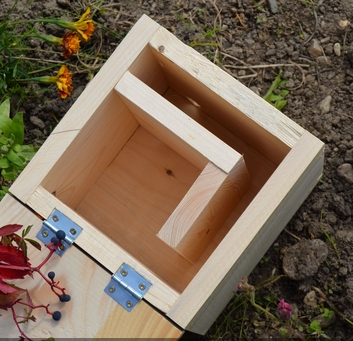
(You will learn how to carry out nest checks in due course in the relevant chapter)
Recommendation
- The hive should not have any additional internal chambers/vestibules accessible to the bumblebees; bumblebees consider such a space to be „outside“ and defecate there, which can then become a source of infection for the nest.
- The internal walls can be painted with ecological paint, but it is better to leave the walls untreated. The smooth finish of the walls makes them easy to clean.
- All internal spaces accessible to bumblebees must also be accessible to the owner to enable them to carry out post-season maintenance and cleaning.
( Instructions on preparing the hive before the season can be found HERE )
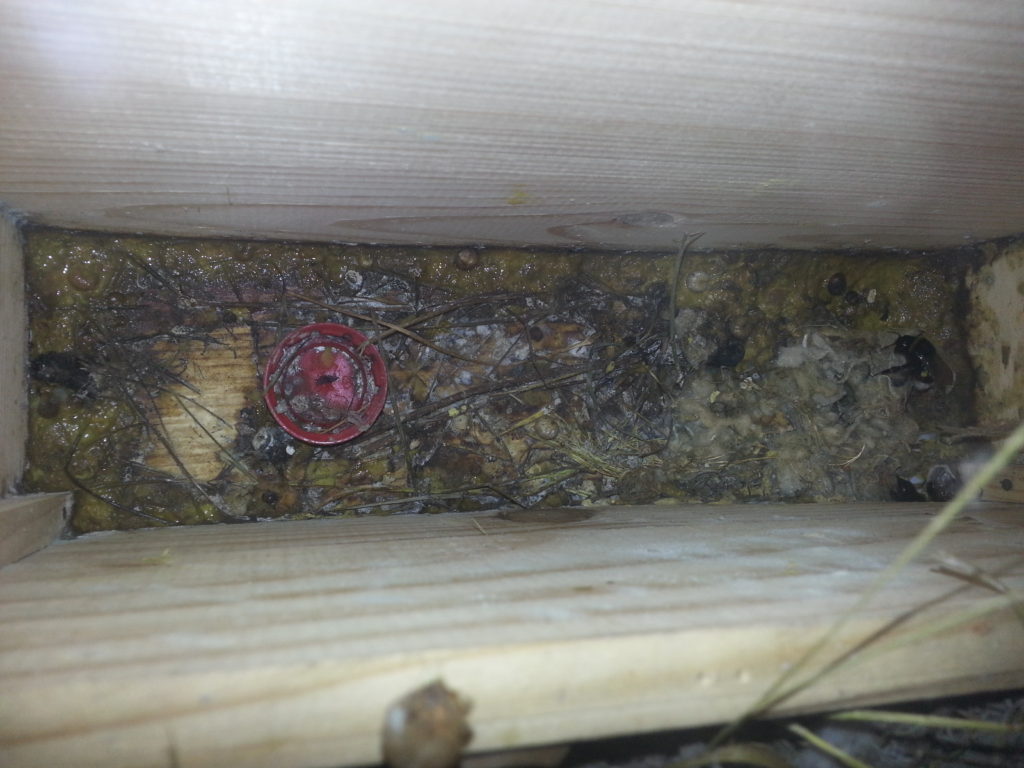
Unsuitable solution– a hall with a vestibule. A large amount of waste is visible, which is a source of disease and a hiding place for parasites.
Hive coating
- The coat protects the beehive from the elements
Recommendation
- a coat of paint isn't necessary, if you don't mind the patina
- When a hive is coated/varnished, it should be with eco-friendly paints or paints used by beekeepers. The coating should not be fresh at the time of installation.
- It is advisable to paint the roof with a waterproof coating (or provide it with another waterproof layer), for example, with teak oil
- If you are going to paint, use proven paints and coatings used by beekeepers and always well in advance of the season.
- Treat surfaces exposed to weather and rainwater with a suitable coating – typically the wooden parts of the protective flap at the end of the season.
Hive mounting
- hive fittings are generally not addressed by manufacturers, some hives have screw legs
- The mounting will ensure that the hive is placed in the desired location, so that it is securely fixed and can withstand wind etc.
Recommendation
- the mounting must be secure and rigid
- The shaft must not vibrate
- The mount must prevent ants from crossing.
- it is appropriate to use a fitting that allows the hive to be easily removed and taken to an intervention in an enclosed space
- If the hive does not have a solved mounting solution, it should be structurally prepared for it, e.g. with a reinforced base or back wall. (It's difficult to attach stable legs to 20mm...).
(Here is an example of where and how to place a shelter in the garden. HERE )

Jakub Černý – Bumblebee Houses, or Helping Nature
Source: Ekolist.cz