



How to prevent the destruction of a colony due to heat or frost
What you will learn here
- Is it possible to prevent a situation where a colony in a hive freezes in spring?
- Can this be solved with just good thermal insulation?
- Is it suitable to heat a bumblebee nest and how to do it
Last updated: 11/2/2022
Contents
Thermal insulation for bumblebee boxes (bumblebee nests) – an introduction to the topic
The temperature inside a beehive changes in response to the ambient air temperature. Bees regulate the hive's internal temperature through a combination of behavioural and physiological mechanisms.
**How Bees Regulate Hive Temperature:**
* **When it's cold:**
* **Clustering:** Bees will huddle together in a tight ball (cluster). This communal huddling conserves heat. The bees on the outside of the cluster form a protective shell, while those on the inside generate heat by vibrating their wing muscles. They rotate positions so that no bee gets too cold for too long.
* **Metabolic Heat Production:** By consuming honey and increasing their metabolic rate, bees generate heat.
* **Reducing Airflow:** They may seal small cracks in the hive with propolis (bee glue) to reduce drafts.
* **When it's hot:**
* **Fanning:** Bees will fan their wings at the hive entrance and inside the hive to create airflow and draw cooler air in, expelling warmer air.
* **Water Collection:** Bees collect water and spread it throughout the hive. As the water evaporates, it cools the interior of the hive, similar to how sweating cools the human body.
* **Regurgitating Honey:** In some cases, they may regurgitate honey, which also aids in evaporative cooling.
* **Spreading Out:** Bees will spread out within the hive, reducing the density of the cluster to minimise heat buildup.
**Why They Regulate Temperature:**
* **Brood Development:** The most critical reason for temperature regulation is to maintain a stable temperature for the developing brood (eggs, larvae, and pupae). This optimal temperature is typically around 34-35°C. Fluctuations outside this range can be detrimental to brood development, leading to deformities or death.
* **Honey Production and Storage:** While bees can tolerate a wider range of temperatures for themselves, maintaining a stable temperature is important for efficient honey processing and storage.
* **Queen's Health:** The queen bee also benefits from a stable, warm environment.
* **General Colony Health:** A consistently regulated internal temperature contributes to the overall health and survival of the colony, especially during harsh weather conditions.
In summary, bees actively manage the temperature inside their hive by clustering and generating heat in cold conditions, and by fanning and evaporative cooling in hot conditions, primarily to ensure the optimal development of their young.
Our measurements
Bee nest heating
Bumblebees PLUS recommend
Conclusion
Thermal insulation for bumblebee boxes (bumblebee nests) – an introduction to the topic
In the spring months the temperature often fluctuates greatly and sometimes for a prolonged period and unfortunately also will cool down considerably.
Breeder has several options, How to react to itt:
- It will leave the nest to fate and nature.
– bumblebee queens can sometimes endure such a situation, but often they will abandon the nest
– sometimes they get exhausted and die during the heating of the fruit - Leaves the nest outside, but will supply the mother with malt (medium-sugar dough, or sugar solution)
– the mother has a source of energy and a better chance of managing the situation - At night, fright closes in and takes you to a temperature. maximum 15°C visibility
– but the transfer isn't the optimal solution
– besides vibrations and interference, moisture also condenses on the hive walls (temperature differences)These options are described in more detail HERE
- Will passive heating secure the hive
– but it must be a heating system that will not endanger the chick = it won't overheat it, dry it out, or cause sudden temperature changes
– simple heaters without regulation but often not entirely satisfactory - Ensures heating of the ulcer with temperature regulation
– this solution should regulate the heating power within a specified range, with an accuracy of °C
In all cases, the condition for success, so that startle qualityIn, well insulated and also with sufficient thermal inertiaa which dampen temperature changes.
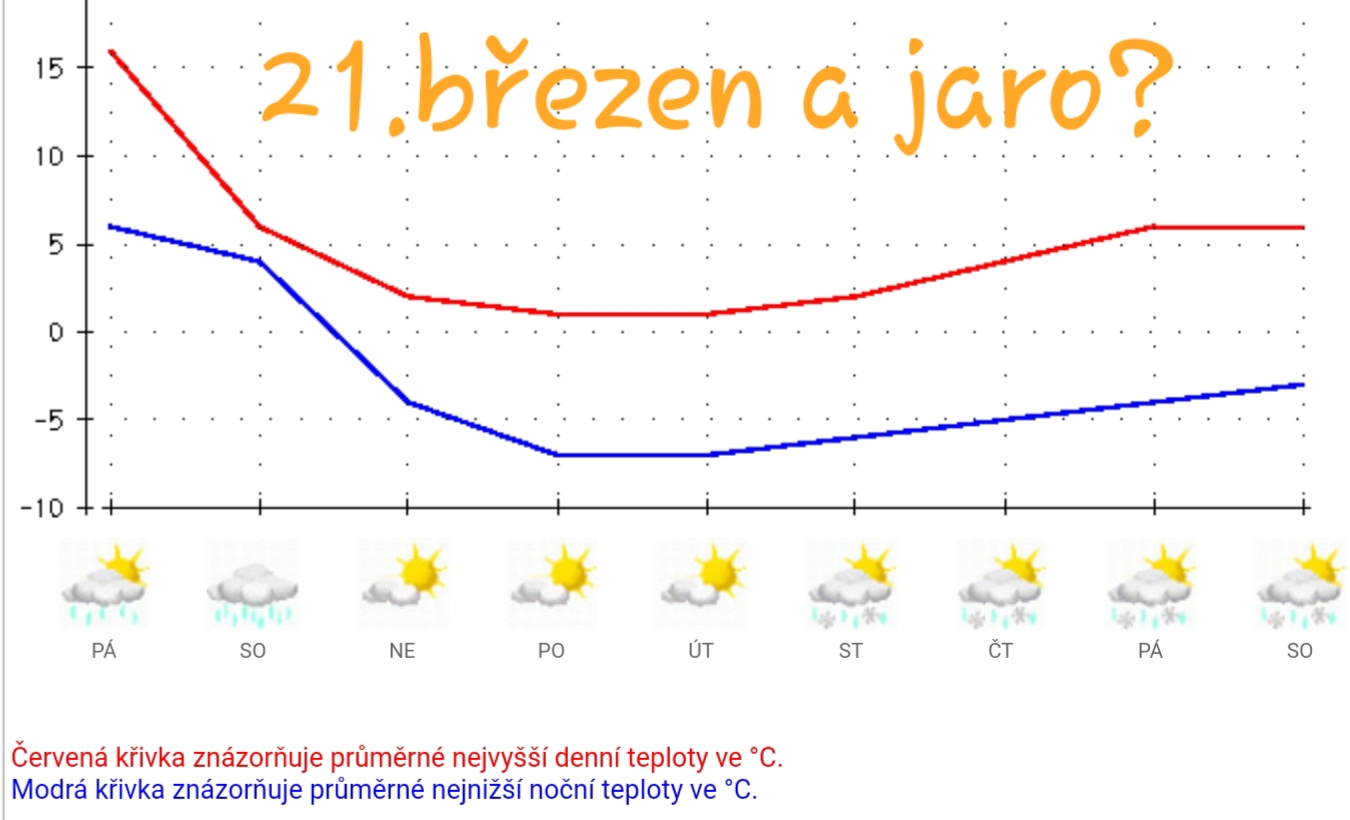
Extreme temperature drops in spring
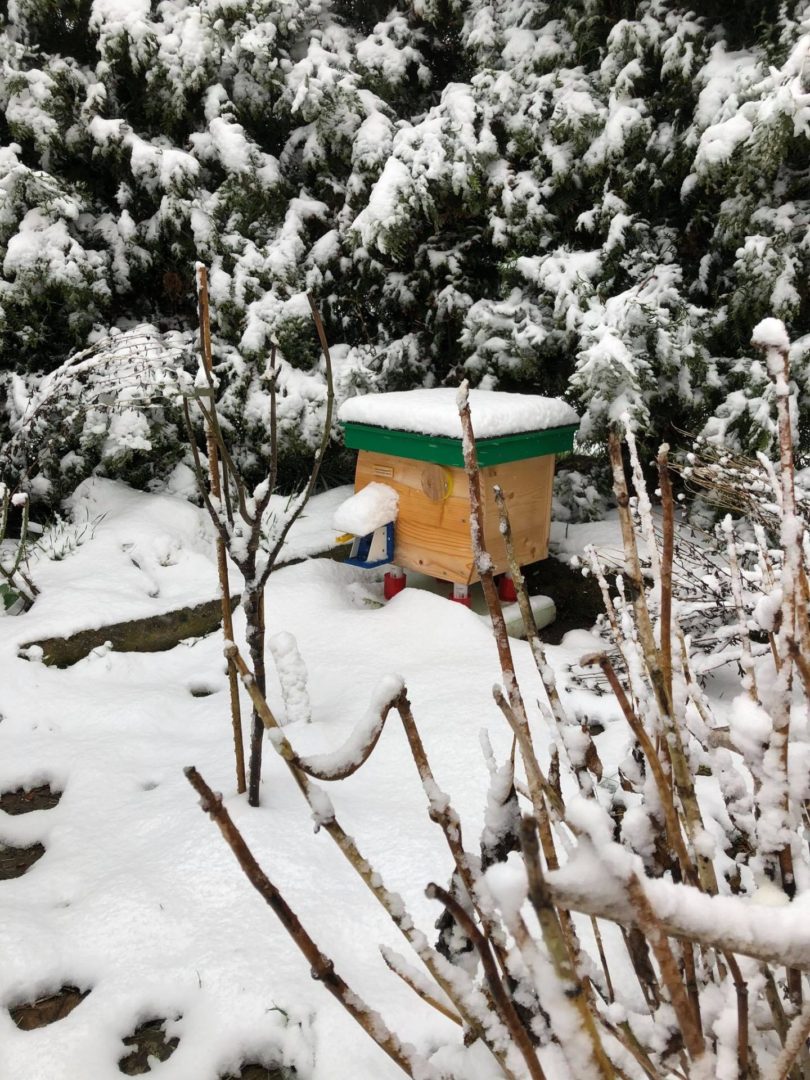
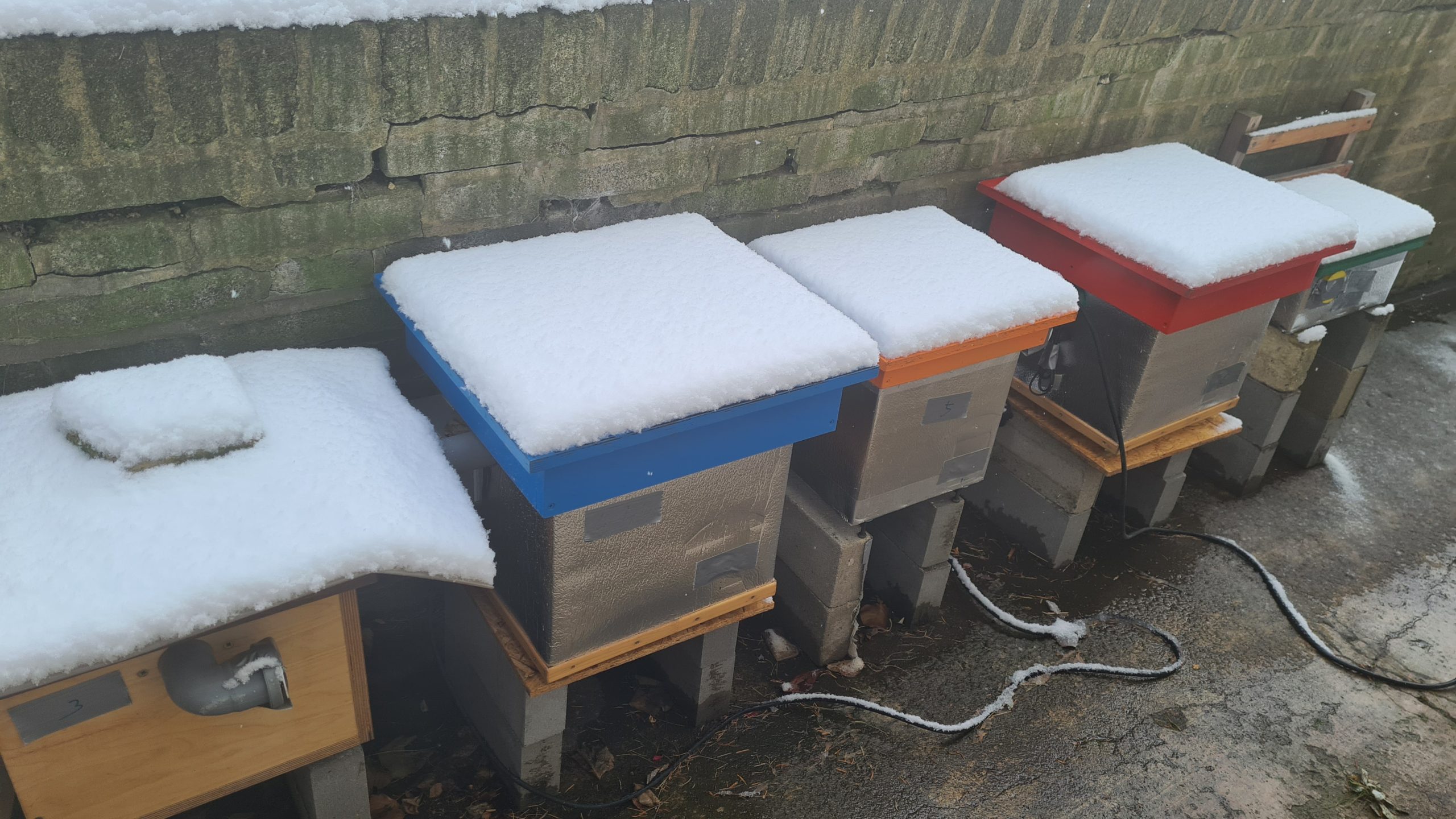
A scare in the snowy garden
Photo: P. G. Gröbl (21/3/2020)
The temperature inside a beehive changes in response to the ambient air temperature. Bees regulate the hive's internal temperature through a combination of behavioural and physiological mechanisms. **How Bees Regulate Hive Temperature:** * **When it's cold:** * **Clustering:** Bees will huddle together in a tight ball (cluster). This communal huddling conserves heat. The bees on the outside of the cluster form a protective shell, while those on the inside generate heat by vibrating their wing muscles. They rotate positions so that no bee gets too cold for too long. * **Metabolic Heat Production:** By consuming honey and increasing their metabolic rate, bees generate heat. * **Reducing Airflow:** They may seal small cracks in the hive with propolis (bee glue) to reduce drafts. * **When it's hot:** * **Fanning:** Bees will fan their wings at the hive entrance and inside the hive to create airflow and draw cooler air in, expelling warmer air. * **Water Collection:** Bees collect water and spread it throughout the hive. As the water evaporates, it cools the interior of the hive, similar to how sweating cools the human body. * **Regurgitating Honey:** In some cases, they may regurgitate honey, which also aids in evaporative cooling. * **Spreading Out:** Bees will spread out within the hive, reducing the density of the cluster to minimise heat buildup. **Why They Regulate Temperature:** * **Brood Development:** The most critical reason for temperature regulation is to maintain a stable temperature for the developing brood (eggs, larvae, and pupae). This optimal temperature is typically around 34-35°C. Fluctuations outside this range can be detrimental to brood development, leading to deformities or death. * **Honey Production and Storage:** While bees can tolerate a wider range of temperatures for themselves, maintaining a stable temperature is important for efficient honey processing and storage. * **Queen's Health:** The queen bee also benefits from a stable, warm environment. * **General Colony Health:** A consistently regulated internal temperature contributes to the overall health and survival of the colony, especially during harsh weather conditions. In summary, bees actively manage the temperature inside their hive by clustering and generating heat in cold conditions, and by fanning and evaporative cooling in hot conditions, primarily to ensure the optimal development of their young.
Our measurements
As evidence of the behaviour of various ulcers, we present internal temperature fluctuations in different ulcers. The graph and measurements will be described here, and here only. demonstration of the influence of external temperature on hives and differences in internal temperature changes.
You can see for yourselves, how the internal temperature changes over time and even at a static external temperature. The less the temperature in the hive fluctuates, the better.. Therefore it is necessary to pay attention to the thermal insulation of the hive, than heating, which in practice is only used for a few days a year.
Chart 1 shows how the temperature inside the ulcers rises depending on the ambient temperature.
Description:
- Completely at the top - exterior temperature
- Place hives with varying thermal insulation quality.
- Lowest curvegreyrepresents startle with adjustments, which we further describe HERE.
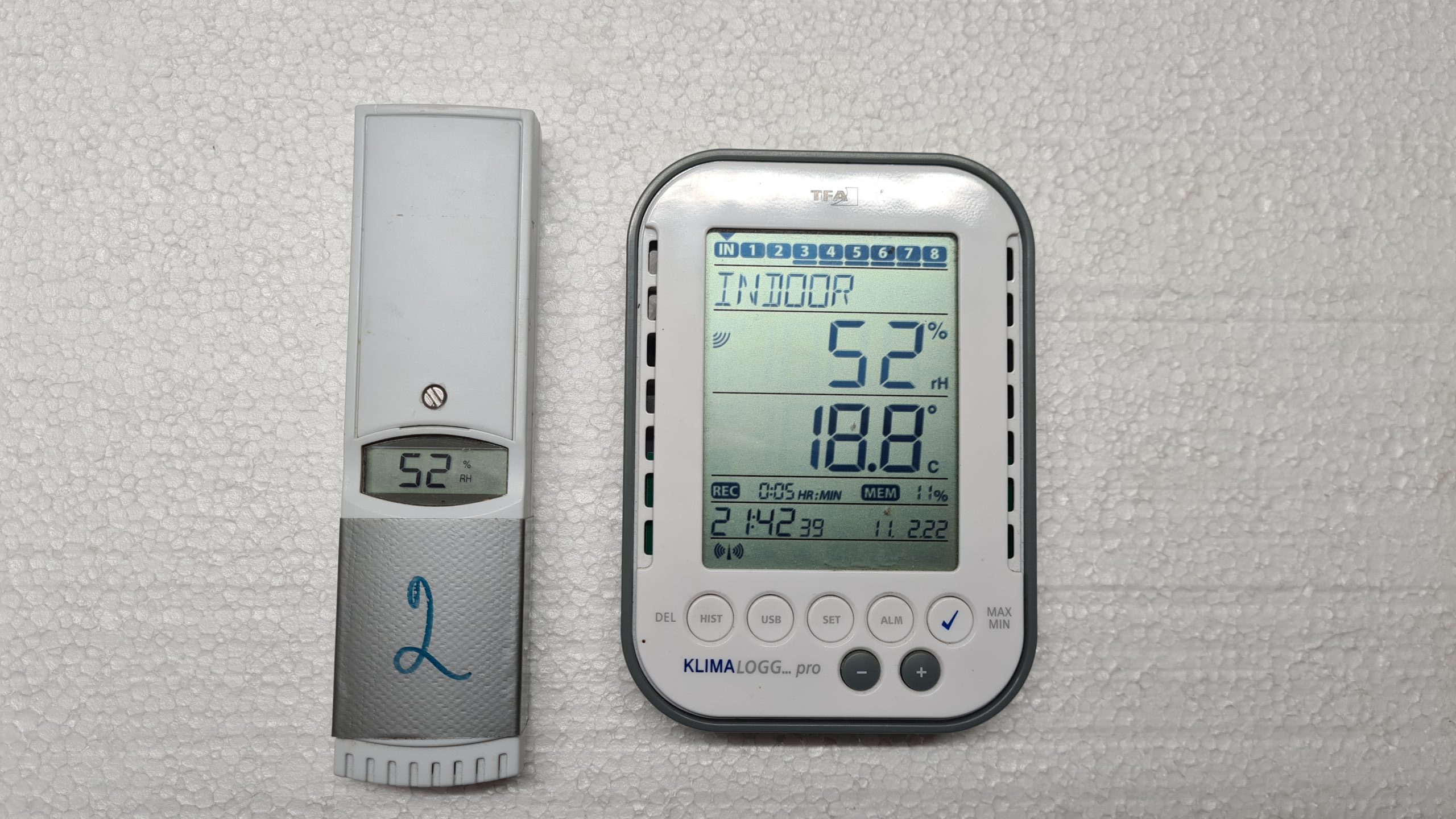
Temperature measurement kit
Photo: O. Hercog 2021
Figure 1 shows how the temperature rises in ulcers depending on the ambient temperature.
Description and evaluation of results:
- Completely at the top - exterior temperature
- Place hives with varying thermal insulation quality.
- You can clearly see how big the differences are between the individual constructions.
- Quickest The temperature is changing in a small corner (green curve)
- Slowly in a larger corner
- The temperature changes almost as quickly in a commercially available hive as it does in a hive with 20mm internal polystyrene insulation.
- slowest representation of changes grey curve a Light blue – it's about elec with external insulation 30mm polystyrene and 25mm wooden walls inside insulation – its description HERE
I It is complicated to ensure stable temperature conditions in a passive shelter, as you don't want to turn it into a „machine room full of technology“, it seems optimal to place it indoors - see Description of ulcer location.
Unfortunately, this solution, where the shock absorber is located in a relatively stable environment such as a garage or cellar, is not accessible to everyone.

Chart 1 – Change in temperature in ulcers depending on external temperature – temperature increase
Measured by: O. Hercog 2021
Figure 2 demonstrates the course of ulcer cooling depending on the external temperature
Description and evaluation of results
- A small fright did not participate in this measurement
- It's similar to Chart 1 but in reverse order.
- Igloos without thermal insulation cool down very quickly.
- The large shock, without insulation, equalised its internal temperature with the surroundings.
- A well-insulated hive will cool down the slowest – his description HERE
Physics simply is and will continue to work.

Figure 2 – Change in ulcer temperature depending on ambient temperature – temperature decrease
O. Hercog measured 2021
Bee nest heating
Bumblebees PLUS recommend
- We are dedicating efforts to improvement construction of passive houses and their thermal insulation
This is worthwhile even in times of high temperatures and sharp changes, when a good solution dampens fluctuations and allows suitable conditions to be maintained in the hive for as long as possible. - During cold days, provide the mother bee with supplementary food (nectar and, if available, pollen), but do not disturb her unnecessarily by interfering with the hive.
- Neodporuji., if you don't have a good solution
Spring temperature drops can be dealt with differently. For example Transport of the ulcer after dark, where frost is expected, to a place where fear doesn't freeze, but it also won't overheat unnecessarily. The temperature in such a place should not exceed 10-15°C. - It's no use heating strongly. in the nest at a time when it is cold outside and bumblebees cannot fly and collect food, these are not natural conditions.
It is more natural for mothers to wait in a state of reduced activity for warmer weather..Short-term temperature drops can be overcome by bumblebee mothers in a good hive with a sufficient amount of good bedding, even without heating. - If you want to heat the hive, deal with itso that the fright doesn't freeze and if possible use heating with a regulator
Further references:
On the issue of thermal insulation and you can read about our measurements, for example HERE
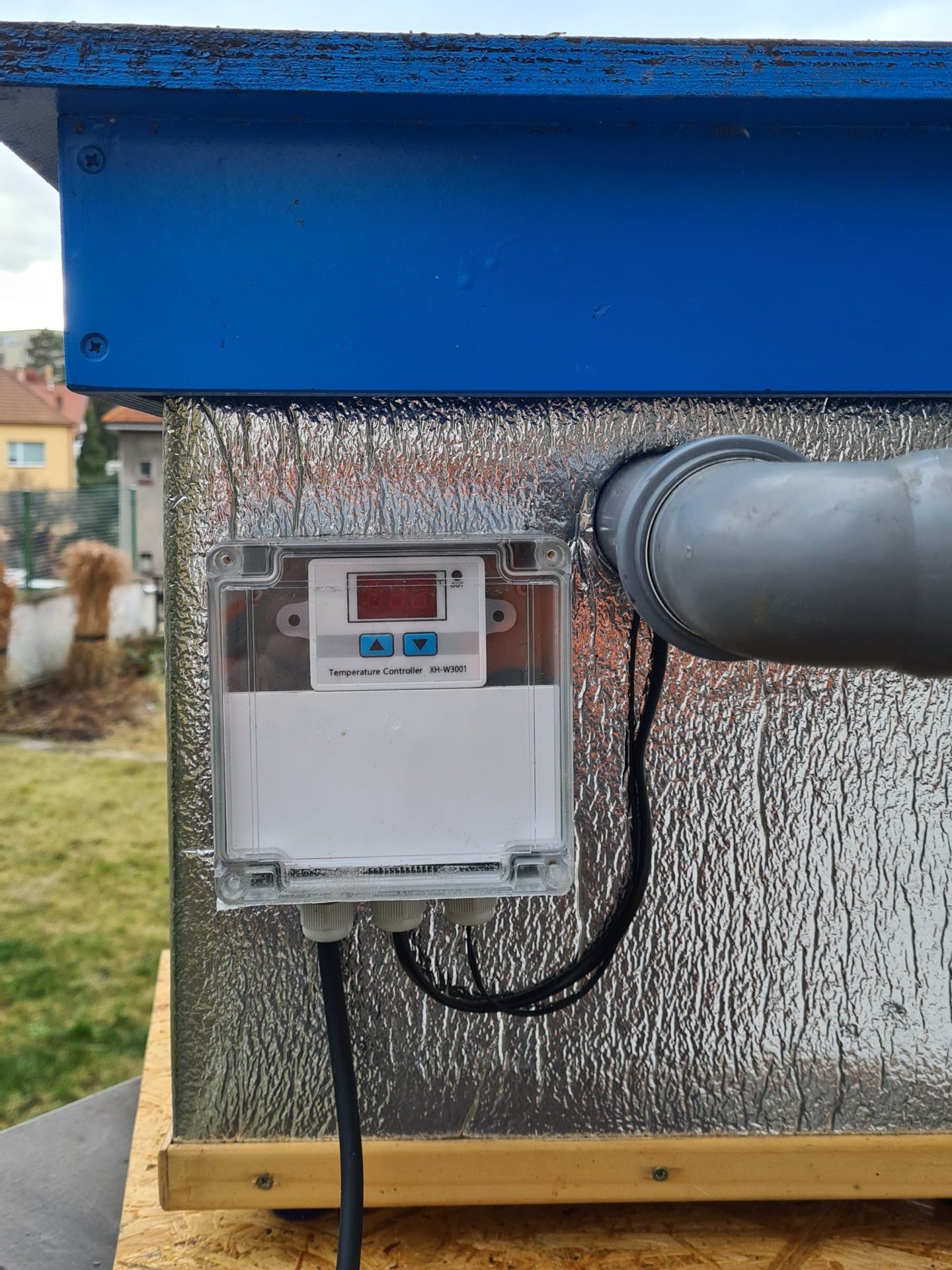
Regulator in a box on the wall of the hive
Photo: O. Hercog 2021
Measuring temperatures in ulcers
Photo: O. Hercog 2021
Conclusion
As always, we've suggested to you a few solutions and explained their pros and cons
Choose a solution that suits you in terms of difficulty and your approach to bumblebee keeping.
If you share your experiences with us, we'd be happy to use them and offer them to others.