


Hive inspection and season review
Final check after the colony's end-of-life
What you will find here
- We will explain how to carry out an ulcer check after the end of the season.
- We will teach you to read in the nest
- We will teach you to find weaknesses that you can eliminate for next season.
Why do it?
- Revealing weaknesses in the hive.
- Assessment of the season's success – colony status and size, estimation of new queens.
- Control of parasite infestations and assessment of the effectiveness of individual protective measures.
- Findings from the life of bumblebees without interference in colony development
Don't forget thorough cleaning of the ulcer, the procedure can be found HERE
The tour is a bit like detective work, where you gradually dismantle the nest, observe its condition, and document it.
Recommendation:
It is advantageous to use a camera and photograph the entire process step-by-step as if it were a crime scene. Similarly, it is worthwhile to have a ruler, tape measure, and the like with the photos. If you wish to consult with others about something found in the nest (e.g. a parasite, a strange cocoon, a dead bumblebee), the attached photographs along with a scale will help greatly, as photographs taken with zoom and focus from different angles can distort the size. Photographs will also allow you to revisit the matter even years later, and you can then observe how the bumblebees are doing in a particular spot during different periods, and whether the location is suitable for them or if it would be better to choose another placement. (Even a nest placed according to recommendations may be in a cooler or wetter part of the garden, etc.)
Start of tour – external condition
- It's good to take a picture of the hive in its original location to start with (you'll appreciate it in years to come :).
- We are checking the external condition of the hive for damage, for example from mice, and whether there was increased moisture in the area.
- We are checking whether the external components of the hive, such as the flap, long external corridors, traps, etc., have served their intended purpose. We are primarily looking for risks of contamination with waste, soil, and vegetation, as well as checking whether water has pooled anywhere. This could also include condensation, which we might not detect during routine hive inspections while the colony is alive.
- We monitor and document the catch from the traps. Whether harmless species or bumblebees have been caught, whether the traps have been damaged or clogged.
- Only after these initial steps will we move the hive outside, where we have enough space to dismantle and clean the nest. As the nest is often mouldy and rich in parasites, we recommend carrying out the inspection in good weather, somewhere sheltered and truly outdoors.
Top of the nest
- Those who carried out regular checks have thoroughly researched it. For others, however, it's just a surface where bumblebees rest, ventilate, and defecate. The degree of pollution can be used to estimate the strength of the colony. We assess the extent of the lining's processing and the ventilation channels.
- We always look at the condition of the roof and edges from underneath, checking for parasites, leaks, or damage caused by parasites gnawing through the seals.
- And according to the level of humidity and settled dust, airflow can be estimated – i.e. a leak that may not be visible.
- Parasites are often found on the roof and the top of the lining or inside the ventilation, where they try/tried to get out. – We are again evaluating the effectiveness of the protection in the ventilation and other elements. We also search for their traces, such as cocoon remnants, larvae, and droppings.
Below is a sample of three possible findings and their interpretation: (photos in the text from Karel Kučera's inspections)

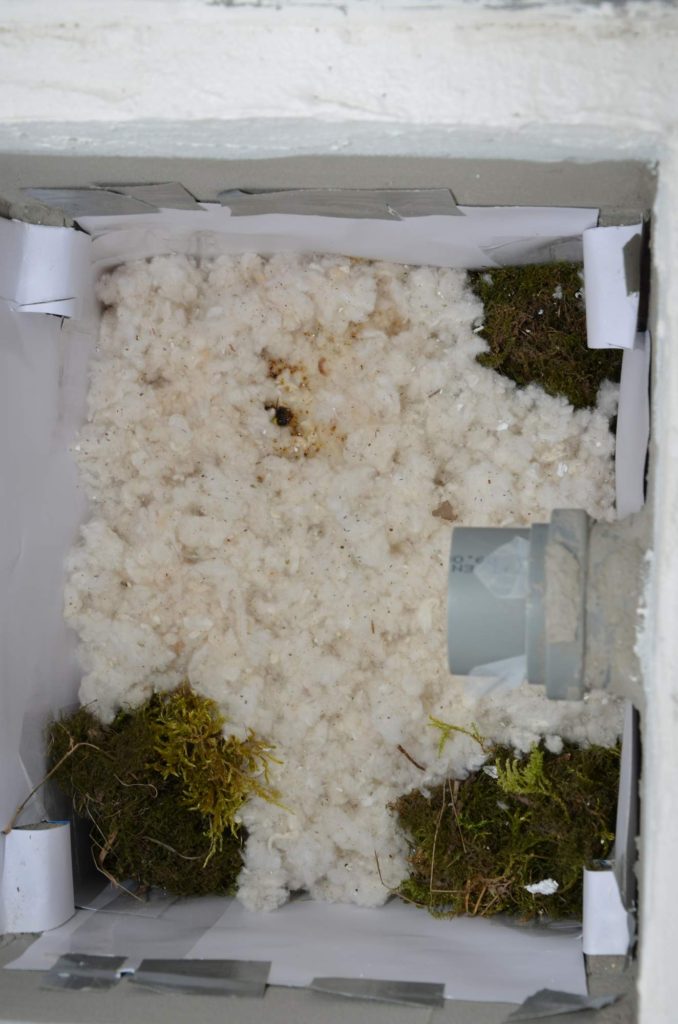
Top check.
Image as before settling in spring. Minimum fouling, only one access point visible. No parasites, however, in this state of preservation, a weak nest can be expected.
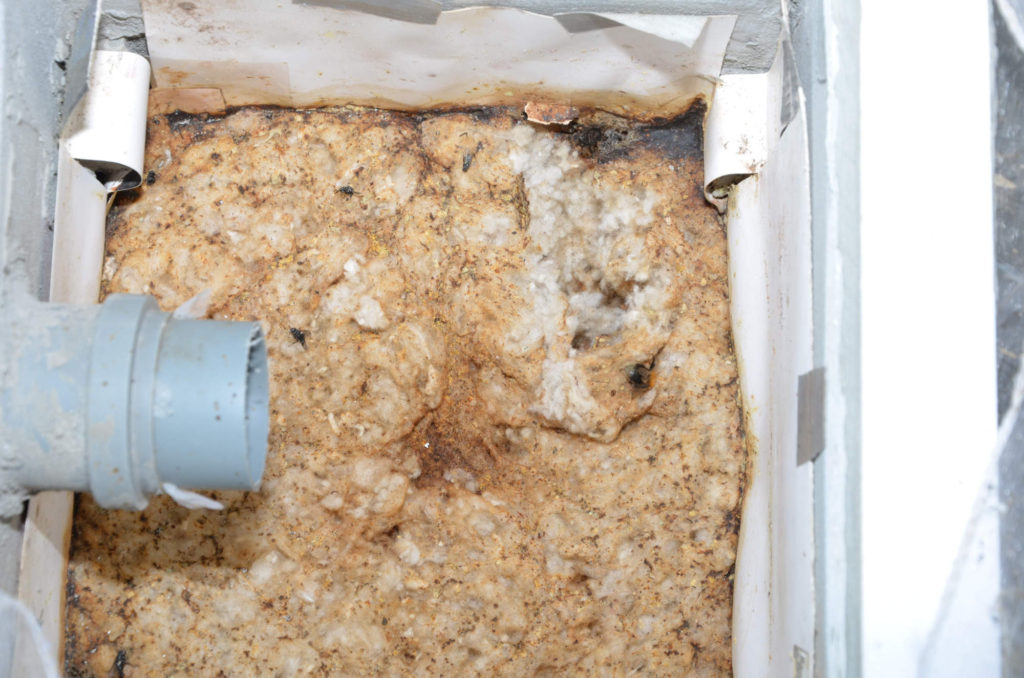
Upper part of lining – optimal condition.
Contamination only at the corners, paper without mould, lining processed by bees without mould, only the top layer settled, only adult flies from parasites
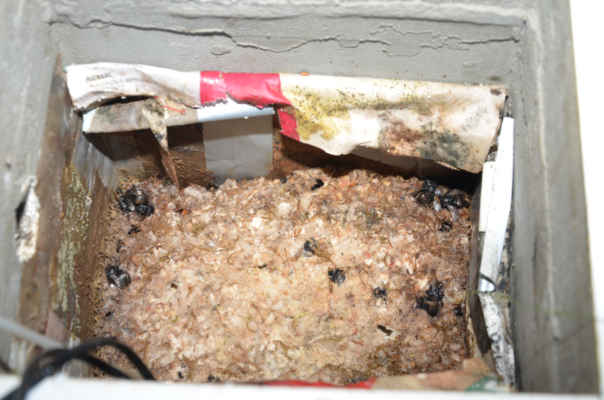
A sample top-down view of the lining in a ground hive. Clear signs of excessive moisture, the paper walls are wet, mouldy, and the lining is disintegrating. The lining is mouldy, wet, and has collapsed. No parasites, but a rather large number of dead bees already on the surface. This was the problem...
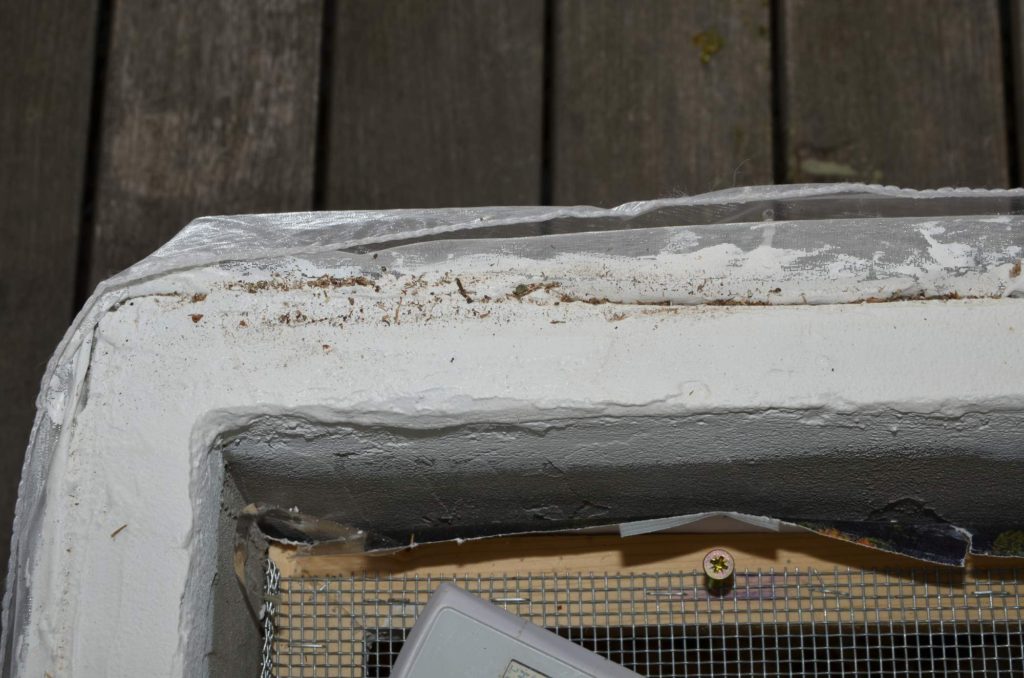
Detective work of inspecting hive roof edges in situ. We see a deposit of dust in one spot, here there was a leak in the hive roof seal and it was a potential risk area for parasite entry. The result of the inspections was therefore the adjustment of the roof edge and seal before the next season.
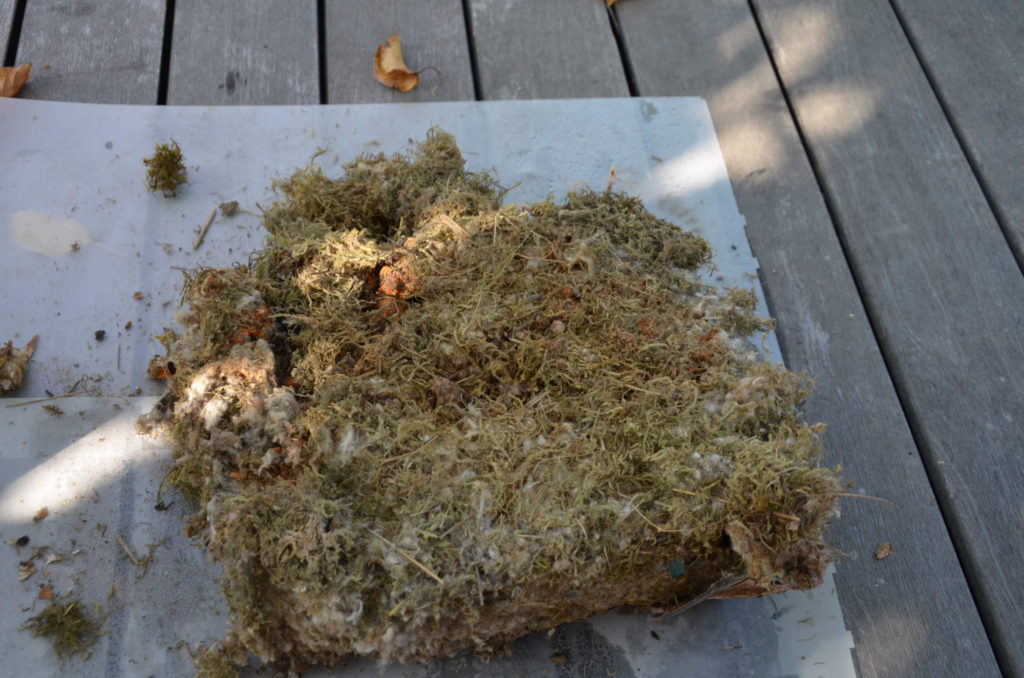
Nesting area and floor
Similarly, as with inspections, we will dismantle the lining and search for
- parasitic
- potential uninvited visits by other bumblebees (workers, queen battles in spring)
- we are assessing the present dead bumblebees, whether they are not tangled in the bedding, whether they show signs of infestation, the total number of dead workers, males, and queens
- we will assess the condition of the lining – mould, damp and degree of compaction
- It is also good to notice how the nest was placed within the whole hive.
We do the same for the floor beneath the nest, where we often find parasite larvae or pupae.
The obtained materials can be used to assess the quality of the used bedding, the suitability of bedding and the choice of material combinations (moss and cotton, animal fur, etc.).

Moss from the lining of the bottom
We can see that it is free from parasites such as the European corn borer, however, it is damp with signs of mould.
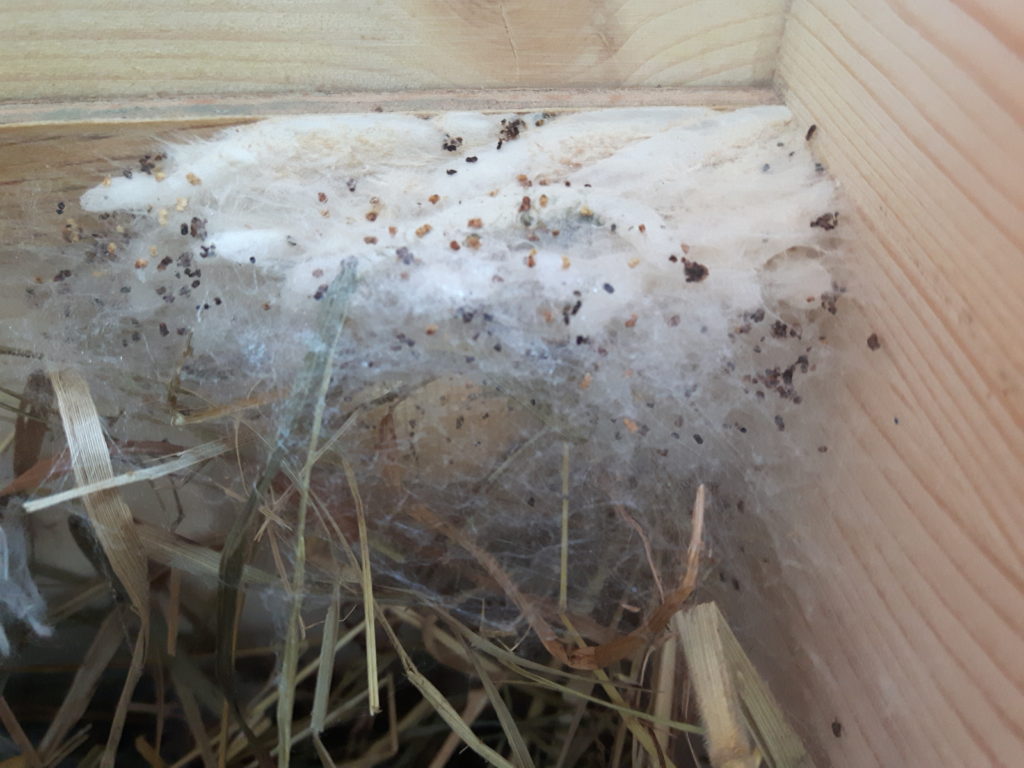
Lesser wax moth (Aphomia sociella) – nest infested by moth
Photo O. Hercog (2016)
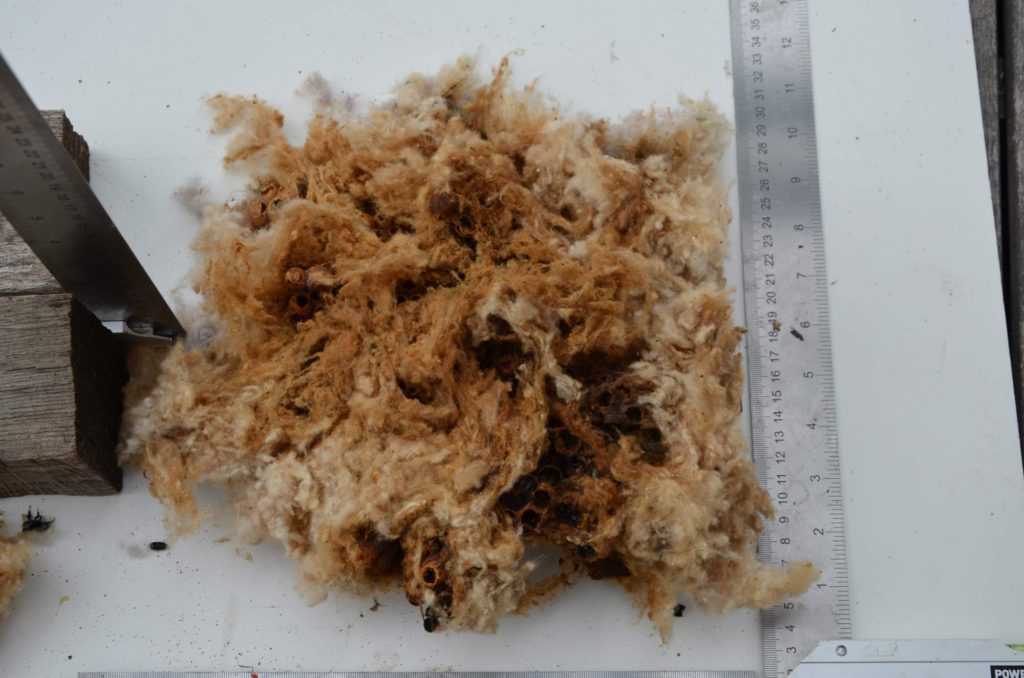
Checking your own nest
After removing the surrounding lining, we assess the size and shape of the nest. We carefully remove the ceiling in species that form one. We examine it for the presence of parasites.
We get a view of the whole nest. The condition can also be assessed by smell – whether it smells more musty or honey-like. We mustn't forget to check the bottom of the nest under the cocoons and the underside of the cocoons. We gradually dismantle the cocoons and sort them by size.
- conspicuously large cocoons were predominantly maternal – meaning new queens developed from them
- small cells were cocoons of workers and honey cups
- We notice the presence of honey and whether it is present at all
- We are looking for the presence of parasites or the degree of destruction of the bumblebee nest.
- We will assess the level of mould
- We will set aside the cocoons that did not open.
- We will count and sort the dead bumblebees in the nest into workers, queens, and males
- We will count the large open mother cocoons, subtracting the dead mothers in the nest, to get an idea of how many mothers the nest produced and thus the overall breeding success.
- We will very carefully examine the closed cocoons and count them. Dissection is also advantageous. We will often find dead undeveloped bumblebees inside them, but we may also discover parasitic infestations.

A sample of a nest of its size. It can be seen that it is not mouldy, the ceiling shows no signs of parasite infestation, and the surrounding lining is clean. In the bottom left, a pupa was found, most likely *Brachycoma devia*.
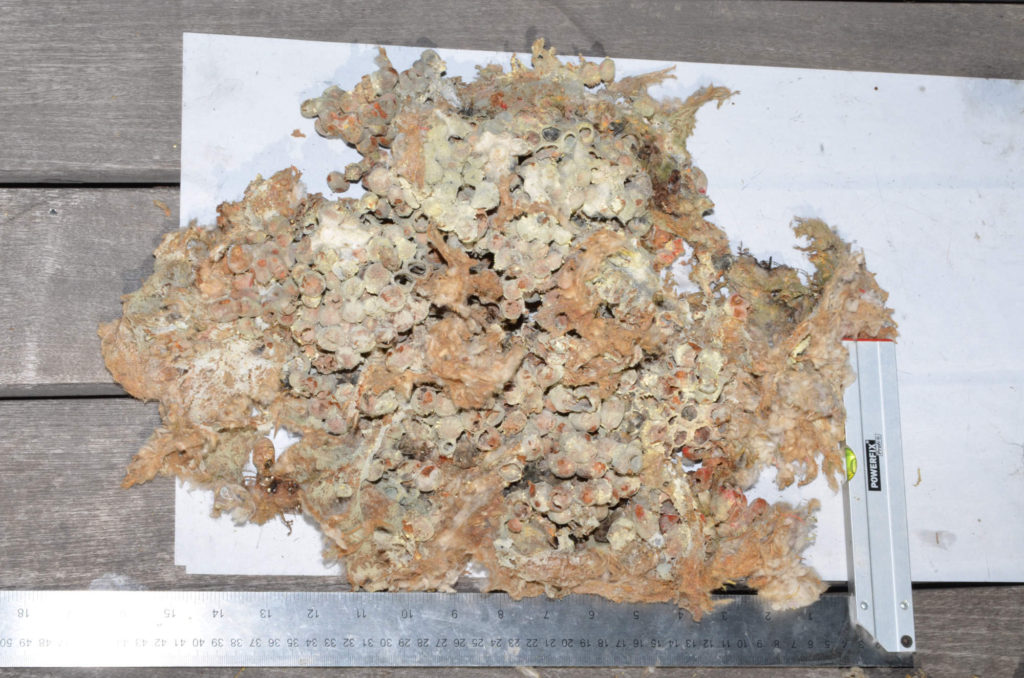
Inspection of a bumblebee nest from a ground hive.
Visible mould covers the entire nest and surrounding lining. Keeping bees in such a hive will need to be adjusted or it cannot be recommended for further settlement.
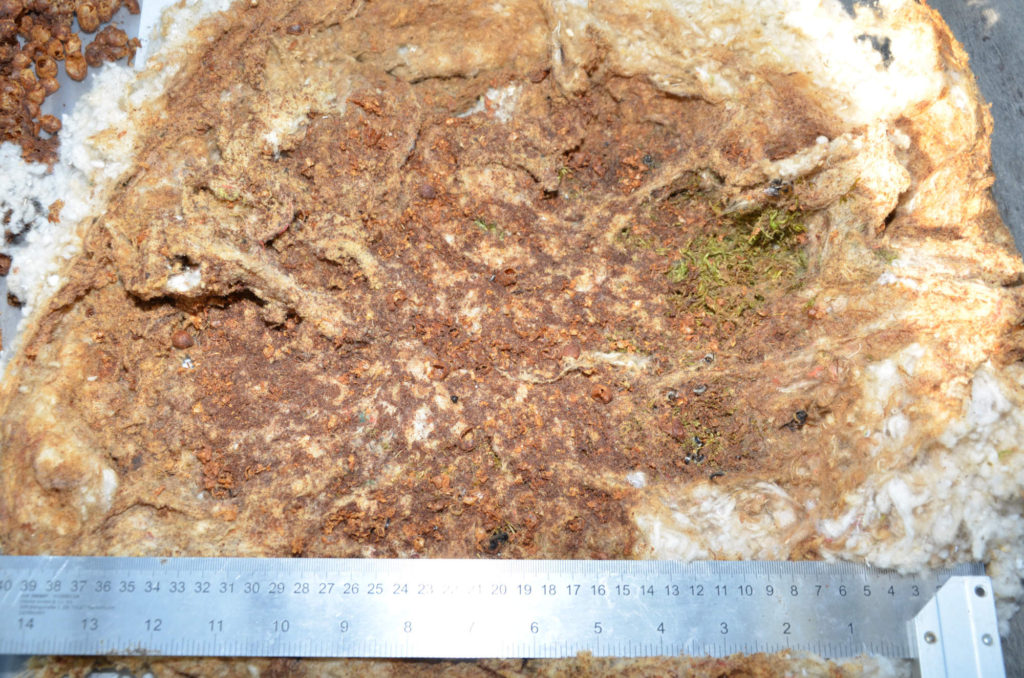
Checking the lower part under the cocoons, with parasites only mites and *Antherophagus nigricornis*, ideal condition without signs of mould
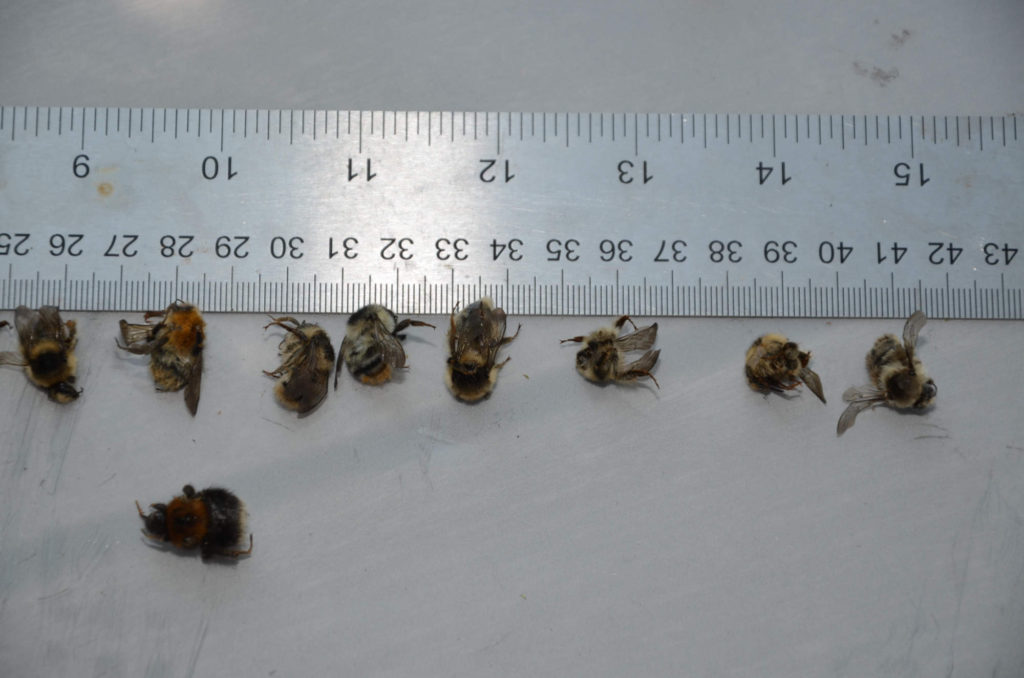
Checking for dead bumblebees from the buff-tailed bumblebee nest.
Our inspection revealed a common state, carcasses without signs of viral infection or infestation. In the foreground, however, a dead buff-tailed bumblebee mother without wings and parts of her legs – it is likely that a battle occurred in the nest between a garden bumblebee worker and the buff-tailed intruder, who lost its way.
[
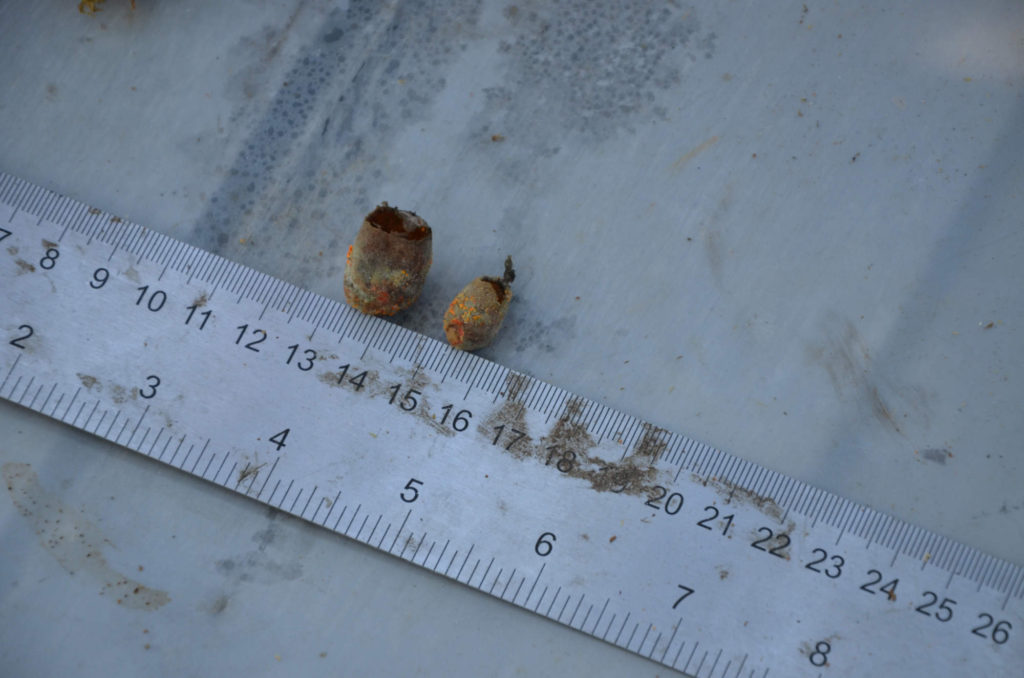
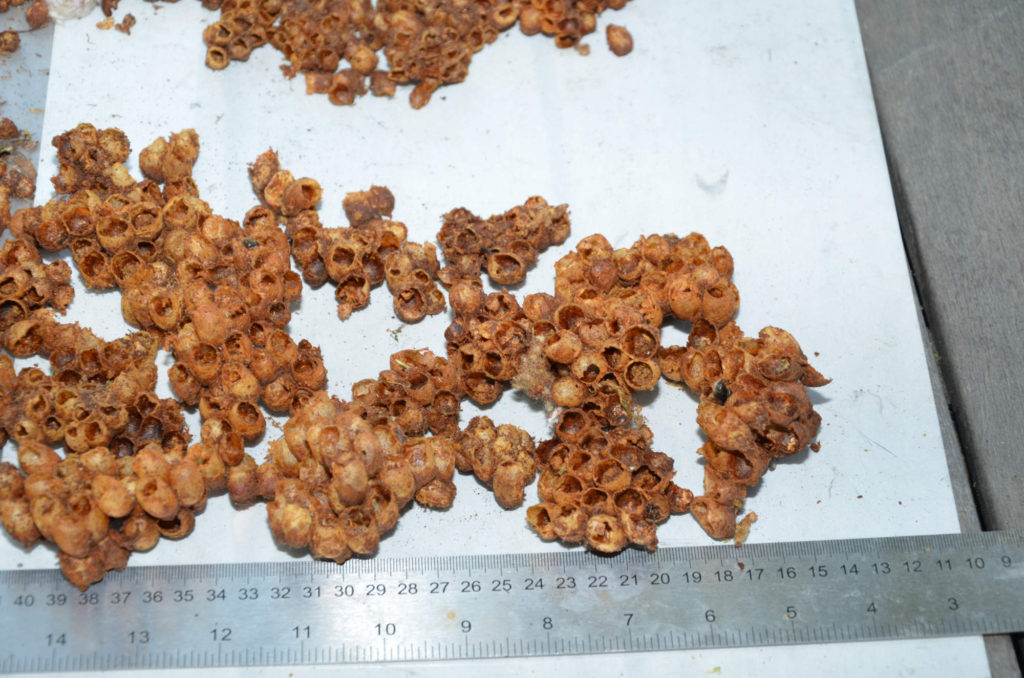
A sample showing the difference between a small and a large cocoon. In both cases, the bumblebees have completed their development, the cocoons are open and, apart from mould, show no signs of parasitic infestation. With mould, it is necessary to assess the time between inspection and the end of the nest – whether it occurred rather late or already during the colony's lifetime.
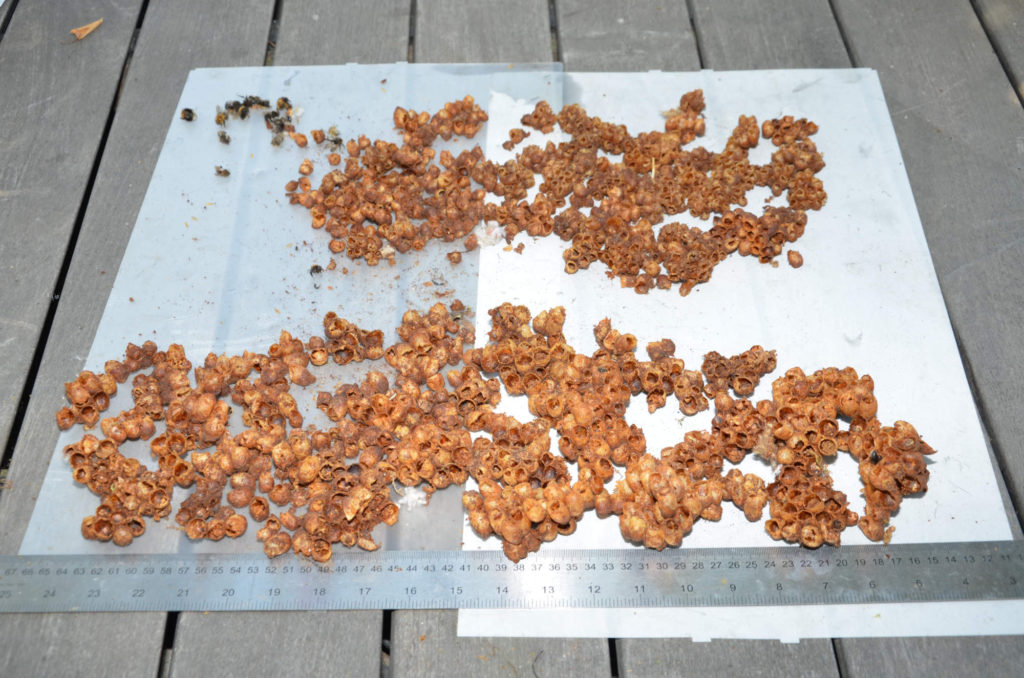
Cocoon sorting.
Above, small worker cocoons and honey cups, below, all open queen cocoons. In the top left corner, dead bees in the nest. A sample of a beautiful, strong and healthy nest. Free from mould, parasites, a huge number of queen cocoons. A minimal number of dead bees.
A detailed inspection, we do not see parasites, finding some dead bumblebees when leaving their cocoons is common.
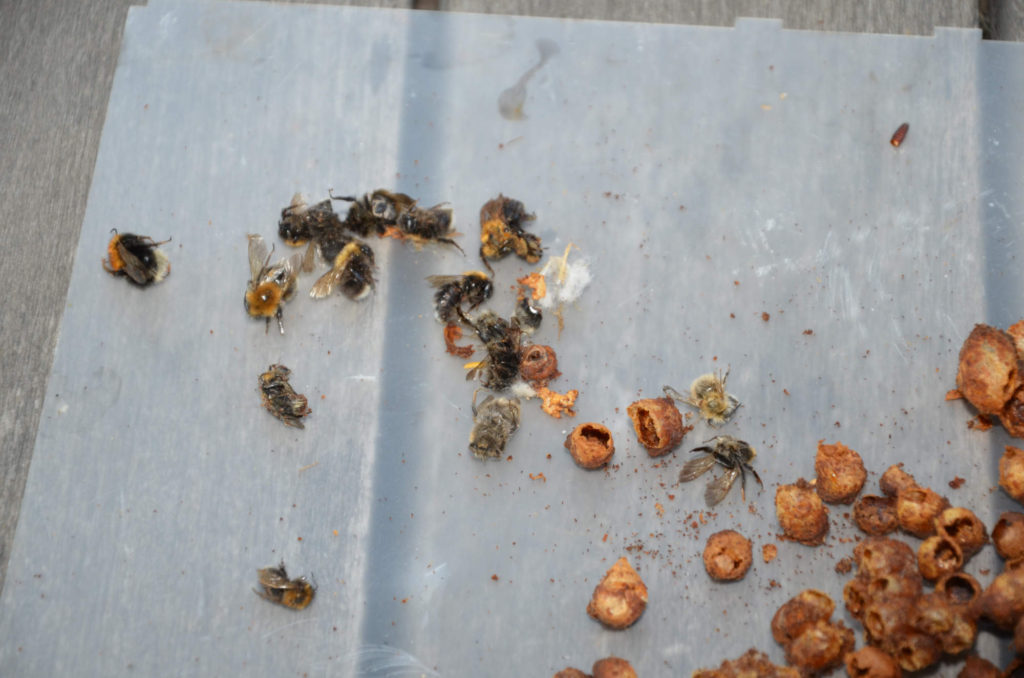
A common finding of dead bumblebees in a nest.
Finding body parts with the head separated is normal after a turning point.
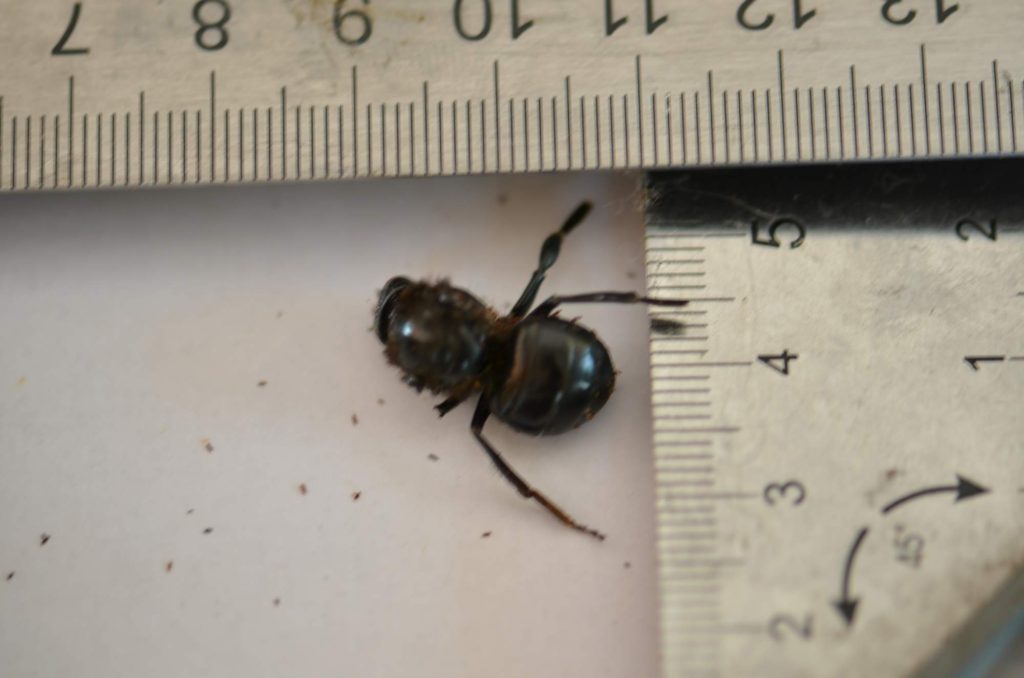
A surprising find in a rock bee nest. Detective work has its rewards.
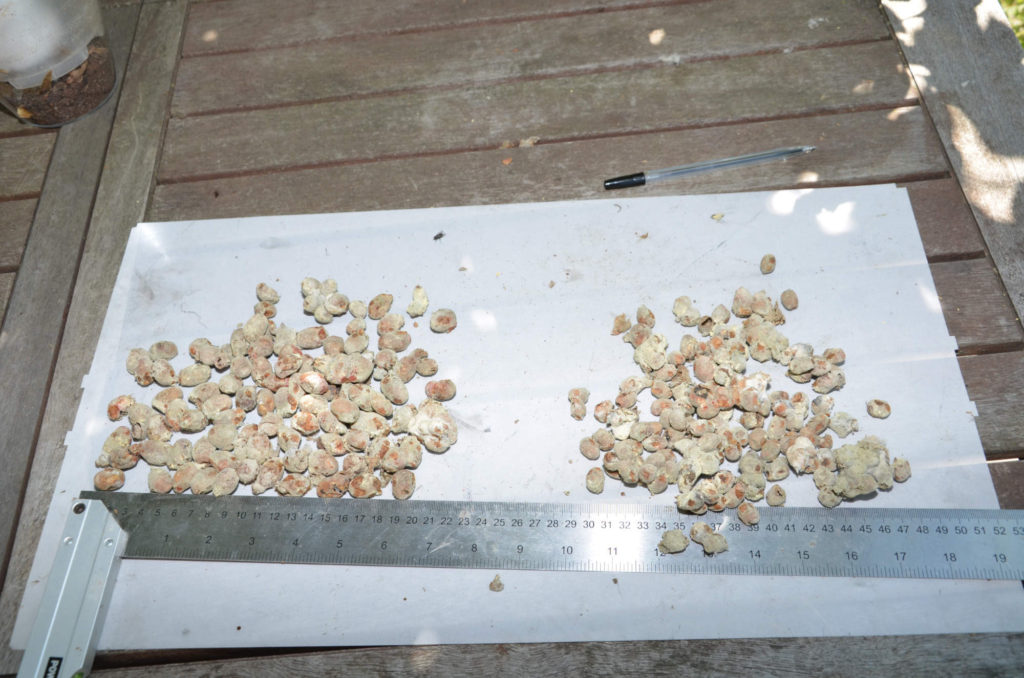
Sample of cocoon sorting.
To the right, small cocoons, closed; to the left, large cocoons, closed. There are already many of them, all are mouldy. This indicates a problem in the nest towards the end of the colony's life. Possible causes: excessive humidity, poor ventilation.
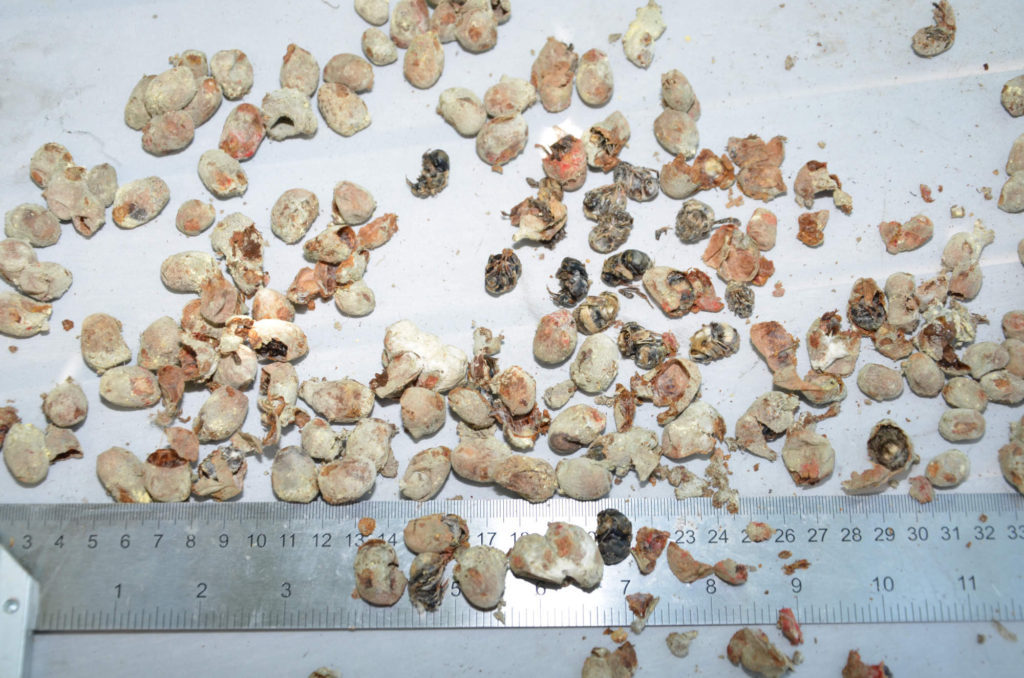
Detective work – dissection of large, sealed cocoons. We are finding only dead bumblebees with unfinished development and omnipresent mould. This suggests that the nest did not prematurely collapse due to a parasite infestation, but rather due to poor ventilation or a decrease in food supply. Indeed, there were no full honey pots in the nest.
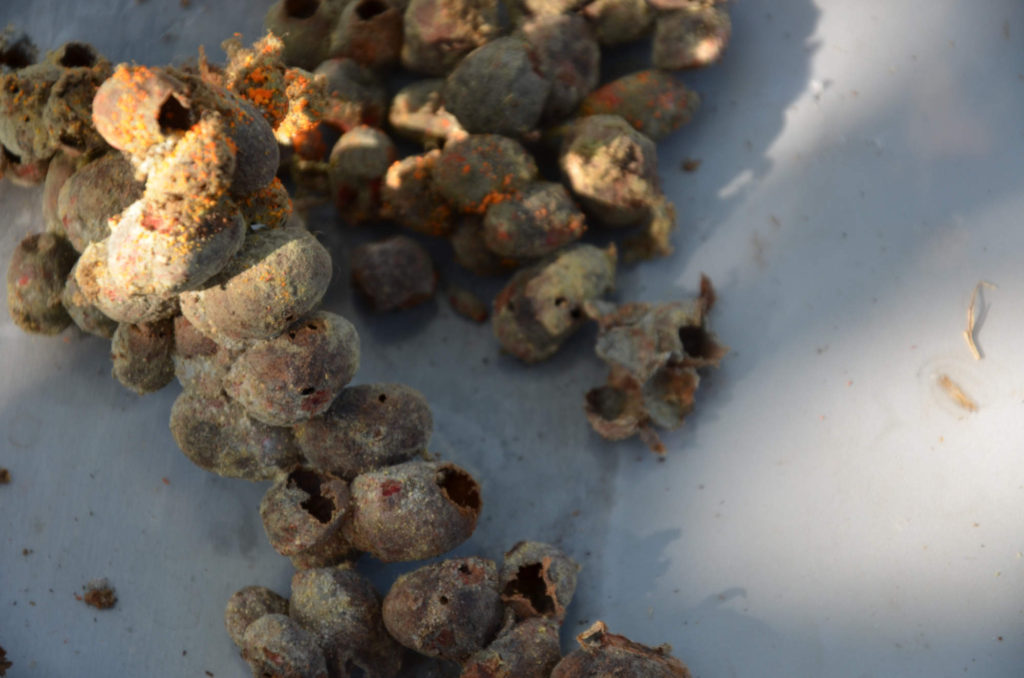
Closed mother cocoons with holes from parasite infestation. Examination later of cocoons with signs of mould, as it cannot be determined whether the infestation occurred while the colony was still alive or at a later stage.
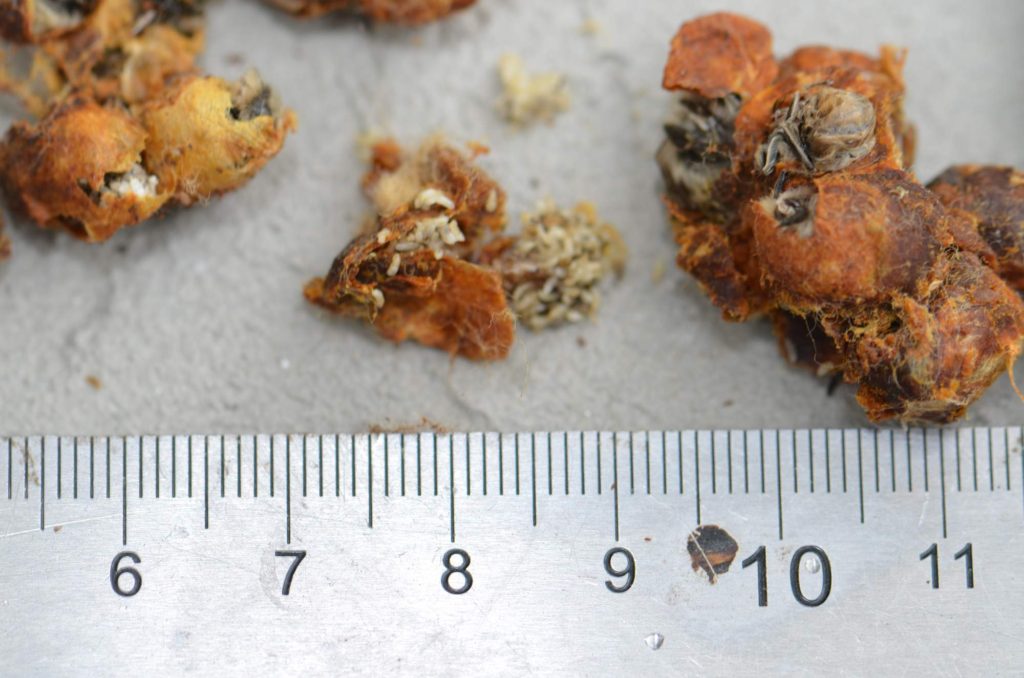
Sample dissection of closed common cutworm cocoons.
On the left is a dead, undeveloped specimen in the cocoon (a common finding), but in the centre is a sign of cocoon infestation by Melittobia acasta. The bumblebee larva has been eaten by thousands of tiny larvae. There were only two cocoons, so the infestation occurred only at the very end of the colony's life; no adults were found in the hive. Therefore, the parasite did not spread, and the hive completed its development, perhaps with an earlier end. Further investigative work found a hole in the udine material at 53S as a possible entry point.
Wall, corridor, and opening inspection
- We will check the wallpaper wall coverings, assess their function, integrity, level of mould, durability of the applied joints, and search for pests on both sides.
- We'll assess wall dampness, degree of soiling, look for potential leaks, cracks, and so on….
- We are again looking for possible parasites
- At the openings, we assess the degree of contamination of bumblebees and evaluate whether the function of the openings (ventilation, traps) was restricted or not during operation.
- At the end, it is worthwhile to empty the inside of the hive onto paper/a plastic sheet; we assess the captured parasites and their stages.
- We won't forget the flap either, we'll investigate leaks, parasites, assess the condition from both sides, look for lost dander, and find any dead bees or larvae.
- in the corridor, we notice the degree of silting, its permeability. We assess the contents of the corridor separately – parasites, other workers / mothers from neighbouring nests

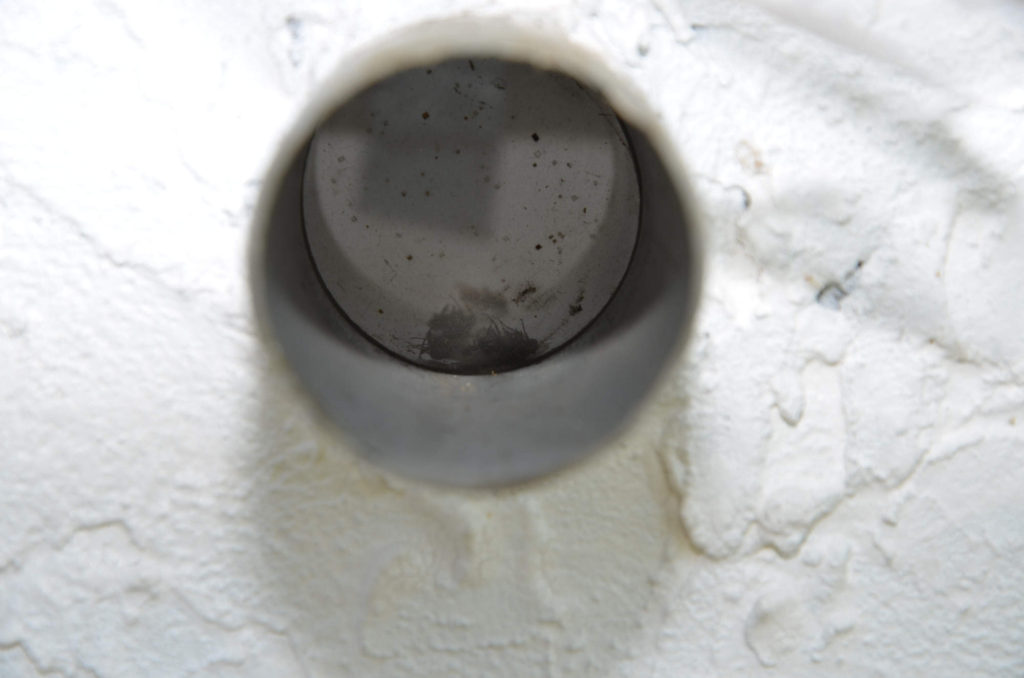
Ventilation check. Intact 53S urethane, minimal dust and mould, flycatcher inside the nest
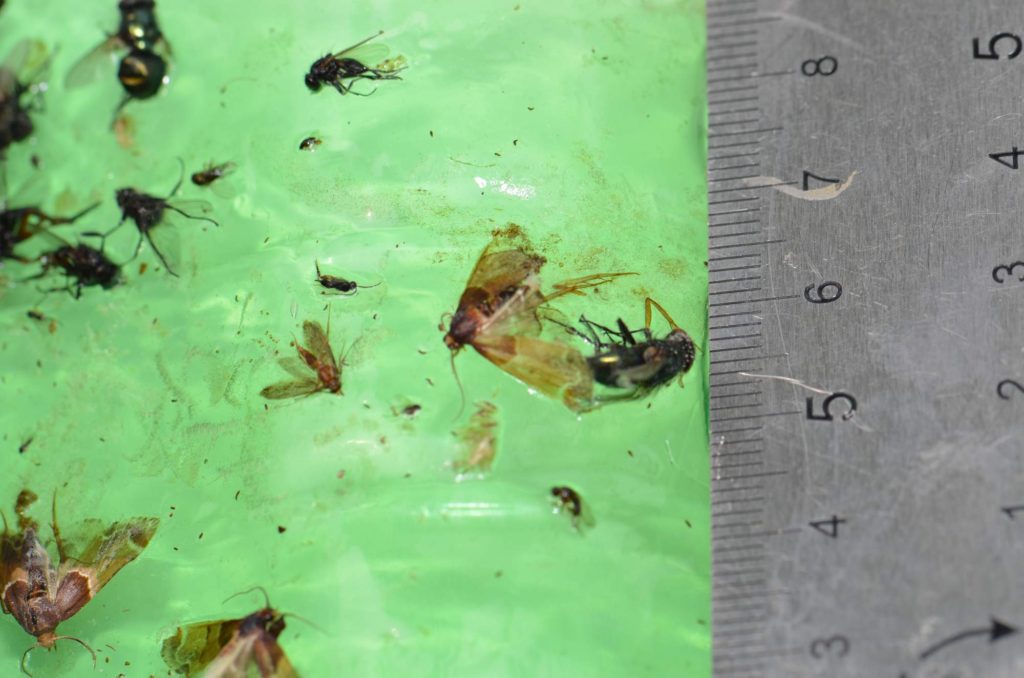
Sticky trap catch. Flies and moths.
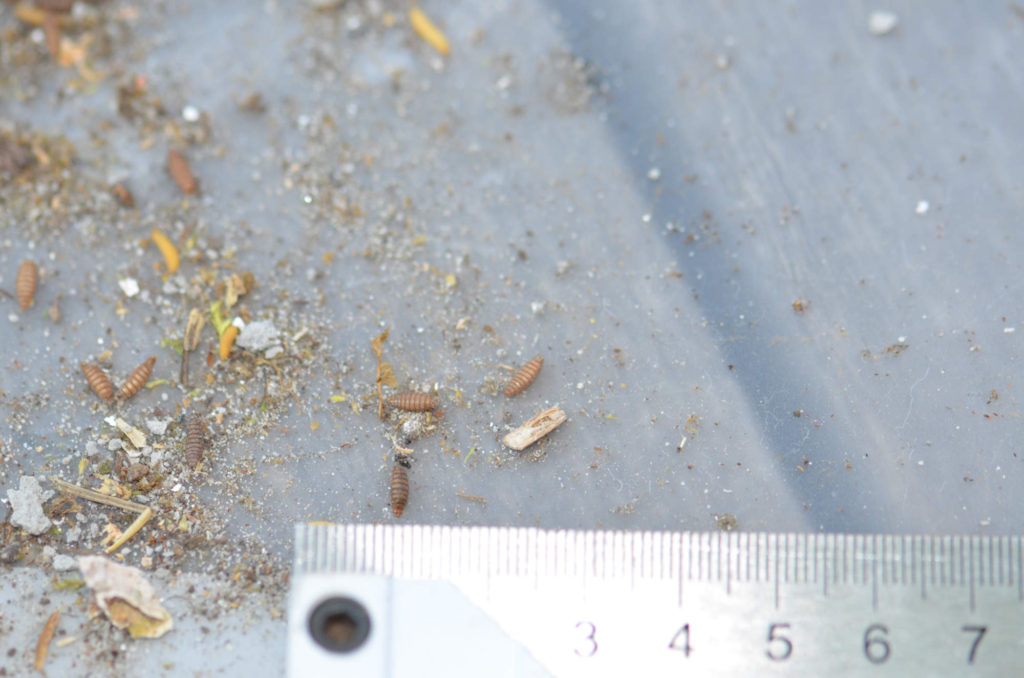
It is also worthwhile to check the hive's landing board, where *Antherophagus nigricornis* pupae were collected here.
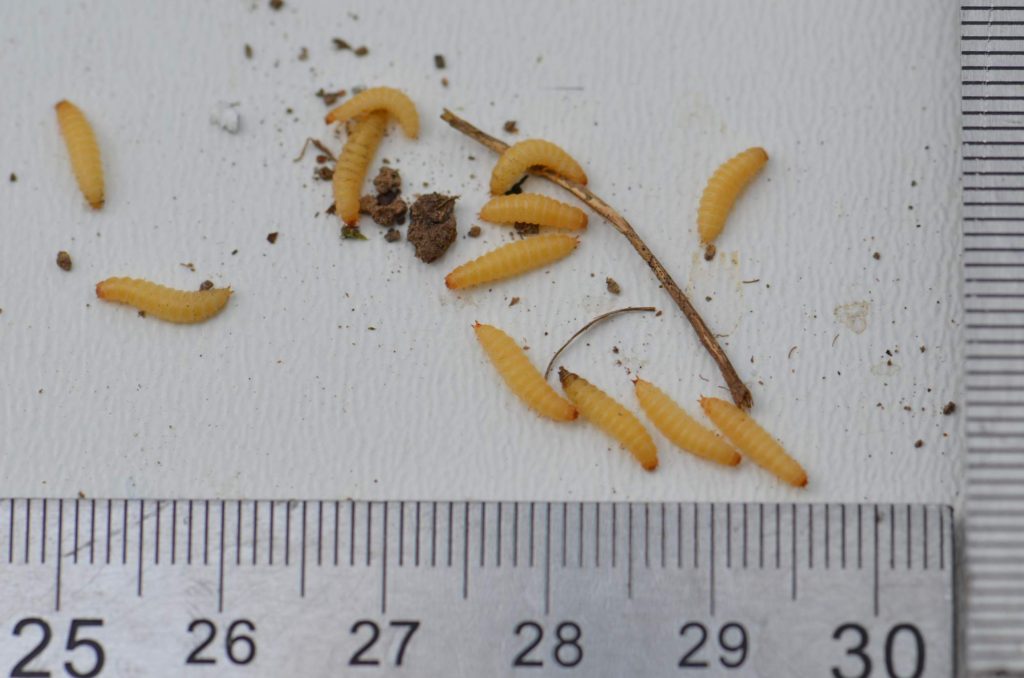
Common parasite during ulcer inspection after the season.
If you don't know the species, a photo like this, with a scale and sufficient sharpness, will help us identify the parasite – this is larvae of Antherophagus nigricornis.
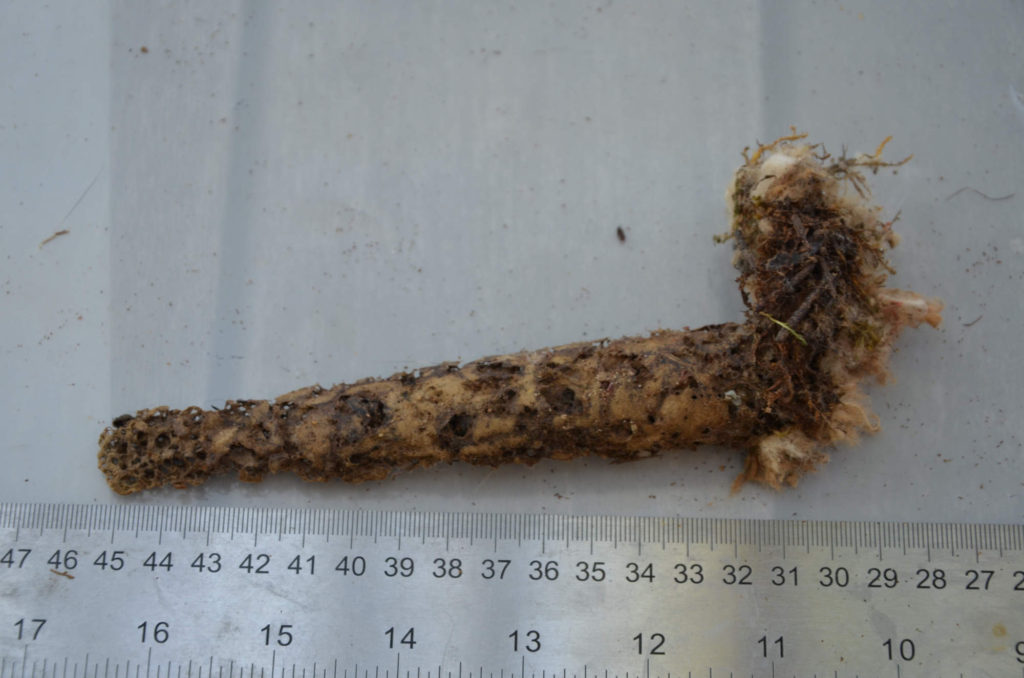
The droppings and the corridor. Upon inspection, we can see it was dry, which is good. Its size did not cause a blockage of the corridor, and from the infestation, only traces of droppings being consumed by fly larvae were observed.
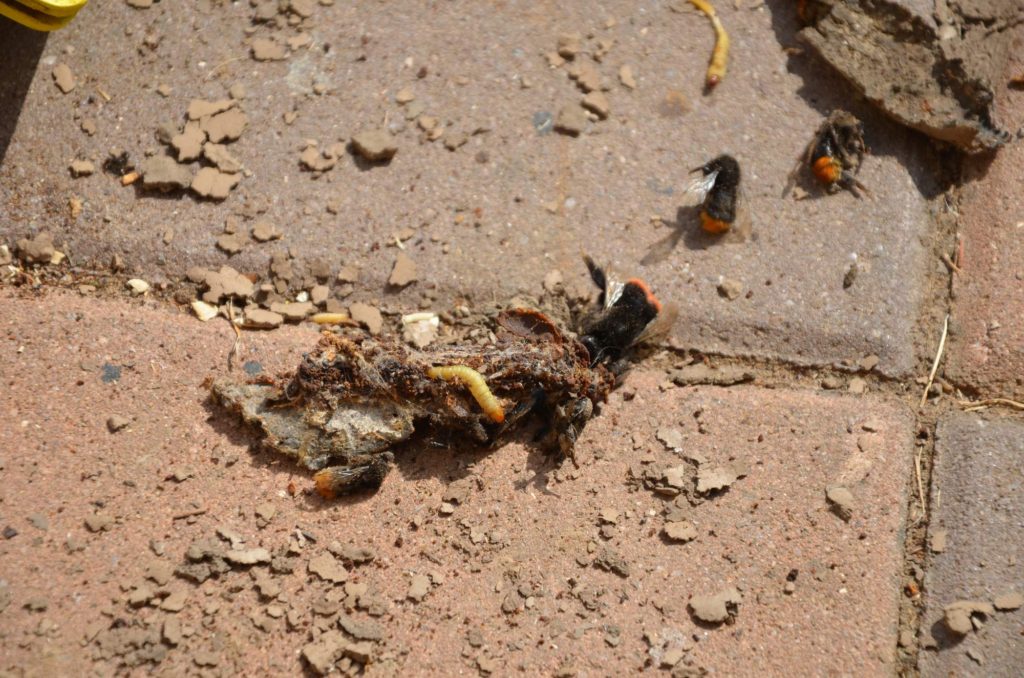
Discovery during the hallway waste check, just behind the flap.
Dead worker bees, number of stone and in waste, were fed upon by _L. aphomia sociella_, three specimens. Only one caterpillar was found in the nest near the entrance. This only suggests that eggs were laid near the entrance flap without the adult moth entering the hive. Therefore, the conclusion is that the hive was well secured, and the protective elements fulfilled their purpose.
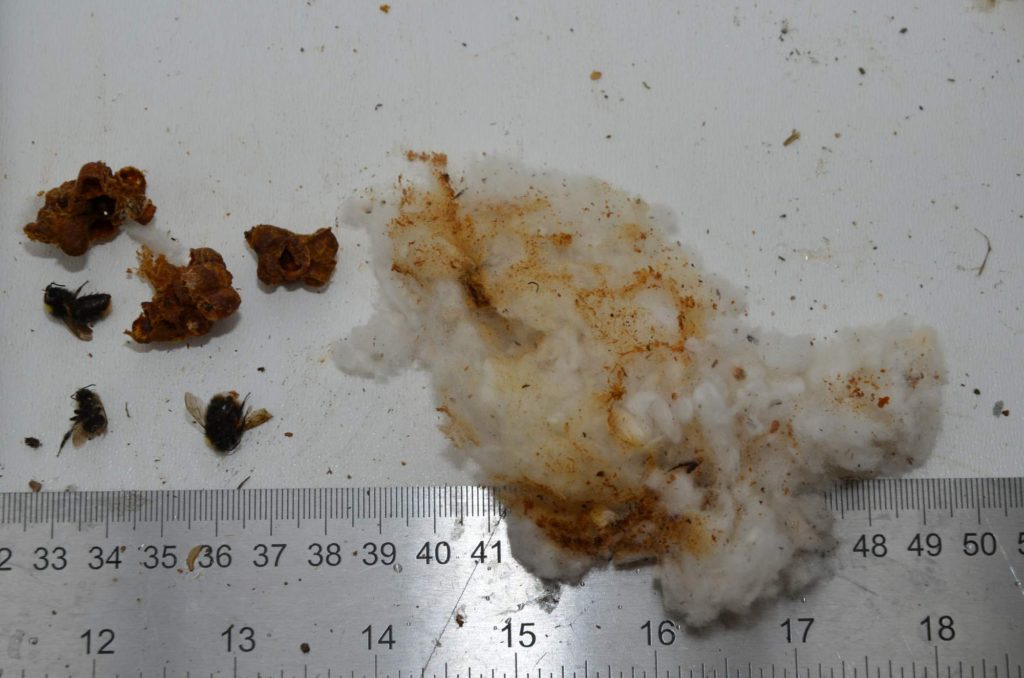
Conclusions and possible interpretations of the results
- When carrying out an overall assessment, the time factor between the end of the colony's life and the inspection must always be taken into account. The later it is, the more mould there will be in the nest, and parasites will consume dead bumblebees, cocoons, and cocoons with larvae.
- From the overall condition of the nest, the amount of mould and dead workers, the quality of ventilation can be inferred.
- A detailed inspection also gives us an idea of the conditions in the nest, whether the hive wasn't too small.
- A larger number of alien bumblebees may indicate that hives are poorly placed close together.
- By assessing the lining and internal wall cladding, we will gain insights for material selection in the coming years. This also applies to the adhesive tapes, insulation, moisture drainage, and so on, that are used.
- Discovering a larger number of closed cocoons, a greater number of dead bumblebees – all these can indicate a possible problem with the colony's end of life. The causes can be unsuitable conditions within the nest, parasite infestation, or most commonly, a lack of food. A general assessment, for example, finding a moderate level of nest infestation by parasites along with a large number of dead workers, a higher proportion (1/3) of unopened cocoons, and the absence of honey or pollen, might suggest the colony's demise due to lack of food.
- The condition of the colony, when compared with other hives or beekeepers, will allow the beekeeper to provide their own feedback and discover potential errors.
- Corpses can show signs of fights, post-mortem liquidation by commensals or parasites, nest debris, and also signs of possible more serious diseases, such as viral infections. Similarly, the discovery of *Melittobia acasta* larvae is an indication and guide to the extent of subsequent overall colony clean-up. In the case of viral infection, for example, old bedding should not be used. Surfaces that have been in contact with bumblebees should be replaced or treated with virucidal agents. This intervention is ideally carried out immediately after the colony's life ends, firstly to prevent further spread and secondly, so that active chemical components dissipate in the hive by spring, or their concentration is reduced to a safe value for bumblebees.
- Common parasites in a hive include flies and their larvae or pupae, larvae or pupae of Antherophagus nigricornis, and mites. None of these pose a significant problem or indicate a poorly managed hive.
- In the event of finding larvae or adult Mediterranean flour moths (Aphomia sociella), we also assess the location of the find and their number. This can also be used to estimate the effectiveness of traps, the consistency in the use and cleaning of the flap, and the quality of the ventilation carried out, its protection, and the protection of the hive roof. We also receive feedback on the effectiveness of the inspections carried out. Finding up to ten larvae is more indicative that the moth did not get inside the hive, but laid eggs nearby, for example near the flap, and the larvae were then able to penetrate inside. However, finding tens of larvae already indicates that the parasite has penetrated directly into the hive. In that case, it is necessary to search for the possible cause.
- Findings of 20-50 large queen-cells indicate an average nest, but even this is a success, as we rarely reach these numbers in nature. Larger numbers indicate a healthy and strong nest. Small numbers or numbers without queen-cells are no cause for complaint. There can be a whole range of reasons, and many of them are not the fault of the breeder or the breeding itself. However, checks and this detective work will help us distinguish between a nest that simply didn't work out and a nest where there was an identifiable problem, and that is the goal. Not repeating mistakes or resting on our laurels just by looking at the lively activity at the hive…
- If you are unsure about the nest assessment, upload photos to one of the repositories and we will be happy to help you. With time, the breeder will gain both systematicity and a detective's eye :).

Result of a check of a defunct second-generation bumblebee nest.
We see a queen, two workers. A pair of cocoons, including the laying, a full honey cup. The cocoons and lining are free of mould. Poisoning would be possible, further examination is needed to rule out parasite infestation, but this is more likely about the cessation of reproduction in the second-generation queen or another cause, but one that the beekeeper cannot influence. These too are valuable insights.
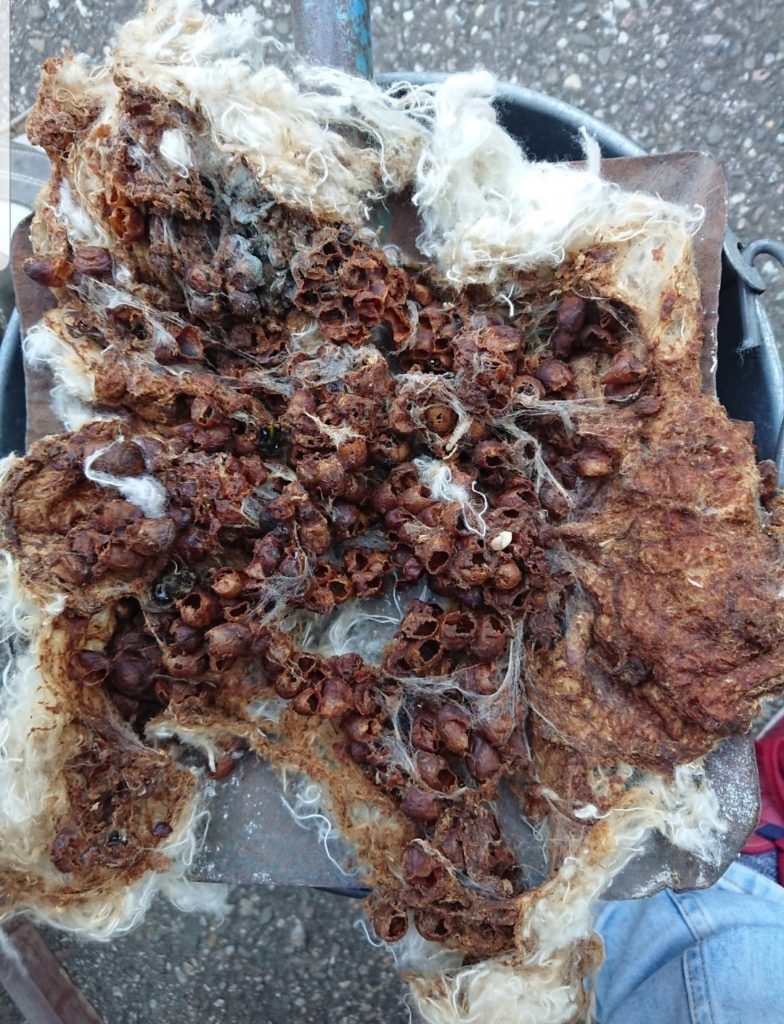
Lesser wax moth (Aphomia sociella) – nest infested by moth
Photo P. Menšík (2019) Our commentary: Were it not for that, it would be a beautiful nest with minimal mould. Even so, open large cocoons are evident, which indicates breeding success. The nest thus prematurely ended its life solely due to aphomia infestation, which is a fairly common occurrence in natural nests. The live bumblebees left it prematurely. Investigation outcome – consider the possible cause of aphomia infestation, thorough eradication and cleaning of the hive. The nest, including its lining, is best burnt to prevent aphomia from multiplying.
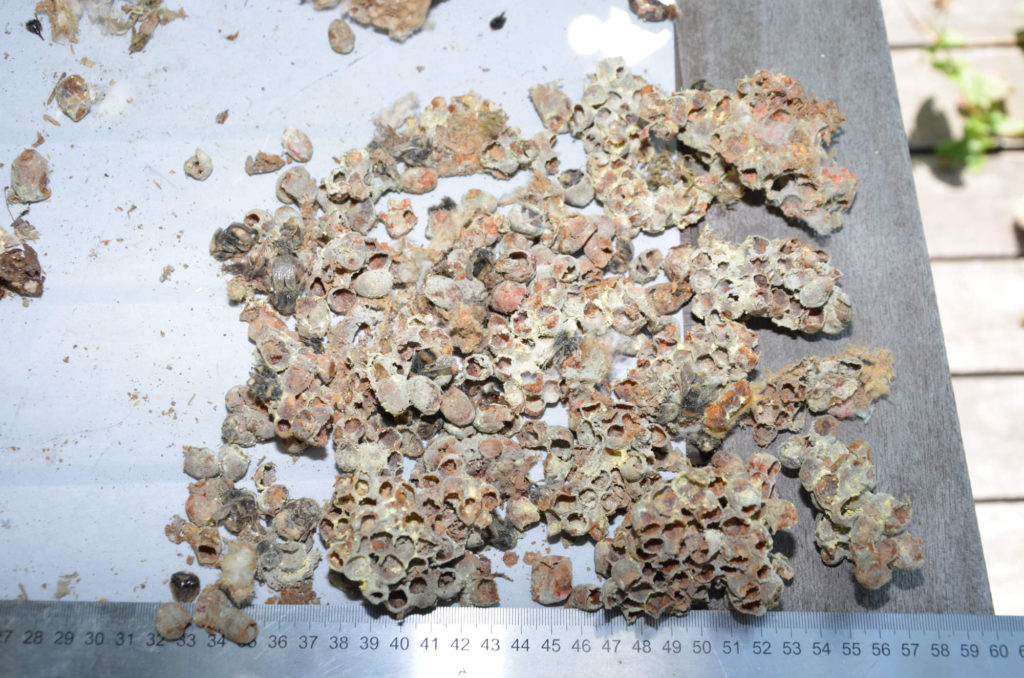
At first glance, the bumblebee nest looked enormous, but the extent of the mould was also considerable.
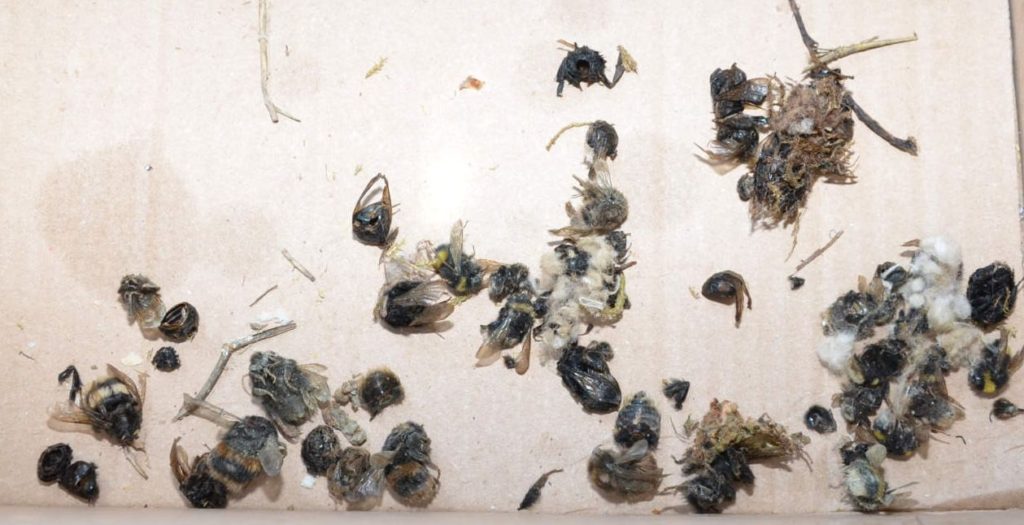
A large find of dead individuals was also present at the site.
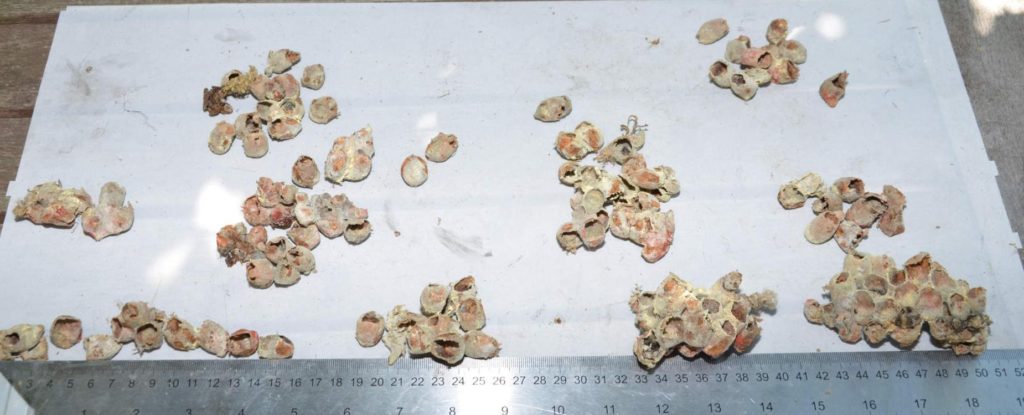
after sorting, a summary of large mother open cocoons
You have encountered this nest before, a huge nest at first glance. However, the number of closed cocoons made up roughly 1/3 of the total number, a striking amount of mould was apparent everywhere, many dead individuals, no honey stores, and minimal parasitic infestation. A free, unblocked passage. This was an underground nest where the bumblebees clearly began to struggle during full development. The cause is likely both unsuitable hive parameters and a lack of food – however, when compared with other nests in the same location, the unsuitable hive parameters will be dominant. This hive (it was a test project of a polystyrene hive embedded in the ground) therefore proved unsuccessful and will no longer be used for further bumblebee breeding. Next year, it will still be left for any potential returnees. However, it will not be used for settlement again and if it remains empty, it will be dismantled. These too are valuable results. Do not repeat mistakes and do not prepare a seemingly safe place for bumblebees that is actually a trap, however well-intentioned.
