



How to distinguish an established bumblebee from a searching queen
What you will learn here
- What does a queen bumblebee do after waking up
- How it looks for a nesting place – a nesting site
- How to reliably recognise such a mother
- Why do mothers sometimes not nest, even when they are looking for a nesting site?
Last updated: 23/02/2024
- Queen bumblebees are waking up: Mothers wake up gradually, first the early species – they are awakened by the spring sun, which warms the ground where they hibernate
- Upon waking, there is hunger and time to explore: Their first objective is to find enough food and replenish their energy after a long winter hibernation, and to warm up – therefore they feed and rest often.
- Mothers „dance“ in the spring once they've replenished their energy, they start looking for nesting sites – they don't want to nest immediately, but they scout around and wait for the right time when there's enough food. They most often search near the ground and „dance“ their searching flight
- Typical bumblebee nesting sites by bumblebee species: nests of small rodents in the ground, bird boxes and cavities after bird nests, piles of old grass and turf, insulation in roofs and attics, old blankets and carpets, a blanket in a dog kennel, etc.
- No water must leak into the nesting site. Bumblebees instinctively seek out places where they won't be washed away by the rain
- The pigeons and the queens are returning home: If the mothers survive hibernation, instinct leads them to the place where their original nest was. This is both a joy and a concern for breeders at the same time.
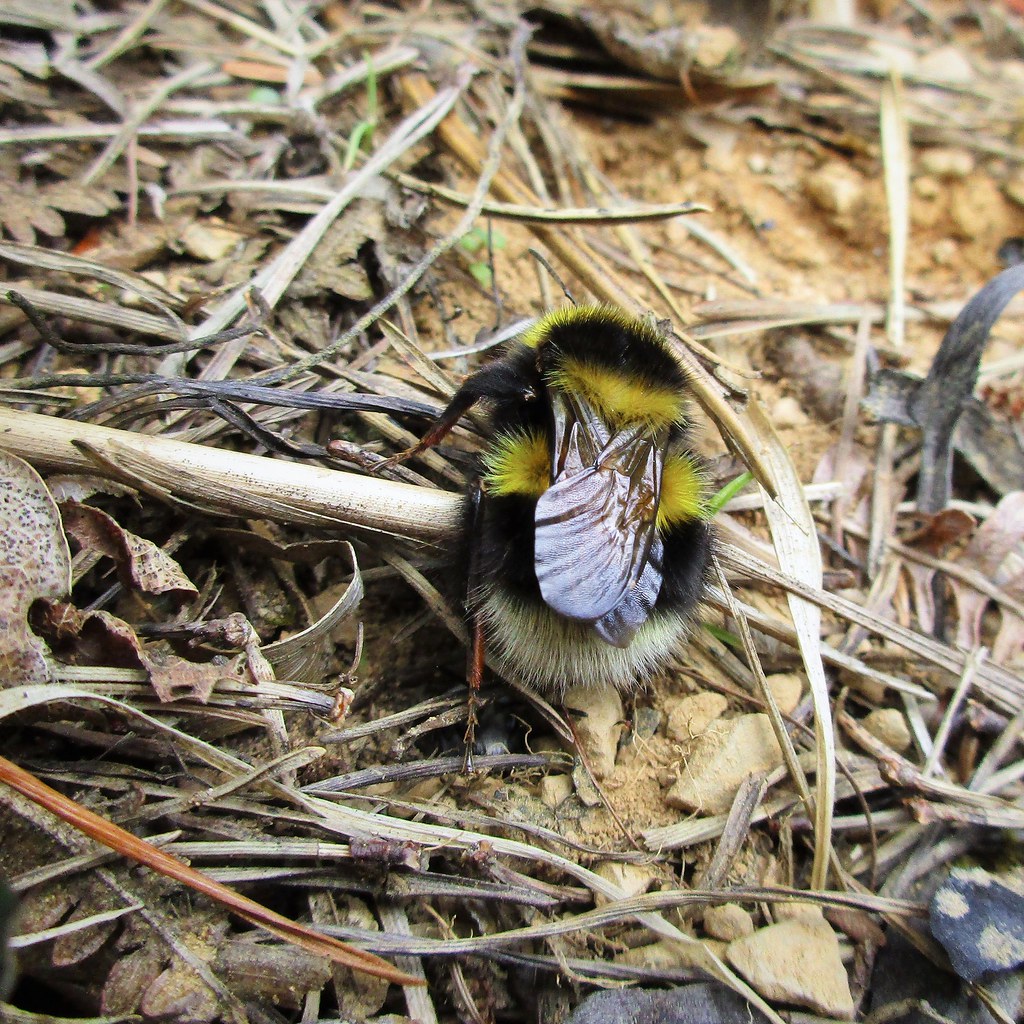
- Respect the Queen Mothers in spring: If you find a queen bumblebee resting, respect her. If she is demonstrably in distress, you can offer her assistance, but consider if she truly needs it.
Contents
Introduction
The queen bees are waking up
Čmeláci hledají různá místa k zahnízdění, která obvykle zahrnují:
* **Podzemní nory:** Mnoho druhů čmeláků, zejména ti větší, si staví hnízda v opuštěných norách hlodavců pod zemí. Tyto nory často nacházejí v travnatých plochách, na loukách nebo pod živými ploty.
* **Teplá a chráněná místa nad zemí:** Některé druhy preferují hnízdění nad zemí, kde hledají dutiny ve starých stromech, kůlnách, poštovních schránkách, ptačích budkách nebo dokonce v hromadách dřeva.
* **Hustá vegetace:** Čmeláci se rádi usazují na místech s hustou vegetací, která jim poskytuje ochranu a úkryt před predátory a nepříznivým počasím.
* **V místech s dostatkem potravy:** V blízkosti potenciálních hnízdních lokalit by mělo být dostatek kvetoucích rostlin, které poskytují zdroj nektaru a pylu pro krmení kolonie.
Důležité je, aby místo bylo klidné, chráněné před větrem a deštěm a aby poskytovalo dobrou izolaci pro udržení stálé teploty v hnízdě.
How to recognise a mother bird looking for a nesting site?
When a mother searches for a nesting site, does she always nest there?
How to distinguish a mother looking for a nesting site from one who is not?
What if more mothers meet in a suitable nesting place?
Do mothers need help in the spring – when, and if so, what kind?
Introduction
In this chapter, we will take a look at an important detail from the life of a mother queen, which is Finding a suitable nesting site, so nesting site. We are continuing from the chapter From the life of bumblebees – how things work in the nest.
When the bumblebee queen awakens, a lot of work awaits her, and so she soon begins to look for a nesting site. First, however, she must strengthen and check it's nearby Sufficient food.
It's interesting to see a mother looking for a nesting site. We can such a situation to see in spring, when mothers look for a nest after hibernation.
With a bit of luck, a similar situation will be observed and at the start of summer, when mothers who have decided not to hibernate are trying to nest. However, there are fewer such cases than in the spring.
It is important to observe the mothers and their flight and behaviour. We can tell from that, that the nesting site is really looking. This is immensely important in order to The breeder made the right decision whether it makes sense to offer the queen mother prey, or even when it is forbidden.
However, it is necessary to realise that Even when a mother is seeking a nesting site, she doesn't always want to settle down straight away..Sometimes you just really looks around a chooses place, Where will he return later . When she is ready herself and when they truly are suitable conditions.
Impatience and persistence a common mistake made by novice breeders, which leads to failure. The attempt to settle the bumblebee queen immediately, or Expecting it to behave according to a fixed algorithm and your plan is also a mistake..
It is necessary to give things time and Don't push your luck.. As time goes on, the breeder will learn respect nature also that he doesn't behave as he would wish. An experienced breeder can then recognise from a series of signs that they have met a mother who is ready to nest. But that takes years of practice...
We will dedicate sufficient space to this topic.

Bumblebee queen upon waking
Flickr photos
The queen bees are waking up
Bumblebee queens emerge gradually – by type and above all according to the weather, above all according to air temperature a soils, in which they slept.
They appear gradually with increasing altitude, or in deep cool valleys. The difference can also be a matter of weeks. The overall climate and situation also influence everything.
Example:
In early March 2020, many beekeepers had already settled their queens. Then came two cold spells.
In the first decade of March 2021, we recorded a number of prematurely awakened mothers, but none were yet making foraging flights – they weren't trying to find nesting sites.
First mother queens of the buff-tailed bumblebee (Bombus lucorum) and the large earth bumblebee (Bombus terrestris) appear. On nice days, they can appear as early as at the beginning of March–April.
These types allow for Risk, that they will not find enough food. If they do find food, there is relatively little food competition, which they consider an advantage, and therefore they go to such risk.
Queen wild bees (Bombus sylvarum) appear almost until May or June at the latest.
However, with the changing climate, the awakening time of mothers is also shifting. This is because rising soil temperatures where they hibernated and solar radiation, unmitigated by clouds or snow cover, are waking the mothers. The line between winter and spring is becoming less distinct... However, the changing climate also brings prominent weather fluctuations, see our example.
When the queen mother recovers from hibernation, she must first Strengthen and recover. It is therefore first interested in feeding.
I'm going to take a weight, which she lost – therefore she is interested in nectar from spring flowers, which is a source of energy, and in pollen, which for her represents a supply of protein. The entire time in the hibernaculum, she drew energy from her fat bodies.
A mother knows well that after this, she will not stop until the end of her life, and if she is not strong, she will not succeed in her task of „founding the next generation„. The mother thus feeds on the flowers.
When they find out, that favourable conditions have arisen, she will gradually start looking for a place where she can build a nest. With the intake of fresh food, processes that lead to ovarian development.
Only then is the mother ready to build a nest and begins to actively search for it..
Interesting fact
- He wakes up last Bumblebee mothers. And they too will search, but they aren't looking for a nesting place, but for a bumblebee nest that they can seize. That's why bumblebee mothers wake up last – they wait for the opportune moment, often buried deeper than the bumblebee mothers that the bumblebees want to parasitize.
You can read more about the Dutch long-eared bat on the page bumblebees and bumblebee keeping
Čmeláci hledají různá místa k zahnízdění, která obvykle zahrnují: * **Podzemní nory:** Mnoho druhů čmeláků, zejména ti větší, si staví hnízda v opuštěných norách hlodavců pod zemí. Tyto nory často nacházejí v travnatých plochách, na loukách nebo pod živými ploty. * **Teplá a chráněná místa nad zemí:** Některé druhy preferují hnízdění nad zemí, kde hledají dutiny ve starých stromech, kůlnách, poštovních schránkách, ptačích budkách nebo dokonce v hromadách dřeva. * **Hustá vegetace:** Čmeláci se rádi usazují na místech s hustou vegetací, která jim poskytuje ochranu a úkryt před predátory a nepříznivým počasím. * **V místech s dostatkem potravy:** V blízkosti potenciálních hnízdních lokalit by mělo být dostatek kvetoucích rostlin, které poskytují zdroj nektaru a pylu pro krmení kolonie. Důležité je, aby místo bylo klidné, chráněné před větrem a deštěm a aby poskytovalo dobrou izolaci pro udržení stálé teploty v hnízdě.
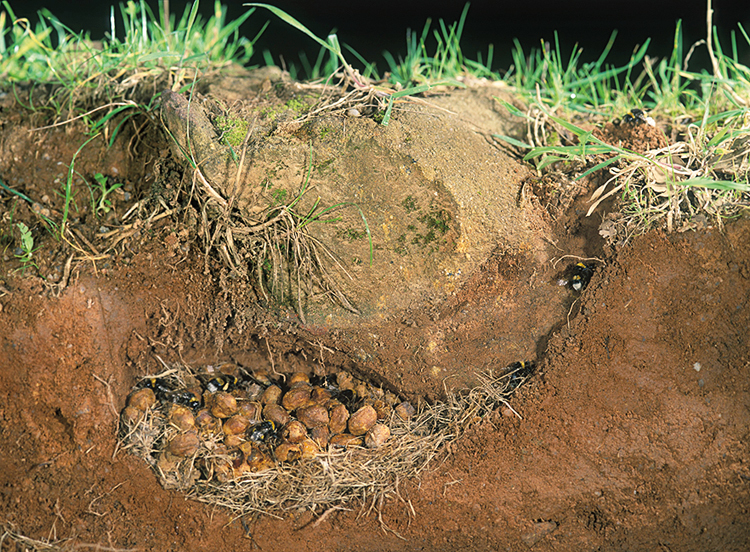
Queens of the bumblebee mothers are primarily looking for cavitiesand where they will settle and start building their nest. For example, field bumblebees (Bombus pascuorum) are an exception, as they will also make themselves at home in a pile of old grass.
Bumblebees cannot create a cavity themselves, nor can they build a nest from papier-mâché like wasps and hornets, for example. Cavity size which it seeks, corresponds to the needs of its species. The number of individuals in a nest varies by species and conditions, ranging from 50 to 800.
In the country
Some species of bumblebees look for duty in the country, for example Buff-tailed bumblebee, White-tailed bumblebee sky Duty in walls and rocks such as Buff-tailed bumblebee.
2. Holes in trees with bird nests, birdhouses, roof insulation
More bumblebees prefer cavities of trees, in thermal insulation under the roof and empty birdhouses, such as the tree bumblebee (Bombus hypnorum), or meadow bumblebee.
3. On the surface and just beneath it
Some species can inhabit both underground and above ground. An example is the garden bumblebee (Bombus hortorum) and also Field bumblebee.
Of course, there can be a number of exceptions, see for example the nest of earth bumblebees in the birdhouse in the video.
The cavity must additionally contain sufficient amount of heat-retaining lining (e.g. mouse/bird nest), it must not contain draught a it must not leak.
Mother must explore and consider all this – alone and in the dark. She must also explore. thermal insulation properties Duty.
We haven't found suitable literature on this yet, but we believe it will use similar methods to bees (though in their case, a group of workers carries it out). It will go through the cavity, investigate Go sniff by touch ticklish. It will also swirl its wings, with the help of which „measures the cavity size“The buzzing sounds the queen mother makes during the exploration of the cavity are certainly important.
A view into a nest that the mother is exploring can be found in the following text.
The appearance of a swarm and which queen bees they will accept are described in our guides, for example, on the page Pre-season ulcer preparation.
Interesting fact
- Sometimes it's not crucial for a mother whether the cavity is empty or not. Unless absolutely necessary, a queen bumblebee can expel the original owner (a mouse, small bird) – such feistiness is quite common in the tree bumblebee (Bombus hypnorum).
- If necessary, the queen bee will fight for a nest cavity, even with other bumblebees and even with her own sisters – see further text)

Bumblebee nest in a rodent burrow Photo Stock Images
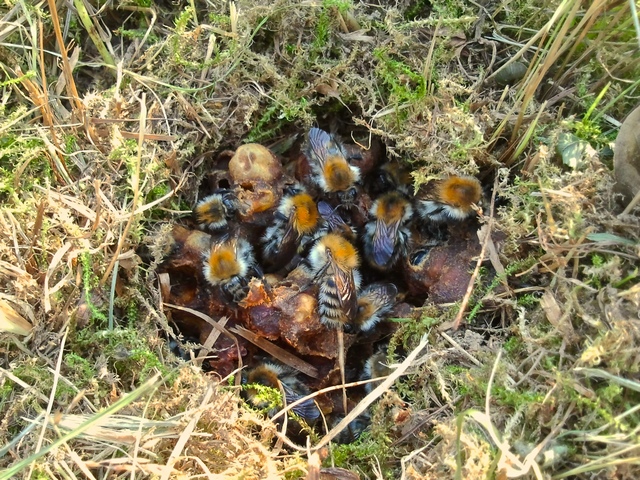
A bumblebee nest (Bombus pascuorum) in a grass pile
Internet Photo
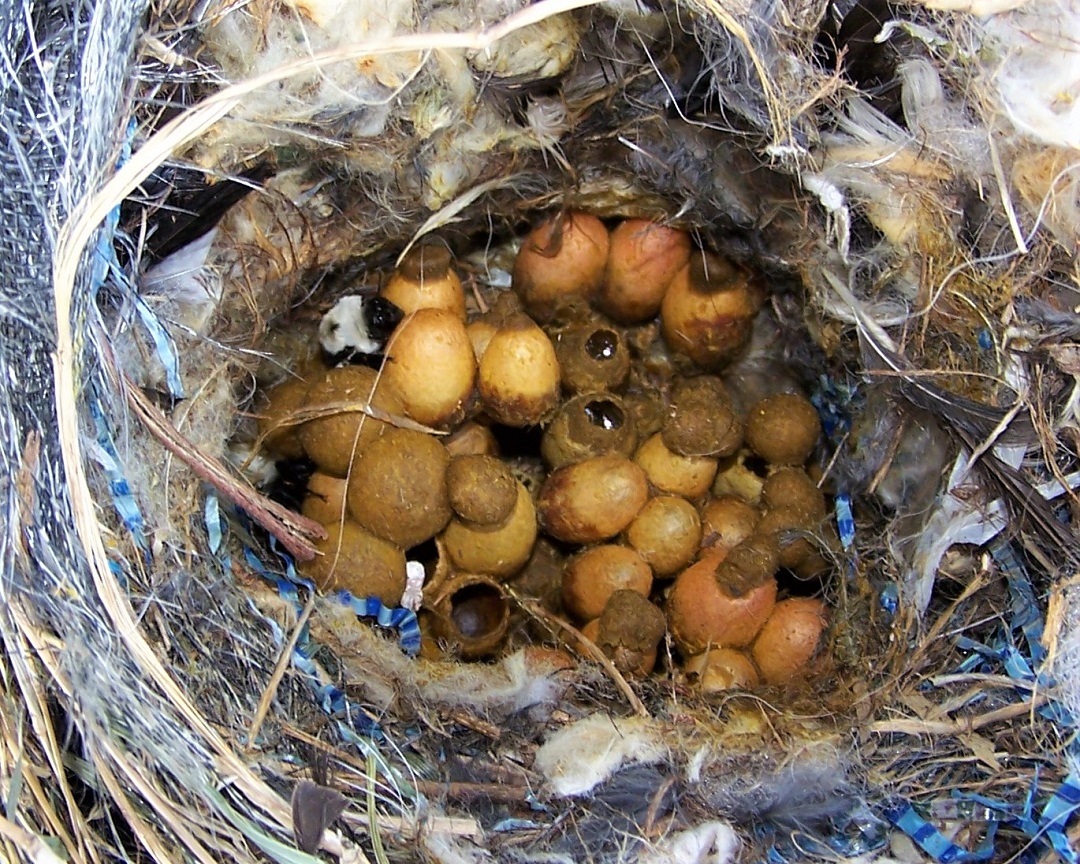
A bumblebee nest (Bombus hypnorum) in a bird box
Photo The Peace Bee Farmer
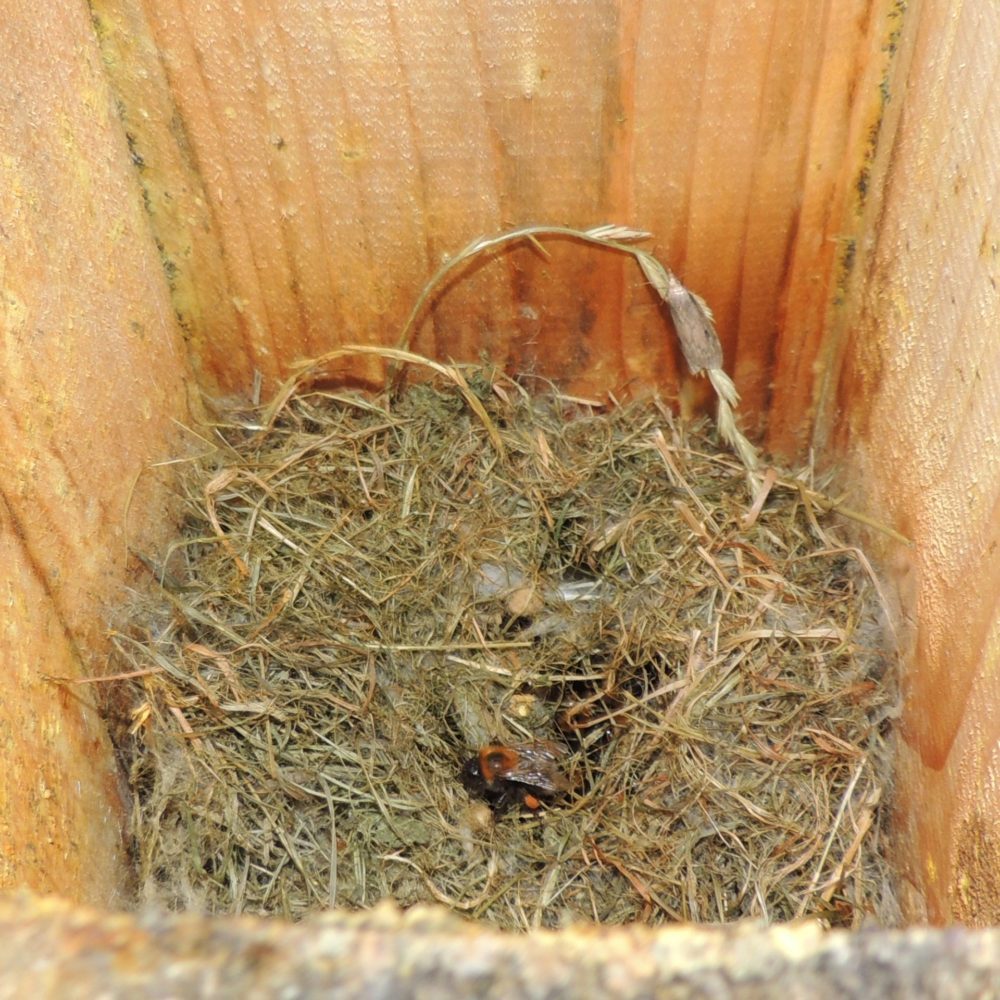
Tree bumblebee (Bombus hypnorum) nest in a bird box
Photo Jesus College Nature Trail
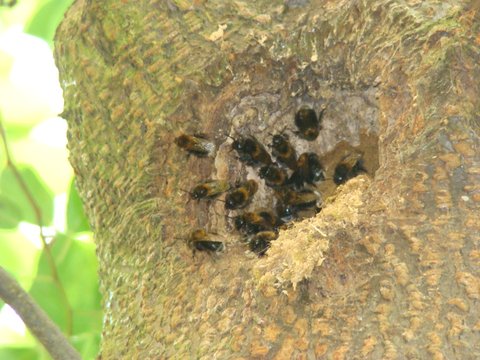
Tree bumblebee (Bombus hypnorum) nest
Photo Jesus College Nature Trail
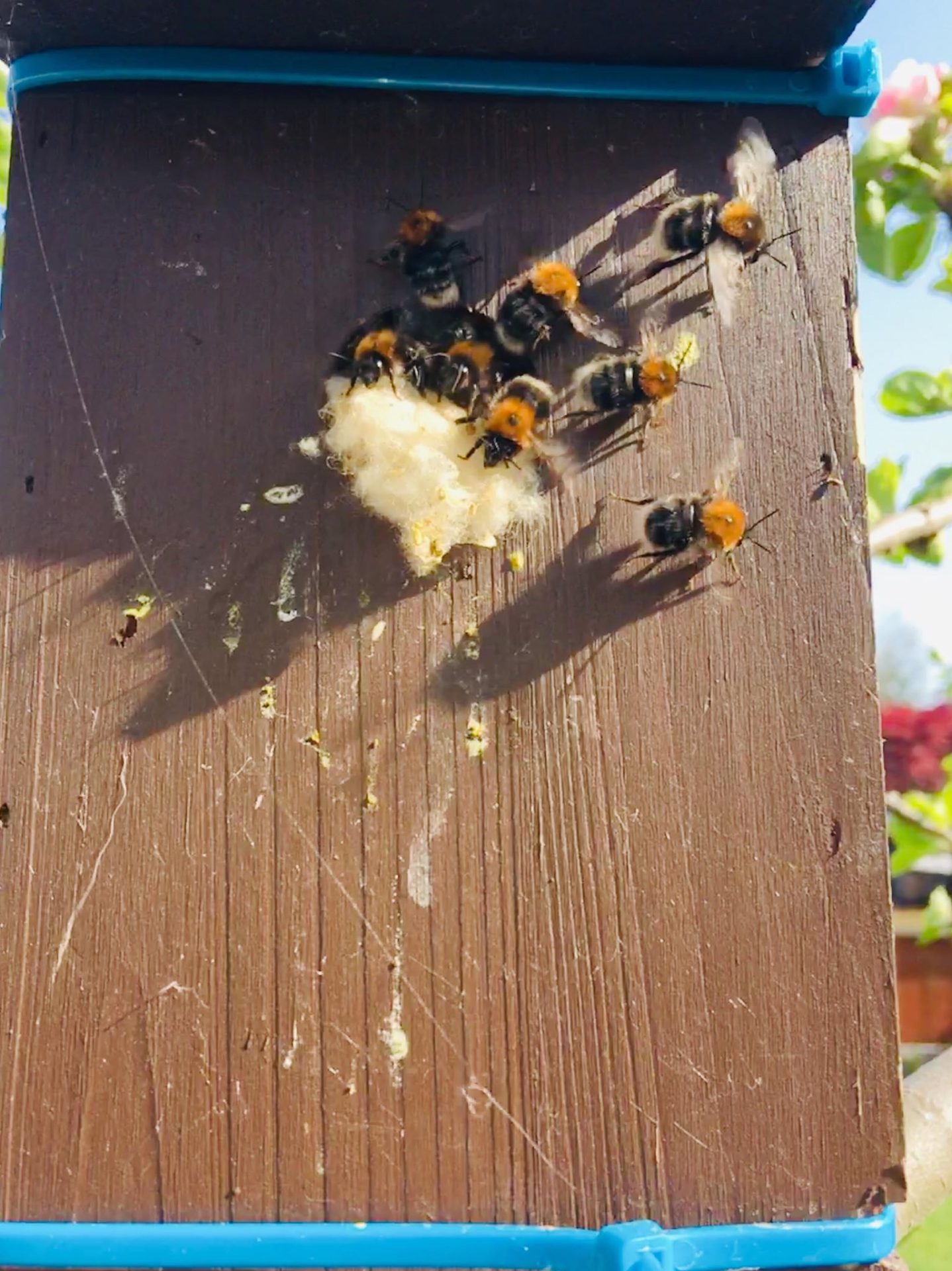
Bumblebee nest (Bombus hypnorum) in a birdhouse
Photo: Dave Jones
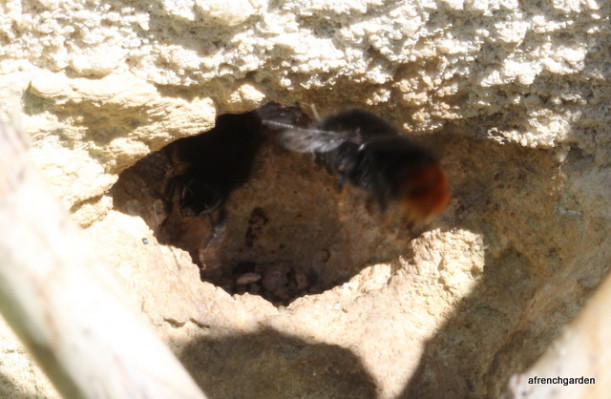
Bumblebees PLUS – Nest of red-tailed bumblebees (Bombus Lapidarius) in a wall
A French Garden Photograph
Entrance to the nest of buff-tailed bumblebees (Bombus terrestris) at Kněževes nursery school near Prague
Photo O. Hercog
A rather unique video by Vítek Cach. He captured an atypical situation where a buff-tailed bumblebee mother (Bombus terrestris) is carrying dry moss into her nesting cavity. Most bumblebee species do not do this.
Exceptions prove the rule – here, buff-tailed bumblebees (Bombus terresttris) have nested in a birdhouse.
How to recognise a mother bird looking for a nesting site?
A mother queen seeker is easily recognisable, primarily by the typical search flight low to the ground.
It does not land on flowers, passing them by indifferently. It crawls into holes in the ground, or into various openings, and leaves them again. It searches for cavities within them to nest. It lingers in some and inspects them, while abandoning others immediately.
Mothers actively seeking nesting sites during several waves – in the morning, and then later in the afternoon in 1-2 waves. Especially The evening is interesting for them, when the wind calms down and they don't need as much energy for flight.
If it's cold or windy, they aren't as active in their search. Likewise, they aren't very active when they sense a change in the weather and when conditions (temperature and food availability) won't be suitable for nesting.
These are general rules, but you might well encounter a queen bumblebee looking for a nesting site even at noon.
Mother Looking for dark areas. – holes in the ground, holes in the wall, entrances to birdhouses, cracks in the wall.
This is a very typical flight and cannot be confused with anything else. The flight of males, who look for females to mate with later in the season, also looks different, and workers never fly like this. Furthermore, you won't find workers or males in nature in the spring. The queen uses this flight only when she is looking for a nesting site.
Interesting fact
- Mothers will search only when the weather is niceand when they are not hungry and foraging for food – it’s no good on an empty stomach….
- They therefore often search in the morning and later in the afternoon, when there is no strong wind and the search flight will not cost them much energy.
- Sometimes The post-winter feeding and foraging phases can overlap.. This way, the mother-queen just surveys the terrain and gradually gets to the interesting places. return, when the right time comes to build a nest.
- Searching for the nest may take for several weeks. Until the mother finds a suitable place, she won't settle, as she knows it wouldn't be worth it.
- Mother sometimes searches alone interrupt, for example, if it cools down sharply. If everything else is fine, the search will be returned to later
- If a mother cannot find a suitable nesting site in time, or if she loses an established nest, she becomes so-called Will-o'-the-wisp.
It will look for a nesting place, but its nesting drive will weaken and it will never found a nest again. Such a mother can be repeatedly introduced into the hive by the beekeeper, but she will not settle there.
Please watch the videos that show typical mother bird search flights. If you don't see such a flight, there's no point in persuading the mother to settle down.
When a mother searches for a nesting site, does she always nest there?
Sometimes with the establishment of a nest must wait, because it is cold and there is a lack of food. So it often just looks for suitable places and returns there when the time is right.
This is why you might offer such a mother a scare, and she won't accept it – she simply doesn't want to yet, and you can't persuade her.
The mother attempts to become Will-o'-the-wisp, will also sometimes conduct a search flight, but will not nest. Sometimes such Adventitious queens invade the nests of other queens of their species is trying to take over the nest.
We explain it as, A mother who has lost her nest no longer has enough energy to start from scratch. and proto takes a risk and tries to take over another nest.
Beekeepers sometimes use this effect by offering such a queen a hive, which for some reason has lost its queen.
How to distinguish a mother looking for a nesting site from one who is not?
If the mother pcarrying out search and rescue is looking for nesting sites. Is it worth offering her a shock?.
If the queen mother feeds on flowers, or leating at height Yes is not looking for a nesting site, or it's impossible to determine. But she definitely There's no point in offering him a shock – he won't accept it..
If the mother on the hind pair of legs pollen baskets that's enough She has her own nest and you must not disturb it. Under no circumstances would she accept the offered nest, and if an accident were to occur, her abandoned offspring would perish.
What if more mothers meet in a suitable nesting place?
Unfortunately, this happens. Here then The law of the strongest prevails. Mothers quarrel amongst themselves. Fight And the strongest wins. It's a fight to the death, and often ends with both mothers injured and dead.
Similarly, it can happen that a later, stronger species of bumblebee wants to move into a cavity occupied by an early species. It has been observed Coexistence two and Multiple mothers in one hive, but only temporarily. A duel eventually took place there.
This can be prevented when breeding bumblebees. so that the breeder in good time gets the established queen accustomed to going through the flap (closed hatch) and the latecomer thus cannot get into the cavity.
The mothers of most species reliably returns to its native nest (if they survive hibernation). The sisters will then fight over a nesting site.
The fight is fierce – mothers are battling for a cavity that was suitable and bumblebees have finished their cycle here, so they will try again.
Regarding the solution to the situation, When do queens return to the nesting site for breeders?, you will read on the page The return of mothers to the hive – their native nesting ground.
Interesting fact
- Sometimes a beekeeper is surprised to find one queen with a brood and another dead in the hive. Apparently, a fight has occurred here.
- Unfortunately, mothers can injure each other during combat and both die.
- In nature, a place can be found where there are more dead mothers and only one successfully nesting (observation by J. Čížek).
Do mothers need help in the spring – when, and if so, what kind?
Queen bees are ready for the challenges of spring – temperature changes, rainfall, and a lack of food. However, sometimes you may find an exhausted queen in the wild and consider whether and how to help her.
Our website will help you with decision-making and potential action. Helping bumblebees in spring

